 Nissan 350Z
Specs, engines and history
Published Report an error
By Felix Hartmann, Automotive Technology & EV Contributor
Which 350Z to buy
Our verdict · Felix Hartmann
- Best all-round choice: a 2007–2009 coupé with the VQ35HR, the most powerful version, with the improved interior.
- Lower budget: a 2006 coupé with the Rev-up engine, after checking oil consumption and service history.
- Open-air driving: the roadster, but expect more weight and a much smaller boot.
- Collectors: the NISMO models and the European 35th Anniversary and Racing Edition cars, built in small numbers.
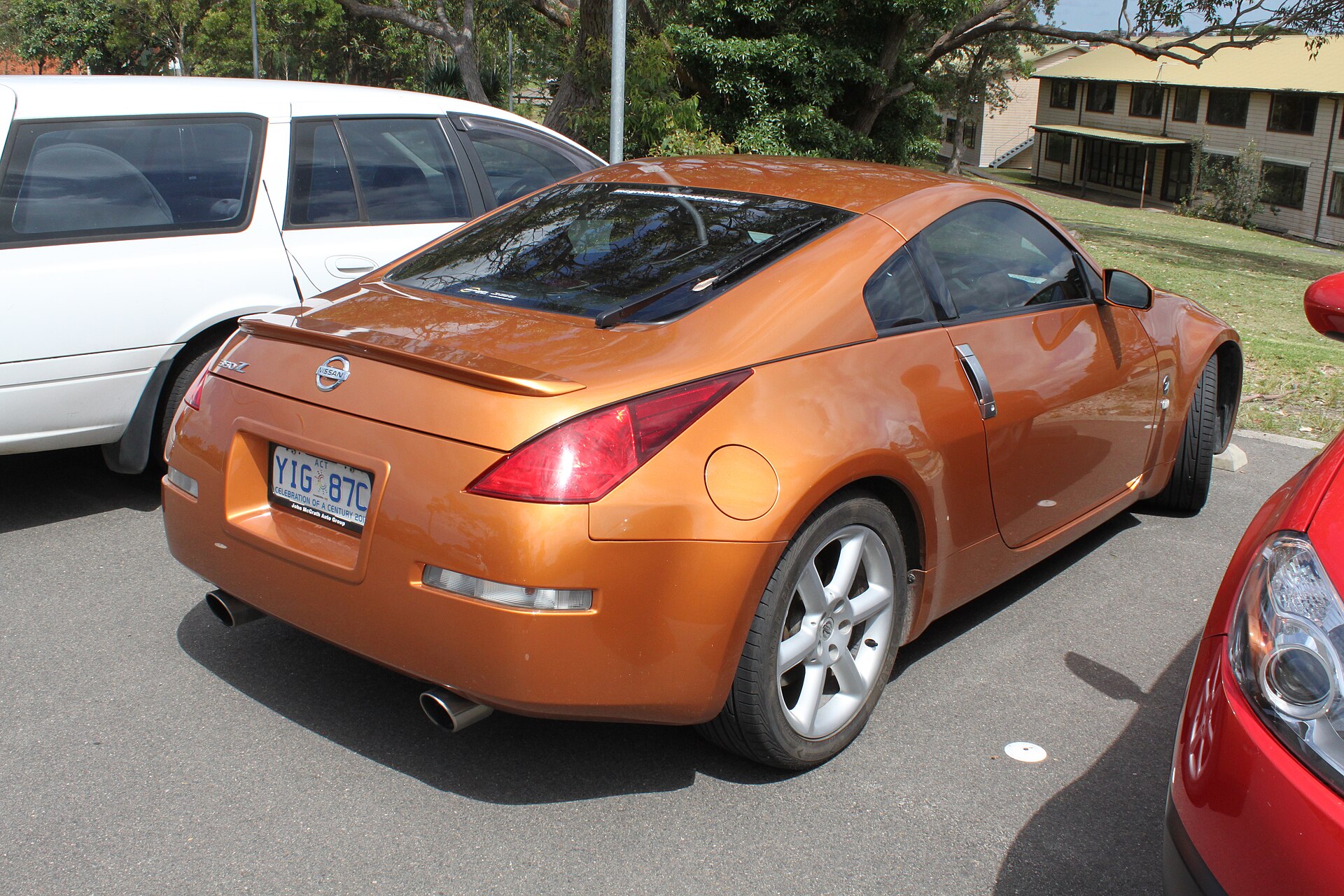
The Nissan 350Z is the two-seat sports car that succeeded the 300ZX as Nissan's Z car in 2002. Built in Japan with the chassis code Z33 and sold there as the Fairlady Z, it was offered as a coupé from July 2002 and as a roadster from 2003. Its 3.5-litre V6, mounted behind the front axle, drove the rear wheels. The 370Z replaced it for 2009.
In short
- Fifth-generation Z car, built from 2002 to 2008 in Oppama and from January 2004 in Tochigi, Japan; sold until 2009.
- 3.5-litre VQ V6 with 206–230 kW (280–313 PS) in European specification; the Japanese NISMO 380RS had 257 kW (349 PS).
- About 161,900 sold in the US and about 23,000 in Europe, including 6,309 registrations in Germany.
- Car and Driver 10Best 2003, Automobile of the Year 2003, Top Gear Car of the Year 2004.
Nissan 350Z at a glance
| Specification | Nissan 350Z (Z33) |
|---|---|
| Production | July 2002 – 2008 (roadster from 2003) |
| Plants | Oppama (2002–2003), Tochigi (from January 2004), Japan |
| Platform | Nissan FM, front-mid engine, rear-wheel drive |
| Body styles | two-seat coupé, two-seat roadster |
| Engines | 3.5-litre V6: VQ35DE, VQ35DE "Rev-up", VQ35HR |
| Power | 206–230 kW (280–313 PS), Europe |
| Gearboxes | six-speed manual, five-speed automatic |
| Wheelbase / length | 2,649 mm / 4,303–4,314 mm |
| Kerb weight | about 1,414–1,634 kg depending on version |
| Predecessor / successor | 300ZX (Z32) / 370Z (Z34) |
The 350Z is part of our Nissan catalogue. Its direct successor, the Nissan 370Z, used an updated version of the same layout.
From a retro concept to the production car
In 1998 and 1999 Nissan showed a concept inspired by the original Datsun 240Z, with a 2.4-litre four-cylinder of about 149 kW (200 bhp). Nissan judged the design too retro and started again. In February 2000 Carlos Ghosn announced that a new Z would go into production.
The final shape came from Ajay Panchal of Diane Allen's team at Nissan Design America in San Diego in 2000. A pre-production car with the 3.5-litre VQ35DE engine was shown at the 2001 Tokyo Motor Show. Sales started in Japan in July 2002 and in the US on 20 August 2002. Germany followed in October 2003 at a base price of €33,850 in 2003.
The 350Z used Nissan's FM ("front midship") platform, shared with the Skyline V35, which was sold in North America as the Infiniti G35.
Engines and performance
Three versions of the 3.5-litre V6 were used. The power figures differ between markets: Wikipedia EN gives US ratings, German Wikipedia the European ones.
| Engine | Years | Power (Europe) | Power (US) | Torque (Europe) | 0–100 km/h (coupé) |
|---|---|---|---|---|---|
| VQ35DE | 2002–2005 | 206 kW (280 PS) | 214 kW (287 hp) | 363 Nm | 5.9 s |
| VQ35DE "Rev-up" | 2005–2007 | 221 kW (301 PS) | 224 kW (300 hp) | 353 Nm | 5.8 s |
| VQ35HR | 2007–2009 | 230 kW (313 PS) | 228 kW (306 hp) | 358 Nm | 5.7 s |
Top speed was limited to 250 km/h. The roadster, about 110 kg heavier, needed 6.3 seconds from 0 to 100 km/h. In Europe the average consumption was 11.4 l/100 km of super plus petrol, according to German Wikipedia.
The Rev-up engine of mid-2005 revved higher and was first used with the six-speed manual. The VQ35HR of 2007, recognisable by a bulge in the bonnet, was an extensively revised engine with peak power at 6,800 rpm instead of 6,400 rpm; it gave the most power of any regular 350Z.
Two body styles
The coupé was offered in the US in Base, Enthusiast, Performance, Touring and Track trims. The roadster followed in 2003 and reached Germany in March 2005 at €36,500. It has a fabric roof and only 130 litres of luggage space, against 235 litres in the coupé. Parkers called the coupé's boot "poorly designed" because a large brace across the luggage area limits what fits.
A facelift for 2006 brought bi-xenon headlights, LED tail lights and an improved interior; early cars had been criticised for cabin quality below Nissan's usual standard.

Special editions and NISMO versions
- 35th Anniversary (2005): marked 35 years since the Datsun 240Z. Europe received 700 cars, 100 of them for Germany, priced at €38,250 (black) and €38,840 (yellow) in 2005.
- NISMO 350Z (2007–2008): presented at the New York Auto Show on 4 April 2007, with about 1,607 built for the US and Japan; US list price US$38,070 for the 2007 model year (about €27,800).
- Racing Edition (2007): 50 cars for Germany only, at €48,590 in 2007.
- NISMO Type 380RS (2007–2008): 300 cars for Japan with an engine detuned to 257 kW (349 PS) and 397 Nm, priced at ¥5.397 million.
- Type E: five cars built to homologate the 350Z for Super GT racing.
Racing and drifting
From 2003 to 2007 the 350Z replaced the Skyline GT-R in the GT500 class of Japan's Super GT series, using a turbocharged VQ30DETT engine. Nismo won the GT500 championship in 2004, and Hasemi Sports won the GT300 title in 2003. When the GT-R took over the GT500 class in 2008, the 350Z continued in GT300. The car also became popular in drifting, in Japan's D1 Grand Prix and the American Formula D series, and in club racing such as NASA's Spec Z class.

What to check on a used 350Z
Grassroots Motorsports lists the typical faults:
- Gearbox: worn second- or third-gear synchromesh, causing a crunchy shift, is the most common problem.
- Engine: some 2005 and 2006 Rev-up engines used too much oil; most affected engines were replaced by dealers early on. Crank and cam position sensors can fail.
- Tyres and suspension: 2003–2004 cars wore their front tyres quickly, because of soft original tyres, aggressive toe-in and fast-wearing bushes. Later cars were corrected.
- Body: thin rear quarter panels dent easily; weak window motors and tired tailgate struts are common.
In the UK the 350Z sits in insurance group 45, according to Parkers.

Rivals
When new, the 350Z competed with cars such as the Mazda RX-8, the Audi TT and the BMW Z4, and at a higher price the Porsche Cayman. Our comparison tool shows how they line up on power and weight.
Photo gallery


FAQ
Is the 350Z the same car as the Fairlady Z?
Yes. In Japan the Z33 was sold as the Nissan Fairlady Z; elsewhere it was called the 350Z.
How much power does a Nissan 350Z have?
In Europe 206 kW (280 PS) at launch, 221 kW (301 PS) from 2005 and 230 kW (313 PS) from 2007.
Did the 350Z have an automatic gearbox?
Yes. A five-speed automatic was offered alongside the six-speed manual.
How much did the 350Z cost new?
In Germany the coupé started at €33,850 in 2003 and the roadster at €36,500 in 2005; the limited Racing Edition cost €48,590 in 2007.
What replaced the 350Z?
The Nissan 370Z (Z34), launched for 2009; the 350Z roadster was sold alongside it for that year.