
 Mazda RX-8
Specs, engines and history
Updated Published Sources (5) Report an error
By Sarah Whitmore, Senior Automotive Writer Reviewed by Oleksandr Hnatiuk

- Built
- 2003–2012
- Top power
- 177 kW (241 PS)
- New price
- from about €29,600 (2003)
- Used price today
- about €4,500–13,500 (AutoScout24, Nov 2026)
Should you buy a Mazda RX-8: our verdict
Our verdict · Sarah Whitmore
- Buy one if you want a superbly balanced, high-revving rear-drive coupé with four seats, and you accept high fuel and oil use. A 2009–2012 car with the Renesis II engine and a documented rebuild or compression test is the safest choice.
- Choose the 231 PS six-speed for the full experience; the 192 PS five-speed is gentler and cheaper but slower.
- Avoid it as an everyday high-mileage car or if you cannot budget for a possible engine rebuild.
All Mazda models in our database are on the Mazda brand page.
The Mazda RX-8 is a front-mid-engined, rear-wheel-drive sports coupé with four seats and rear-hinged "freestyle" back doors, built in Hiroshima from February 2003 to June 2012. Its 1.3-litre Renesis twin-rotor Wankel engine produced 141 kW (192 PS) or, in the high-power version, 170 kW (231 PS) in Europe. In total 192,094 were made.
In short
- Built 2003–2012 (European sales ended in 2010 on emissions grounds); discontinued without a successor.
- Renesis 13B-MSP: 1,308 cc twin-rotor with side exhaust ports, 141 kW (192 PS) with five gears or 170 kW (231 PS) with six gears; redline up to 9,000 rpm.
- Near 50:50 weight distribution, carbon-fibre propshaft on manual cars, double-wishbone front and multi-link rear suspension.
- Facelift for the 2009 model year (Renesis II engine, stiffer body); 2003 International Engine of the Year and Japanese Car of the Year.

Specs by version
Engines
| Version | Engine | Gearbox | Drive | Production years |
|---|---|---|---|---|
| 1.3 L 2 cyl Automatic (S6) · 2011 (EPA) | 1.3 l · 2 cyl 1,300 cc | 6-sp Automatic | Rear-wheel drive | 2011 |
| 1.3 L 2 cyl Manual 6-spd · 2011 (EPA) | 1.3 l · 2 cyl 1,300 cc | 6-sp Manual | Rear-wheel drive | 2011 |
| 1.3 L 2 cyl Automatic (S6) · 2010 (EPA) | 1.3 l · 2 cyl 1,300 cc | 6-sp Automatic | Rear-wheel drive | 2010 |
| 1.3 L 2 cyl Manual 6-spd · 2010 (EPA) | 1.3 l · 2 cyl 1,300 cc | 6-sp Manual | Rear-wheel drive | 2010 |
| 1.3 L 2 cyl Automatic (S6) · 2009 (EPA) | 1.3 l · 2 cyl 1,300 cc | 6-sp Automatic | Rear-wheel drive | 2009 |
| 1.3 L 2 cyl Manual 6-spd · 2009 (EPA) | 1.3 l · 2 cyl 1,300 cc | 6-sp Manual | Rear-wheel drive | 2009 |
| 1.3 L 2 cyl Automatic (S6) · 2008 (EPA) | 1.3 l · 2 cyl 1,300 cc | 6-sp Automatic | Rear-wheel drive | 2008 |
| 1.3 L 2 cyl Manual 6-spd · 2008 (EPA) | 1.3 l · 2 cyl 1,300 cc | 6-sp Manual | Rear-wheel drive | 2008 |
| 1.3 L 2 cyl Automatic (S6) · 2007 (EPA) | 1.3 l · 2 cyl 1,300 cc | 6-sp Automatic | Rear-wheel drive | 2007 |
| 1.3 L 2 cyl Manual 6-spd · 2007 (EPA) | 1.3 l · 2 cyl 1,300 cc | 6-sp Manual | Rear-wheel drive | 2007 |
| 1.3 L 2 cyl Automatic (S6) · 2006 (EPA) | 1.3 l · 2 cyl 1,300 cc | 6-sp Automatic | Rear-wheel drive | 2006 |
| 1.3 L 2 cyl Manual 6-spd · 2006 (EPA) | 1.3 l · 2 cyl 1,300 cc | 6-sp Manual | Rear-wheel drive | 2006 |
| 1.3 L 2 cyl Automatic (S4) · 2005 (EPA) | 1.3 l · 2 cyl 1,300 cc | 4-sp Automatic | Rear-wheel drive | 2005 |
| 1.3 L 2 cyl Manual 6-spd · 2005 (EPA) | 1.3 l · 2 cyl 1,300 cc | 6-sp Manual | Rear-wheel drive | 2005 |
Performance
Show all 14 versions
| Version | Fuel consumption |
|---|---|
| 1.3 L 2 cyl Automatic (S6) · 2011 (EPA) | 12.4 l/100 km19.0 mpg US · 22.8 mpg UK |
| 1.3 L 2 cyl Manual 6-spd · 2011 (EPA) | 13.1 l/100 km18.0 mpg US · 21.6 mpg UK |
| 1.3 L 2 cyl Automatic (S6) · 2010 (EPA) | 12.4 l/100 km19.0 mpg US · 22.8 mpg UK |
| 1.3 L 2 cyl Manual 6-spd · 2010 (EPA) | 13.1 l/100 km18.0 mpg US · 21.6 mpg UK |
| 1.3 L 2 cyl Automatic (S6) · 2009 (EPA) | 12.4 l/100 km19.0 mpg US · 22.8 mpg UK |
| 1.3 L 2 cyl Manual 6-spd · 2009 (EPA) | 13.1 l/100 km18.0 mpg US · 21.6 mpg UK |
| 1.3 L 2 cyl Automatic (S6) · 2008 (EPA) | 12.4 l/100 km19.0 mpg US · 22.8 mpg UK |
| 1.3 L 2 cyl Manual 6-spd · 2008 (EPA) | 13.1 l/100 km18.0 mpg US · 21.6 mpg UK |
| 1.3 L 2 cyl Automatic (S6) · 2007 (EPA) | 12.4 l/100 km19.0 mpg US · 22.8 mpg UK |
| 1.3 L 2 cyl Manual 6-spd · 2007 (EPA) | 13.1 l/100 km18.0 mpg US · 21.6 mpg UK |
| 1.3 L 2 cyl Automatic (S6) · 2006 (EPA) | 12.4 l/100 km19.0 mpg US · 22.8 mpg UK |
| 1.3 L 2 cyl Manual 6-spd · 2006 (EPA) | 13.1 l/100 km18.0 mpg US · 21.6 mpg UK |
| 1.3 L 2 cyl Automatic (S4) · 2005 (EPA) | 13.1 l/100 km18.0 mpg US · 21.6 mpg UK |
| 1.3 L 2 cyl Manual 6-spd · 2005 (EPA) | 13.1 l/100 km18.0 mpg US · 21.6 mpg UK |
Verified Manufacturer and type-approval data from our catalog · Sources and methodology
Mazda RX-8 at a glance
| Fact | Value |
|---|---|
| Production | February 2003 – 22 June 2012 |
| Plant | Hiroshima (final assembly at Ujina) |
| Total built | 192,094 |
| Body | Four-door, four-seat coupé with freestyle rear doors |
| Layout | Front-mid engine, rear-wheel drive |
| Engine | 1.3 L Renesis 13B-MSP twin-rotor Wankel |
| Power (Europe) | 141 kW (192 PS) or 170 kW (231 PS) |
| Lead designer | Ikuo Maeda |
The RX-8 followed the Mazda RX-7 as Mazda's rotary sports car. Mazda's board approved it on one condition: it had to have four doors. Designer Ikuo Maeda, son of the original RX-7's lead designer, solved this with small rear doors hinged at the back and no central B-pillar; the rear doors open only after the front ones. The wider history of the brand is in the history of Mazda.

From RX-01 to RX-8: development
The engine is older than the car. Mazda showed an early version of the 13B-MSP in the 1995 RX-01 concept, which was shelved for financial reasons. A small team kept the engine alive in a stretched MX-5 test car nicknamed "gokiburi-ka" ("cockroach car"). The RX-EVOLV concept introduced the Renesis name and the freestyle doors, and a near-production RX-8 appeared at the 2001 Tokyo Motor Show. Production started in February 2003.

| Year | Event |
|---|---|
| 1995 | RX-01 concept with an early 13B-MSP engine |
| 2001 | RX-8 shown at the Tokyo Motor Show |
| February 2003 | Production begins in Hiroshima |
| 2003 | International Engine of the Year; Japanese Car of the Year |
| 2006 | Six-speed automatic with paddles |
| November 2008 | Facelift for model year 2009, Renesis II engine |
| 2010 | European sales end (emissions) |
| 2011–2012 | Spirit R farewell edition, about 2,000 cars |
| 22 June 2012 | Last RX-8 built |
The Renesis engine and gearboxes
| Version | Power | Torque | Gearbox | 0–100 km/h | Top speed |
|---|---|---|---|---|---|
| Standard (4-port) | 141 kW (192 PS) | about 216–222 Nm | 5-speed manual or 4-speed automatic | 7.2 s | about 224 km/h |
| High power (6-port, Europe) | 170 kW (231 PS) at 8,200 rpm | 211 Nm at 5,500 rpm | 6-speed manual; 6-speed auto from 2006 | 6.4 s | 234 km/h |
The Renesis (13B-MSP) displaces 1,308 cc across two rotors. Unlike the 13B-REW of the RX-7, it has its exhaust ports in the side housings rather than the rotor housing, which improved fuel economy and emissions and allowed a high redline: 9,000 rpm on the six-speed manual and 7,500 rpm on the five-speed and automatic. Japan and North America had their own ratings, up to 250 PS in Japan. The engine has no turbocharger.

The Renesis II of model year 2009 added a third oil-injection port per rotor housing, an electric oil-metering pump and a new catalytic converter.
Chassis and handling
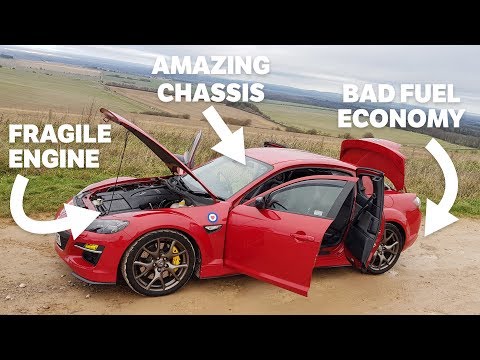
Mazda placed the engine behind the front axle and the fuel tank ahead of the rear axle, which gives near 50:50 weight distribution and a low polar moment of inertia. The front suspension uses double wishbones and the rear a multi-link layout; manual cars have a carbon-fibre propshaft and every RX-8 has a torque-sensing limited-slip differential. The body is steel with aluminium and plastic panels, including an aluminium bonnet.

The 2009 facelift added shock-tower bracing, stronger front suspension towers, revised rear geometry and a shorter final drive (4.777 instead of 4.444) for quicker acceleration on manual cars. It also brought new bumpers and lights, larger exhaust tips and new wheels.
Size, four-seat cabin and boot
| Parameter | Metric | Imperial |
|---|---|---|
| Length | 4,425 mm (2003–2008); 4,470 mm (2009–2012) | 174.2 in; 176.0 in |
| Width | 1,770 mm | 69.7 in |
| Height | 1,340 mm | 52.8 in |
| Wheelbase | 2,700 mm | 106.3 in |
| Kerb weight | 1,309–1,384 kg | 2,886–3,051 lb |
| Boot | 290 l | 10.2 cu ft |
| Fuel tank | 61 l | 16.1 US gal |
The cabin has a T-shaped dashboard with a central analogue rev counter and a digital speedometer, according to the old 1cars text. The front seats have strong side, shoulder and thigh support; the two rear seats fit adults for short trips, with a fold-through hatch for long items. Up to six airbags, ABS with EBD and stability control were fitted, according to the same source.

Fuel and oil consumption: the real running costs
The RX-8's weak point is consumption. The 231 PS version uses 11.2 l/100 km on the combined cycle (21 mpg US), 15.6 l/100 km in town, and emits 284 g/km of CO2. By our calculation, a high-power RX-8 has about 123 kW per tonne at 1,379 kg, similar to many hot hatchbacks, yet it uses far more fuel. To see what that costs at your mileage, use our fuel cost calculator, or compare performance with the power-to-weight calculator.

Rotary engines also burn oil by design, because oil is injected to lubricate the seals. Owners should check the oil level at every fill-up.
Reliability and known issues
The best-documented problem is a failure chain: worn ignition coils leave unburnt fuel, which clogs the catalytic converter; the converter overheats and the engine's side seals fail. In North America, Mazda extended the warranty on the 2004–2008 engine core, seals and gaskets. Engine rebuilds and replacement units are common on used cars. Other checks include starting when hot, compression test results and the condition of the coil packs and spark plugs.

Rivals: how the RX-8 compares
The RX-8 competed with two-seat sports cars such as the Nissan 350Z and 370Z and the Honda S2000. Its unique selling points were four usable seats and a 9,000 rpm engine; the Nissan had far more torque from its V6, and the Honda was a pure two-seater. Today the closest spiritual successor in handling terms is the Subaru BRZ and its Toyota twin, both rear-wheel drive with similar power.

Rivals
Compare with…
Compare Mazda RX-8 with
- Nissan 370Z quick spec comparison
- Honda S2000 quick spec comparison
- Mitsubishi Eclipse quick spec comparison
-
Ended 2009
- Years
- 1999–2009
- Body
- Roadster
- Fuel
- Petrol
- Power
- 177–184 kW (241–250 PS)
-
Ended 2011
- Years
- 2005–2011
- Body
- Coupe
- Fuel
- Petrol
- Power
- 121–198 kW (165–269 PS)
-
In production
- Years
- 2012–present
- Body
- Coupe
- Fuel
- Petrol
- Power
- 147–173 kW (200–235 PS)
2 generations
- ZC6
- ZD8


Mazda RX-8 in our rankings
- No. 25 of 54 · Most economical coupes (12.4 l/100 km · top 50%)
- No. 522 of 1147 · Longest-running car nameplates (9 years · top 50%)
- No. 67 of 130 · Most powerful Japanese cars (177 kW · top 52%)
- No. 652 of 1085 · Most powerful cars (177 kW · top 61%)
- No. 300 of 368 · Most powerful coupes (177 kW · top 82%)
- No. 263 of 317 · Most economical cars (12.4 l/100 km · top 84%)
More economical than 50% of ranked coupes in the 1CARS catalog (No. 25 of 54).
Mazda RX-8 photos 16


Mazda RX-8 videos 2
Test drive
Video overview
FAQ
How much horsepower does the Mazda RX-8 have?
In Europe the RX-8 was sold with 141 kW (192 PS) and five gears or 170 kW (231 PS) and six gears. North American and Japanese ratings differed slightly, from about 189 hp to 250 PS in Japan's high-power version. All use the 1.3-litre Renesis rotary.
Why was the Mazda RX-8 discontinued?
European sales ended in 2010 because the car no longer met emissions standards there, and global production stopped on 22 June 2012. Mazda did not replace it with a new rotary sports car.
Is the Mazda RX-8 reliable?
It can be, with care. The known weak point is a chain of ignition-coil wear, catalytic-converter blockage and seal failure, which led Mazda to extend its engine warranty in North America. Regular oil checks, healthy coils and a good compression test are essential.
How many Mazda RX-8 were made?
Mazda built 192,094 RX-8s between February 2003 and June 2012 in Hiroshima. Special editions included the Shinka, the UK PZ developed with Prodrive, the R3 and the final Spirit R of 2011–2012, of which about 2,000 were made.
Does the Mazda RX-8 have four doors?
Yes. It has two conventional front doors and two small rear-hinged "freestyle" doors, with no B-pillar between them. The rear doors open only after the front doors, giving easy access to two rear seats.
Data sources
Data checked by an editor against the sources below.
- Wikipedia - Mazda RX 8
- US EPA fueleconomy.gov - 30615.shtml
- US EPA fueleconomy.gov - 30614.shtml
- US EPA fueleconomy.gov - 28558.shtml
- US EPA fueleconomy.gov - 28557.shtml


