 Mazda CX-7
Specs, engines and history
Updated Published Sources (3) Report an error
By Oleksandr Hnatiuk, Automotive Editor & Used Car Specialist

- Built
- 2006–2012
- Top power
- 191 kW (260 PS)
Which Mazda CX-7 to buy
Our verdict · Oleksandr Hnatiuk
The facelifted 2009–2012 cars have better equipment and the choice of the 2.5 petrol or, in Europe, the 2.2 diesel, which is the most economical. The 2.3 turbo is fast but expensive to run. When buying used, check the service history, the turbocharger and oil consumption on the 2.3 DISI, the timing chain, the AWD clutches and, on diesels, the SCR system and particulate filter.
The Mazda CX-7 is a five-seat mid-size crossover built in Hiroshima, Japan, from February 2006 to August 2012. Shown at the Los Angeles Auto Show in January 2006 as the production version of the MX-Crossport concept, it combined SUV practicality with a sporty, steeply raked design and a turbocharged 2.3 DISI petrol engine with up to 191 kW (260 PS). It was replaced by the Mazda CX-5.
In short
- Production: 20 February 2006 – August 2012 at Mazda's Ujina plant in Hiroshima; facelift in February 2009.
- Engines: 2.3 MZR DISI turbo petrol (175–191 kW), 2.5 MZR petrol (120 kW) from 2009, 2.2 MZR-CD diesel (125 kW) in Europe from 2009.
- Drive: front-wheel drive or Active Torque Split AWD, sending up to 50% of torque to the rear.
- Size: 4,676–4,681 mm long on a 2,750 mm wheelbase; boot about 455 litres, 1,350 litres folded.
Size at a glance
| Dimensions | Mazda CX-7 ER |
|---|---|
| Length | 4,676 mm184.1 in |
| Width | 1,872 mm73.7 in |
| Height | 1,646 mm64.8 in |
| Wheelbase | 2,750 mm108.3 in |
| Boot | 455 L16.1 cu ft |
Specs by version
Engines
Dimensions and weight
Verified Manufacturer and type-approval data from our catalog · Sources and methodology
A sporty crossover from Hiroshima
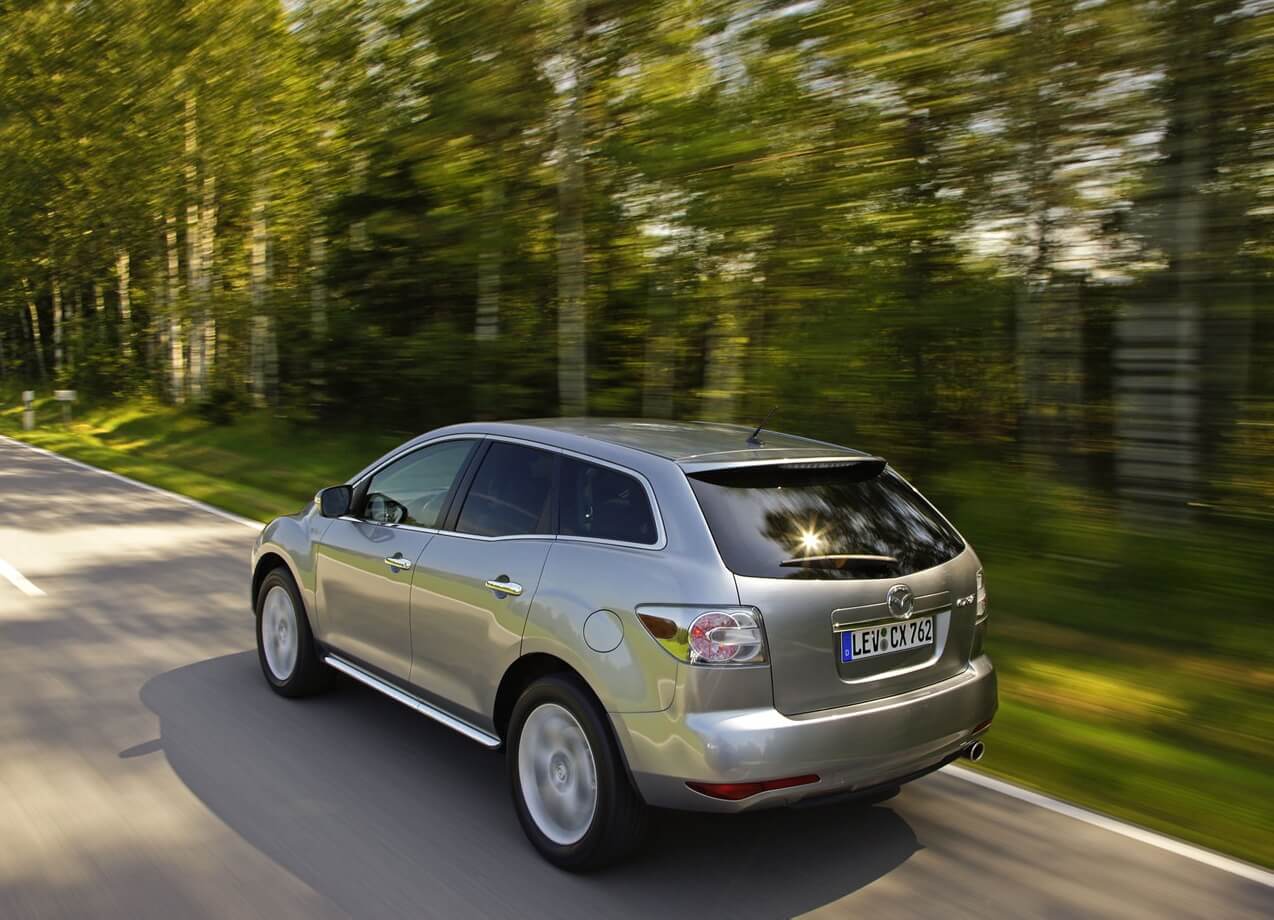
The CX-7 was Mazda's sporty alternative to boxy SUVs, sitting below the three-row CX-9. Its design, credited to Moray Callum's team with Iwao Koizumi, features a wide five-point grille, bulging front wings inspired by the Mazda RX-8, a steep windscreen and a tapering glasshouse. It uses Ford C1 platform elements, with front suspension shared with the Mazda MPV and rear suspension from the Mazda5. The brand's story is told in the history of Mazda, and the range is in the Mazda catalogue.

| Fact | Value |
|---|---|
| Production | 2006–2012, Hiroshima (Ujina), Japan |
| Body | 5-door crossover, 5 seats |
| Platform | Ford C1 elements; MPV front and Mazda5 rear suspension |
| Engines | 2.3 turbo petrol, 2.5 petrol, 2.2 diesel |
| Drive | FWD or AWD |
| Successor | Mazda CX-5 |
DISI turbo, 2.5 and diesel engines
| Engine | Power | Torque | Gearbox | Drive |
|---|---|---|---|---|
| 2.3 MZR DISI turbo (L3-VDT) | 175–191 kW (238–260 PS), by market and year | 350–380 Nm | 6-speed automatic | FWD or AWD |
| 2.5 MZR (L5-VE), from 2009–2010 | 120 kW (163 PS) | 205–218 Nm | 5-speed automatic | FWD |
| 2.2 MZR-CD diesel (Europe, 2009–2012) | 125 kW (170 PS) | 400 Nm | 6-speed manual | AWD |
The 2.3 DISI combines direct injection with a turbocharger and intercooler; it is related to the engines of the Mazdaspeed3 and Mazdaspeed6. In North America it was retuned with a smaller turbocharger for more torque at low revs. With this engine the CX-7 reaches 100 km/h in about 8.3 seconds and more than 200 km/h, but it is thirsty: about 9.3 L/100 km on the highway and 15.3 L/100 km in town. The 2.5 is calmer, taking about 10.3 seconds to 100 km/h and averaging about 9.4 L/100 km. The European diesel used urea-based selective catalytic reduction (SCR), cutting nitrogen oxide emissions by up to 40% and meeting Euro 5.

All-wheel drive and chassis
Active Torque Split AWD uses electronically controlled magnetic clutches. In normal driving the front wheels take the torque; on slippery surfaces up to 50% goes to the rear wheels. With ground clearance of about 205 mm (208 mm after the 2009 update), the CX-7 handles snow and gravel roads, but it is not intended for real off-road use.

Suspension is independent at both ends, with disc brakes all round, ABS, electronic brakeforce distribution, brake assist, traction control and DSC stability control.
CX-7 size and luggage space
| Parameter | Metric | Imperial |
|---|---|---|
| Length | 4,676–4,681 mm | 184.1–184.3 in |
| Width | 1,872 mm | 73.7 in |
| Height | 1,646 mm | 64.8 in |
| Wheelbase | 2,750 mm | 108.3 in |
| Ground clearance | 205–208 mm | 8.1–8.2 in |
| Kerb weight | about 1,782 kg | about 3,929 lb |
| Boot (seats up / folded) | about 455 / 1,350 L | about 16.1 / 47.7 cu ft |
CX-7 cabin
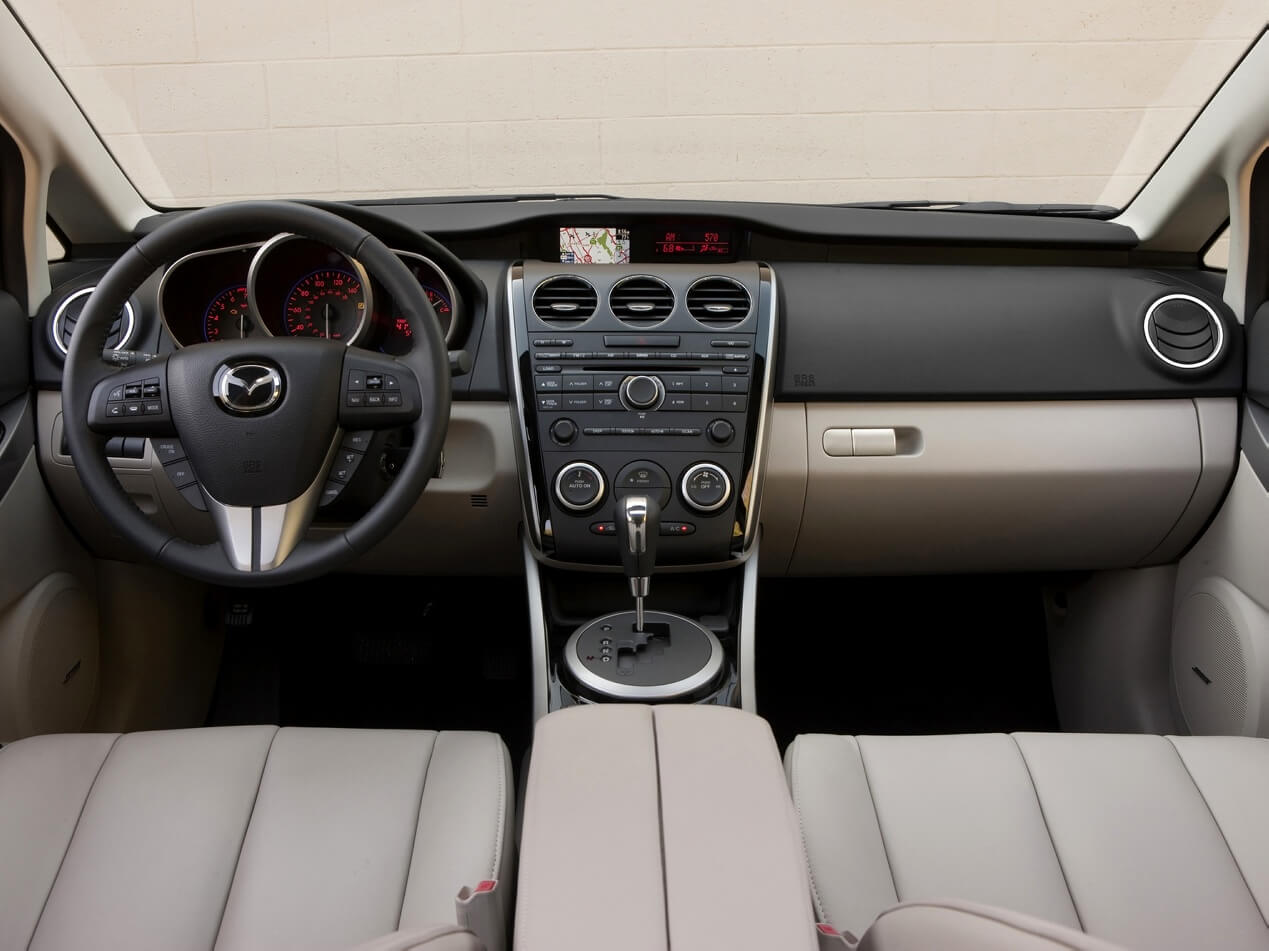
The cabin focuses on solid build quality rather than luxury; the plastics are hard but do not rattle. The three-spoke steering wheel, borrowed from the Mazda3, adjusts for reach and rake, and the leather-trimmed wheel and gear lever carry controls for the main systems. The sporty front seats sit low and deep, and the thick A-pillars limit visibility. The rear seat suits two adults; a third is tight. Storage includes a 5.4-litre box between the front seats, a lockable glovebox, door pockets and seat-back pockets.

The heater warms the cabin quickly in winter. Owners have criticised the small reversing-camera screen and a camera that gets dirty in rain, and on some cars the powerful audio system made the door trims vibrate.
The 2009 facelift
Mazda revealed the updated CX-7 at the Canadian International AutoShow in Toronto in February 2009 and showed it in Europe at Geneva a month later. It gained a larger five-point grille, new fog lights in reshaped side intakes, revised rear styling, new instruments with a 3.5-inch monochrome and 4.1-inch colour information display, Bluetooth, a driver's seat memory with three positions, blind-spot monitoring and, in later years, a touchscreen multimedia system. The 2.5 petrol and the 2.2 diesel joined the range at the same time.

CX-7 crash test results
In Euro NCAP's test of the 2010 model, the CX-7 scored 76% for adult occupants, 79% for child occupants, 43% for pedestrians and 71% for safety assist, with weak neck protection lowering the result. The body is designed to spread crash forces across the structure, the engine is guided downwards in a frontal collision, the steering column collapses and the pedal box is designed not to intrude. Front belts have pretensioners and force limiters, and the airbags deploy in stages depending on the crash severity.

Rivals: how the CX-7 compares
The CX-7 competed with the Nissan Murano, Hyundai Santa Fe, Mitsubishi Outlander, Honda CR-V and Toyota RAV4, and with the Nissan X-Trail in Europe. It stood out with its styling and handling but the turbo petrol version was thirsty.

Mazda CX-7 in our rankings
- No. 174 of 420 · Longest cars (4,676 mm · top 42%)
- No. 173 of 403 · Widest cars (1,872 mm · top 43%)
- No. 70 of 146 · Longest SUVs and crossovers (4,676 mm · top 48%)
- No. 117 of 243 · Biggest boot: cars (455 l · top 49%)
- No. 43 of 88 · Most powerful Japanese cars (191 kW · top 50%)
- No. 60 of 125 · Biggest engines: SUVs and crossovers (2,500 cc · top 51%)
Longer than 58% of ranked cars in the 1CARS catalog (No. 174 of 420).
Mazda CX-7 photos 27




Mazda CX-7 videos 3

Mazda CX-7 video 1

Mazda CX-7 video 2

Mazda CX-7 video 3
FAQ
When was the Mazda CX-7 produced?
The CX-7 was built in Hiroshima from February 2006 to August 2012. It debuted at the January 2006 Los Angeles Auto Show, was facelifted in 2009 and was replaced by the Mazda CX-5.
What engines does the Mazda CX-7 have?
It was offered with a 2.3 DISI turbo petrol producing 175–191 kW (238–260 PS), a 2.5 petrol with 120 kW (163 PS) and, in Europe from 2009, a 2.2 diesel with 125 kW (170 PS).
Is the Mazda CX-7 all-wheel drive?
Many versions have Active Torque Split AWD, which normally drives the front wheels and sends up to 50% of torque to the rear when they slip. Front-wheel-drive versions were also sold.
How safe is the Mazda CX-7?
In Euro NCAP's test of the 2010 model, it scored 76% for adult occupants and 79% for child occupants. Weak neck protection in rear impacts lowered the adult score.
What replaced the Mazda CX-7?
Mazda replaced the CX-7 with the compact CX-5 in 2012. Despite its smaller exterior, the CX-5 offers similar interior space, and Mazda later added the three-row CX-8.
Data sources
Data checked by an editor against the sources below.
- The text of this article (1cars archive)
- Wikipedia - Mazda CX 7
- Vibilagare - Euro Ncap Best Performing Cars 2010