
 Mazda RX-7
All generations, specs and history
Updated Published Sources (2) Report an error
By Sarah Whitmore, Senior Automotive Writer Reviewed by Oleksandr Hnatiuk

- Built
- 1978–2002
- Generations
- 3 · FB to FD
- Top power
- 206 kW (280 PS)
- New price
- from about €44,534 (1992)
Timeline
RX-7 generations
Click a generation for its own page


FC and FD overlapped in 1991–1992, so FD sits on a second lane
- RX-7 FB (SA22C) 1978–1985 · Coupe · 75–121 kW (102–165 PS)
- RX-7 FC 1985–1992 · Coupe, Convertible · 109–158 kW (148–215 PS)
- RX-7 FD 1991–2002 · Coupe · 176–206 kW (239–280 PS)
Newest first · 3 generations since 1978
-
1991
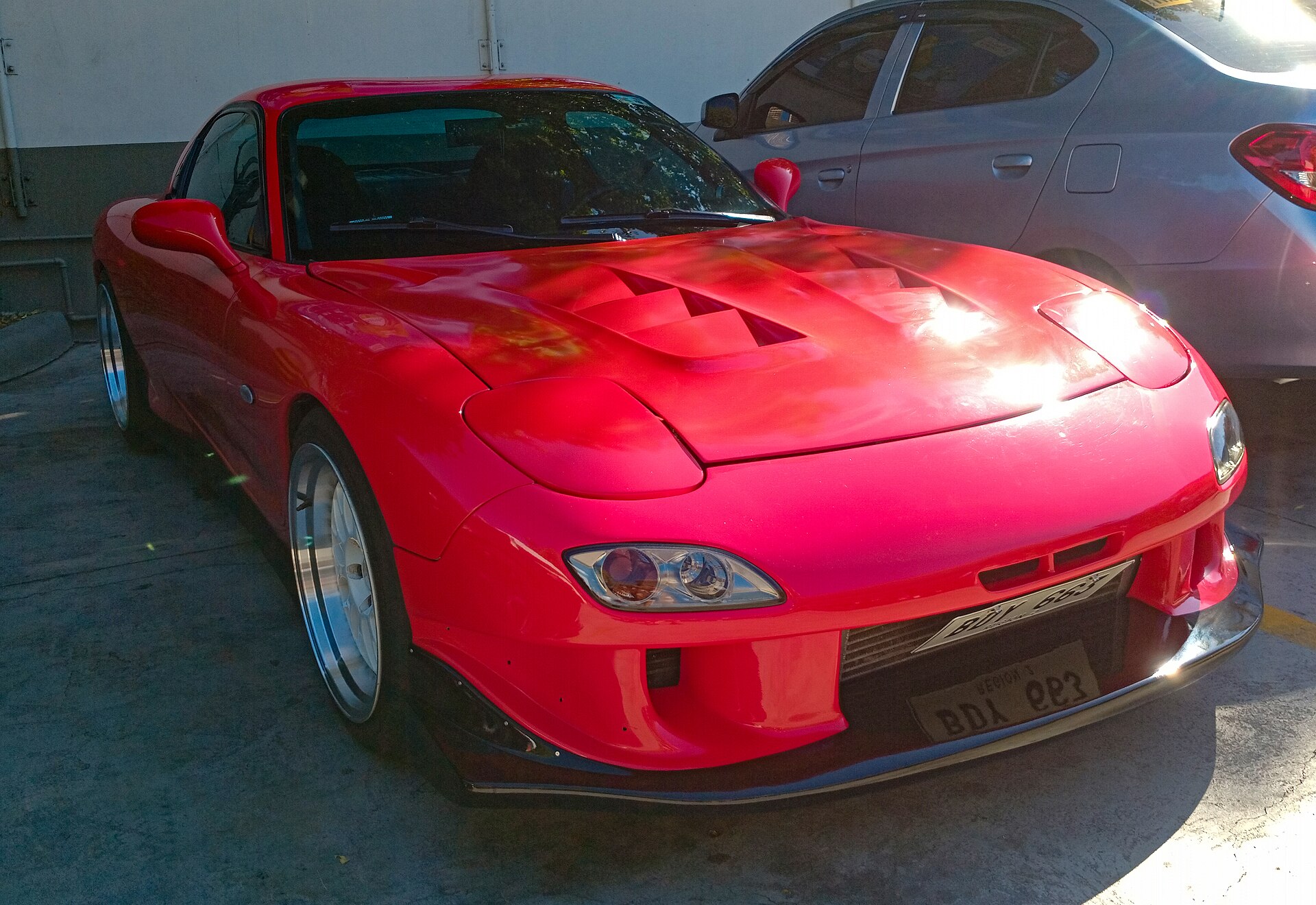
-
1985
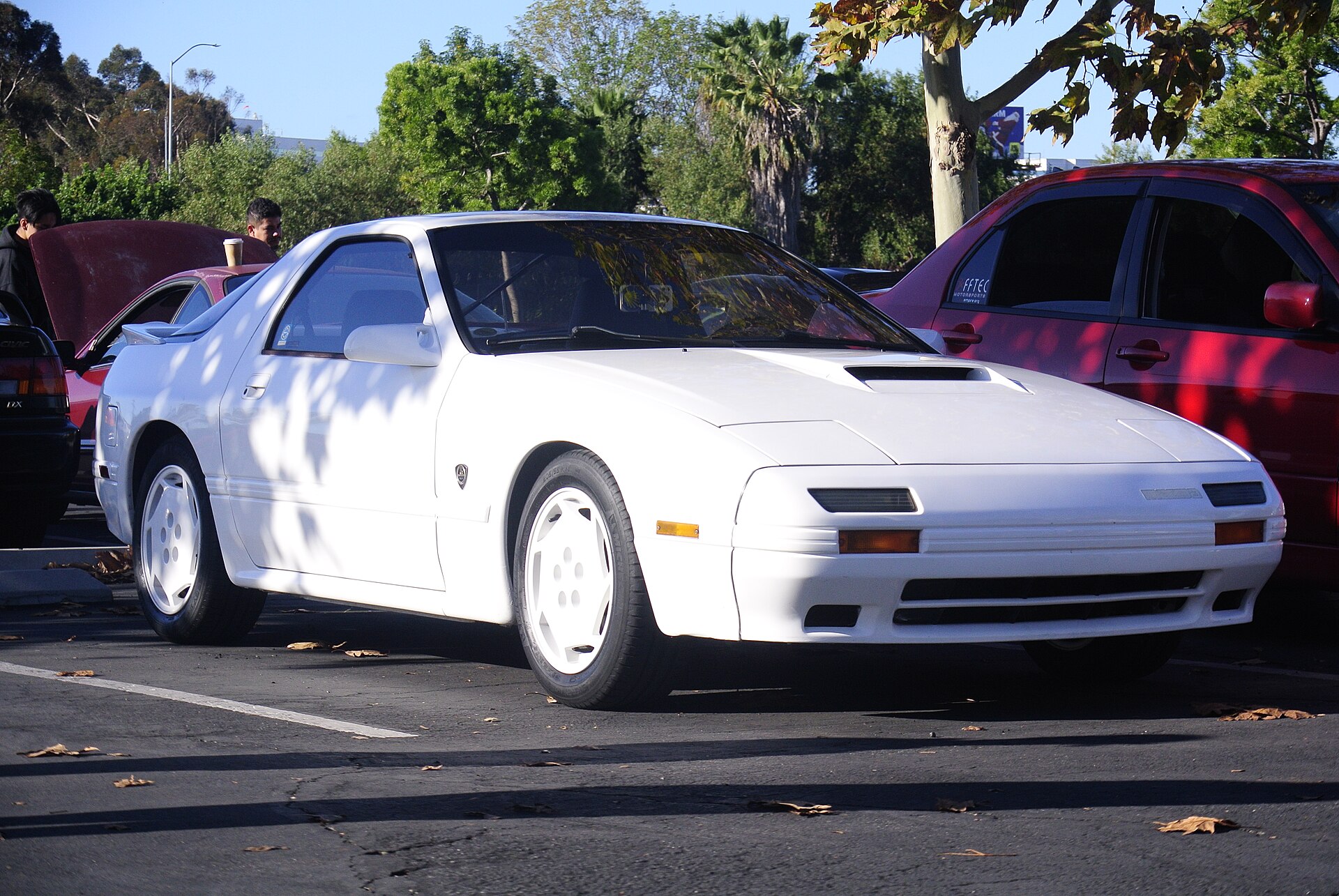
-
1978

All generations by year: RX-7 FD (1991–2002) · RX-7 FC (1985–1992) · RX-7 FB (SA22C) (1978–1985)
Which one is mine?
Pick the year of first registration to see which generation it is.
Check by VINWhich Mazda RX-7 to buy
Our verdict · Sarah Whitmore
The FD is the most desirable and the most expensive; a Series 8 or Spirit R is the peak of the line. The FC Turbo II offers turbo performance for less money, and the first-generation car is the simplest and easiest to maintain. On any RX-7, check the compression of each rotor face, signs of overheating, the turbo pipes and vacuum lines on the FD, rust on door edges, wheel arches, sills and the spare-wheel well, and the service history. Original, unmodified cars are rare and hold their value best. The RX-7's successor, the four-door Mazda RX-8, kept the rotary engine until 2012. More cars of the era are in the 1990s classics section, and the full range is in the Mazda catalogue.
The Mazda RX-7 is a front-mid-engined, rear-wheel-drive sports car powered by a Wankel rotary engine, built by Mazda from 1978 to 2002. Its three generations, known by the codes SA22C/FB, FC and FD, sold 811,634 cars. The last FD of 2002 had a twin-turbo 13B with 206 kW (280 PS).
In short
- First generation (1978–1985): 471,018 built, 12A rotary from 75 to 121 kW, plus a 13B for North America.
- Second generation FC (1985–1992): 272,027 built, 13B with up to 158 kW, Turbo II and a convertible.
- Third generation FD (1992–2002): 68,589 built, sequential twin-turbo 13B-REW with 188 to 206 kW, sold in Japan until the 2002 Spirit R.
- Winner of IMSA GTU titles, the 1981 Spa 24 Hours and Car and Driver 10Best awards in 1983, 1987 and 1993–1995.

Specs by version
Engines
| Version | Engine | Power | Torque | Gearbox | Drive |
|---|---|---|---|---|---|
| FB · 1978–1985 | |||||
| FB · 85 kW (116 PS) Coupe | - | 85 kW 116 PS114 hp | - | - | Rear-wheel drive |
| FD (255 PS) | 1.3 l 13B-REW | 188 kW 256 PS252 hp | - | Manual | Rear-wheel drive |
| FD Type RB | 1.3 l 13B-REW | 195 kW 265 PS261 hp | 294 Nm217 lb-ft | 5-sp Manual | Rear-wheel drive |
| FD Type RS | 1.3 l · Petrol 13B-REW | 206 kW 280 PS276 hp | 314 Nm232 lb-ft | - | Rear-wheel drive |
Dimensions and weight
Show all 4 versions
| Version | Kerb weight | Boot |
|---|---|---|
| FB · 1978–1985 | ||
| FB · 85 kW (116 PS) Coupe | - | 160 l5.7 cu ft |
| FD (255 PS) | - | 160 l5.7 cu ft |
| FD Type RB | 1,310 kg2,888 lb | 160 l5.7 cu ft |
| FD Type RS | 1,280 kg2,822 lb | - |
Verified Manufacturer and type-approval data from our catalog · Sources and methodology
Mazda RX-7 at a glance
The RX-7 replaced the RX-3 and became Mazda's main rotary model; only the Cosmo kept the rotary engine alongside it. The engine sits behind the front axle line, which gives near 50:50 weight distribution. All RX-7s are two-door coupés, with a convertible in the FC range. Mazda's own story, including its rotary engine programme, is told in the history of Mazda.

| Generation | Years | Built | Engines | Power range |
|---|---|---|---|---|
| First (SA22C / FB) | 1978–1985 | 471,018 | 12A, 12A turbo (Japan), 13B (North America) | 75–121 kW (101–165 PS) |
| Second (FC) | 1985–1992 | 272,027 | 13B, 13B turbo | 109–158 kW (148–215 PS) |
| Third (FD) | 1992–2002 | 68,589 | 13B-REW twin turbo | 188–206 kW (255–280 PS) |
Engines and performance by generation
First generation (1978–1985)
The first RX-7 used the 12A twin-rotor engine. North American cars had 75 kW (100 hp) and reached 60 mph in about 9.2 seconds; European cars started at 77 kW (105 PS) and got 85 kW (115 PS) with the 1981 FB facelift. In Japan, the SE-Limited of 1982 had 103 kW (140 PS), and a turbo 12A with 121 kW (165 PS) arrived in September 1983. North America got the fuel-injected 13B GSL-SE in 1984 with 101 kW (135 hp).

Second generation FC (1985–1992)
The FC moved to the larger 13B. In North American form the naturally aspirated engine gave 109 kW (146 hp), later 119 kW (160 hp), while the Turbo II with a twin-scroll turbo and intercooler produced 136 kW (182 hp), and 149 kW (200 hp) after the 1989 update. The Japanese ɛ̃fini versions reached 158 kW (215 PS) from 1990. A convertible joined in 1987 in Japan and 1988 in the US, and about 22,000 were built. The Winning Limited edition of 1991, 1,000 cars, marked Mazda's 1991 Le Mans win with the 787B.
Third generation FD (1992–2002)
The FD brought a lighter body and the 13B-REW with two sequential turbochargers: one works at low revs, and the second joins at about 4,500 rpm. Power rose from 188 kW (255 PS) in 1992 to 265 PS on the Type RB and 206 kW (280 PS) on the top models from 1999. Depending on version, the FD reaches 100 km/h in 4.9 to 5.4 seconds and is limited to 250 km/h (155 mph). A five-speed manual was standard and a four-speed automatic optional; in Japan, automatic cars had lower outputs.
| FD version | Weight |
|---|---|
| Series 6 Type R | 1,260 kg |
| Series 6 A-Spec | 1,220 kg |
| Series 6 EU-Spec | 1,325 kg |
| Series 8 Type RZ | 1,270 kg |
| Series 8 Type RB | 1,310 kg |
With 206 kW and 1,270 kg, a Series 8 Type RZ has about 162 kW per tonne, on a par with much larger-engined sports cars of the 1990s.
Body, cabin and practicality
Every RX-7 has pop-up headlights and a glass rear hatch. The FD seats two in most versions, while some Japanese trims kept small rear seats. The cabin is driver-focused, with leather on the gear lever, handbrake and seats in higher trims. Luggage space under the hatch is limited, and the FD's low roof suits drivers of average height better than tall ones.

Fuel, oil and rotary running costs
Rotary engines are thirsty and also burn some oil by design. The old 1cars text quoted about 11.1 l/100 km for the FD in mixed driving, and real figures are often higher when the turbos are used. Oil use of up to about 0.25 l per 1,600 km is considered normal on an FD. Engine rebuilds are a known cost of ownership, so a compression test is essential before buying.

Versions and trims
In Japan the FD was sold under Mazda's ɛ̃fini sales channel from 1991 to 1997. Series 6 ran from 1992 to 1995, Series 7 from 1996 to 1998 and Series 8 from 1998 to 2002. Exports to the US and Canada ended after 1995, most European sales after 1995 and UK imports in 1996; officially, Europe received 1,152 FDs.

The farewell Spirit R of 2002 came in three types, 1,504 cars in total:
- Type A, 1,044 built: two-seater with 206 kW (280 PS) and a five-speed manual;
- Type B, 420 built: the same engine with 2+2 seating;
- Type C, 40 built: 2+2 with the four-speed automatic and a lower output.
Crash-test history
The RX-7 was never tested by Euro NCAP, which began crash tests in 1997, when the FD had already left most European markets. No official crash rating exists for any generation.

Rivals: how the RX-7 compares
| Model | Era | Engine | Notes |
|---|---|---|---|
| Mazda RX-7 FD | 1992–2002 | 1.3 twin-rotor twin turbo | 188–206 kW, about 1,270 kg |
| Toyota Supra A80 | 1993–2002 | 3.0 straight-six, turbo optional | Heavier grand tourer |
| Honda NSX | 1990–2005 | 3.0–3.2 V6, mid-mounted | Aluminium body, more expensive |
| Nissan 300ZX (Z32) | 1989–2000 | 3.0 V6, twin turbo optional | Larger and heavier |
Compared with these rivals, the FD is the lightest and has the smallest engine, which explains its sharp handling. Compare RX-7 data with other sports cars in the 1cars comparison tool or look up versions in the specifications section.


Mazda RX-7 evolution in numbers
Did you know?
- The Mazda RX-7 ran for 24 years, from 1978 to 2002, over 3 generations in our catalog.
- The longest-running generation is the RX-7 FD (1991–2002): 11 years.
- The biggest jump in power came with the RX-7 FD: up to 206 kW (280 PS), 48 kW more than the RX-7 FC.
Most powerful version, kW
Figures from the 1cars catalog: power is the strongest version of each generation; generations without the figure are left out.
Mazda RX-7: first vs latest generation
| Spec | RX-7 FB (SA22C) | RX-7 FD | Change |
|---|---|---|---|
| Years | 1978–1985 | 1991–2002 | 13 years apart |
| Most powerful version | 121 kW (165 PS) | 206 kW (280 PS) | +85 kW (+70%) |
Oldest and newest generation in the 1cars catalog. Power is the strongest version of each; other rows are shown only when both generations have the figure.
Image credits · Photos from Wikimedia Commons under free licences
- Mazda RX-7 FC · Photo: Yaktatel / Wikimedia Commons, Public domain
- Mazda RX-7 FD · Photo: Ethan Llamas / Wikimedia Commons, CC BY-SA 4.0
Rivals
Compare with…
Compare Mazda RX-7 with
- Nissan Silvia quick spec comparison
- Toyota Supra quick spec comparison
- Nissan Skyline quick spec comparison
-
Ended 2026
- Years
- 1978–2026
- Body
- Liftback, Coupe
- Fuel
- Petrol
- Power
- 82–320 kW (111–435 PS)
5 generations
- A40/A50
- A60
- A70
- A80
- A90
-
In production
- Years
- 1957–present
- Body
- Sedan, Station wagon
- Fuel
- Petrol, Diesel, Hybrid
- Power
- 44–309 kW (60–420 PS)
-
Classic
- Years
- 1989–1998
- Body
- Hatchback, Coupe
- Fuel
- Petrol
- Power
- 104–116 kW (141–158 PS)
2 generations
- S13
- S14


Popular comparisons
Mazda RX-7 in our rankings
- No. 132 of 1153 · Longest-running car nameplates (24 years · top 13%)
- No. 98 of 426 · Power-to-weight: cars (161 kW/t · top 24%)
- No. 26 of 100 · Lightest coupes (1,280 kg · top 26%)
- No. 133 of 429 · Lightest cars (1,280 kg · top 32%)
- No. 37 of 117 · Most powerful cars of the 1990s (206 kW · top 35%)
- No. 45 of 131 · Most powerful Japanese cars (206 kW · top 38%)
In production longer than 87% of ranked nameplates in the 1CARS catalog (No. 132 of 1153).
Mazda RX-7 photos 14


FAQ
What is the fuel consumption of the Mazda RX-7?
The FD uses about 11 l/100 km in mixed driving according to the old 1cars data, and often more when driven hard. Rotary engines also consume a little oil by design, up to about 0.25 l per 1,600 km.
Is the Mazda RX-7 available with all-wheel drive?
No. Every RX-7 is rear-wheel drive with the rotary engine mounted behind the front axle. There was never an all-wheel-drive or hybrid version; buyers chose between a five-speed manual and a four-speed automatic.
How much power does the Mazda RX-7 have?
Output ranges from 75 kW (100 hp) in the first North American cars to 206 kW (280 PS) in the last FD models. The FD's sequential twin-turbo 13B-REW started at 188 kW (255 PS) in 1992.
Why did Mazda stop making the RX-7?
Exports to North America and Europe ended in 1995–1996, after sales of the expensive FD fell. Production for Japan ended in 2002 with the Spirit R, and the RX-8 took over the rotary engine in 2003.
What are the main rivals of the Mazda RX-7?
The FD competed with the Toyota Supra A80, the Nissan 300ZX and the Honda NSX. It was the lightest of the group, with the smallest engine, and focused on handling rather than outright power.
Data sources
Data checked by an editor against the sources below.
- The text of this article (1cars archive)
- Wikipedia - Mazda RX 7


