 Nissan Navara
Specs, engines and history
Published Sources (1) Report an error
By Sarah Whitmore, Senior Automotive Writer
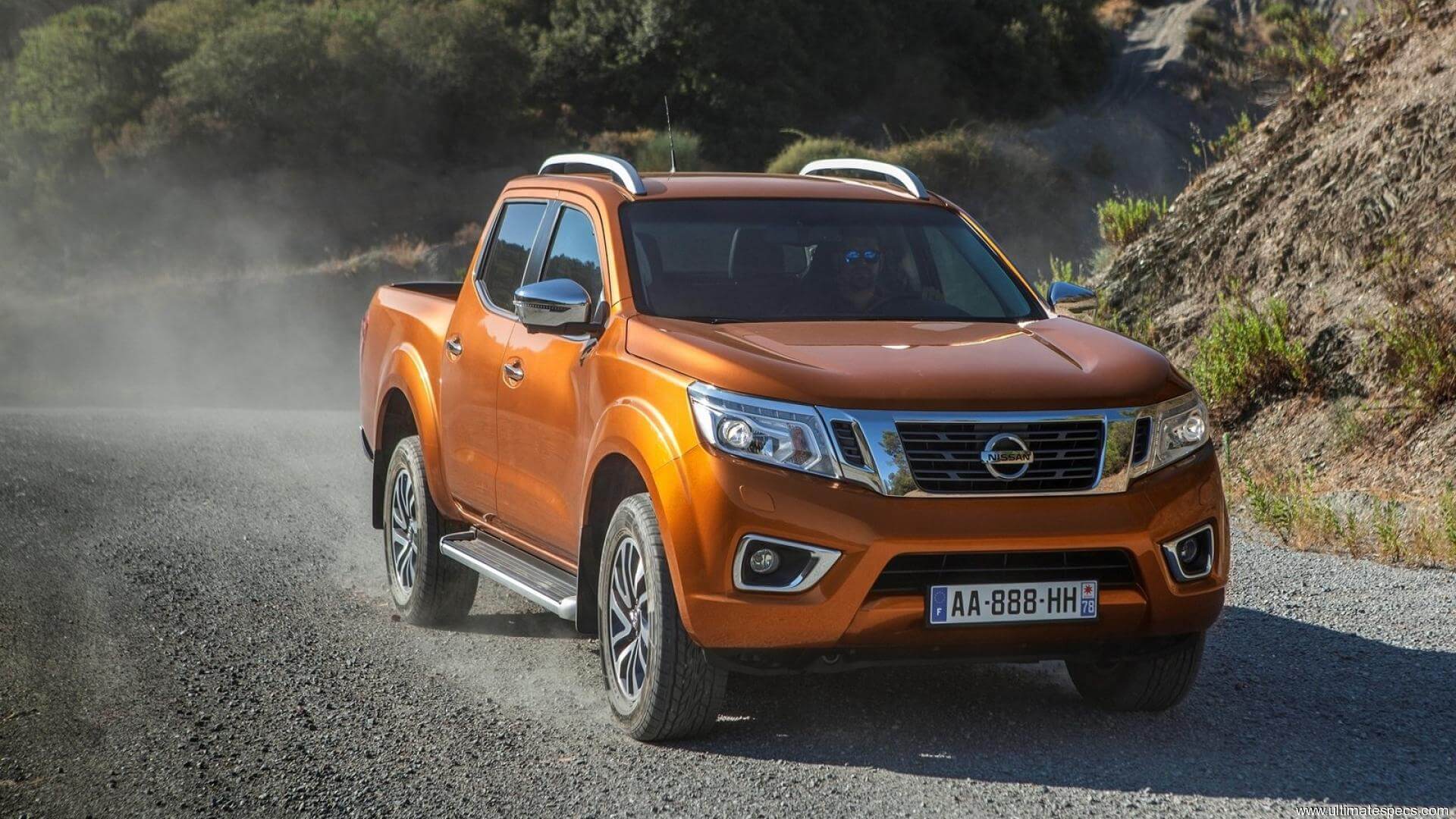
The Nissan Navara is a mid-size pickup with rear- or four-wheel drive and one of Nissan's global products, sold on almost every continent. Counting its Datsun predecessors it belongs to a long line of Nissan pickups; the Navara name was first used in some markets on the D21. The D22 arrived in 1997, the D40 made its debut at the 2004 Detroit motor show, the D23 (also called NP300) was unveiled in June 2014, and a fourth generation (D27), developed from the Mitsubishi Triton, was unveiled in November 2025.
In short
- D22 (1997 onwards), D40 (2004–2015) on the F-Alpha platform, D23/NP300 (2014 onwards) and D27 (2025).
- D23 in Europe: 2.3 dCi diesel with 118 kW (160 PS) single turbo or 140 kW (190 PS) twin turbo.
- Payload of up to 1,000 kg and a towing capacity of 3,500 kg.
- The D23 formed the basis of the Mercedes-Benz X-Class and Renault Alaskan.
Nissan Navara at a glance
The Navara is a ladder-frame pickup with a longitudinal front engine, rear-wheel drive or part-time four-wheel drive, and single, extended or double cabs. More Nissan models are listed in our Nissan catalogue.
Nissan Navara generations
D22 (1997 onwards)
The D22 replaced Nissan's Hardbody trucks and was built in Japan, the United States, Spain, Thailand, South Africa, Brazil, Mexico and elsewhere. Engines included the KA24DE petrol four, TD27 diesel, VG33E V6 and ZD30 and common-rail 2.5 diesels. In some markets it stayed in production until 2015 as a cheaper alternative to the D40.
D40 (2004–2015)
The D40 made its debut at the 2004 Detroit motor show on the new F-Alpha platform with a fully boxed ladder frame. It was larger and better equipped. Engines included a 4.0 V6 petrol with 195 kW (261 hp) in North America, a 2.5 dCi diesel with 106–128 kW (142–172 hp) originally, later 140 kW (190 PS), and, from the 2010 facelift, a 3.0 V6 diesel with 179 kW (240 hp). Gearboxes were six-speed manuals and five-speed automatics. It was built in Barcelona, Spain, among other plants.
D23 / NP300 (2014 onwards)
The D23 was unveiled on 11 June 2014, and production began in Samut Prakan, Thailand, in July 2014. For Europe it was built in Barcelona from 2015 until the plant closed in 2021; production also takes place in Argentina. It was not sold in the United States and Canada. A facelift was unveiled on 5 November 2020, adding the Pro-4X version and more active safety equipment.
Exterior
The D23 has smoother, more dynamic lines with almost no sharp edges. The grille follows Nissan's SUV style, a V-shaped inverted trapezoid with a large badge. Muscular front wings with strong creases, an aggressive bumper, modern headlights with LED running-light sections and a sculpted bonnet make it look tough. In double-cab form its profile has been compared with the Renault Duster. The mirrors have built-in indicators, and the body is rounded, with smooth lines and strong creases. Base versions ride on 16-inch steel wheels. The wings have double erosion protection, mud flaps keep the sides and sills clean, and ground clearance is 215–219 mm. At the rear are large vertical lights, a drop-down tailgate and a sturdy bumper, with the third brake light above the cab's rear window and the spare wheel and exhaust under the load bed.
Interior
The cabin changed far more than the exterior, with higher-quality materials and advanced equipment. A colour TFT trip-computer display sits between the dials, behind a new three-spoke multifunction steering wheel with audio controls. The front seats are ergonomic and comfortable - Nissan says they were designed using technology developed with NASA research. A 7-inch colour touchscreen with Apple CarPlay and Android Auto controls many functions, with 4G connectivity and 3D navigation optional; base versions are simpler. The minimalist centre console resembles the Nissan X-Trail's. The rear bench seats three adults, although the backrests are more upright than in a typical SUV, which can be tiring on long trips. The load bed carries up to 1,000 kg, and the Navara can tow 3,500 kg.
Engines and transmissions (Europe)
| Engine | Power (kW / PS) | Torque | Gearbox |
|---|---|---|---|
| 2.3 dCi, single turbo | 118 kW / 160 PS | 403 Nm | 6-speed manual |
| 2.3 dCi, twin turbo | 140 kW / 190 PS | 450 Nm | 7-speed automatic |
The 2.3-litre diesel, shared with the Nissan NV400 van, has direct injection, injection pressure raised from 2,000 to 2,200 bar, diamond-like-carbon-coated piston rings and improved cooling, and meets the Euro 6d-Temp standard. 0–100 km/h takes 10.8–12 seconds, top speed is 172–184 km/h and combined consumption is 6.3–7.0 l/100 km. Drive is rear-wheel or part-time four-wheel drive with a rear differential lock and low range.
Chassis and safety
The D23 uses an improved version of its predecessor's platform with a stiffer ladder frame, double-wishbone coil-spring front suspension and a rigid rear axle. Steering is rack-and-pinion with hydraulic assistance, and the turning circle was reduced. Brakes are ventilated discs at the front and drums at the rear, with ABS, EBD and brake assist as standard. Equipment includes stability control, hill-start assist and hill descent control, a rear camera, LED headlights, navigation, cruise control, Intelligent Trailer Sway Assist, automatic emergency braking, the Intelligent Around View Monitor, keyless entry, front and side airbags and curtain airbags for both rows. Higher trims add seven airbags, dual-zone climate control, leather and heated electric front seats.
D27 (2025)
The fourth Navara, unveiled on 19 November 2025, was developed from the Mitsubishi Triton and is built by Mitsubishi Motors. It uses a 2.4-litre twin-turbo diesel with 150 kW and 470 Nm, an automatic gearbox and four-wheel drive only.
Key specifications by generation
| Parameter | D40 | D23 | D27 |
|---|---|---|---|
| Years | 2004–2015 | 2014 onwards | 2025 onwards |
| Platform | F-Alpha | Nissan (improved D40) | Mitsubishi Triton |
| Diesel power | 106–179 kW | 118–140 kW (Europe) | 150 kW |
| Gearboxes | 6MT, 5AT | 6MT, 7AT | Automatic |
Strengths and weaknesses
Owners like the Navara's rugged looks, high ground clearance, powerful engines and four-wheel drive, which make it capable and stable off-road, as well as its payload, safety, comfortable cabin, value for money, build quality and reliability; the latest generation adds many electronic driver aids and economical diesels. Rivals include the Toyota Hilux, Ford Ranger, Mitsubishi L200, Volkswagen Amarok and Isuzu D-Max.
FAQ
Is the Nissan Navara the same as the NP300?
Yes, the D23-generation Navara is also sold as the NP300 in some markets.
What engines does the European Nissan Navara D23 have?
A 2.3 dCi diesel with 118 kW (160 PS) or, with two turbochargers, 140 kW (190 PS).
How much can the Nissan Navara tow?
Up to 3,500 kg, with a payload of up to 1,000 kg.
Which cars are based on the Nissan Navara?
The Mercedes-Benz X-Class and Renault Alaskan were based on the D23.
Data sources
Data checked by an editor against the sources below.