 Nissan Caravan
Specs, engines and history
Published Sources (1) Report an error
By Felix Hartmann, Automotive Technology & EV Contributor
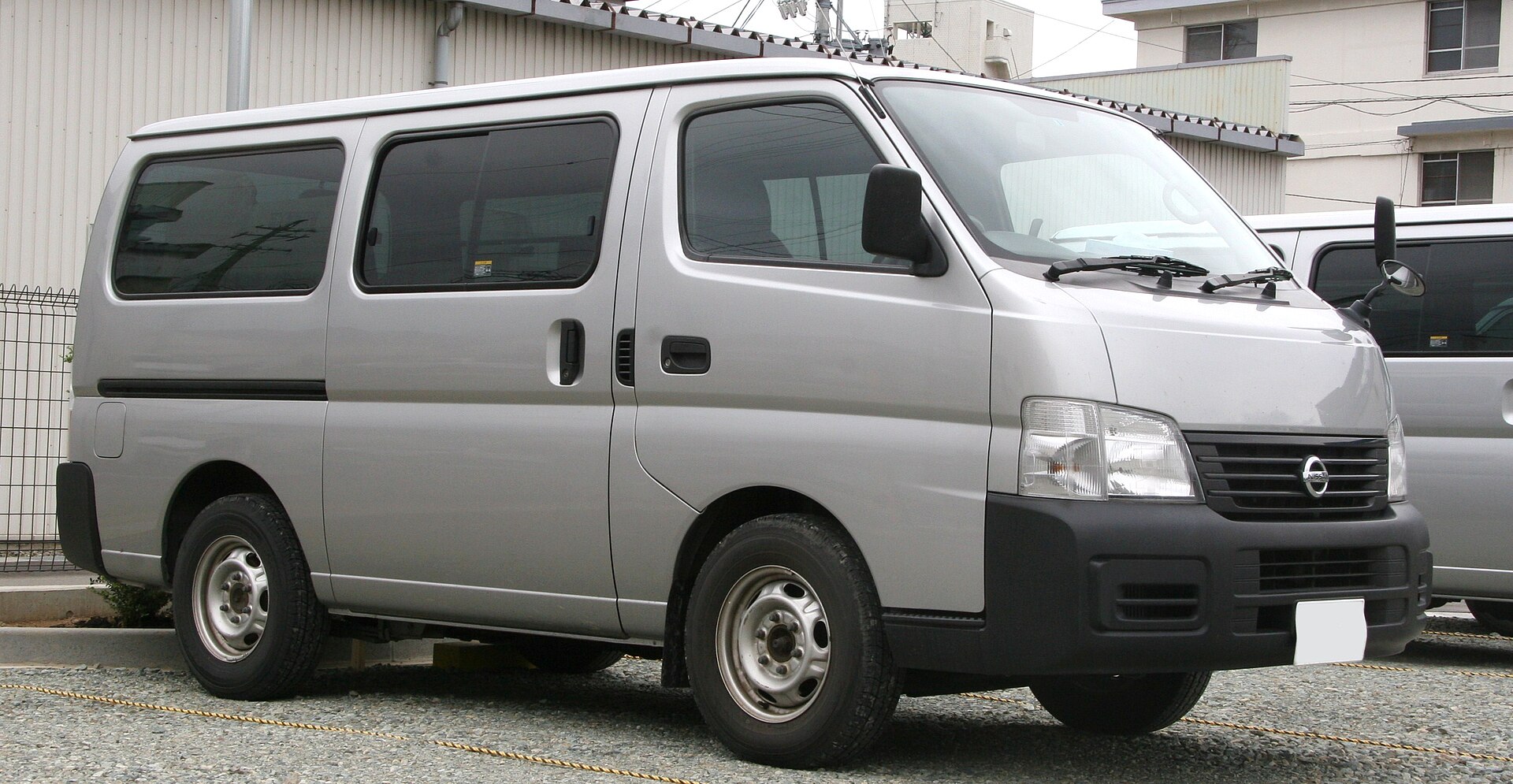
Which Caravan E25 to choose
Our verdict · Felix Hartmann
The super-long body adds about 300 mm over the later long body (4,995 against 4,695 mm), and the high roof brings the height to 2,285 mm, so check the van against your garage or car park with our garage fit tool.
- For goods transport: a long-body van after the December 2005 facelift, with headlamp levelling as standard.
- For rough roads and snow: a ZD30DDTi with Autech four-wheel drive.
- For passengers: weigh the poor 2009 frontal crash result against newer vans such as the NV350.
The Nissan Caravan E25 is the 2001–2012 generation of Nissan's long-running one-box van, sold in Japan as the Caravan and in export markets mostly as the Nissan Urvan. It was offered as a panel van, a high-roof van and a microbus in long and super-long bodies, with petrol and diesel engines and optional four-wheel drive. Isuzu sold it in Japan as the Isuzu Como. In 2012 the NV350 Caravan (E26) replaced it.
In short
- Announced on 26 April 2001, on sale in Japan from 14 May 2001, built until June 2012; Philippine production ran from April 2002 to March 2014.
- Long body under 4.7 m (4,695 mm in later form) and super-long body of about 4,990–4,995 mm; high roof 2,285 mm tall.
- Engines: KA20DE and KA24DE petrol, later QR-series petrol; ZD30DD and turbocharged ZD30DDTi 3.0 diesels.
- Sold as the Isuzu Como in Japan and as the Nissan Urvan in Asia, Australia, New Zealand and Mexico.
Caravan E25 at a glance
| Specification | Nissan Caravan E25 |
|---|---|
| Production | April 2001 – June 2012 (Japan); April 2002 – March 2014 (Philippines) |
| Body types | panel van with dual sliding doors, high-roof van with single sliding door, microbus, coach |
| Lengths | long (4,695 mm in later form), super long (4,990–4,995 mm) |
| Layout | one-box van with the engine under the cab; two-wheel drive or part-time four-wheel drive |
| Engines | 2.0 and 2.4 petrol (KA), QR petrol from 2007, 3.0 diesel and turbodiesel (ZD30) |
| Gearboxes | manual (floor shift), automatic (column shift); 5-speed automatic for petrol from 2007 |
| Other names | Nissan Urvan, Nissan Urvan Estate, Isuzu Como |
| Predecessor / successor | Caravan E24 / NV350 Caravan (E26) |
The Caravan is part of our Nissan catalogue. For a Nissan commercial vehicle sold widely in Europe, see our guide to the Navara pickup generations.
A name since 1973
Nissan has built the Caravan since 1973. For many years it had a twin, the Homy, which came from Prince and was sold through Nissan's Prince Store dealers until the name was dropped in June 1999. Export versions were sold as the Datsun Urvan and later the Nissan Urvan. The earlier generations were the E20 (1976–1980), E23 (1980–1986) and E24 (1986 onwards); the E25 was the first Caravan without a Homy twin.
The E25 at launch in 2001
Nissan announced the E25 on 26 April 2001, and sales began on 14 May. In Japan it came as a van in several registration classes and as a microbus, each in long and super-long bodies. The long body was designed to stay under the 4.7 m limit of Japan's small-vehicle registration class, which reduced the cargo floor by 200 mm to 2,800 mm compared with the previous van.
When sales began, Isuzu renamed its version of the van the Isuzu Como; it replaced the Isuzu Fargo. In November 2001 a ten-seat coach with the 2.4 petrol engine followed, along with Autech conversions such as a jumbo taxi and, from January 2002, a nursery-school bus.


Engines and gearboxes
The launch range combined the 2.0-litre KA20DE and 2.4-litre KA24DE twin-cam petrol engines with the ZD30DD 3.0-litre direct-injection diesel. On 30 September 2002 Nissan added the turbocharged ZD30DDTi for automatic two-wheel-drive vans, and Autech developed four-wheel-drive versions of it. Like its predecessor, the E25 used part-time four-wheel drive.
Manual gearboxes had a floor-mounted lever, automatics a column shift. In August 2004 the diesel range was reduced to a more powerful ZD30DDTi. On 31 August 2007 the petrol engines changed to the QR family, including the 2.5-litre QR25DE, and a five-speed automatic arrived for petrol models; at the same time the diesel met Japan's new long-term emission rules. A further diesel update for the post-new long-term rules followed in December 2010.
The model history used for this article (Japanese Wikipedia) does not give power or torque figures for the E25 engines, so they are not listed in this article.
Model-year changes
| Date | Change |
|---|---|
| May 2003 | minor update; eight-seat Silk Road coach returns |
| October 2003 | Autech CNG van with underfloor gas tanks, based on the KA20DE |
| August 2004 | stronger ZD30DDTi only diesel; redesigned GX with a five-door option |
| December 2005 | new grille, bumper and headlamps; headlamp levelling on all models |
| August 2007 | QR petrol engines, 5-speed automatic, tachometer standard |
| January 2009 | Super GX becomes a regular grade; Super DX and Silk Road dropped |
| August 2010 | revised second-row seat on DX; updated welfare (Life Care) vehicles |
| June 2012 | production ends |

Export markets: the Nissan Urvan
Outside Japan the E25 was sold mostly as the Nissan Urvan or Urvan Estate, for example in Thailand and the Philippines. Mexico was the only North American market, with 2010 as its last model year there. In the Philippines the E25 Urvan stayed in production until March 2014, almost two years after Japan had switched to the next generation.


Safety
ANCAP tested the E25 Urvan in 2009. It scored 16 of 16 points in the side impact but only 1.32 of 16 in the frontal offset test, with no seat belt reminders and no electronic stability control available. The New Zealand Urvan received a one-star ANCAP rating. In plain terms, the side structure scored full marks while the frontal result was below a tenth of the maximum, so buyers who need a van for passengers should keep this in mind.
The NV350 Caravan (E26)
The successor premiered at the 2011 Tokyo Motor Show. Diesel models went on sale on 15 June 2012 and super-long bodies on 13 July 2012, with the YD25DDTi 2.5 diesel and the QR20DE petrol engine. After facelifts in 2017 and 2021, the van was renamed back to Nissan Caravan in October 2021. The company's story is told in the history of Nissan.

FAQ
What years was the Nissan Caravan E25 made?
From April 2001 to June 2012 in Japan; the Philippine Urvan was built until March 2014.
Is the Nissan Urvan the same as the Caravan?
Yes. Urvan is the export name of the Caravan; the E25 was also sold in Japan as the Isuzu Como.
What engines does the Caravan E25 have?
2.0 and 2.4 KA petrol engines, QR petrol engines from 2007, and the 3.0 ZD30 diesel with or without turbocharger.
Is the Caravan E25 available with four-wheel drive?
Yes, as part-time four-wheel drive, developed by Autech for the turbodiesel from 2002.
What replaced the Caravan E25?
The NV350 Caravan (E26), on sale in Japan from June 2012.
Data sources
Data checked by an editor against the sources below.