
 Ford Taunus
All generations, specs and history
Published Sources (5) Report an error
By Felix Hartmann, Automotive Technology & EV Contributor
- Built
- 1939–1994
- Generations
- 8 · G93A to TC
- Top power
- 72 kW (98 PS)
Timeline
Taunus generations
Click a generation for its own page
P1 and P2 overlapped in 1957–1962, so P2 sits on a second lane
- Taunus G93A/G73A 1939–1952 · Sedan, Station wagon · 25 kW (34 PS)
- Taunus 12M/15M P1 1952–1962 · Sedan, Station wagon · 28–40 kW (38–54 PS)
- Taunus 17M P2 1957–1960 · Sedan, Station wagon · 44 kW (60 PS)
- Taunus 17M P3 1960–1964 · Sedan, Station wagon · 40–55 kW (54–75 PS)
- Taunus 12M P4 1962–1966 · Sedan, Station wagon · 29–48 kW (39–65 PS)
- Taunus 17M/20M P5 1964–1967 · Sedan, Station wagon · 60–66 kW (82–90 PS)
- Taunus 12M/15M P6 1966–1970 · Sedan, Station wagon
- Taunus TC 1970–1982 · Sedan, Station wagon · 66–72 kW (90–98 PS)
Newest first · 8 generations since 1939
- 1970 TC 1970–1982 · Sedan, Station wagon · 66–72 kW (90–98 PS)
- 1966 P6 1966–1970 · Sedan, Station wagon
- 1964 P5 1964–1967 · Sedan, Station wagon · 60–66 kW (82–90 PS)
- 1962 P4 1962–1966 · Sedan, Station wagon · 29–48 kW (39–65 PS)
- 1960 P3 1960–1964 · Sedan, Station wagon · 40–55 kW (54–75 PS)
- 1957 P2 1957–1960 · Sedan, Station wagon · 44 kW (60 PS) P1 and P2 overlapped in 1957–1962
- 1952 P1 1952–1962 · Sedan, Station wagon · 28–40 kW (38–54 PS)
- 1939 G93A 1939–1952 · Sedan, Station wagon · 25 kW (34 PS)
All generations by year: Taunus TC (1970–1982) · Taunus 12M/15M P6 (1966–1970) · Taunus 17M/20M P5 (1964–1967) · Taunus 12M P4 (1962–1966) · Taunus 17M P3 (1960–1964) · Taunus 17M P2 (1957–1960) · Taunus 12M/15M P1 (1952–1962) · Taunus G93A/G73A (1939–1952)
Which one is mine?
Pick the year of first registration to see which generation it is.
The Ford Taunus is the name Ford Germany gave its family cars from the 1939 "Buckeltaunus" to the Taunus TC, the Cortina twin built until 1982 in Europe. The TC lived on in Argentina until 1984 and in Turkey, where Ford Otosan built it until 1994. Engines ranged from a 1,172 cc side-valve four of 25 kW (34 PS) to Cologne V4 and V6 units and Pinto fours.
In short
- Named after the Taunus hills; the 12M and 17M badges carried an "M" said to stand for "Meisterstück".
- Eight series: G93A/G73A (1939-1952), 12M/15M P1, 17M P2, 17M P3, 12M P4, 17M/20M P5, 12M/15M P6, then the Taunus TC (1970-1982).
- Built in Cologne-Niehl and Genk in Europe, at General Pacheco in Argentina (1974-1984) and in Istanbul by Ford Otosan (1984-1994).
- The 1962 Taunus 12M P4 was the first Ford with front-wheel drive; its design came from the cancelled American Ford Cardinal.
Specs by version
Engines
| Version | Engine | Power | Drive | Production years |
|---|---|---|---|---|
| G93A · 1939–1952 | ||||
| G93A · 1.2 side-valve 25 kW | 1.2 l · 4 cyl · Petrol 1,172 cc | 25 kW 34 PS34 hp | Rear-wheel drive | 1939–1952 |
| P1 · 1952–1962 | ||||
| P1 · 12M 1.2 28 kW | 1.2 l · 4 cyl · Petrol 1,172 cc | 28 kW 38 PS38 hp | Rear-wheel drive | 1952–1962 |
| P1 · 15M 1.5 40 kW | 1.5 l · 4 cyl · Petrol 1,498 cc | 40 kW 54 PS54 hp | Rear-wheel drive | 1954–1959 |
| P2 · 1957–1960 | ||||
| P2 · 17M 1.7 44 kW | 1.7 l · 4 cyl · Petrol 1,698 cc | 44 kW 60 PS59 hp | Rear-wheel drive | 1957–1960 |
| P4 · 1962–1966 | ||||
| P4 · 12M 1.2 V4 29 kW | 1.2 l · 4 cyl · Petrol 1,183 cc | 29 kW 39 PS39 hp | Front-wheel drive | 1962–1966 |
| P4 · 12M TS 1.5 V4 48 kW | 1.5 l · 4 cyl · Petrol 1,498 cc | 48 kW 65 PS64 hp | Front-wheel drive | 1964–1966 |
| TC 2.0 V6 66 kW | 2.0 l · 6 cyl · Petrol Cologne V6 | 66 kW 90 PS89 hp | Rear-wheel drive | 1970–1982 |
| TC 2.0 OHC 72 kW | 2.0 l · 4 cyl · Petrol Pinto | 72 kW 98 PS97 hp | Rear-wheel drive | 1976–1982 |
Performance
Show all 3 versions
| Version | Top speed |
|---|---|
| G93A · 1939–1952 | |
| G93A · 1.2 side-valve 25 kW | 105 km/h65 mph |
| P1 · 1952–1962 | |
| P1 · 12M 1.2 28 kW | 112 km/h70 mph |
| P1 · 15M 1.5 40 kW | 128 km/h80 mph |
Dimensions and weight
Show all 2 versions
| Version | Wheelbase |
|---|---|
| TC 2.0 V6 66 kW | 2,579 mm101.5 in |
| TC 2.0 OHC 72 kW | 2,579 mm101.5 in |
Verified Manufacturer and type-approval data from our catalog · Sources and methodology
Ford Taunus at a glance
| Specification | Ford Taunus |
|---|---|
| Years | 1939-1942 and 1948-1982 in Germany and Belgium; Argentina 1974-1984; Turkey 1984-1994 |
| Plants | Cologne-Niehl (Germany), Genk (Belgium), General Pacheco (Argentina), Istanbul (Turkey) |
| Body styles | two- and four-door saloons, three-door Kombi and five-door Turnier estates, coupe, cabriolet by Karl Deutsch, van |
| Layout | front engine, rear-wheel drive; front-wheel drive on the 12M P4 and P6 |
| Designer | Uwe Bahnsen (17M P3) |
| Engines | 1,172 cc side-valve four to 2,293 cc Cologne V6; V4s on P4, P5 and P6; Pinto OHC fours on the TC |
| Power | 25 kW (34 PS) in 1939; 66 kW (90 PS) 2.0 V6 and 72 kW (98 PS) 2.0 four in the TC |
| Top speed | 105 km/h (G93A, claimed) to 128 km/h (15M, P1) |
| Production | 555,463 P1; 239,978 P2; 669,731 P3; 672,695 P4; 1,583,699 TC2 and TC3 (1976-1982) |
| Price new | 2,870 Reichsmark in 1939; DM 5,555 for the entry 12M in 1959 |
Ford Taunus generations and codes
| Series | Code | Years | Engines | Built |
|---|---|---|---|---|
| Taunus ("Buckeltaunus") | G93A, G73A | 1939-1942, 1948-1952 | 1,172 cc side-valve four | 7,100 pre-war; 76,590 by 1952 |
| Taunus 12M/15M ("Weltkugeltaunus") | G13, P1 | 1952-1962 | 1,172 cc side-valve; 1,498 cc OHV | 555,463 |
| Taunus 17M ("Barocktaunus") | P2 | 1957-1960 | 1,698 cc OHV four | 239,978 |
| Taunus 17M ("Badewanne") | P3 | 1960-1964 | 1,498, 1,698 and 1,758 cc fours | 669,731 |
| Taunus 12M | P4 | 1962-1966 | 1,183 and 1,498 cc V4, front-wheel drive | 672,695 |
| Taunus 17M/20M ("Grosse Wanne") | P5 | 1964-1967 | 1.5 and 1.7 V4; 2.0 V6 | not stated |
| Taunus 12M/15M | P6 | 1966-1970 | 1.2 to 1.7 litre V4 | not stated |
| Taunus TC | TC1, TC2, TC3 | 1970-1982 | 1.3, 1.6 and 2.0 Pinto fours; 2.0 and 2.3 Cologne V6 | see table below |
The Taunus name covered every German Ford passenger car after the war until 1967. The large P7 models of 1967-1971 were sold as the Ford 17M, 20M and 26M without it, and the name came back for the TC in 1970.
The Buckeltaunus and the post-war 12M
Production of the first Taunus, the G93A, began in Cologne on 30 April 1939, and the car was shown in June, less than six months before the war began in Europe. The steep fastback earned it the "Buckeltaunus" (hunchback) nickname, and the styling borrowed from the Lincoln-Zephyr. Under the Ambi Budd body sat the platform of the Ford Eifel, hydraulic brakes and a 1,172 cc side-valve four with a claimed 25 kW (34 PS) and 105 km/h. The car cost 2,870 Reichsmark. About 7,100 were built before car production stopped in February 1942, and output resumed after the war, fully in-house from November 1948.
The Taunus 12M of January 1952 was the first new German Ford after the war, with pontoon styling and the old 1,172 cc side-valve engine, now with 28 kW (38 PS) and 112 km/h. The 15M added a 1,498 cc overhead-valve four of 40 kW (54 PS) and 128 km/h. The base 12M cost under DM 6,000 in 1955 and DM 5,555 in 1959, when the side stripes gave it the "Seitenstreifentaunus" name. In all, 555,463 P1 cars were built.
Taunus 17M: Barocktaunus and Badewanne
The 17M P2 (production from August 1957, shown at the Frankfurt Motor Show the following month) brought American-style tailfins and a 1,698 cc OHV four of 44 kW (60 PS). Ford built 239,978 P2s by August 1960, 45,468 of them estates. Its rival was the Opel Olympia Rekord; the Opel Rekord was built 817,003 times over the same three years.
The 17M P3 of 1960, designed by Uwe Bahnsen, went the other way: a smooth, wide body that Germans nicknamed the "Badewanne" (bathtub). It was faster than the P2, and engines of 1,498, 1,698 and 1,758 cc gave 40-55 kW. Front disc brakes became optional in April 1963 and standard in July 1963. Cologne built 669,731 P3s, including 86,010 Turnier estates and about 150 cabriolets and coupes by Karosseriewerk Deutsch. Its successor, the 17M/20M P5 of 1964, brought V4 engines of 1.5 litres (44 kW, 60 PS) and 1.7 litres (48-51.5 kW) to the 17M and a 2.0-litre V6 (62.5-66 kW, 85-90 PS) to the 20M.
Front-wheel drive Taunus 12M P4 and P6
The Taunus 12M P4 was designed by Ford in America as the Ford Cardinal, a planned rival to the Volkswagen Beetle. Ford cancelled the US launch and handed the finished design to Cologne in 1960. On sale from September 1962 to August 1966, it was the first Ford with front-wheel drive, using a longitudinal layout with the engine ahead of the axle, as Auto Union and DKW had done.
The V4 engines came in 1,183 cc with 29 kW (40 PS) and 1,498 cc with 37 kW (50 PS), 40 kW (55 PS) in the 1962 12M TS and 48 kW (65 PS) in the TS from 1964. Production started at Cologne-Niehl; the new plant at Genk in Belgium built the P4 as its first volume model from August 1963, and almost all P4s came from Genk by 1966. Ford sold 672,695 P4s in four years. The P6 of 1966-1970 kept the front-wheel-drive layout and the V4 engines, now of 1.2 to 1.7 litres, under a new body.
Ford Taunus TC: the Cortina twin of 1970-1982
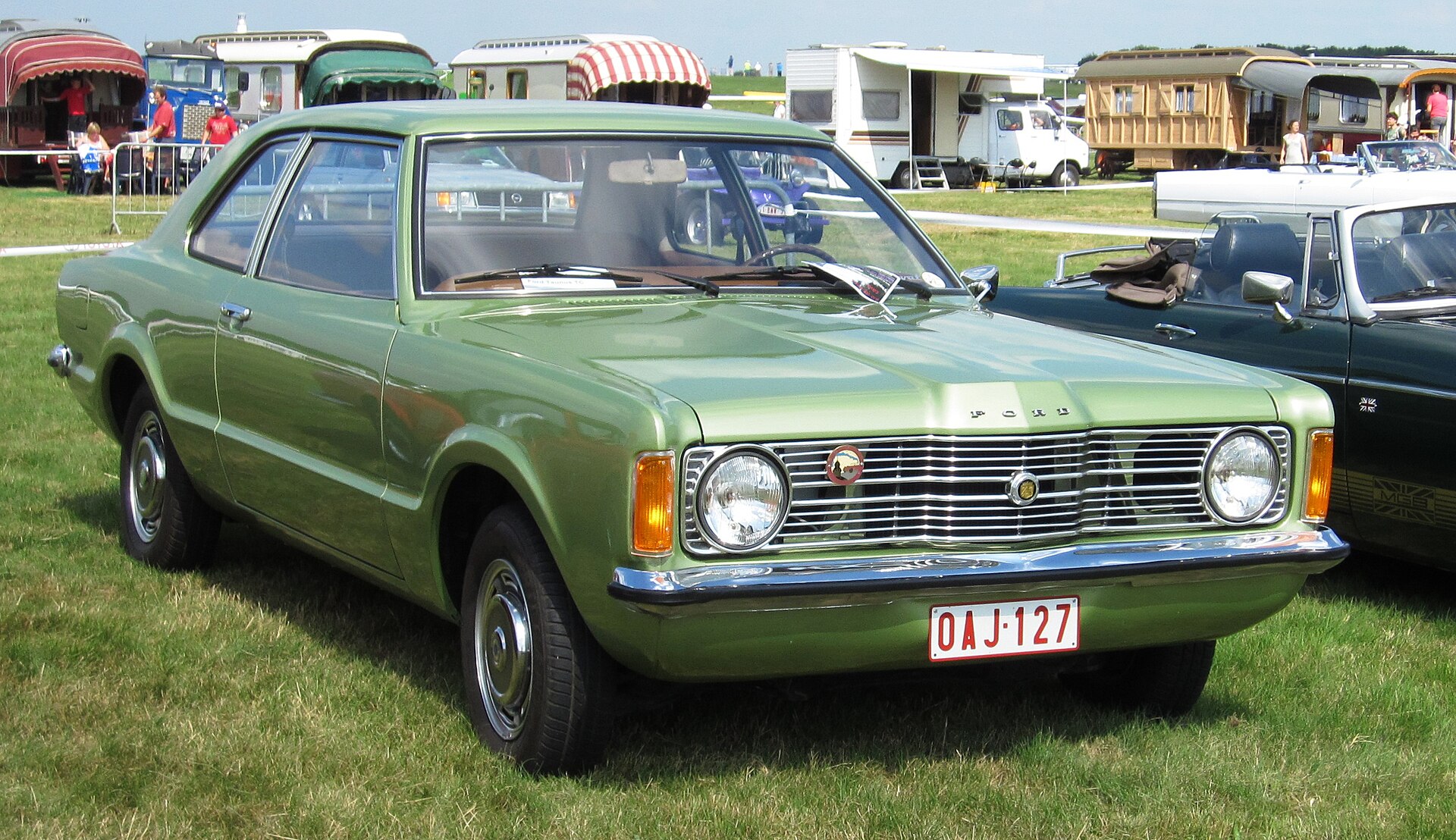
The Taunus TC ("Taunus Cortina") arrived in September 1970 as a slightly upmarket replacement for the P6, sharing its platform and most components with the British Ford Cortina Mk III; only door skins and rear wings differed. It was developed under the supervision of Semon "Bunkie" Knudsen and is nicknamed "Knudsen-Taunus", though the story that he ordered the bonnet scoop is called a legend. European cars came from Genk. Saloons had two or four doors, the Turnier estate five, and a fastback coupe was offered until 1975.
| Engine (Taunus TC) | Years | Power |
|---|---|---|
| 1,294 cc Pinto OHC four | 1970-1982 | not stated in the sources |
| 1,593 cc Pinto OHC four | 1970-1982 | not stated in the sources |
| 1,993 cc Pinto OHC four | 1976-1982 | 72 kW (98 PS) |
| 1,999 cc Cologne V6 | 1970-1982 | 66 kW (90 PS) |
| 2,293 cc Cologne V6 | 1970-1982 | not stated in the sources |
The TC1 got rectangular headlights and anti-roll bars in September 1973. The restyled TC2, built from the end of November 1975 and nearly identical to the Cortina Mk IV, added servo brakes, the 2.0 four and Ford's C3 automatic. The TC3 of 1979 had wraparound bumpers, larger rear lights and a slightly higher saloon roof. Ford Germany built 284,527 cars in 1976 and 285,384 in 1977, the two best years, and 1,583,699 TC2s and TC3s in total. European production ended in July 1982, and the Ford Sierra replaced it in October 1982.

Ford Taunus in Argentina, Turkey and Korea
Ford Argentina built the first Taunus at General Pacheco on 3 June 1974 and launched it on 24 September 1974. The local cars used 2.0 and 2.3-litre four-cylinder engines, the L with 92 HP SAE and the GXL and Coupe GT with 122 HP SAE, and there was no estate version. The SP5 coupe added 132 HP and the first five-speed gearbox in an Argentine Ford. The TC3 look arrived there in 1980, according to English Wikipedia. Production ended in 1984 after 197,031 cars. In the TC 2000 championship from 1979, Ford's Taunus coupes won the 1984 title with Mario Gayraud.
Ford Otosan took over the Argentine production line in 1984 and built the Taunus in Istanbul until 1994; a TC3 with remodelled ends stayed in production there to the end. Hyundai assembled the car at Ulsan in South Korea from 1977 to 1983, where the Ford Cortina name was used.

Ford Taunus today: what to check when buying
A Ford Taunus is easiest to judge when you know exactly which series it is. On a 12M P4, the rocker cover colour from 1964 shows the engine: green for 29 kW (40 PS), blue for 37 kW (50 PS) and red for 48 kW (65 PS). On a TC, wraparound bumpers and larger rear lights mark a 1979-1982 TC3, while rectangular headlights only became standard on the TC1 in September 1973. The 1.3-litre TC was not offered with an automatic, and European cars did not use the Kent engine, so either combination suggests a later conversion. Argentine cars have Lima four-cylinder engines only, and Turkish cars are recognisable by their remodelled front and rear panels.
The TC's Pinto engines also went into the Sierra, and its platform is shared with the Cortina. The sources used give no dated market values. More German and British Fords are in the Ford catalogue.
Photo gallery

Ford Taunus evolution in numbers
Did you know?
- The Ford Taunus ran for 43 years, from 1939 to 1982, over 8 generations in our catalog.
- The biggest jump in power came with the Taunus 17M/20M P5: up to 66 kW (90 PS), 18 kW more than the Taunus 12M P4.
Most powerful version, kW
Figures from the 1cars catalog: power is the strongest version of each generation; generations without the figure are left out.
Ford Taunus: first vs latest generation
| Spec | Taunus G93A/G73A | Taunus TC | Change |
|---|---|---|---|
| Years | 1939–1952 | 1970–1982 | 31 years apart |
| Most powerful version | 25 kW (34 PS) | 72 kW (98 PS) | +47 kW (+188%) |
Oldest and newest generation in the 1cars catalog. Power is the strongest version of each; other rows are shown only when both generations have the figure.
Ford Taunus in our rankings
- No. 126 of 200 · Biggest engines: sedans (1,999 cc · top 63%)
- No. 556 of 830 · Biggest engines: cars (1,999 cc · top 68%)
- No. 140 of 175 · Most powerful cars of the 1960s (66 kW · top 81%)
- No. 204 of 241 · Most powerful sedans (72 kW · top 85%)
- No. 150 of 173 · Most powerful cars of the 1970s (72 kW · top 87%)
- No. 103 of 113 · Fastest sedans (128 km/h · top 92%)
Bigger engine than 37% of ranked sedans in the 1CARS catalog (No. 126 of 200).
FAQ
What does Taunus mean in Ford Taunus?
Taunus is the name of a range of hills in Germany. Ford Germany used it for its family cars from 1939, and the M in 12M and 17M is said to stand for the German word Meisterstück.
What is the difference between the Ford Taunus and the Cortina?
From 1970 the Taunus TC and the British Cortina Mk III shared their platform and most parts, with different door skins and rear wings. The TC2 was nearly identical to the Cortina Mk IV, and the TC3 became the Cortina 80.
Which Ford Taunus had front-wheel drive?
The Taunus 12M P4 of 1962 was the first Ford with front-wheel drive, using V4 engines. Its successor, the 12M and 15M P6 of 1966 to 1970, kept the same layout.
When did Ford stop making the Taunus?
European production of the Taunus TC ended in July 1982, when the Sierra replaced it. Argentina built it until 1984, and Ford Otosan in Turkey produced it until 1994.
What engines did the Ford Taunus TC have?
The Taunus TC used Pinto overhead-camshaft fours of 1.3, 1.6 and, from 1976, 2.0 litres, plus Cologne V6 engines of 2.0 and 2.3 litres. Argentine cars had 2.0 and 2.3 four-cylinder engines only.
Data sources
Data checked by an editor against the sources below.
- Wikipedia - Ford Taunus
- Wikipedia - Ford Taunus G93A
- Wikipedia - Ford Taunus P1
- Wikipedia - Ford Taunus P2
- Wikipedia - Ford Taunus P3


