
 Audi SQ7
All generations, specs and history
Published Sources (4) Report an error
By Oleksandr Hnatiuk, Automotive Editor & Used Car Specialist
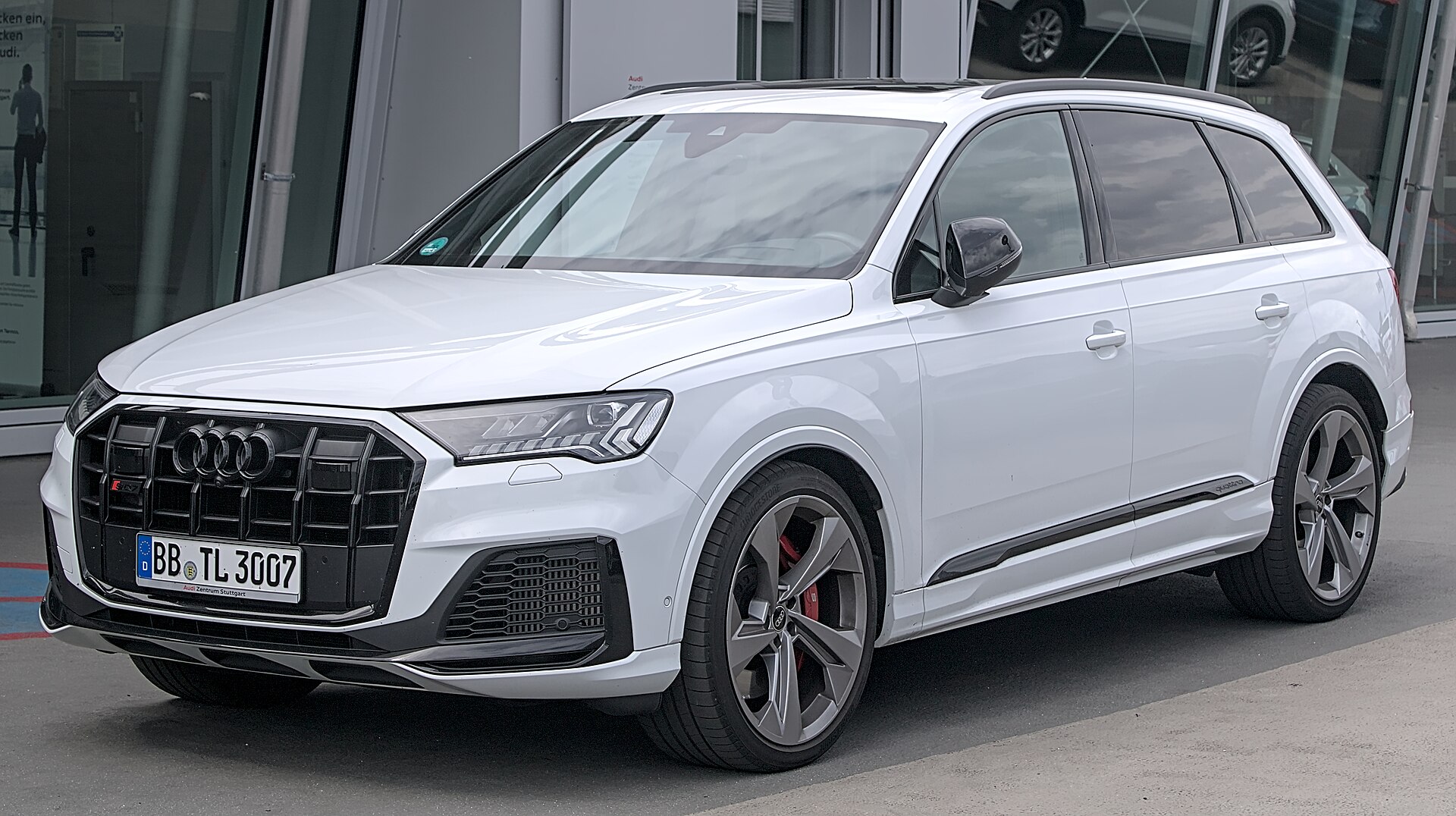
- Built
- 2016–present
- Generations
- 2
- Top power
- 441 kW (600 PS)
Timeline
SQ7 generations
Click a generation for its own page
Newest first · 2 generations since 2016
- 2026 II In production 2026–now · SUV · 441 kW (600 PS)
- 2016 I 2016–2026 · SUV · 320–373 kW (435–507 PS)
All generations by year: SQ7 II (2026–now) · SQ7 I (2016–2026)
Which one is mine?
Pick the year of first registration to see which generation it is.
Which SQ7 to choose
Our verdict · Oleksandr Hnatiuk
A used SQ7 TDI from 2016-2020 is the European choice for long distances, with 900 Nm from 1,000 rpm and an 85-litre tank (Audi's NEDC data). The TFSI is the only option in the US and the faster car, and in Australia it came with rear-wheel steering as standard. CarExpert found the 2024 car harsh over sharp-edged bumps and potholes and said its exterior styling may be showing its age; What Car? notes that the 22-inch wheels pick up more surface imperfections. Buyers who want the newest cabin and 441 kW should wait for the 2027 SQ7.
The Audi SQ7 is the high-performance version of the Q7 seven-seat SUV, on sale since 2016 with a V8 engine and quattro all-wheel drive. The first SQ7 used a 4.0-litre V8 TDI with an electric compressor and 900 Nm; from 2020 a 4.0 TFSI petrol V8 with 373 kW (507 PS) took over. A third-generation SQ7 with 441 kW (591 hp) was revealed in June 2026.
In short
- SQ7 TDI (2016-2020): 320 kW (435 PS), 900 Nm from 1,000 rpm, 0-100 km/h in 4.8 seconds, 7.4 l/100 km NEDC.
- SQ7 TFSI (from 2020): 373 kW (507 PS), 770 Nm, 0-100 km/h in 4.1 seconds, 11.9-12.5 l/100 km WLTP.
- Prices from EUR 89,900 in Germany in 2016, GBP 81,990 in the UK and AUD 174,815 in Australia in 2024.
- The 2027 SQ7 on the new Q7 arrives in North America in the fourth quarter of 2026 from USD 98,700.
Size at a glance
| Dimensions | Audi SQ7 I |
|---|---|
| Length | 5,072 mm199.7 in |
| Width | 1,970 mm77.6 in |
| Height | 1,748 mm68.8 in |
| Wheelbase | 3,005 mm118.3 in |
| Boot | 793 L28.0 cu ft |
Running cost
Fuel · SQ7 SQ7 4.0 TDI 320 kW
about 1,850 EUR fuel a year at 15,000 km
7.4 l/100 km · diesel at 1.65 EUR/l · change mileage, fuel price or version
Specs by version
Engines
| Version | Engine | Power | Torque | Gearbox | Drive | Production years |
|---|---|---|---|---|---|---|
| Diesel · 1 version | ||||||
| SQ7 I · SQ7 4.0 TDI 320 kW | 4.0 l · 8 cyl · Diesel 3,956 cc | 320 kW 435 PS429 hp | 900 Nm664 lb-ft | 8-sp Automatic | All-wheel drive | 2016–2020 |
| Petrol · 2 versions | ||||||
| SQ7 I · SQ7 4.0 TFSI 373 kW | 8 cyl · Petrol | 373 kW 507 PS500 hp | 770 Nm568 lb-ft | 8-sp Automatic | All-wheel drive | 2020–2026 |
| SQ7 II · SQ7 4.0 V8 441 kW | 8 cyl · Petrol | 441 kW 600 PS591 hp | 800 Nm590 lb-ft | 8-sp Automatic | All-wheel drive | 2026 |
Performance
Show all 2 versions
| Version | 0–100 km/h | Top speed | Fuel consumption | CO₂ |
|---|---|---|---|---|
| Diesel · 1 version | ||||
| SQ7 I · SQ7 4.0 TDI 320 kW | 4.8 s 0–62 mph | 250 km/h155 mph | 7.4 l/100 km31.8 mpg US · 38.2 mpg UK | 194 g/km |
| Petrol · 1 version | ||||
| SQ7 I · SQ7 4.0 TFSI 373 kW | 4.1 s 0–62 mph | 250 km/h155 mph | 12.5 l/100 km18.8 mpg US · 22.6 mpg UK | 284 g/km |
Dimensions and weight
Show all 2 versions
| Version | Length | Width | Height | Wheelbase | Kerb weight | Boot | Fuel tank |
|---|---|---|---|---|---|---|---|
| Diesel · 1 version | |||||||
| SQ7 I · SQ7 4.0 TDI 320 kW | - | - | - | - | - | - | 85 l22.5 gal US |
| Petrol · 1 version | |||||||
| SQ7 I · SQ7 4.0 TFSI 373 kW | 5,072 mm199.7 in | 1,970 mm77.6 in | 1,748 mm68.8 in | 3,005 mm118.3 in | 2,265 kg4,993 lb | 793 l28.0 cu ft | 85 l22.5 gal US |
Verified Manufacturer and type-approval data from our catalog · Sources and methodology
Audi SQ7 at a glance
| Specification | Audi SQ7 (second-generation Q7) |
|---|---|
| Segment and body | large SUV, five or seven seats |
| On sale | Europe from spring 2016; US from the second quarter of 2020 |
| Platform | Volkswagen Group MLB, shared with the Q7 |
| Drive | quattro permanent all-wheel drive, eight-speed tiptronic |
| Engines | 4.0 V8 TDI (2016-2020); 4.0 TFSI twin-turbo V8 petrol (from 2020) |
| Power | 320 kW (435 PS) TDI; 373 kW (507 PS) TFSI |
| Torque | 900 Nm TDI; 770 Nm TFSI |
| 0-100 km/h | 4.8 s TDI; 4.1 s TFSI |
| Top speed | 250 km/h, electronically limited |
| Consumption | 7.4 l/100 km NEDC (TDI); 11.9-12.5 l/100 km WLTP (TFSI) |
| Length and wheelbase | 5,072 mm and 3,005 mm |
| Towing (braked) | 3,500 kg |
| Safety | five stars, Euro NCAP and ANCAP (Q7, ANCAP 2019) |
| Price from | GBP 81,990 (UK, 2024); AUD 174,815 (Australia, 2024) |
The first S model of the Q7
Audi revealed the second-generation Q7 in January 2015, and the SQ7 TDI followed as the first S version of the line. Orders in Europe opened in spring 2016 at EUR 89,900 in Germany, a price Audi said included standard equipment worth about EUR 10,000 compared with the base model. The car shares the Q7 body, with hot-formed sheets in the occupant cell and an aluminium outer skin, and measures 5.07 m long with a drag coefficient of 0.34 (Cd). Like the Q7, it is offered with five or seven seats. A first facelift for model year 2020 brought new styling and dual touchscreens; a second update followed for model year 2025.
SQ7 TDI with the electric compressor (2016-2020)
The SQ7 TDI introduced a new 3,956 cc 90-degree V8 diesel. Two turbochargers work in sequence, the second one cutting in only at higher loads, and an electric powered compressor fills the gap at low revs. Audi called it a world first in a production car. The compressor sits after the intercooler, spins to 70,000 rpm, draws up to 7 kW and builds boost in under 250 milliseconds.
To power it, the SQ7 got a 48-volt system with a 470 Wh lithium-ion battery under the boot floor, linked to the 12-volt network by a DC/DC converter. The Audi valvelift system made its first appearance in an Audi diesel here, switching the second exhaust valves to bring in the second turbo. The result was 320 kW (435 PS) and 900 Nm between 1,000 and 3,250 rpm. Audi quoted 0-100 km/h in 4.8 seconds, 250 km/h, 7.4 l/100 km and 194 g/km CO2 on the NEDC cycle, with an 85-litre tank and AdBlue SCR exhaust treatment.
The optional driving dynamics package combined a rear sport differential, electromechanical active roll stabilisation and all-wheel steering that turns the rear wheels by up to 5 degrees. The roll system uses an electric motor and a three-stage planetary gearbox, needs no oil, and can apply up to 1,200 Nm to the anti-roll bars.
SQ7 TFSI petrol V8 (from 2020)
In 2016 Autoblog judged a big diesel SUV unlikely for the US, and Audi instead launched a petrol SQ7 there in the second quarter of 2020; Wikipedia lists the TDI up to 2020 and the 4.0 TFSI from 2020. The twin-turbo V8 gives 373 kW (507 PS) and 770 Nm, again through an eight-speed automatic and quattro drive. CarExpert gives the quattro torque split as 40:60 front to rear in normal driving, with up to 70 percent able to go to the front axle and up to 85 percent to the rear.
| Version | Years | Engine | Power | Torque | 0-100 km/h | Official consumption |
|---|---|---|---|---|---|---|
| SQ7 TDI | 2016-2020 | 4.0 V8 diesel, electric compressor | 320 kW (435 PS) | 900 Nm | 4.8 s | 7.4 l/100 km NEDC |
| SQ7 TFSI | 2020-2026 | 4.0 twin-turbo V8 petrol | 373 kW (507 PS) | 770 Nm | 4.1 s | 11.9-12.5 l/100 km WLTP |
| SQ7 (third generation) | from 2026 | 4.0 twin-turbo V8 petrol | 441 kW (591 hp) | 800 Nm | about 3.9 s | not yet published |
The Australian-market SQ7 TFSI weighs 2,265 kg and needs 98 RON fuel. Standard equipment there includes 22-inch wheels, sport adaptive air suspension, rear-wheel steering, variable-ratio steering, soft-close doors and ventilated Valcona leather front seats.

Audi SQ7 fuel consumption in real use
Official figures for the petrol car range from 11.9 to 12.5 l/100 km WLTP and 270-284 g/km CO2, depending on the seat layout. What Car? quotes Audi's 23.3 mpg (UK), about 12.1 l/100 km. CarExpert in Australia recorded 17.2 l/100 km in its 2024 test, 46 percent above the claimed 11.8 l/100 km. The diesel was rated at 7.4 l/100 km on the NEDC cycle, a figure that is not directly comparable with WLTP.
Practicality, towing and safety
The SQ7 TFSI is 5,072 mm long, 1,970 mm wide without mirrors and 1,748 mm tall on a 3,005 mm wheelbase. CarExpert lists 793 litres of boot space with five seats up and 1,921 litres with two, and a braked towing capacity of 3,500 kg. The third row suits children and shorter adults, and it has two ISOFIX and top-tether points. The Mercedes-AMG GLE 53 offers a third row only as an option.
ANCAP applies its five-star rating from 2019 testing of the Q7 to the SQ7, with 92 percent for adult occupants, 87 percent for children, 71 percent for vulnerable road users and 71 percent for safety assist. What Car? lists five Euro NCAP stars.
Audi SQ7 price by market
| Market | Price | Year and source |
|---|---|---|
| Germany | EUR 89,900 (SQ7 TDI) | 2016, Audi via Autoblog |
| United Kingdom | from GBP 81,990 | 2024, What Car? |
| Australia | AUD 174,815 before on-road costs | August 2024, CarExpert |
| United States | about USD 93,800 (2026 model year) | Motor1 |
| United States | USD 98,700 (2027 model year) | Motor1 |
In Australia the optional Dynamic package (active roll stabilisation and quattro sport differential) cost AUD 10,900 and the Sensory package with a 23-speaker Bang & Olufsen system AUD 14,400 in 2024.
The 2027 SQ7 on the third-generation Q7
Audi revealed the third-generation Q7 and SQ7 on 9 June 2026, more than 11 years after the previous car. The new SQ7 keeps a twin-turbo 4.0 V8, now rated at 441 kW (591 hp) and 800 Nm (590 lb-ft), with an eight-speed tiptronic and quattro drive that gains a new limited-slip centre differential. Audi quotes 0-60 mph in 3.7 seconds and about 3.9 seconds to 100 km/h. Front rotors are 16 inches and wheels are 22 or 23 inches. Towing is rated at 7,700 lb (3,493 kg) with the optional towing package. The Q7 range seats six or seven, and the cabin borrows its layout from the larger Audi Q9. The launch reports cover North America, where the car reaches dealers in the fourth quarter of 2026 at USD 98,700, up USD 4,900.
SQ7 against the X5 M60i and GLE 53
CarExpert found the SQ7 quicker and cheaper than either the Mercedes-AMG GLE 53 or the BMW X7 M60i in 2024, and noted that the BMW X5 M60i has no third row. What Car? lines it up against the BMW X7 M50i, Porsche Cayenne GTS and Range Rover Sport SVR. Inside Audi, CarExpert names the two-row Audi Q8 and SQ8 as its closest siblings. The standard model is covered in our guide to the Audi Q7.
Audi SQ7: first vs latest generation
| Spec | SQ7 I | SQ7 II | Change |
|---|---|---|---|
| Years | 2016–2026 | 2026–present | 10 years apart |
| Most powerful version | 373 kW (507 PS) | 441 kW (600 PS) | +68 kW (+18%) |
Oldest and newest generation in the 1cars catalog. Power is the strongest version of each; other rows are shown only when both generations have the figure.
Audi SQ7 in our rankings
- No. 1 of 135 · Most torque: diesel cars (900 Nm)
- No. 1 of 82 · Quickest diesel cars, 0–100 (4.8 s)
- No. 2 of 226 · Most powerful diesel cars (320 kW)
- No. 15 of 264 · Most torque: SUVs and crossovers (900 Nm · top 6%)
- No. 42 of 739 · Most torque: cars (900 Nm · top 7%)
- No. 23 of 286 · Longest SUVs and crossovers (5,072 mm · top 9%)
More torque than 99% of ranked diesel cars in the 1CARS catalog (No. 1 of 135).
FAQ
Is the Audi SQ7 diesel or petrol?
Both, at different times. From 2016 to 2020 the SQ7 used a 4.0 V8 TDI diesel with 320 kW and 900 Nm. Since 2020 it has a 4.0 TFSI twin-turbo petrol V8 with 373 kW, and the 2027 car keeps a petrol V8.
How fast is the Audi SQ7?
The SQ7 TFSI reaches 100 km/h in 4.1 seconds and is limited to 250 km/h. The diesel SQ7 TDI needed 4.8 seconds. Audi quotes 0-60 mph in 3.7 seconds for the 2027 SQ7 with 441 kW (591 hp).
How much does the Audi SQ7 cost?
The SQ7 cost from GBP 81,990 in the UK and AUD 174,815 in Australia in 2024. In the US the 2027 SQ7 starts at USD 98,700, about USD 4,900 more than the 2026 model.
Is the Audi SQ7 a seven-seater?
Yes, it is offered with seven seats, and five-seat versions exist in some markets. The third row suits children and shorter adults. The 2027 Q7 range offers six or seven seats.
How much can the Audi SQ7 tow?
The SQ7 is rated to tow 3,500 kg braked in Australia. The 2027 SQ7 is rated at 7,700 lb (3,493 kg) in North America with the optional towing package.
Data sources
Data checked by an editor against the sources below.
- Wikipedia - Audi Q7
- Auto123
- Autoblog - Audi Sq7 Tdi Official
- Com - 2025 Audi Sq7 Tfsi Review


