
 Citroen CX
Specs, engines and history
Published Sources (1) Report an error
By Felix Hartmann, Automotive Technology & EV Contributor
- Built
- 1974–1991
- Top power
- 124 kW (169 PS)
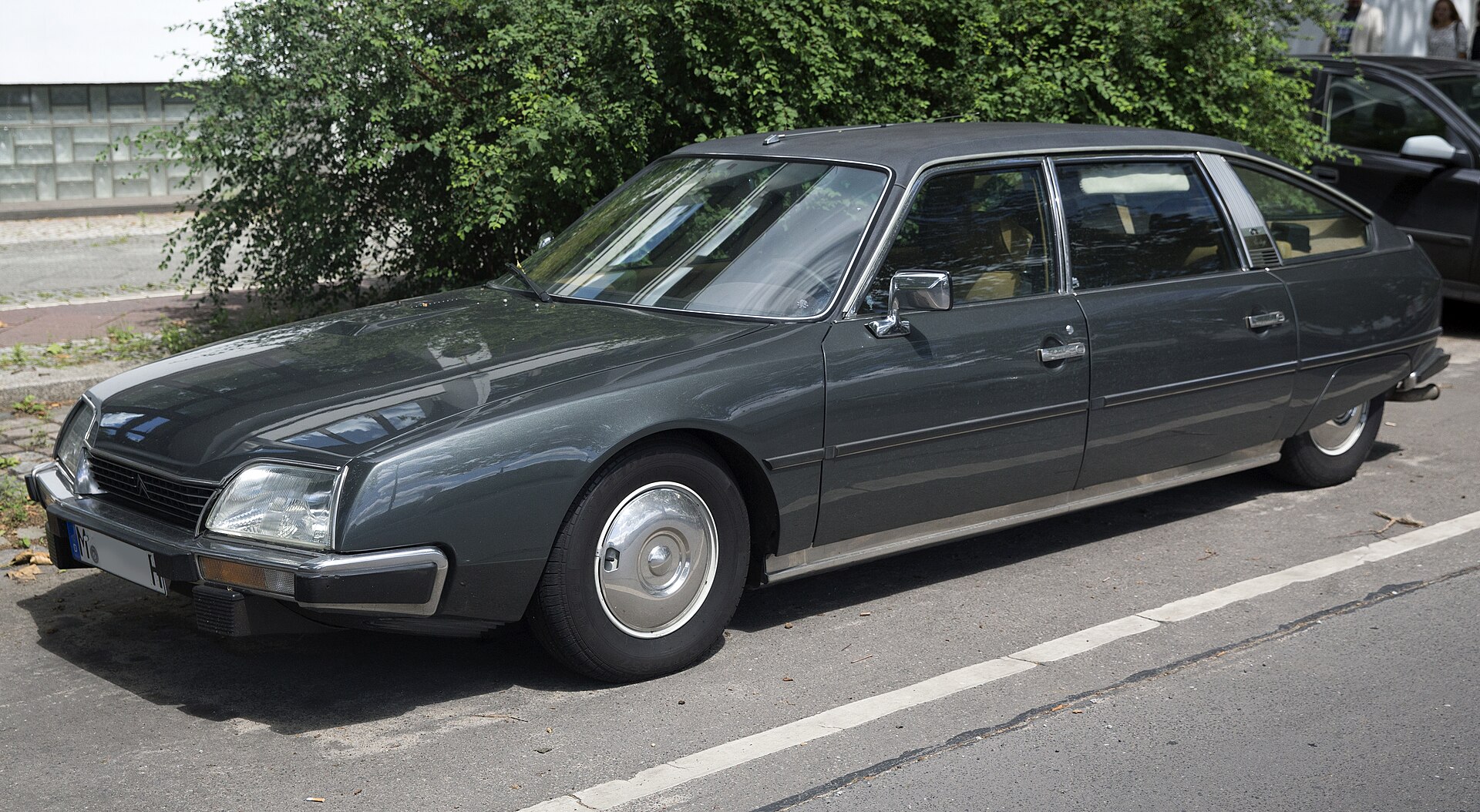
The Citroën CX is a front-wheel-drive executive car that Citroën built from 1974 to 1991 as the successor to the DS. Robert Opron styled it, and it kept hydropneumatic self-levelling suspension while adding DIRAVI speed-sensitive steering. Petrol and diesel four-cylinders from 2.0 to 2.5 litres powered 1,170,645 saloons, long-wheelbase Prestiges and estates.
In short
- Built from August 1974 to 1991, mainly at Aulnay-sous-Bois near Paris; the saloon ended in 1989, the estate in 1991.
- European Car of the Year 1975, voted by 49 journalists from 14 countries.
- Outputs ran from 49 kW (66 PS) in the first CX 2200 Diesel to 124 kW (168 PS) in the 25 GTi Turbo.
- Replaced by the Citroën XM, which took over from the saloon in May 1989.
Size at a glance
| Dimensions | Citroen CX I |
|---|---|
| Length | 4,666 mm183.7 in |
| Width | 1,730 mm68.1 in |
| Height | 1,360 mm53.5 in |
| Wheelbase | 2,845 mm112.0 in |
Specs by version
Engines
| Version | Engine | Power | Gearbox | Drive | Production years |
|---|---|---|---|---|---|
| Diesel · 2 versions | |||||
| CX 25 D | 2.5 l · 4 cyl · Diesel 2,499 cc | 55 kW 75 PS74 hp | - | Front-wheel drive | 1978–1990 |
| CX 25 Turbo D 2 | 2.5 l · 4 cyl · Diesel 2,499 cc | 88 kW 120 PS118 hp | - | Front-wheel drive | 1987–1991 |
| Petrol · 3 versions | |||||
| CX 2000 | 2.0 l · 4 cyl · Petrol 1,985 cc | 75 kW 102 PS101 hp | Manual | Front-wheel drive | 1974–1979 |
| CX 2400 GTi | 2.3 l · 4 cyl · Petrol 2,347 cc | 94 kW 128 PS126 hp | Manual | Front-wheel drive | 1977–1983 |
| CX 25 GTi Turbo 2 | 2.5 l · 4 cyl · Petrol 2,499 cc | 124 kW 169 PS166 hp | 5-sp Manual | Front-wheel drive | 1986–1989 |
Performance
Show all 5 versions
| Version | 0–100 km/h | Top speed |
|---|---|---|
| Diesel · 2 versions | ||
| CX 25 D | - | 156 km/h97 mph |
| CX 25 Turbo D 2 | 10.9 s 0–62 mph | 195 km/h121 mph |
| Petrol · 3 versions | ||
| CX 2000 | 12.8 s 0–62 mph | 174 km/h108 mph |
| CX 2400 GTi | - | 190 km/h118 mph |
| CX 25 GTi Turbo 2 | 7.8 s 0–62 mph | 223 km/h139 mph |
Dimensions and weight
Verified Manufacturer and type-approval data from our catalog · Sources and methodology
Citroën CX at a glance
| Item | Citroën CX |
|---|---|
| Production | August 1974 to 1991 (saloon to 1989, estate to 1991) |
| Numbers built | 1,170,645 (1,041,560 saloons and 128,185 estates per Wikipedia FR) |
| Plants | Aulnay-sous-Bois, France; last estates by Heuliez in Cerizay; kit assembly in Spain, Portugal, Yugoslavia, Chile and Thailand |
| Body styles | fastback saloon, long-wheelbase Prestige, estate (Safari in the UK), seven-seat Familiale |
| Designer | Robert Opron; Series 2 update by Geoff Matthews |
| Layout | transverse front engine, front-wheel drive, hydropneumatic suspension |
| Engines | 2.0 to 2.5 litre petrol fours, 2.2 and 2.5 litre diesels, turbo petrol and turbodiesel |
| Power | 49 to 124 kW (66 to 168 PS) |
| Kerb weight | 1,265 to 1,520 kg |
| Top speed | 174 km/h (CX 2000) to 223 km/h (25 GTi Turbo 2) |
| 0-100 km/h | 12.8 s (CX 2000) to 7.8 s (25 GTi Turbo 2), Wikipedia FR |
| Price new | FF 25,785 for the CX 2000 at launch in 1974 |
Replacing the DS with a shorter, more aerodynamic car
The DS had been on sale since 1955, and Citroën wanted a large car that was cheaper to build and easier to service. The CX 2000 and CX 2200 fastbacks were introduced on 28 August 1974 and shown at that year's Paris Motor Show. Its name is the French symbol for drag coefficient, and the body achieved a Cd of 0.36. Because the engine sat across the car instead of lengthways, the CX was about 20 cm shorter than the DS while offering similar cabin space.
The car was developed while Citroën was still independent, before Peugeot took control of the company in the mid-1970s. Jurors made it European Car of the Year for 1975. Demand was strong at first: Citroën sold more than 100,000 a year from 1975, and 1978 was the best year, with 132,000 cars according to Wikipedia EN or "just over 150,000" according to Wikipedia FR.
The range expanded quickly. The estate arrived in January 1976, 25 cm longer than the saloon, and the seven-seat Familiale used the same long body. The Prestige used a wheelbase about 25 cm longer (3,085 mm against 2,845 mm) and was chosen by the Élysée; a raised roof first built for presidential cars became standard on the Prestige in 1978.
Hydraulics, DIRAVI and the drum speedometer
The CX inherited the DS's hydropneumatic suspension: gas spheres and green LHM fluid kept the ride height constant whatever the load. The system was good enough that Rolls-Royce took a licence for the self-levelling of the Silver Shadow. Steering on the more powerful cars was DIRAVI, a powered system first fitted to the SM that self-centred and grew heavier with speed. Early cars carried about 70% of their weight over the front wheels, and some launch versions had no power assistance at all.
Inside, the Series 1 cars (1974-1985) used a dashboard with rotating-drum speedometer and rev counter, and stalk-free switchgear grouped beside the wheel replaced conventional column levers. The indicators do not cancel themselves, a detail that surprises drivers today. In 1981 Citroën switched from anaphoresis to cataphoresis primer, which improved rust protection.
CX engines from the 2000 to the Turbo 2
The early cars used pushrod fours derived from the DS. In 1979 the CX 20 adopted the 1,995 cc "Douvrin" engine shared with Renault and Peugeot. The GTi of 1977 brought Bosch L-Jetronic injection, and in July 1983 the 2.4-litre gave way to a 2,499 cc unit. Transmission choices grew too: a five-speed manual from 1977, the C-Matic semi-automatic from 1976, and a ZF three-speed automatic around 1980-1981.
| Version | Engine | Power | Years |
|---|---|---|---|
| CX 2000 | 1,985 cc petrol | 75 kW (102 PS) | 1974-1979 |
| CX 2200 | 2,175 cc petrol | 82 kW (112 PS) | 1975-1976 |
| CX 20 | 1,995 cc petrol (Douvrin) | 78 kW (106 PS) | 1979-1989 |
| CX 2400 GTi | 2,347 cc injection | 94 kW (128 PS) | 1977-1983 |
| CX 25 GTi | 2,499 cc injection | 101 kW (138 PS) | 1983-1989 |
| CX 25 GTi Turbo and Turbo 2 | 2,499 cc turbo petrol | 124 kW (168 PS) | 1984-1989 |
| CX 2200 Diesel | 2,175 cc diesel | 49 kW (66 PS) | 1976-1978 |
| CX 25 D | 2,499 cc diesel | 55 kW (75 PS) | 1978-1990 |
| CX 25 Turbo D and Turbo D 2 | 2,499 cc turbodiesel | 70 kW (95 PS), 88 kW (120 PS) from 1987 | 1984-1991 |
The GTi Turbo of October 1984 reached more than 220 km/h and was the first French car that could be ordered with ABS. An air-to-air intercooler arrived in September 1986 for the Turbo 2, which Wikipedia FR credits with 223 km/h and 0-100 km/h in 7.8 seconds. The CX 2200 Diesel was Citroën's first diesel passenger car since the 11 UD of 1937, and the 1984 Turbo D was described as the fastest diesel saloon of its time at 195 km/h. In February 1987 the Turbo D 2 gained an intercooler and 88 kW (120 PS).

Series 2, falling sales and the XM
The Series 2 of July 1985 replaced the stainless-steel bumpers with body-coloured plastic ones, added faired mirrors and fitted a new dashboard with conventional dials. Corrosion protection and finish were improved, and the Prestige received the 124 kW turbo petrol engine. Classic & Sports Car rates 1983-1986 as the peak of CX build quality. From 1987 the 2.5-litre cars had ABS as standard.
The changes did little for sales, which fell to about 35,000 a year in 1986 and 1987, although the millionth CX left Aulnay in February 1987. In the UK in 1980 the range ran from GBP 6,179 for the Reflex to GBP 11,594 for the Prestige, which put the bigger versions against the Audi 100 and the BMW 5 Series. The XM, built on the Peugeot 605 platform, replaced the saloon in May 1989, and Heuliez kept the estate going until early 1991. The CX also won rallies: it took the Tour du Sénégal and the Paris-Dakar, and Paddy Hopkirk finished third in the 1977 London-Sydney Marathon.

Citroën CX today: what to check when buying
Rust decides most purchases. Check the wheelarches, windscreen and rear screen surrounds, door bottoms, sills and floors, and look hard at the longitudinal chassis members: Hagerty UK says a car with rotten longerons is probably uneconomic to restore. Cars built from October 1980 have better protection. On estates a seized tailgate hinge can crack the roof.
The hydraulics need regular care. The six spheres lose their charge and usually need replacing every five years or so, and the LHM fluid should be fully changed every four years. A healthy car rises to ride height within 15 to 30 seconds of starting, and the pressure regulator should click every 20 to 30 seconds. Never work under a car held up only by its own suspension.
The DS-derived pushrod engines are durable, while the all-alloy Douvrin unit needs a timing belt every 40,000 miles (64,000 km) or four years. Some 2.5 diesel blocks cracked internally near the head studs, so ask for history. Worn seals make the C-Matic awkward, and its special Fluid T is no longer made new; the ZF automatic is the tougher choice. Electrics can be fragile, and a faulty speedometer sender also upsets the DIRAVI steering. Many cars run on Michelin TRX tyres, which are still available but expensive.
Hagerty UK's buying guide (updated October 2026) puts a decent early CX 2000 at about EUR 5,300 (GBP 4,600) and a mint one at EUR 11,000 (GBP 9,600), while a GTi Turbo ranges from about EUR 10,500 to EUR 18,600 (GBP 9,100 to 16,200) in October 2026. The very best cars can approach EUR 34,500 (GBP 30,000) by the same October 2026 guide. The Citroën catalogue lists the wider range, the history of Citroën explains where the CX fits, and more cars of the era are collected in our classic cars section.
Citroen CX in our rankings
- No. 10 of 35 · Quickest French cars, 0–100 (7.8 s)
- No. 10 of 20 · Fastest cars of the 1970s (190 km/h)
- No. 247 of 1106 · Longest-running car nameplates (17 years · top 25%)
- No. 12 of 35 · Fastest French cars (223 km/h · top 35%)
- No. 29 of 72 · Most powerful French cars (124 kW · top 41%)
- No. 27 of 66 · Fastest sedans (223 km/h · top 41%)
In production longer than 75% of ranked nameplates in the 1CARS catalog (No. 247 of 1106).
FAQ
When was the Citroën CX made?
The CX was built from August 1974 to 1991. The saloon was replaced by the XM in May 1989, while Heuliez continued building the estate in Cerizay until early 1991. Main production was at Aulnay-sous-Bois near Paris.
How many Citroën CX were built?
Citroën sold 1,170,645 CXs between 1974 and 1991. Wikipedia FR splits the total into 1,041,560 saloons and 128,185 estates. The millionth car left the Aulnay line in February 1987, and sales peaked in 1978.
Which Citroën CX is the fastest?
The 25 GTi Turbo 2 is the fastest series CX. Its 2.5-litre turbo petrol engine produces 124 kW (168 PS), and with the intercooler added in 1986 it reaches 223 km/h and covers 0-100 km/h in 7.8 seconds, according to Wikipedia FR.
Is the Citroën CX expensive to maintain?
It can be, mainly because of rust and the hydraulics. Spheres usually need renewing every five years and the LHM fluid every four years. The pushrod engines are durable, but bodywork repairs to the longerons and sills can cost more than the car is worth.
Data sources
Data checked by an editor against the sources below.
- Wikipedia - Citroën CX


