 Oldsmobile 442 W-30
All generations, specs and history
Published Sources (3) Report an error
By Felix Hartmann, Automotive Technology & EV Contributor
- Built
- 1966–1972
- Generations
- 2
- Top power
- 276 kW (375 PS)
Timeline
442 W-30 generations
Click a generation for its own page
- 442 W-30 400 1966–1969 · Coupe, Convertible · 268 kW (364 PS)
- 442 W-30 455 1970–1972 · Coupe, Convertible · 224–276 kW (305–375 PS)
Newest first · 2 generations since 1966
- 1970 455 1970–1972 · Coupe, Convertible · 224–276 kW (305–375 PS)
- 1966 400 1966–1969 · Coupe, Convertible · 268 kW (364 PS)
All generations by year: 442 W-30 455 (1970–1972) · 442 W-30 400 (1966–1969)
Which one is mine?
Pick the year of first registration to see which generation it is.
- 442 W-30 455 1970–1972
- 442 W-30 400 1966–1969
W-30 was Oldsmobile's option code for the strongest 4-4-2 engine package, offered from the 1966 to the 1972 model year. It paired a tuned V8 with cold-air induction: first a 6.6-litre 400 rated at 268 kW (360 hp, SAE gross), from 1970 the 7.5-litre 455 at 276 kW (370 hp). Lower compression brought the 1972 rating to 224 kW (300 hp, SAE net).
In short
- 1966: 54 factory W-30 cars plus 97 dealer-installed kits.
- 1967: 502 factory W-30 engines, built to meet NHRA homologation rules.
- 1970: 455 W-30 with 276 kW (370 hp) and 678 Nm (500 lb-ft); about 3,100 cars, 1,542 of them automatics.
- 1972: 772 W-30 cars, 659 coupés and 113 convertibles.
Specs by version
| Version | Engine | Power | Torque | Drive | Production years |
|---|---|---|---|---|---|
| 442 W-30 400 · 400 W-30 V8 (SAE gross) | 6.6 l · 8 cyl · Petrol 6,551 cc | 268 kW 364 PS359 hp | 597 Nm440 lb-ft | Rear-wheel drive | 1966–1969 |
| 442 W-30 455 · 455 W-30 V8 (SAE net) | 7.5 l · 8 cyl · Petrol 7,457 cc | 224 kW 305 PS300 hp | 556 Nm410 lb-ft | Rear-wheel drive | 1971–1972 |
| 442 W-30 455 · 455 W-30 V8 (SAE gross) | 7.5 l · 8 cyl · Petrol 7,457 cc | 276 kW 375 PS370 hp | 678 Nm500 lb-ft | Rear-wheel drive | 1970 |
| 442 W-30 455 · 455 W-30 V8 (SAE gross), Turbo Hydra-Matic | 7.5 l · 8 cyl · Petrol 7,457 cc | 276 kW 375 PS370 hp | 678 Nm500 lb-ft | Rear-wheel drive | 1970 |
Verified Manufacturer and type-approval data from our catalog · Sources and methodology
442 W-30 at a glance
| Specification | Oldsmobile 442 W-30 |
|---|---|
| Model years | 1966-1972 |
| Built | 54 + 97 dealer kits (1966); 502 (1967); about 3,100 (1970); 772 (1972) |
| Bodies | two-door coupé and hardtop; convertible (not in 1966) |
| Platform | GM A-body (Oldsmobile F-85 and Cutlass) |
| Engines | 400 V8, 6.6 L (1966-1969); 455 V8, 7.5 L (1970-1972) |
| Power | 268 kW (360 hp) gross 1966-1969; 276 kW (370 hp) gross 1970; 224 kW (300 hp) net 1971-1972 |
| Torque | 597 Nm (440 lb-ft) 400; 678 Nm (500 lb-ft) 1970 455; 556 Nm (410 lb-ft) net 1971-1972 |
| Induction | ducts from the grille (1966-1967), scoops under the front bumper (1968-1969), fibreglass bonnet with twin scoops (1970-1972) |
| Gearboxes | four-speed manual or Turbo Hydra-Matic automatic |
| Quarter mile | 13.3 s at 103.30 mph (Car Life, 1968 four-speed, 4.33 axle); 14.2 s at 102 mph (Motor Trend, 1970) |
| 0-60 mph | 6.5-6.7 s (Cars magazine, 1967 four-speed, 4.33 axle) |
Outside air for the 1966 W-30
Oldsmobile introduced the W-30 quietly for 1966 as an addition to the L69 engine, the 4-4-2's 400 with three two-barrel carburettors. The L69 cost US$264.54 (1966) and was rated at 268 kW (360 hp) at 5,000 rpm and 597 Nm (440 lb-ft) at 3,600 rpm. The W-30 kept that rating and added a hotter camshaft and an induction system that drew cool air through tubes from openings at the front of the car.
The air hoses needed space under the bonnet, so Oldsmobile moved the battery to the boot. That ruled out the convertible for 1966. Only 54 W-30 cars came from the factory, and dealers installed another 97 kits.
1967 to 1969 with the Quadrajet and red wheel arches
GM's 1967 ban on multiple carburettors ended the triple-carb L69. The W-30 kept its 268 kW (360 hp) rating with a single four-barrel Quadrajet, hoses to slots above and below the parking lights, heavy-duty springs, chrome valve covers and new red plastic inner wing liners. Oldsmobile built 502 factory W-30 engines to satisfy NHRA homologation rules, and dealers fitted an unknown number more. Cars magazine tested a four-speed car with the dealer-only 4.33 axle and recorded 14.1 seconds at 103 mph for the quarter mile and 6.5 to 6.7 seconds to 60 mph.
For 1968 the intakes moved under the front bumper, feeding a dual-snorkel air cleaner, and the wheel arches were lined in bright red plastic. Car Life ran a four-speed W-30 with a 4.33 axle through the quarter mile in 13.3 seconds at 103.30 mph. W-30 cylinder heads also went into the W-45 engine of the 1968 Hurst/Olds. The 1969 W-30 carried the same forced-air layout and 268 kW (360 hp), now quoted at 5,400 rpm. Oldsmobile added the W-32 that year for buyers who wanted the forced-air induction with the base camshaft and an automatic.

The 455 W-30 of 1970
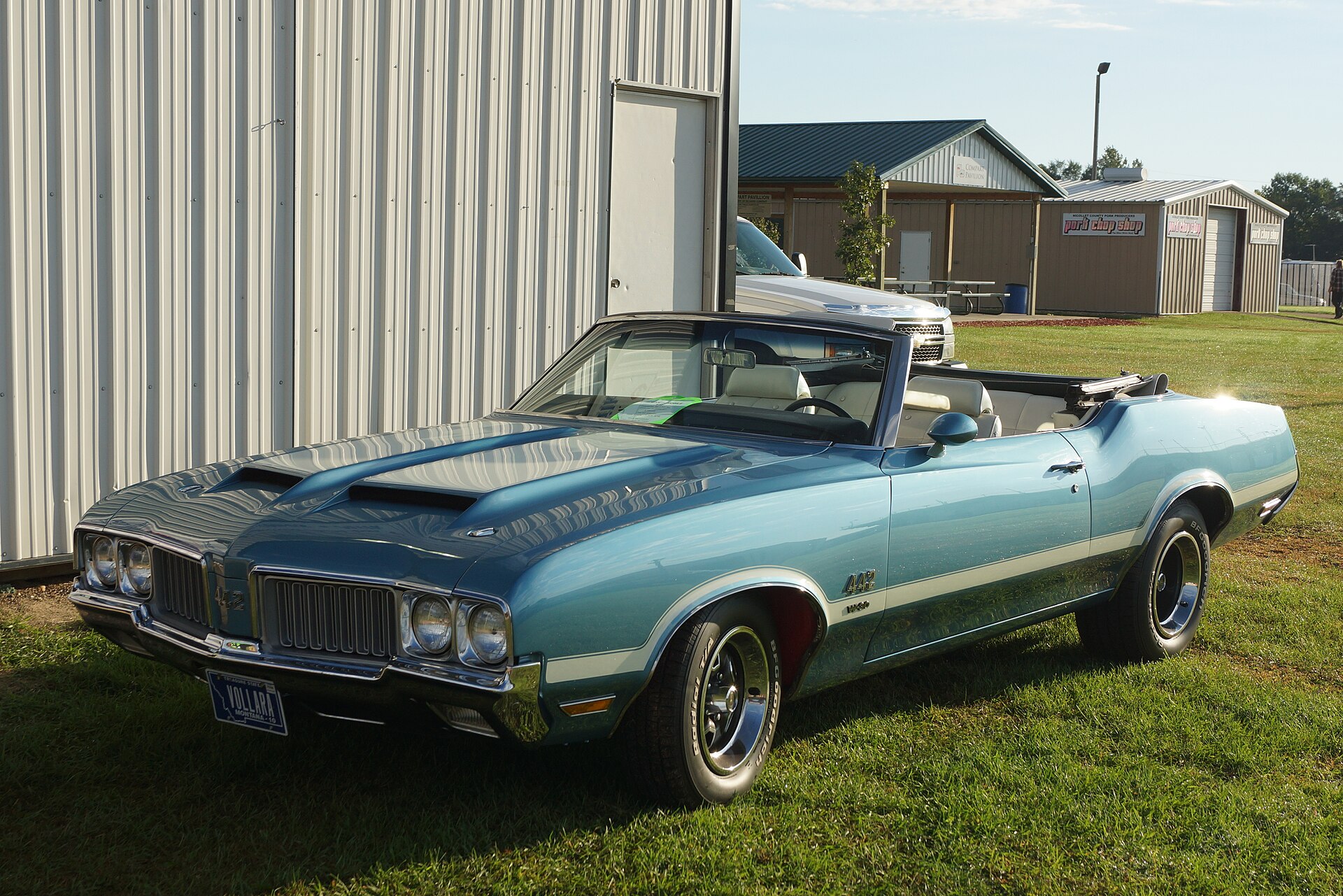
For 1970 the 4-4-2 received the 455 as standard, rated at 272 kW (365 hp) and 678 Nm (500 lb-ft). The W-30 version gave 276 kW (370 hp) at 5,200 rpm with the same torque at 3,600 rpm. Its parts list included a special camshaft, cylinder heads, distributor and carburettor, an aluminium intake manifold, a low-restriction air cleaner and the W25 fibreglass bonnet with functional twin scoops, 8 kg (18 lb) lighter than the steel one. Plastic inner wings and less sound insulation saved further weight.
An aluminium differential carrier and cover were extra-cost options at US$157 and US$58 (1970), fitted to around 350 cars according to autoevolution. The same source counts about 3,100 W-30 cars for 1970, 1,542 with the Turbo Hydra-Matic, which cost US$227 (1970). RM Sotheby's describes a 1970 W-30 convertible as one of 264 built, 96 of them with the four-speed. Motor Trend timed a four-speed W-30 with 3.91 gears at 14.2 seconds and 102 mph; Oldsmobile engineers had run 13.7 seconds with the same car after a fresh tune. Two W-30 Vista Cruiser wagons were built to special order.
| Model year | Engine | Rating | W-30 cars built |
|---|---|---|---|
| 1966 | 400, three two-barrel carburettors | 268 kW (360 hp) gross | 54 factory, 97 dealer kits |
| 1967 | 400, Quadrajet | 268 kW (360 hp) gross | 502 factory engines |
| 1968 | 400, Quadrajet | 268 kW (360 hp) gross | not published in sources used |
| 1969 | 400, Quadrajet | 268 kW (360 hp) gross | not published in sources used |
| 1970 | 455, Quadrajet | 276 kW (370 hp) gross | about 3,100 |
| 1971 | 455, 8.5:1 | 261 kW (350 hp) gross, 224 kW (300 hp) net | not published in sources used |
| 1972 | 455 (L77) | 224 kW (300 hp) net | 772 |
The low-compression W-30 of 1971 and 1972
GM cut compression to 8.5:1 across its 1971 engines so they could use lower-octane fuel. The W-30 kept its forced-air bonnet and the 1970 camshaft and was rated at 261 kW (350 hp) gross, or 224 kW (300 hp) at 4,700 rpm and 556 Nm (410 lb-ft) at 3,200 rpm net. The musclecarclub history reproduced by Oldsmobiles Forever quotes 0-60 mph in 6.5 seconds and the quarter mile in 14.8 seconds at 98 mph for a 1971 W-30.
In 1972 the 4-4-2 became an appearance and handling package, W-29, and the W-30 option was the L77 455 with the same net rating. It came with low-restriction dual exhausts, the aluminium intake, the W25 bonnet, an anti-spin differential with 3.42 gears (3.73 optional) and heavy-duty cooling. The camshaft left too little idle vacuum for air conditioning, and power brakes were available only with the automatic. Oldsmobile built 659 W-30 coupés and 113 convertibles that year.

442 W-30 today: what to check
Many W-30 parts bolt on, so the engine and the paperwork matter more than the bonnet and stripes. RM Sotheby's sold a 1970 W-30 convertible, chassis 344670M243716, for US$247,500 at Fort Lauderdale in 2022 without its original factory documents. The chassis number shows the pattern: 344 for the 4-4-2, 67 for the convertible body, 0 for the 1970 model year.
- 1966-1967: dealer-installed kits are period-correct but were not factory W-30 cars.
- 1967-1968: red plastic inner wing liners are a W-30 feature.
- 1970-1972: look for the aluminium intake manifold and the W25 fibreglass bonnet.
- 1972: a W-30 left the factory without air conditioning.
The W-30's GM relatives were the Buick Gran Sport and the Chevrolet Chevelle. The whole 4-4-2 story is told in the Oldsmobile 4-4-2 hub, the brand's models are in the Oldsmobile catalogue, and the car's rivals are in the muscle car guide.
Oldsmobile 442 W-30: first vs latest generation
| Spec | 442 W-30 400 | 442 W-30 455 | Change |
|---|---|---|---|
| Years | 1966–1969 | 1970–1972 | 4 years apart |
| Most powerful version | 268 kW (364 PS) | 276 kW (375 PS) | +8 kW (+3%) |
Oldest and newest generation in the 1cars catalog. Power is the strongest version of each; other rows are shown only when both generations have the figure.
Oldsmobile 442 W-30 in our rankings
- No. 17 of 659 · Biggest engines: cars (7,457 cc · top 3%)
- No. 13 of 199 · Biggest engines: coupes (7,457 cc · top 8%)
- No. 22 of 103 · Most powerful cars of the 1970s (276 kW · top 22%)
- No. 108 of 506 · Most torque: cars (678 Nm · top 22%)
- No. 32 of 110 · Most powerful cars of the 1960s (268 kW · top 30%)
- No. 45 of 134 · Most torque: coupes (678 Nm · top 35%)
Bigger engine than 97% of ranked cars in the 1CARS catalog (No. 17 of 659).
FAQ
What does W-30 mean on an Oldsmobile 442?
W-30 was the factory option code for the high-performance engine package with cold-air induction. It was offered on the 4-4-2 from 1966 to 1972 and included a hotter camshaft and special induction parts.
How much horsepower did the 1970 442 W-30 have?
276 kW (370 hp, SAE gross) at 5,200 rpm from the 455 V8, with 678 Nm (500 lb-ft) of torque. The standard 1970 455 had 272 kW (365 hp).
How many 442 W-30s were made?
Totals vary by year: 54 factory cars in 1966, 502 engines in 1967, about 3,100 cars in 1970 and 772 in 1972. Figures for 1968, 1969 and 1971 are not given in the sources used here.
Did the 442 W-30 have air conditioning?
Not in 1972, when the camshaft left too little idle vacuum for factory air. Earlier cars could have it; autoevolution describes a 1970 W-30 with the US$375 (1970) air-conditioning option.
Data sources
Data checked by an editor against the sources below.
- Wikipedia - Oldsmobile 442
- Oldsmobilesforever - 442 History
- Autoevolution - 1970 Olds 442 W 30 Is Restoration Perfection And Hides A One Year Only Lightweight Secret 227448