 Volvo V70
Specs, engines and history
Published Report an error
By Felix Hartmann, Automotive Technology & EV Contributor
Which Volvo V70 to buy
Our verdict · Felix Hartmann
- For high mileage: a second- or third-generation car with the D5 diesel, offered from 2000 to the end of production.
- For lowest running costs: a third-generation D2 or DRIVe 1.6D.
- For performance: the 2003–2007 V70 R (221 kW) or a third-generation T6 AWD (224 kW).
- For rough roads: the XC70, with all-wheel drive and up to 210 mm of ground clearance.
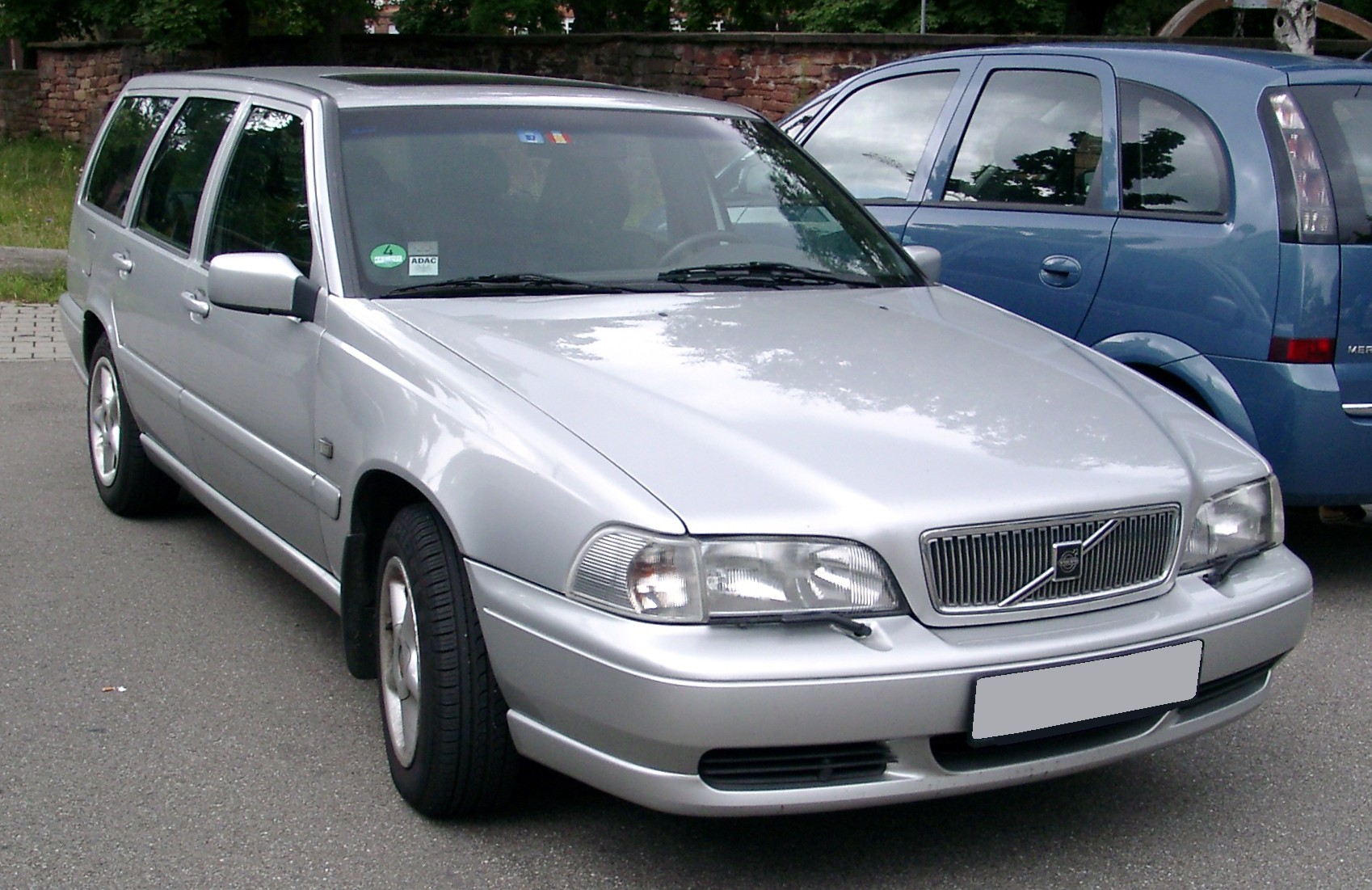
The Volvo V70 is the large estate car that Volvo built from 1996 to 2016 in three generations. The first V70 of November 1996 was a heavily revised Volvo 850 estate; the second (2000–2007) moved to the P2 platform of the S60; the third (2007–2016) shared its body and engineering with the second S80. Five-cylinder petrol and diesel engines, the fast V70 R and the raised Cross Country/XC70 versions made it one of the best-known Volvos of its era, before the V90 and V60 replaced it in 2016.
In short
- Three generations: P80 (1996–2000), P2 (2000–2007) and P3 (2007–2016); last V70 built on 25 April 2016.
- Engines from the 82 kW (111 PS) 1.6 diesel to the 224 kW (304 PS) T6; the 2003 V70 R had 221 kW (300 PS).
- First-generation output: 373,689 cars, including 53,857 Cross Country models.
- Euro NCAP gave the third generation five stars in 2007 (34 of 37 points).
Volvo V70 at a glance
| Specification | Volvo V70 |
|---|---|
| Segment | large family / executive estate |
| Production | November 1996 – April 2016 |
| Plants | Torslanda (Sweden), Ghent (Belgium); assembly in Malaysia and Thailand (P2) |
| Body style | five-door estate; raised Cross Country / XC70 |
| Layout | front engine, front- or all-wheel drive |
| Engines | 1.6–3.2 petrol (four, five and six cylinders), 1.6–2.4 diesel |
| Power range | 82–224 kW (111–304 PS) |
| Gearboxes | 5/6-speed manual; 4-, 5-, 6- and 8-speed automatics |
| Predecessor / successors | Volvo 850 estate / Volvo V90 and V60 (2016) |
The V70 is listed in our Volvo catalogue. Its raised sister model has its own guide, the Volvo XC70, and its successor is covered in our Volvo V90 article.
Volvo V70 generations
| Generation | Code | Years | Body styles | Engines | Power |
|---|---|---|---|---|---|
| First | P80 | 1996–2000 | estate, V70 XC | 2.0–2.5 five-cylinder petrol, 2.5 TDI diesel, bi-fuel | 93–195 kW (126–265 PS) |
| Second | P2 | 2000–2007 | estate, XC70 | 2.0–2.5 five-cylinder petrol, D5 diesel | 103–221 kW (140–300 PS) |
| Third | P3 | 2007–2016 | estate, XC70 | 1.6–3.2 petrol, 1.6–2.4 diesel | 82–224 kW (111–304 PS) |
First generation (1996–2000): the 850 reworked
The V70 appeared in November 1996 as an evolution of the 850 estate; Volvo counted about 1,800 changes. Peter Horbury led the exterior design. All engines were five-cylinder: 2.0 and 2.5-litre petrol units with 10 or 20 valves, turbocharged 2.0T, 2.5T AWD and T5 versions, a 2.5 TDI diesel bought from Volkswagen, and a bi-fuel 2.4 that could run on compressed natural gas.
In September 1997 Volvo added the V70 XC (Cross Country), with all-wheel drive, 35 mm more ride height and 166 mm of ground clearance. The V70 R, unveiled in May 1997, had 177–184 kW (240–250 PS) at first; the final 2000 R AWD reached 195 kW (265 PS) and 400 Nm. Volvo built 319,832 V70s and 53,857 V70 XCs of this generation.
The first V70 was a safe car for its time: the equivalent S70 saloon earned four stars from Euro NCAP in 1998, and the IIHS rated its frontal crash protection "good".
Second generation (2000–2007): P2 platform
The second V70 arrived in spring 2000 on the P2 platform shared with the S60. It was 50 mm longer in the wheelbase and 40 mm wider than its predecessor, and Volvo claimed a 70% stiffer body. The drag coefficient was 0.30. The raised version was renamed XC70 for the 2003 model year and given 210 mm of ground clearance.
The new D5 five-cylinder diesel delivered 120 kW (163 PS), and 136 kW (185 PS) from 2005. The V70 R of 2003 used a 2.5-litre turbo with 221 kW (300 PS) and 400 Nm, all-wheel drive and a top speed limited to 250 km/h. A 2005 facelift added a six-speed automatic and a diesel particulate filter.

Third generation (2007–2016): the large V70
Launched on 2 February 2007 for the 2008 model year, the third V70 shared its styling and P3 platform with the second-generation S80. It was larger again, with 55 litres more load volume and 2 cm more rear legroom. Euro NCAP awarded five stars in 2007, with 34 of 37 points.
The engine range was the widest in the V70's history, from economical DRIVe and D2 diesels to the 3.2-litre six and the turbocharged T6 with all-wheel drive. Sensus infotainment arrived in 2011–2012 and a TFT instrument display for the 2014 model year. Sales in North America ended after the 2011 model year, although the XC70 continued there. The last V70 was built on 25 April 2016, the last XC70 on 13 May 2016.

Engines, transmissions and performance
| Engine | Generation | Power | Torque |
|---|---|---|---|
| 2.5 TDI (VW) diesel | 1st | 103 kW (140 PS) | 290 Nm |
| T5 2.3 five-cylinder petrol | 1st | 177 kW (240 PS) | 330 Nm |
| D5 2.4 five-cylinder diesel | 2nd | 120–136 kW (163–185 PS) | 340–400 Nm |
| R 2.5 turbo, AWD | 2nd | 221 kW (300 PS) | 400 Nm |
| 1.6D DRIVe | 3rd | 82 kW (111 PS) | 240 Nm |
| D4 diesel (2014–2016) | 3rd | 133 kW (181 PS) | 400 Nm |
| D5 diesel (2012–2016) | 3rd | 158 kW (215 PS) | 440 Nm |
| 3.2 six-cylinder petrol | 3rd | 175 kW (238 PS) | 320 Nm |
| T6 3.0 turbo, AWD (2011–2016) | 3rd | 224 kW (304 PS) | 440 Nm |
Gearboxes evolved from a five-speed manual and four-speed automatic in 1996 to six-speed manuals, six-speed automatics (Ford MPS6 or Aisin) and, late in the third generation, an eight-speed Aisin automatic.
Dimensions and boot space
| Parameter | First (P80) | Second (P2) | Third (P3) |
|---|---|---|---|
| Length | 4,722–4,729 mm | 4,709 mm | 4,823 mm |
| Wheelbase | 2,664 mm | 2,756 mm | 2,816 mm |
| Width | - | 1,803 mm | 1,861 mm |
| Height | - | 1,466–1,491 mm | 1,547 mm |
| Kerb weight | - | - | 1,579–1,801 kg |
Key figures for the latest version (third generation):
| Parameter | Metric | Imperial |
|---|---|---|
| Length | 4,823 mm | 189.9 in |
| Width (without mirrors) | 1,861 mm | 73.3 in |
| Height | 1,547 mm | 60.9 in |
| Wheelbase | 2,816 mm | 110.9 in |
| Kerb weight | 1,579–1,801 kg | 3,481–3,971 lb |
Safety ratings
| Test | Year | Result |
|---|---|---|
| Euro NCAP (S70 saloon, sister of the first V70) | 1998 | four stars, 25 of 37 points |
| Euro NCAP (S60, platform twin of the second V70) | 2001 | four stars, 28 of 37 points |
| Euro NCAP (third-generation V70) | 2007 | five stars, 34 of 37 points |
| ANCAP (third generation) | 2008 | frontal 15.20/16, side 16/16 |
Rivals: how the V70 compares
The V70 competed with the Mercedes-Benz E-Class estate, BMW 5 Series Touring, Audi A6 Avant, Volkswagen Passat Variant and Ford Mondeo estate. Our comparison tool helps to compare sizes and engines.
Photo gallery

FAQ
How many generations of the Volvo V70 are there?
Three: P80 (1996–2000), P2 (2000–2007) and P3 (2007–2016).
Is the Volvo V70 available with all-wheel drive?
Yes. AWD was offered on versions such as the 2.5T AWD, the V70 R and the T6, and on the Cross Country and XC70 models.
What replaced the Volvo V70?
The V90 estate and the smaller V60 took over in 2016.
Which V70 is the fastest?
The second-generation V70 R of 2003 (221 kW, 300 PS) and the third-generation T6 (224 kW, 304 PS).
How safe is the Volvo V70?
The third generation scored five stars in Euro NCAP's 2007 test with 34 of 37 points.