 Mitsubishi Lancer Evo VI TME
Specs, engines and history
Published Sources (3) Report an error
By Felix Hartmann, Automotive Technology & EV Contributor
- Built
- 1999–2001
- Top power
- 206 kW (280 PS)
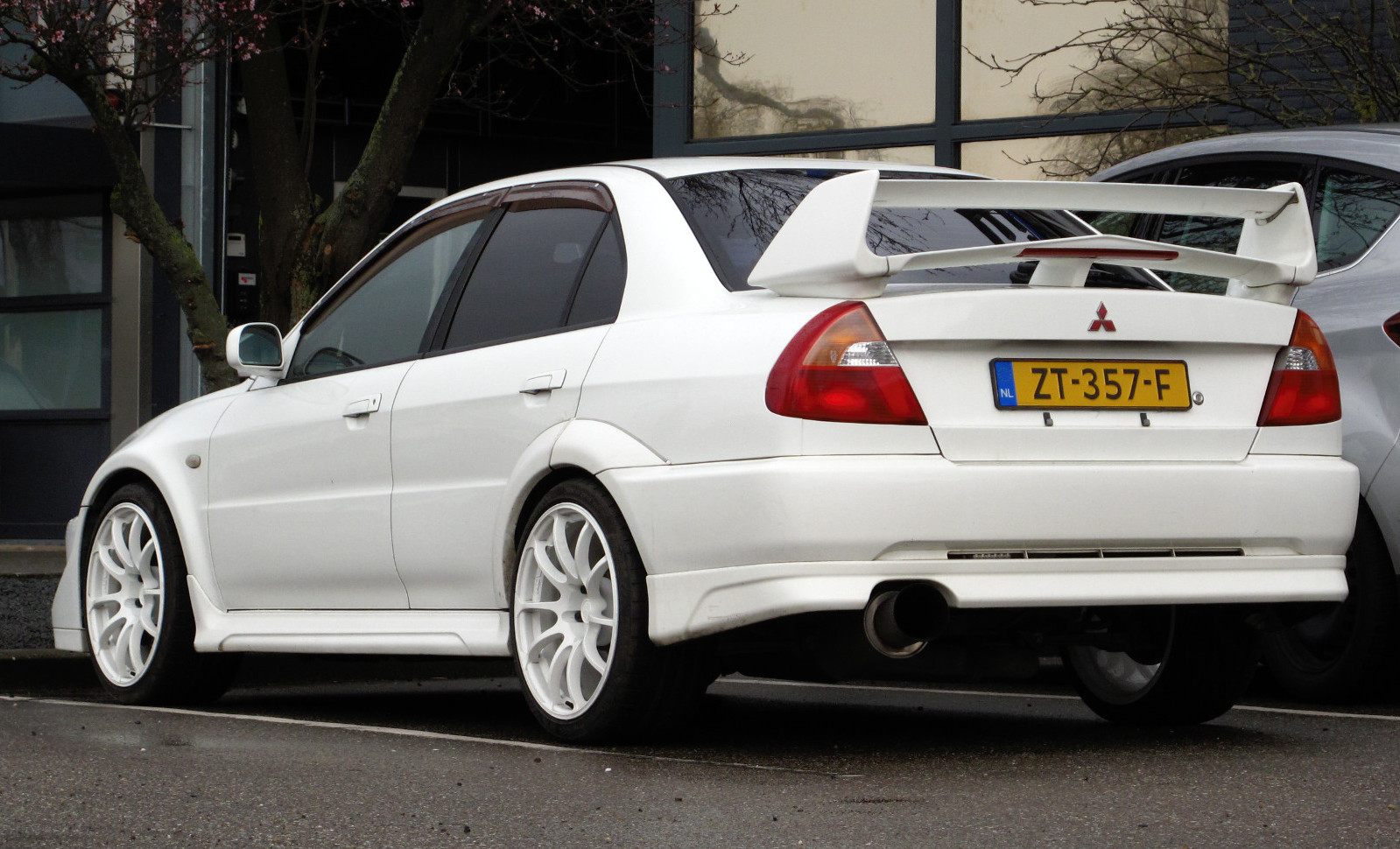
The Mitsubishi Lancer Evolution VI Tommi Mäkinen Edition, usually shortened to TME and also called the Evo 6.5, is a special edition of the Evo VI that Mitsubishi announced in December 1999. It celebrated the Finnish driver's fourth World Rally Championship title in a row and added tarmac-rally suspension, a quicker steering rack, a faster-spooling titanium turbine and a new front bumper. Built in only a few thousand examples, it is the most collectable of the early Evos.
In short
- Announced in December 1999; Wikipedia gives 4,092 cars.
- 2.0-litre 4G63 turbo four with 206 kW (280 PS) and 373 Nm, like the regular Evo VI.
- Lowered "tarmac" suspension, quicker steering, front strut brace, white 17-inch Enkei wheels.
- Optional red paint with decals copying Mäkinen's works rally car.
Specs by version
Engines
| Version | Engine | Power | Torque | Gearbox | Drive | Production years |
|---|---|---|---|---|---|---|
| Evolution VI Tommi Mäkinen Edition | 2.0 l · 4 cyl · Petrol 4G63T | 206 kW 280 PS276 hp | 373 Nm275 lb-ft | 5-sp Manual | All-wheel drive | 1999–2000 |
Performance
Show all 1 versions
| Version | 0–100 km/h | Top speed |
|---|---|---|
| Evolution VI Tommi Mäkinen Edition | 4.6 s 0–62 mph | 241 km/h150 mph |
Dimensions and weight
Show all 1 versions
| Version | Kerb weight |
|---|---|
| Evolution VI Tommi Mäkinen Edition | 1,365 kg3,009 lb |
Verified Manufacturer and type-approval data from our catalog · Sources and methodology
Evo VI TME at a glance
| Specification | Lancer Evolution VI Tommi Mäkinen Edition |
|---|---|
| Announced | December 1999 |
| Also known as | Evolution 6.5, Evo 6½, TME |
| Numbers built | 4,092 (Wikipedia EN); other sources give about 2,500 or 5,000 |
| Versions | TME GSR and TME RS |
| Body | four-door saloon |
| Engine | 1,997 cc 4G63 turbocharged inline-four, DOHC 16 valves |
| Power | 206 kW (280 PS) at 6,500 rpm |
| Torque | 373 Nm at 3,000 rpm |
| Drive | four-wheel drive; Active Yaw Control on the GSR |
| Gearbox | five-speed manual |
| Kerb weight | about 1,360 kg (GSR) |
| Predecessor / successor | Lancer Evolution VI / Lancer Evolution VII |
The TME is part of our Mitsubishi catalogue. The whole Lancer line, from the 1973 saloon to the last Evo, is covered in our Mitsubishi Lancer history, and the later cars in our Lancer Evolution IX and X guide.
Why Mitsubishi built a Mäkinen edition
Tommi Mäkinen won the World Rally Championship drivers' title four seasons in a row, from 1996 to 1999. His cars were the Lancer Evolution III, IV, V and VI. In 1998, helped by his team-mate Richard Burns, Mitsubishi also won the constructors' championship, the only time the brand has done so. The Evo VI of 1999 was the car of the fourth title, and the special edition announced that December was Mitsubishi's way of marking the run.
What changed from the Evo VI
The standard Evo VI had concentrated on cooling and durability: a larger intercooler and oil cooler, new pistons, and smaller fog lamps moved to the bumper corners for better airflow. The TME kept the mechanical package and changed the details that matter on tarmac.
| Area | Evo VI GSR | Evo VI TME GSR |
|---|---|---|
| Front bumper | Evo VI bumper with small corner fog lamps | new design, styling similar to the Evo V |
| Turbo | standard turbine (titanium-aluminide on the RS) | titanium turbine wheel for quicker response |
| Ride height | standard | lowered for tarmac stages |
| Steering | standard ratio | quicker ratio |
| Body bracing | - | front upper strut brace |
| Wheels | standard alloys | white 17-inch Enkei |
| Seats | Recaro | red/black Recaro with embossed T. Mäkinen logo |
| Steering wheel and gear knob | standard | Momo, leather with red stitching |
The New Zealand AutoTrader test also mentions a new silencer. Wikipedia notes that the titanium-aluminide turbine of the regular Evo VI RS was "the first in a production car".


TME engine, drivetrain and performance
Like every Evo of the period, the TME uses the 1,997 cc 4G63 four-cylinder with a twin-scroll turbocharger. Japanese makers then observed an advertised limit of 206 kW (280 PS), so the official figures stayed at 206 kW (280 PS) at 6,500 rpm and 373 Nm at 3,000 rpm. The AutoTrader tester found the boost building from about 3,000 rpm and the engine revving freely to about 7,000 rpm.
| Version | Power (kW / PS) | Torque | Drivetrain | Gearbox |
|---|---|---|---|---|
| TME GSR | 206 kW (280 PS) | 373 Nm | 4WD, Active Yaw Control rear differential, front helical LSD | 5-speed manual |
| TME RS | 206 kW (280 PS) | 373 Nm | 4WD, mechanical 1.5-way rear LSD instead of AYC | close-ratio 5-speed manual |
Supercars.net lists a kerb weight of 1,360 kg (AutoTrader NZ: 1,365 kg) and a top speed of about 240 km/h. That works out at 6.6 kg per kW by our calculation, a strong figure for a four-door saloon of 1999. No 0–100 km/h figure appears in the sources used here.
On the road: how the TME drives
AutoTrader NZ drove a 20-year-old TME GSR and found little bump steer and no understeer under power, with some torque steer that remained easy to manage. The steering was light and precise, though it passed some kickback through the rim, and the brakes were strong. The five-speed gearbox felt a little notchy after two decades, but its gates were well spaced. The weak point was the period dampers, which struggled with sharp bumps.
Dimensions and key specifications
| Parameter | Metric | Imperial |
|---|---|---|
| Length | 4,350 mm | 171.3 in |
| Width | 1,770 mm | 69.7 in |
| Height | 1,415 mm | 55.7 in |
| Wheelbase | 2,510 mm | 98.8 in |
| Kerb weight | 1,360–1,365 kg | 2,998–3,009 lb |
| Front brakes | Brembo 320 mm, four-piston | 12.6 in |
| Rear brakes | Brembo 305 mm, two-piston | 12.0 in |
| Tyres | 225/45 ZR17 on 7.5 × 17 in wheels | - |
| Top speed | about 240 km/h | about 149 mph |
Colours, versions and prices
The TME GSR was the road car, with Active Yaw Control, ABS, Recaro seats and automatic air conditioning. The TME RS was the stripped competition base, with a close-ratio gearbox and the titanium turbine as an option. Wikipedia lists red (exclusive to the TME), white, blue, black and silver, with the rally-style decals optional. AutoTrader NZ writes that only the red cars carried the Ralliart decals and that black was the rarest colour, with 244 cars.
In Japan the TME GSR cost ¥3,278,000 at launch in 1999 (about €32,000 at the exchange rate of the time), according to AutoTrader NZ. The Evo was sold officially in the UK and other European markets from the Evo IV onward, and AutoTrader NZ also reports New Zealand-new cars.

Buying a TME today
AutoTrader NZ describes the TME as reliable when kept standard and well maintained, and reports rising prices as buyers from the UK and the United States bid for cars at Japanese auctions. Its checklist for buyers:
- rust: Lancers of this age need undersealing and cavity protection checked;
- paint: factory paint quality is average, and resprayed panels are common;
- originality: many Evos were modified, and standard parts, such as original shock absorbers, are scarce and expensive;
- the Active Yaw Control differential can cause problems if the car has not been serviced properly.
Proof of a genuine TME matters as much as condition, because the bumper, wheels and decals can be fitted to an ordinary Evo VI. Our car comparison tool helps to set the TME's figures against later Evos and other four-wheel-drive performance saloons, and the car finder lists current cars with similar power.
Photo gallery


Mitsubishi Lancer Evo VI TME in our rankings
- No. 5 of 49 · Quickest Japanese cars, 0–100 (4.6 s)
- No. 6 of 22 · Quickest cars of the 1990s, 0–100 (4.6 s)
- No. 7 of 59 · Fastest Japanese cars (241 km/h)
- No. 8 of 46 · Quickest sedans, 0–100 (4.6 s)
- No. 12 of 60 · Power-to-weight: sedans (151 kW/t · top 20%)
- No. 88 of 343 · Quickest cars, 0–100 (4.6 s · top 26%)
Quicker from 0 to 100 km/h than 89% of ranked Japanese cars in the 1CARS catalog (No. 5 of 49).
FAQ
How many Evo VI Tommi Mäkinen Editions were made?
Wikipedia gives 4,092 cars. AutoTrader NZ speaks of around 2,500 and Supercars.net of 5,000, so the exact number is disputed.
How much power does the Evo 6.5 TME have?
The official figures are 206 kW (280 PS) and 373 Nm, identical to the regular Evo VI.
What is the difference between the Evo VI and the Tommi Mäkinen Edition?
The TME has a new front bumper, a titanium turbine wheel, lowered tarmac suspension, a quicker steering ratio, a front strut brace, white 17-inch Enkei wheels and Mäkinen-branded Recaro seats.
Why is it called the Evo 6.5?
Because it is a special edition of the sixth-generation Evo, launched at the end of the Evo VI's life and before the Evo VII.
Which colours were available on the Evo VI TME?
Red (only on the TME), white, blue, black and silver, with optional decals in the style of Mäkinen's rally car.
Data sources
Data checked by an editor against the sources below.
- Wikipedia - Mitsubishi Lancer Evolution
- Zwischengas - Klassikerperlen der Zukunft Mitsubishi Lancer Evolution
- Co - Mitsubishi Evo Vi Makinen Edition