 Mitsubishi Lancer Evolution
Specs, engines and history
Published Sources (1) Report an error
By Sarah Whitmore, Senior Automotive Writer
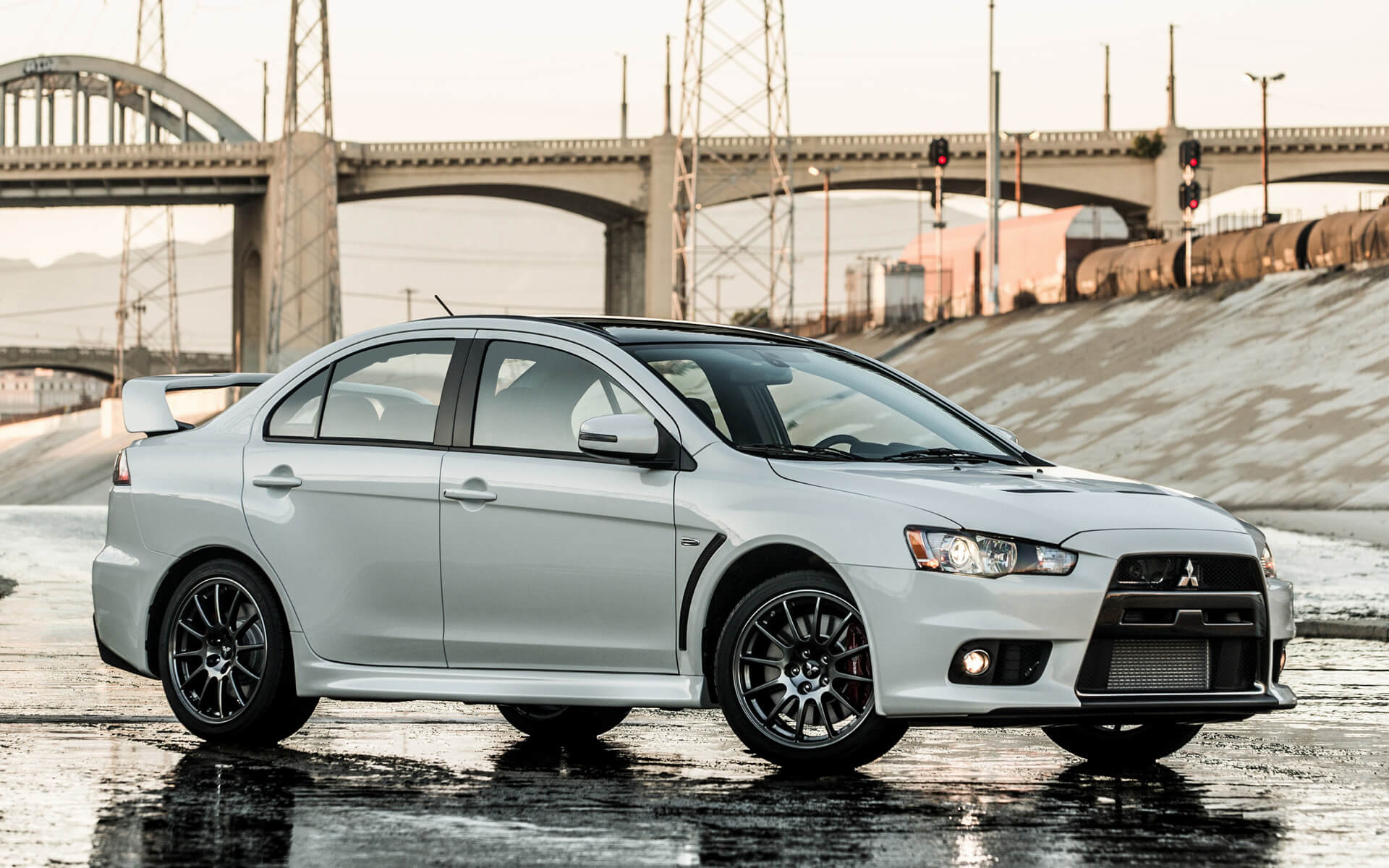
The Mitsubishi Lancer Evolution is a compact four-wheel-drive sports saloon — a C-segment car in European terms — that combines everyday practicality with a genuinely driver-focused character. Its core audience was young, ambitious drivers who wanted a fast but usable car. Born for the World Rally Championship, the "Evo" became one of the best-known performance cars of its era.
In short
- The first Lancer Evolution appeared in 1992 as a homologation special for the World Rally Championship; ten generations were built until April 2016.
- Tommi Mäkinen won four consecutive WRC drivers' titles from 1996 to 1999 in Evolutions III to VI, and Mitsubishi took the manufacturers' title in 1998.
- The Evo IX (2005–2007) used the 2.0 turbo 4G63 MIVEC with about 214 kW (291 PS) and 392 Nm.
- The Evo X (2007–2016) switched to the aluminium 4B11T engine, with a six-speed TC-SST dual-clutch option and S-AWC all-wheel drive.
Lancer Evolution at a glance
The sporting Lancer family first appeared in 1992, designed quickly and specifically for the World Rally Championship. It instantly won over drivers who loved speed. In total ten generations were produced, and Mitsubishi retired the Evolution in April 2016. This article focuses on the ninth and tenth generations. More of the brand's range is in our Mitsubishi catalogue; an earlier car is covered in Mitsubishi Lancer Evo VI TME.
Evolution IX (2005–2007)
The ninth Evolution went on sale in Japan on 3 March 2005 and was produced until the tenth generation arrived in 2007. Alongside the saloon, Japan also received an Evolution IX Wagon in GT and GT-A versions.
Design
The Evo IX is lean, handsome and dynamic, and every detail of the body hints at its potential. The front has darkened headlights with halogen bulbs, an expressive bonnet with a large central vent and a big aerodynamic bumper. Compared with the regular Lancer, the side view differs mainly in its wheels, sills and the large rear wing on the boot lid. Ground clearance is an average 140 mm. At the rear, the spoiler and a diffuser around the thick exhaust pipe are there less for fashion than for the downforce needed at high speed.
Interior
The cabin is less remarkable than the exterior, but sporting minimalism is part of the appeal. The driver faces a small three-spoke MOMO steering wheel and a simple instrument cluster with a speedometer reading to 270 km/h and a rev counter to 9,000 rpm, lit in red and easy to read in all conditions. The centre console has air vents with a large hazard switch between them, a double-DIN radio and small climate controls, all within easy reach. Despite many new features, the Evo IX was about 60 kg lighter than its predecessor. Hard plastics with carbon-look inserts dominate, but the seats are trimmed in good leather with Alcantara, and the pedals have aluminium covers.
The sports seats have pronounced side bolsters and hold the body firmly; the steering wheel adjusts for height, and the gear lever falls naturally to hand. The rear bench has two headrests and a centre armrest with cupholders. The boot holds 430 litres but cannot be extended, as the rear seat does not fold. There is no spare wheel — only a repair kit, tools and a jack — and the washer reservoir and a fluid tank were moved into the boot to improve weight distribution. To save weight, the boot lid has no inner trim panel or handle.
Engine and drivetrain
| Parameter | Evolution IX |
|---|---|
| Engine | 2.0 turbo inline-4 4G63 MIVEC, intercooled, 16 valves |
| Power | about 214 kW / 291 PS (206 kW / 280 PS advertised in Japan) |
| Torque | 392 Nm (up to 407 Nm depending on version) |
| Gearbox | 5- or 6-speed manual |
| 0–100 km/h | 5.7 s |
| Top speed | 250 km/h |
| Consumption | 14.6 urban / 8.2 extra-urban / about 11 l/100 km combined |
The big news for the Evo IX was MIVEC variable valve timing on the famous 4G63 turbo engine, which, together with an optimised turbocharger, improved response at low and medium revs. Depending on the version, power went through a five- or six-speed manual gearbox to a four-wheel-drive system with an Active Center Differential, whose clutch is locked electronically as needed; Japanese versions also had Active Yaw Control at the rear to send torque to the wheel with the most grip. Suspension uses MacPherson struts at the front and a multi-link rear, with hydraulic power steering. Brembo brakes have four-piston calipers and 320 mm discs at the front and two-piston calipers with 300 mm discs at the rear.
Evolution X (2007–2016)
After Mitsubishi showed the Concept-X at the 2005 Tokyo Motor Show, the production Evo X went on sale in Japan on 1 October 2007. It was the last Lancer Evolution, offered only as a saloon, and it became a familiar sight in everything from circuit racing and drag racing to rallying and drifting.
Design
The tenth generation follows the styling of the regular Lancer X. A sculpted bonnet flows into a huge "jet fighter" grille, and the bonnet overlaps the headlights slightly for a more aggressive look; small round fog lights sit in the bumper. Crisp lines run along the sides, with decorative vents ahead of the front doors. Ground clearance is 140 mm, and flared arches contain 18-inch wheels with low-profile tyres. The body kit and spoiler improve aerodynamics and downforce, while vents release hot air from the engine bay and help cool the brakes. The rear has a large spoiler, attractive lights, a big bumper with a diffuser and two exhaust pipes.
Interior
The cabin is based on the regular Lancer but adds a MOMO steering wheel and Recaro sports seats in leather and Alcantara with strong side support. The seats lack height adjustment and the steering column does not adjust for reach, though most drivers of average height still find a good position. TC-SST cars have paddle shifters. Hard plastics dominate, but the cabin looks neat. A large display between the two instrument dials shows the drive modes and the real-time torque distribution. Visibility is good, although not as good as in the Evo IX. The Evo X is more suited to daily driving, with an audio system with subwoofer, heated front seats, up to nine airbags and Bluetooth.
The rear seat suits two adults best because of the tunnel, though there is enough knee-, shoulder- and headroom. The boot is small at 243 litres, because the battery and washer reservoir were moved there for better weight distribution, and a full-size 18-inch spare sits under the floor.
Engine and drivetrain
| Parameter | Evolution X |
|---|---|
| Engine | 2.0 turbo inline-4 4B11T MIVEC, aluminium block and head |
| Power | 217 kW / 295 PS (at least 206 kW / 280 PS in all markets) |
| Torque | 366 Nm |
| Gearboxes | 5-speed manual (GSR) or 6-speed TC-SST dual-clutch (MR) |
| 0–100 km/h | 6.3 s |
| Top speed | 242 km/h |
To save weight, the block, head and timing-chain cover are made of aluminium. The six-speed TC-SST has two clutches, and earlier cars could also be ordered with a five-speed manual. S-AWC (Super All Wheel Control) combines an active centre differential with a multi-plate clutch, an active rear differential that vectors torque between the rear wheels, and stability control. Special versions included the British FQ-330 SST of 2009 with about 242 kW (329 PS) and the FQ-400 with about 294 kW (400 PS), according to published figures.
The Evo X uses the regular Lancer platform but with an aluminium roof, front wings, bonnet and bumper beams, plus extra bracing and a welded cross-member behind the rear seat. Suspension is MacPherson at the front and multi-link at the rear, with aluminium arms, Eibach springs and Bilstein dampers on some versions and a wider track. Steering is hydraulically assisted, and Brembo brakes with four-piston front and two-piston rear calipers provide stopping power. The RISE safety body uses high-strength steel to form a protective cage, and adaptive xenon headlights turn with the steering.
Strengths and weaknesses
Owners praise the superb handling, sports seats, aggressive looks and huge tuning potential, and families appreciate the high level of safety. The Evo holds the road brilliantly and turns in precisely, and four-wheel drive with a powerful engine delivers excellent performance. Downsides include a small fuel range, mediocre sound insulation, a small boot (especially in the Evo X), a plain interior and hard plastics. Its main rival has always been the Subaru Impreza WRX STI.
Mitsubishi Lancer Evolution in our rankings
In production longer than 86% of ranked nameplates in the 1CARS catalog (No. 114 of 912).
FAQ
When did the Mitsubishi Lancer Evolution end?
Mitsubishi retired the Evolution in April 2016, after ten generations starting in 1992.
What engine does the Evo IX have?
The 2.0 turbo 4G63 with MIVEC, officially about 214 kW (291 PS) and 392 Nm (advertised as 206 kW (280 PS) in Japan).
What is the difference between the Evo X GSR and MR?
The GSR has a five-speed manual gearbox, while the MR uses the six-speed TC-SST dual-clutch transmission.
What is S-AWC on the Evo X?
Super All Wheel Control: an active centre differential, an active rear differential that vectors torque, and stability control working together.
How successful was the Evo in rallying?
Tommi Mäkinen won four consecutive WRC drivers' titles from 1996 to 1999, and Mitsubishi won the manufacturers' title in 1998.
Data sources
Data checked by an editor against the sources below.