 Mitsubishi i-MiEV
Specs, engines and history
Published Sources (1) Report an error
By Felix Hartmann, Automotive Technology & EV Contributor
- Built
- 2009–2021
- Top power
- 49 kW (67 PS)
Which i-MiEV to buy: verdict
Our verdict · Felix Hartmann
- Best buy: a car from the 2013 model year or later, with the LEV50N cells, and a battery health check.
- Same car, other badge: a Peugeot iOn or Citroën C-Zero; note the 14.5 kWh battery from 2013.
- Fast charging: make sure the car has the CHAdeMO socket if you plan longer trips.
- Who it suits: short daily drives in town, up to around 100 km in real use.
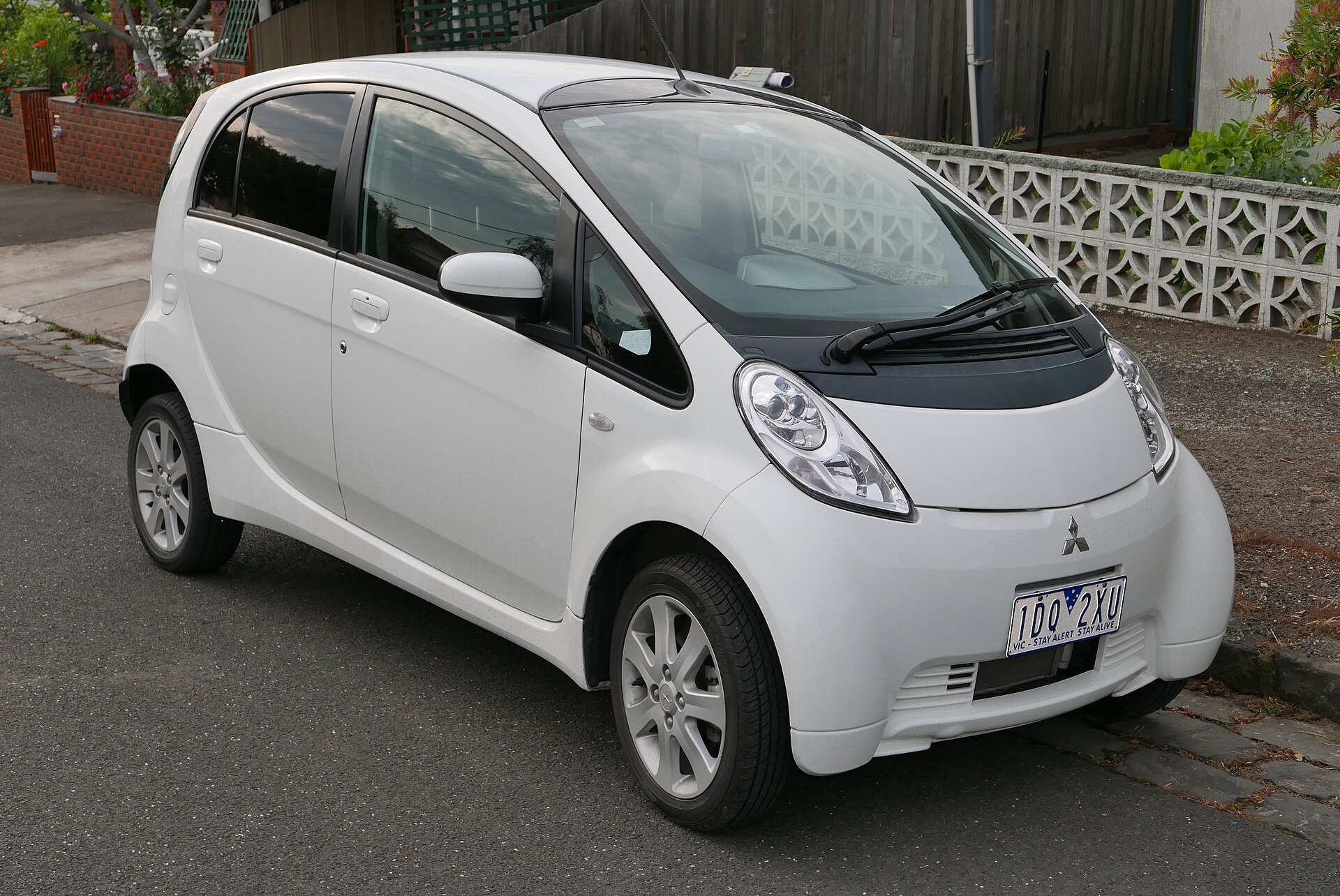
The Mitsubishi i-MiEV is a four-seat electric city car built from 2009 to March 2021 at Mitsubishi's Mizushima plant in Japan. Based on the rear-engined Mitsubishi i kei car, it was one of the first mass-produced electric cars, reached Europe in 2010 and was also sold as the Peugeot iOn and Citroën C-Zero. It has a 16 kWh battery, a 49 kW motor at the rear and an official European range of 150 km.
In short
- One generation (2009-2021), a five-door hatchback with rear-wheel drive and a 16 kWh lithium-ion battery under the floor.
- Motor: 49 kW (67 PS) peak and 180 Nm; top speed 130 km/h.
- Range 150 km NEDC, 160-180 km on the Japanese cycles and 100 km on the US EPA cycle; CHAdeMO fast charging to about 80% in 30 minutes.
- German list price EUR 34,990 at launch (December 2010), cut to EUR 23,790 when it was renamed Electric Vehicle in 2014 (ADAC).
Size at a glance
| Dimensions | Mitsubishi i-MiEV HA0 |
|---|---|
| Length | 3,395 mm133.7 in |
| Width | 1,475 mm58.1 in |
| Height | 1,600 mm63.0 in |
| Wheelbase | 2,550 mm100.4 in |
Specs by version
Engines
| Version | Engine | Power | Torque | Gearbox | Drive | Production years |
|---|---|---|---|---|---|---|
| i-MiEV 16 kWh | Electric | 49 kW 67 PS66 hp | 180 Nm133 lb-ft | Single-speed | Rear-wheel drive | 2009–2021 |
Performance
Show all 1 versions
| Version | Top speed |
|---|---|
| i-MiEV 16 kWh | 130 km/h81 mph |
Dimensions and weight
Show all 1 versions
| Version | Length | Width | Height | Wheelbase | Kerb weight |
|---|---|---|---|---|---|
| i-MiEV 16 kWh | 3,395 mm133.7 in | 1,475 mm58.1 in | 1,600 mm63.0 in | 2,550 mm100.4 in | 1,080 kg2,381 lb |
Verified Manufacturer and type-approval data from our catalog · Sources and methodology
Mitsubishi i-MiEV at a glance
| Specification | Mitsubishi i-MiEV |
|---|---|
| Segment | A-segment city car, battery-electric |
| Years | 2009-2021 (Europe from 2010) |
| Body | five-door hatchback, four seats |
| Plant | Mizushima, Kurashiki, Okayama (Japan) |
| Drive | rear-mounted permanent-magnet motor, rear-wheel drive |
| Battery | 16 kWh lithium-ion, 88 cells, 330 V |
| Twins | Peugeot iOn, Citroën C-Zero; vans: Minicab-MiEV |
The i-MiEV is one of the early cars in our electric cars section. Mitsubishi's other models are on our Mitsubishi brand page.
Generations
| Generation | Code | Years | Body styles | Engines | Power (kW / hp) |
|---|---|---|---|---|---|
| i-MiEV | HA0 | 2009-2021 | 5-door hatchback | permanent-magnet electric motor, 16 kWh battery | 47-49 kW (63-67 PS) |
There was only one generation. The car was updated several times, most visibly for North America, where it was longer and wider, and in Japan from 2018, when new bumpers increased the length to 3,480 mm. The code HA0 is the one used by ADAC.
History: from kei car to electric pioneer
The i-MiEV takes the body of the Mitsubishi i, a Japanese kei car whose engine sat ahead of the rear axle. For the electric version Mitsubishi replaced the engine and fuel tank with a battery pack, motor and inverter. Fleet customers in Japan received the first cars in July 2009, and private buyers from 1 April 2010.
European production started in October 2010, and 15 European countries received the car from January 2011. PSA sold it as the Peugeot iOn and Citroën C-Zero; Wikipedia reports a contract for up to 100,000 units, but Mitsubishi suspended deliveries to PSA in August 2012 because of weak sales. By July 2014 more than 17,500 cars of the three badges had been sold in Europe, with Norway the largest market (about 4,920 registrations), followed by France and Germany. Global sales passed 50,000 by March 2015, counting the Minicab-MiEV vans and trucks.
Outside Europe the numbers stayed small: Japan had taken 10,423 cars by December 2014 and the United States 1,893. Mitsubishi also put the same motor and battery options into the Minicab-MiEV van and pick-up, launched in Japan in 2011; Wikipedia gives combined sales of the Minicab-MiEV and the i-MiEV of more than 31,000 by April 2019.
In Germany Mitsubishi renamed the car simply Electric Vehicle in April 2014 and cut the list price. The US version was dropped in August 2017, and production ended in March 2021.

Motor, battery and performance
| Parameter | Figure |
|---|---|
| Motor | permanent-magnet synchronous, rear axle |
| Peak power | 49 kW (67 PS); some sources give 47 kW (63 hp) |
| Continuous power | 35 kW (47 hp) |
| Torque | 180 Nm |
| Top speed | 130 km/h (80 mph) |
| Battery | 16 kWh lithium-ion, 88 cells, 330 V nominal |
| Japanese M grade | 10.5 kWh battery |
From the 2013 model year the cells changed from LEV50 to LEV50N, with an electrolyte additive meant to improve life under heavy load and heat. The Peugeot and Citroën versions moved to an 80-cell, 14.5 kWh pack at the same time. A Toshiba SCiB lithium-titanate battery was offered only in Japan. Our power converter translates kW into PS and hp.

Range and charging
| Cycle | Range |
|---|---|
| NEDC (Europe) | 150 km |
| Japanese JC08, G grade | 180 km |
| Japanese JC08, M grade | 120 km |
| US EPA combined (2012) | 100 km (62 mi) |
| Australian ADR | 155 km |
The EPA rated the 2012 i-MiEV at 112 MPGe combined, more efficient on paper than the 2011 Nissan Leaf. Like all cars of its era it loses much of its range when the heater runs. A CHAdeMO fast charger fills the battery to about 80% in 30 minutes. On an AC wallbox limited to 16 A a full charge takes about five hours, and on a 10 A household socket at 230 V about eight hours.


Dimensions, space and boot
| Parameter (European and Japanese car) | Metric | Imperial |
|---|---|---|
| Length | 3,395 mm (3,480 mm Japan 2018-2021) | 133.7 in |
| Width | 1,475 mm | 58.1 in |
| Height | 1,600 mm | 63.0 in |
| Wheelbase | 2,550 mm | 100.4 in |
| Kerb weight | 1,080 kg | 2,381 lb |
The US car was 3,680 mm long, 1,585 mm wide and 1,615 mm tall, 285 mm longer and 110 mm wider than the Japanese version. The long wheelbase for such a short car puts the wheels at the corners, which helps cabin space. Our sources give no official boot volume. Compare its footprint with other cars using the size comparison tool.
Running costs and prices
At launch the i-MiEV was expensive. Mitsubishi aimed for about EUR 33,000-35,000; the German list price in December 2010 was EUR 34,990, Spain started at EUR 29,153, and the UK price in January 2011 was GBP 28,990 (about EUR 34,000 at the time), down from GBP 38,699 announced in March 2010. ADAC lists the renamed Electric Vehicle at EUR 23,790 in Germany from April 2014. Today the car is a cheap used EV whose value depends almost entirely on the state of its battery.
Safety
Euro NCAP tested the i-MiEV in 2011 and gave it four stars, with 73% for adult occupants, 78% for child occupants, 48% for pedestrians and 86% for safety assist. Euro NCAP stated that the result also applies to the Citroën C-Zero. More results are on our safety page.
Reliability and known issues
The battery is what matters on a used i-MiEV. Wikipedia notes that UK cars did not get the 10-year traction battery warranty offered elsewhere, although that claim is marked as needing a citation. The cell change of 2013 was intended to make the battery more durable. Otherwise our sources contain no fault statistics, so we do not repeat forum claims; a battery health report is the most useful document when buying.
Rivals
| Model | Engines | Power (hp) | Boot (l) | Price from (EUR) |
|---|---|---|---|---|
| Mitsubishi i-MiEV | electric, 16 kWh | 49 kW (67 PS) | not published | 34,990 (Germany, 2010) |
| Peugeot iOn / Citroën C-Zero | electric, 16 kWh (14.5 kWh from 2013) | same motor | not published | not verified |
| Nissan Leaf (2010) | electric | not verified | not verified | not verified |
| Volkswagen e-up! | electric, 18.7 kWh (2013) | not verified | not verified | not verified |
See exact versions in our comparison tool.
Photo gallery


Mitsubishi i-MiEV in our rankings
- No. 1 of 93 · Smallest hatchbacks (3,395 mm)
- No. 2 of 531 · Smallest cars (3,395 mm)
- No. 38 of 391 · Lightest cars (1,080 kg · top 10%)
- No. 16 of 76 · Lightest hatchbacks (1,080 kg · top 22%)
- No. 359 of 1082 · Longest-running car nameplates (12 years · top 35%)
- No. 61 of 91 · Most torque: hatchbacks (180 Nm · top 68%)
Shorter than 99% of ranked cars in the 1CARS catalog (No. 2 of 531).
FAQ
How far can a Mitsubishi i-MiEV go on a charge?
Officially 150 km on the European NEDC cycle; the stricter US EPA test gave 100 km. Heating in winter reduces range noticeably.
Is the Peugeot iOn the same as the i-MiEV?
Yes. The Peugeot iOn and Citroën C-Zero are rebadged i-MiEVs built by Mitsubishi in Japan; from 2013 they used a smaller 80-cell, 14.5 kWh battery.
When was the i-MiEV discontinued?
Production ended in March 2021. US sales had already stopped in August 2017.
Does the i-MiEV support fast charging?
Yes, through a CHAdeMO DC socket, which charges to about 80% in 30 minutes.
Data sources
Data checked by an editor against the sources below.