 Citroen Type A
Specs, engines and history
Published Sources (1) Report an error
By Oleksandr Hnatiuk, Automotive Editor & Used Car Specialist
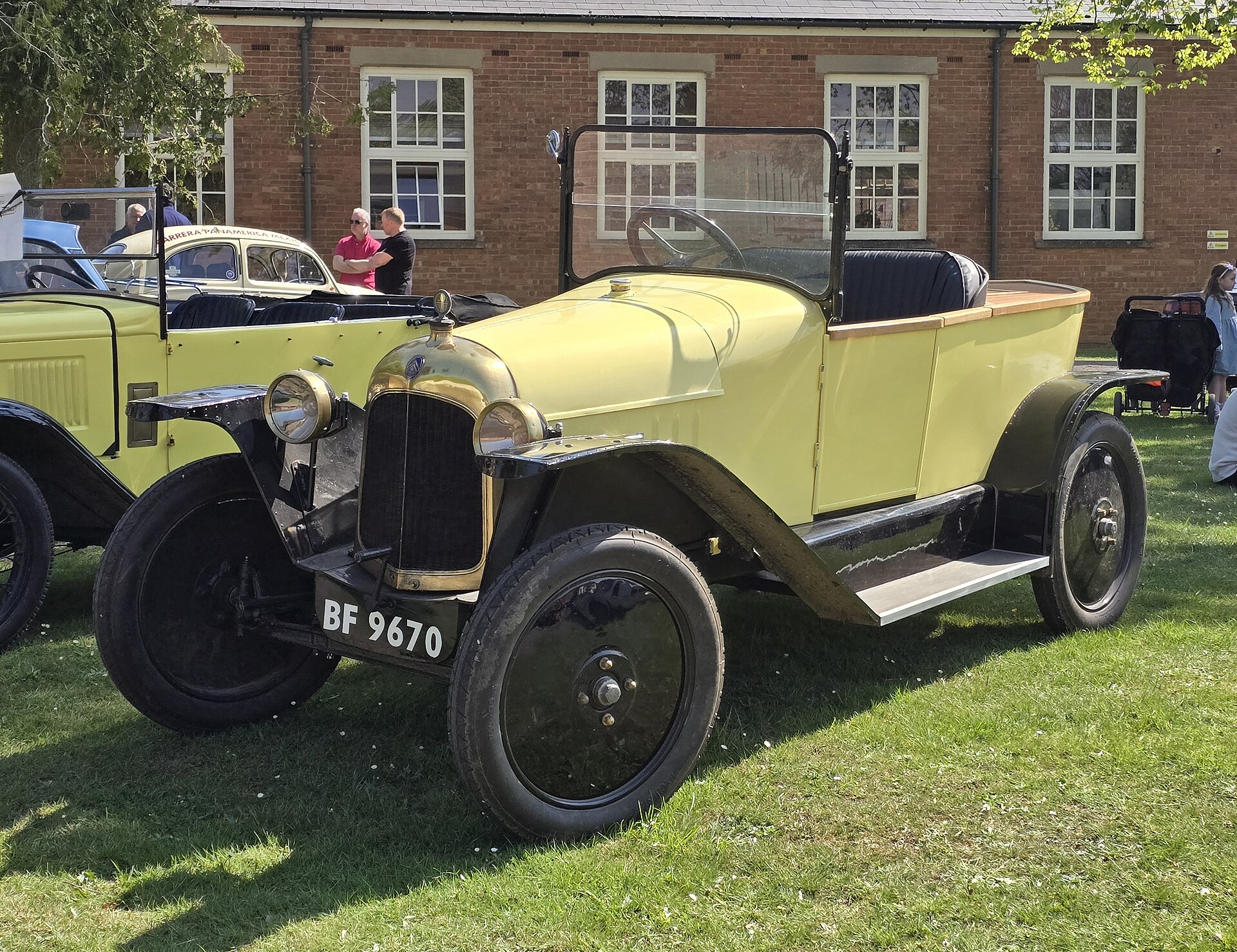
- Built
- 1919–1921
- Top power
- 13 kW (18 PS)
Which Type A to choose
Our verdict · Oleksandr Hnatiuk
- For the full picture: a long-chassis four-seat Torpedo, the standard open tourer of 1919–1921.
- For rarity: a short-chassis car, sold only to order until early 1920.
- For a little more speed: a 1921 Type A Spécial with the 1,462 cc engine.
- For history: a 1919 car from the first months of production at the Quai de Javel.
Mechanical parts are simple, but the brakes work on the rear wheels only, so plan for long stopping distances. The non-synchronised three-speed gearbox also needs double-declutching, and the 25-litre tank limits a day's touring to about 330 km between fills. Citroën's later models are listed in the Citroën catalogue, and other early cars in our classic cars section.
The Citroën Type A was the first car made by Citroën, built at the Quai de Javel in Paris from June 1919 to December 1921. André Citroën had made ammunition during the First World War and turned the factory over to a light four-cylinder car built by assembly-line methods. At about 100 cars a day, Citroën became the first mass-production car maker in Europe. In two and a half years the company built 24,093 Type A cars before the Type B2 replaced it.
In short
- Production from June 1919 to December 1921 in Paris; 24,093 built.
- 1,327 cc water-cooled four-cylinder engine with 13 kW (18 hp) and a top speed of 65 km/h.
- Sold as the "10 HP" after its French fiscal rating of 10 CV; long and short chassis with open and closed bodies.
- One of the first European answers to the Ford Model T, together with the Fiat 501.
Citroën Type A at a glance
| Parameter | Metric | Imperial |
|---|---|---|
| Maker | Citroën, Quai de Javel, Paris | - |
| Production | June 1919 – December 1921 | - |
| Built | 24,093 | - |
| Engine | 1,327 cc straight-four, water-cooled | 81 cu in |
| Power | 13 kW (18 hp) | - |
| Gearbox | three-speed manual, no synchromesh | - |
| Final drive | bevel gears with herringbone teeth | - |
| Wheelbase | 2,830 mm (long), 2,550 mm (short) | 111.4 / 100.4 in |
| Length | 4,000 mm (long), 3,400 mm (short) | 157.5 / 133.9 in |
| Width | 1,410 mm | 55.5 in |
| Kerb weight | 810 kg (long), 680 kg (short) | 1,790 / 1,500 lb |
| Top speed | 65 km/h | 40 mph |
| Successor | Citroën Type B2 | - |
From shells to cars
André Citroën was 35 when he founded the Société des engrenages Citroën in 1913 to make double-chevron gears under a patent he had bought, according to French Wikipedia. During the First World War the business produced ammunition. From 1917 he had a light car of medium range developed under the engineer Jules Salomon, so that the factory would have work once the war ended.
The result was presented at a press event in Citroën's showroom on the Champs-Élysées and went into production in June 1919. French Wikipedia notes that the first order was delivered a month after it was signed. Production took place at the Quai de Javel in the 15th arrondissement of Paris, where Citroën applied assembly-line methods inspired by Taylorism and reached about 100 cars a day.


Assembly-line production in Paris
| Year | Event |
|---|---|
| 1913 | André Citroën founds his gear company |
| 1917 | development of a light car begins under Jules Salomon |
| June 1919 | Type A production starts at the Quai de Javel |
| 1919 | 2,810 cars sold |
| early 1920 | short chassis dropped |
| 1920 | 12,244 cars sold |
| 1921 | 9,039 cars sold; Type A Standard, Luxe and Spécial in the range |
| December 1921 | production ends; the Type B2 takes over |
English Wikipedia contains one inconsistency: its text says that more than 20,000 cars left the factory in 1920, while its own table gives 12,244 for that year. The yearly figures in the table add up to the stated total of 24,093. Citroën later visited Ford in Detroit, in 1923 and 1931, and the Type A and the Fiat 501 are described as the first European responses to Ford's move into Europe. For comparison, the Ford Model T had been in production in the United States since 1908.
Engine and chassis
The Type A used a water-cooled four-cylinder engine of 1,327 cc that produced 13 kW (18 hp). German Wikipedia gives a bore of 65 mm, a stroke of 100 mm and 13 kW (18 PS) at 2,100 rpm. It was advertised as a 10 CV car, its French fiscal horsepower, and the English-language "10 HP" name came from that rating. Per litre, the engine gave about 10 kW, roughly the specific output of Cadillac's first V8 of 1915 and nearly twice the 5 kW per litre of the Ford Model T. A three-speed gearbox without synchromesh drove the rear wheels through a bevel final drive with herringbone teeth; English Wikipedia notes, without a firm reference, that these gears inspired the double-chevron badge.
Suspension used inverted quarter-elliptic springs at the front and double quarter-elliptic springs at the rear. The brakes acted only on the rear wheels, worked by a hand lever, while a pedal operated a transmission brake. French Wikipedia lists the car among the first with left-hand steering.
The long-chassis car weighed 810 kg, so 13 kW gave about 16 kW per tonne; the lighter short chassis managed about 19 kW per tonne. That was enough for 65 km/h (40 mph). Our power-to-weight calculator shows how such figures compare with a current small car.
Economy and running figures
German Wikipedia lists fuel consumption of about 7.5 l/100 km and a 25-litre tank, which gives a range of roughly 330 km on a full tank. The short chassis had a track of 1,190 mm, and the car ran on 710 × 90 tyres.
Type A and Model T compared
| Figure | Citroën Type A | Ford Model T |
|---|---|---|
| Production | 1919–1921 | 1908–1927 |
| Built | 24,093 | about 15 million |
| Engine | 1.3 l four | 2.9 l four |
| Power | 13 kW (18 hp) | 15 kW (20 hp) |
| Gearbox | three-speed | two-speed planetary |
| Weight | 680–810 kg | 540–750 kg |
| Top speed | 65 km/h | about 68 km/h |
On paper the two cars were close: similar power, similar weight and almost the same top speed. The Citroën had a smaller engine, a conventional three-speed gearbox and left-hand steering. What separated them was scale: in 1925 Ford built 9,000 to 10,000 Model Ts a day, more than three times the 2,810 Type A cars Citroën sold in 1919.
Bodies on two chassis lengths
The Type A came on two wheelbases. The short chassis was available only to order and was dropped in early 1920. It was 280 mm shorter in wheelbase, 600 mm shorter overall and 130 kg lighter than the long chassis.
| Variant | Years | Body / purpose | Engine | Notes |
|---|---|---|---|---|
| Long chassis Torpedo | 1919–1921 | four-seat open tourer | 1,327 cc, 13 kW | - |
| Long chassis Torpedo Sport | 1919–1921 | sporting open tourer | 1,327 cc, 13 kW | - |
| Long chassis Conduite Intérieure / Coupé de Ville | 1919–1921 | saloon / town car | 1,327 cc, 13 kW | closed bodies |
| Long chassis light truck | 1919–1921 | commercial | 1,327 cc, 13 kW | - |
| Short chassis | 1919 – early 1920 | three-seat dashboard, saloon, Coupé de Ville, van | 1,327 cc, 13 kW | to order only |
| Type A Spécial (Torpedo Sport Spécial) | 1921 | sporting tourer | 1,462 cc, 16 kW (22 hp) at 2,100 rpm | engine later used in the Type B2 |

Successors and the Javel factory
In 1921 the range consisted of the Type A Standard and the Type A Luxe, which kept the original engine, and the Type A Spécial; the larger 1,462 cc engine of the Spécial passed to the Type B2, which replaced the Type A from 1921. The Type B10 followed in 1925. French Wikipedia also notes that a 1919 Type A appeared in a world-tour episode of the television series Wheeler Dealers, filmed in Kolkata. The Quai de Javel factory itself was demolished in 1975, and the site is now the Parc André-Citroën. The rest of the company's story, from these first cars to today's range, is in our history of Citroën.

FAQ
When was the Citroën Type A built?
From June 1919 to December 1921, at the Quai de Javel factory in Paris.
How many Citroën Type A were made?
24,093: 2,810 sold in 1919, 12,244 in 1920 and 9,039 in 1921, according to English Wikipedia.
What engine did the Citroën Type A have?
A 1,327 cc water-cooled four-cylinder engine with 13 kW (18 hp), good for about 65 km/h (40 mph). The 1921 Spécial had 1,462 cc and 16 kW (22 hp).
Was the Citroën Type A the first mass-produced European car?
English Wikipedia states that with the Type A Citroën became the first mass-production car maker in Europe, building about 100 cars a day at the Quai de Javel with assembly-line methods.
Why is it called the 10 HP?
It was rated at 10 CV under France's fiscal system, and Citroën used "10 HP" as the English label.
Data sources
Data checked by an editor against the sources below.