 Ford Model T
Specs, engines and history
Published Sources (1) Report an error
By Sarah Whitmore, Senior Automotive Writer
- Built
- 1908–1927
- Top power
- 15 kW (20 PS)
Which Model T to choose
Our verdict · Sarah Whitmore
- For originality and value: a 1920s Tudor or Fordor sedan; closed cars are practical in poor weather and are among the most common survivors.
- For the classic look: a touring car or roadster with the "low hood" of 1917–1925.
- For collectors with a large budget: a brass-era car built before 1915, recognised by its five-sided bonnet and brass lamps.
- For everyday tours: look for a car with a Ruckstell axle or an auxiliary gearbox, which make hills and modern traffic easier.
Plan for the controls first: a test drive with an experienced owner is the best way to learn the pedals. Other early Fords and their successors are listed in the Ford catalogue, and more pre-war cars are collected in our classic cars section.
The Ford Model T was the car Ford built from 1908 to 1927 and the first automobile made in such numbers that ordinary families could buy one. A 2.9-litre four-cylinder engine, a pedal-operated planetary gearbox and a high, light chassis carried it over the poor roads of its day. Around 15 million left the factories, a production record that stood until the Volkswagen Beetle passed it in 1972. Its successor was the Model A.
In short
- Built from 1 October 1908 to 26 May 1927 at Piquette Avenue and Highland Park in Detroit, plus assembly plants in Canada, England and many other countries.
- 2.9-litre (177 cu in) side-valve four, 15 kW (20 hp), top speed about 68 km/h (42 mph).
- The moving assembly line of October 1913 cut chassis assembly from 12.5 hours to 93 minutes.
- Price of a runabout fell from $825 in 1909 to $260 in 1925.
Specs by version
Engines
| Version | Engine | Power | Gearbox | Drive | Production years |
|---|---|---|---|---|---|
| Touring 2.9 (20 hp) | 2.9 l · 4 cyl · Petrol 2,896 cc | 15 kW 20 PS20 hp | 2-sp Manual | Rear-wheel drive | 1909–1927 |
| Runabout 2.9 (20 hp) | 2.9 l · 4 cyl · Petrol 2,896 cc | 15 kW 20 PS20 hp | 2-sp Manual | Rear-wheel drive | 1909–1927 |
| Coupe 2.9 (20 hp) | 2.9 l · 4 cyl · Petrol 2,896 cc | 15 kW 20 PS20 hp | 2-sp Manual | Rear-wheel drive | 1909–1927 |
| Tudor / Fordor sedan 2.9 (20 hp) | 2.9 l · 4 cyl · Petrol 2,896 cc | 15 kW 20 PS20 hp | 2-sp Manual | Rear-wheel drive | 1915–1927 |
Performance
Show all 4 versions
| Version | Top speed |
|---|---|
| Touring 2.9 (20 hp) | 68 km/h42 mph |
| Runabout 2.9 (20 hp) | 68 km/h42 mph |
| Coupe 2.9 (20 hp) | 68 km/h42 mph |
| Tudor / Fordor sedan 2.9 (20 hp) | 68 km/h42 mph |
Dimensions and weight
Show all 4 versions
| Version | Length | Wheelbase |
|---|---|---|
| Touring 2.9 (20 hp) | 3,404 mm134.0 in | 2,540 mm100.0 in |
| Runabout 2.9 (20 hp) | 3,404 mm134.0 in | 2,540 mm100.0 in |
| Coupe 2.9 (20 hp) | 3,404 mm134.0 in | 2,540 mm100.0 in |
| Tudor / Fordor sedan 2.9 (20 hp) | 3,404 mm134.0 in | 2,540 mm100.0 in |
Verified Manufacturer and type-approval data from our catalog · Sources and methodology
Ford Model T at a glance
| Parameter | Metric | Imperial |
|---|---|---|
| Production | 1908–1927 | — |
| Built | about 15 million (Ford count) | — |
| Engine | 2.9-litre straight-four, side valves | 177 cu in |
| Power | 15 kW at 1,800 rpm | 20 hp |
| Gearbox | two forward speeds plus reverse, planetary, pedal-operated | — |
| Drive | rear wheels, torque tube | — |
| Wheelbase | 2,540 mm | 100 in |
| Length | 3,404 mm | 134 in |
| Kerb weight | 540–750 kg depending on body | 1,200–1,650 lb |
| Top speed | about 68 km/h | 42 mph |
| Fuel use (Ford) | about 11–18 L/100 km | 13–21 mpg (US) |
| Successor | Ford Model A (1927) | — |
Launch in 1908 and the first orders
The first production Model T was completed on 12 August 1908 at the Piquette Avenue plant in Detroit and left the works on 27 September 1908. Sales officially opened on 1 October. Ford had promised a strong, simple car at a low price, and buyers believed it: 15,000 orders arrived within two days of the release.
Demand soon outgrew Piquette Avenue. In 1910 production moved to the new Highland Park complex, and from 1911 the car was also assembled at Walkerville in Canada and at Trafford Park, Manchester. That made the Model T the first car built in several countries at the same time. After the First World War, assembly lines followed in Germany, Argentina, France, Spain, Denmark, Norway, Belgium, Brazil, Mexico, Australia and Japan. German Wikipedia records that Ford's Berlin operation began assembling imported parts on 1 April 1926 with about 30 workers.

Engine and chassis
Under the five-sided early bonnet sat a four-cylinder side-valve engine of 2.9 litres, with a bore of 95.25 mm and a stroke of 101.6 mm. It produced 15 kW (20 hp) at only 1,800 rpm. Compression started at 4.5:1 and was later lowered to 4:1, so the engine ran on poor fuel; it would also burn kerosene or ethanol. After the first 2,447 cars, Ford dropped the water pump and cooled the engine by thermosiphon.
Ignition came from a magneto built into the flywheel, feeding trembler coils, so no starting battery was needed. Electric headlamps arrived in 1915, and an electric starter became available in 1919. Parts of the car used vanadium steel, and the front axle was drop-forged in one piece; for demonstrations Ford twisted such axles through 2,880 degrees without breaking them.
Suspension relied on transverse semi-elliptic leaf springs at both ends. The car had no brakes on the front wheels at all: a band in the transmission did the stopping, helped by a parking brake on the rear wheels. Wooden artillery wheels were used until steel-spoke wheels arrived for 1926–27. If you want to compare 15 kW with a modern engine, our power converter does the arithmetic in any unit.
How the Model T is driven
The Model T does not use a clutch pedal and gear lever in the modern way. Three floor pedals and a hand lever control everything. The left pedal selects low gear when pressed and high gear when released, with the hand lever holding neutral; the middle pedal engages reverse; the right pedal works the transmission brake.
Contemporary language called this a "three-speed" gearbox, counting reverse; in today's terms it has two forward speeds. Owners who needed more could buy a Ruckstell two-speed rear axle or one of more than 30 aftermarket auxiliary gearboxes. The videos below show how much practice the system takes for a driver used to modern cars.

The moving assembly line
The Model T is remembered above all for the way it was built. On 7 October 1913, Ford started a moving assembly line at Highland Park. Work was broken down into 84 separate tasks, and the time to assemble one chassis fell from 12.5 hours to 93 minutes. By 1914 a finished car rolled off the line every three minutes, and Ford built more cars that year than all other makers combined.
Output kept growing. In 1925 the factories built 9,000 to 10,000 cars a day, about two million a year. By 1918, half of all cars in the United States were Model Ts. When the ten-millionth car was built, half of all cars in the world were Fords.

Paint: "any colour so long as it is black"
Early cars were not all black. From 1908 to 1913 Ford offered grey, green and blue, with red reserved for the touring car, and in 1912 all cars were painted midnight blue with black wings. From 1914 to 1925 only black was available, matching Henry Ford's famous remark from 1909. The usual explanation is that black paint dried faster, but English Wikipedia notes there is no evidence for it; cheap carbon black and asphalt-based gilsonite paints, which only came in dark shades, are the more likely reasons. Ford used more than 30 different black paints during the run.
Prices year by year
The falling price was the point of the whole project. The table shows the runabout, the cheapest open model, in US dollars of each year.
| Year | Runabout price (US$, that year) | Note |
|---|---|---|
| 1909 | $825 | touring car $850 in 1909 |
| 1911 | $680 | Highland Park in full production |
| 1912 | $590 | — |
| 1913 | $525 | moving line starts in October 1913 |
| 1914 | $440 | black paint only from 1914 |
| 1915 | $390 | electric headlamps |
| 1916 | $345 | lowest price before the war |
| 1917–1919 | $500 | wartime costs |
| 1921 | $325 | — |
| 1922 | $319 | — |
| 1925 | $260 | lowest price of the run; touring car $290 |
| 1927 | $360 | last year |
These are list prices of the period, not today's money.
Body styles, Model TT and conversions
The same chassis carried a long list of bodies:
- Touring car: two-door at first, then three-door from 1912 and four-door for 1926–27.
- Roadster (runabout): from no doors in 1909 to two doors in 1926–27, with a pickup version from 1925.
- Closed cars: coupé (1909–1912 and 1917–1927), the coupelet (1915–1917), a two-door sedan with centre doors (1915–1923), the Tudor two-door sedan (1924–27) and the Fordor four-door sedan (1923–27).
- Others: a town car (1909–1918), a C-cab delivery wagon (1912), and a bare chassis for coachbuilders in every year.
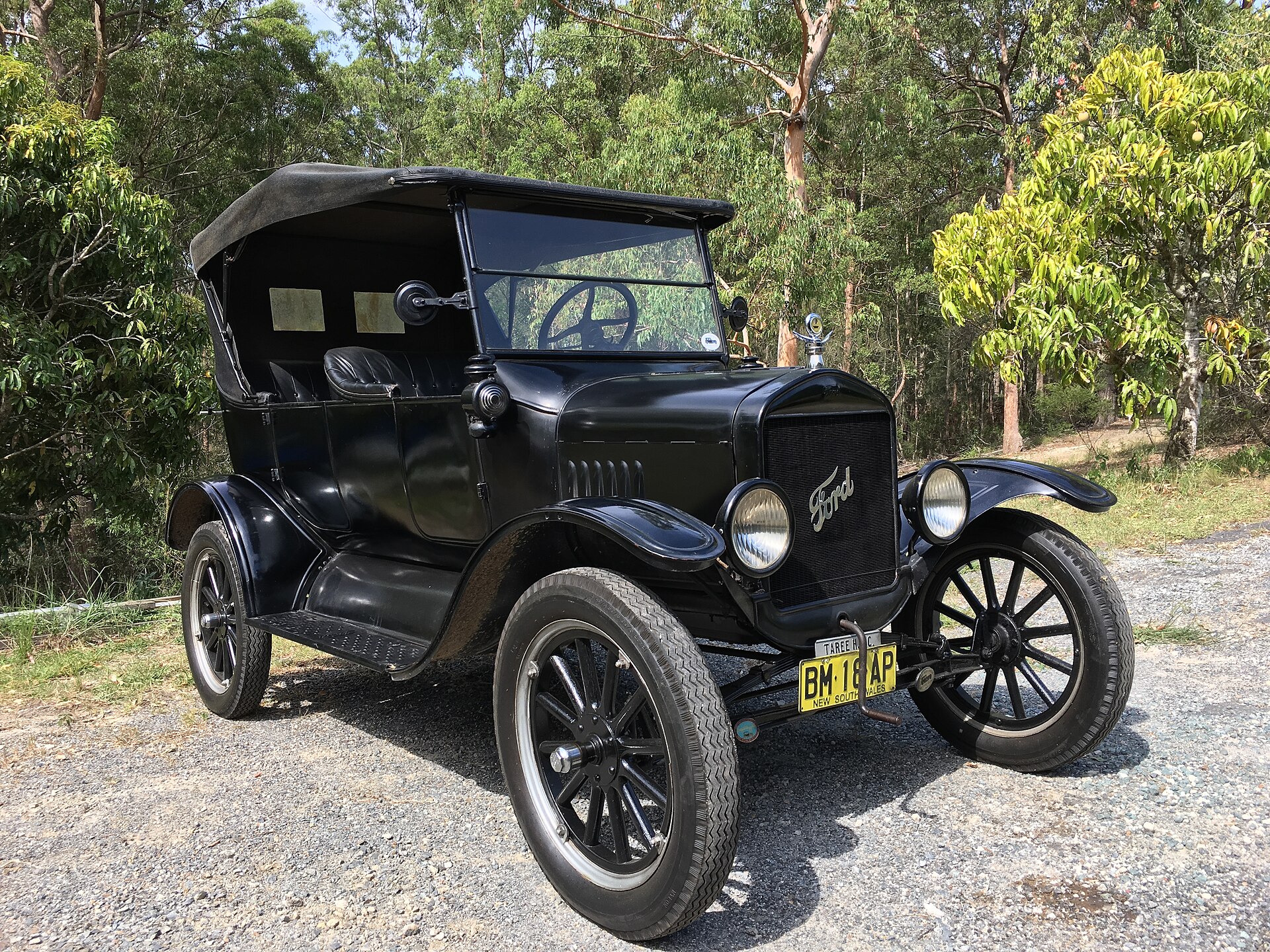
Bonnet shapes help date a car: a five-sided bonnet and acetylene lamps to 1914, a louvred bonnet with electric lamps for 1915–16, the tapered "low hood" from 1917 and the "high hood" for 1926–27. The Model TT was a heavier truck version with a worm-gear rear axle, lower gearing and a stronger frame. Farmers also turned cars into tractors with conversion kits, and the American LaFrance company rebuilt more than 900 Model Ts as fire engines.

Racing and recognition
A heavily modified Model T, the "Montier Special" of Charles Montier, finished 14th in the first 24 Hours of Le Mans in 1923. In the 1999 Car of the Century vote, the Model T was ranked the most influential car of the 20th century, ahead of the Mini, the Citroën DS and the Volkswagen Beetle.
The end of production in 1927
On 26 May 1927, Henry Ford and his son Edsel drove the 15-millionth car off the Highland Park line, and Ford moved on to the Model A, which entered production that October. The last Model T was assembled in Cork, Ireland, in December 1927.
Ford's figure of 15 million is a milestone, not an audited sum: the per-year production table in English Wikipedia adds up to 14,689,525. About 170,000 replacement engines were built after car production stopped, and engine production finally ended on 4 August 1941. The company background is covered in our history of the Ford Motor Company.
Photo gallery


Ford Model T in our rankings
- No. 1 of 89 · Smallest coupes (3,404 mm)
- No. 1 of 86 · Smallest sedans (3,404 mm)
- No. 1 of 30 · Smallest convertibles and roadsters (3,404 mm)
- No. 2 of 420 · Smallest cars (3,404 mm)
- No. 61 of 131 · Biggest engines: sedans (2,896 cc · top 47%)
- No. 293 of 557 · Biggest engines: cars (2,896 cc · top 53%)
Shorter than 99% of ranked cars in the 1CARS catalog (No. 2 of 420).
FAQ
How many Ford Model T were made?
About 15 million by Ford's own count, marked by the 15-millionth car on 26 May 1927. The year-by-year table in English Wikipedia totals 14,689,525.
How much did a Ford Model T cost?
The runabout cost $825 in 1909 and fell to $260 by 1925. These are prices of the time in US dollars; the 1925 touring car cost $290.
What engine did the Model T have?
A 2.9-litre (177 cu in) side-valve four with 15 kW (20 hp) at 1,800 rpm, cooled by thermosiphon and fired by a flywheel magneto.
How fast could a Ford Model T go?
About 68 km/h (42 mph) flat out, according to English Wikipedia; German Wikipedia gives 67 km/h.
Why were Model Ts black?
From 1914 to 1925 only black was offered. Ford said the paint dried faster, but historians point to the low cost of carbon-black and gilsonite paints, which came only in dark shades.
Data sources
Data checked by an editor against the sources below.