 Ford F-100
All generations, specs and history
Published Sources (5) Report an error
By Sarah Whitmore, Senior Automotive Writer
- Built
- 1953–1983
- Generations
- 6
- Top power
- 190 kW (258 PS)
Timeline
F-100 generations
Click a generation for its own page
- F-100 I 1953–1956 · Pickup, Van · 75–128 kW (102–174 PS)
- F-100 II 1957–1960 · Pickup, Van
- F-100 III 1961–1966 · Pickup, Van · 85–155 kW (116–211 PS)
- F-100 IV 1967–1972 · Pickup · 112–190 kW (152–258 PS)
- F-100 V 1973–1979 · Pickup · 87–149 kW (118–203 PS)
- F-100 VI 1980–1983 · Pickup · 82–99 kW (111–135 PS)
Newest first · 6 generations since 1953
-
1980
-
1973
-
1967
-
1961
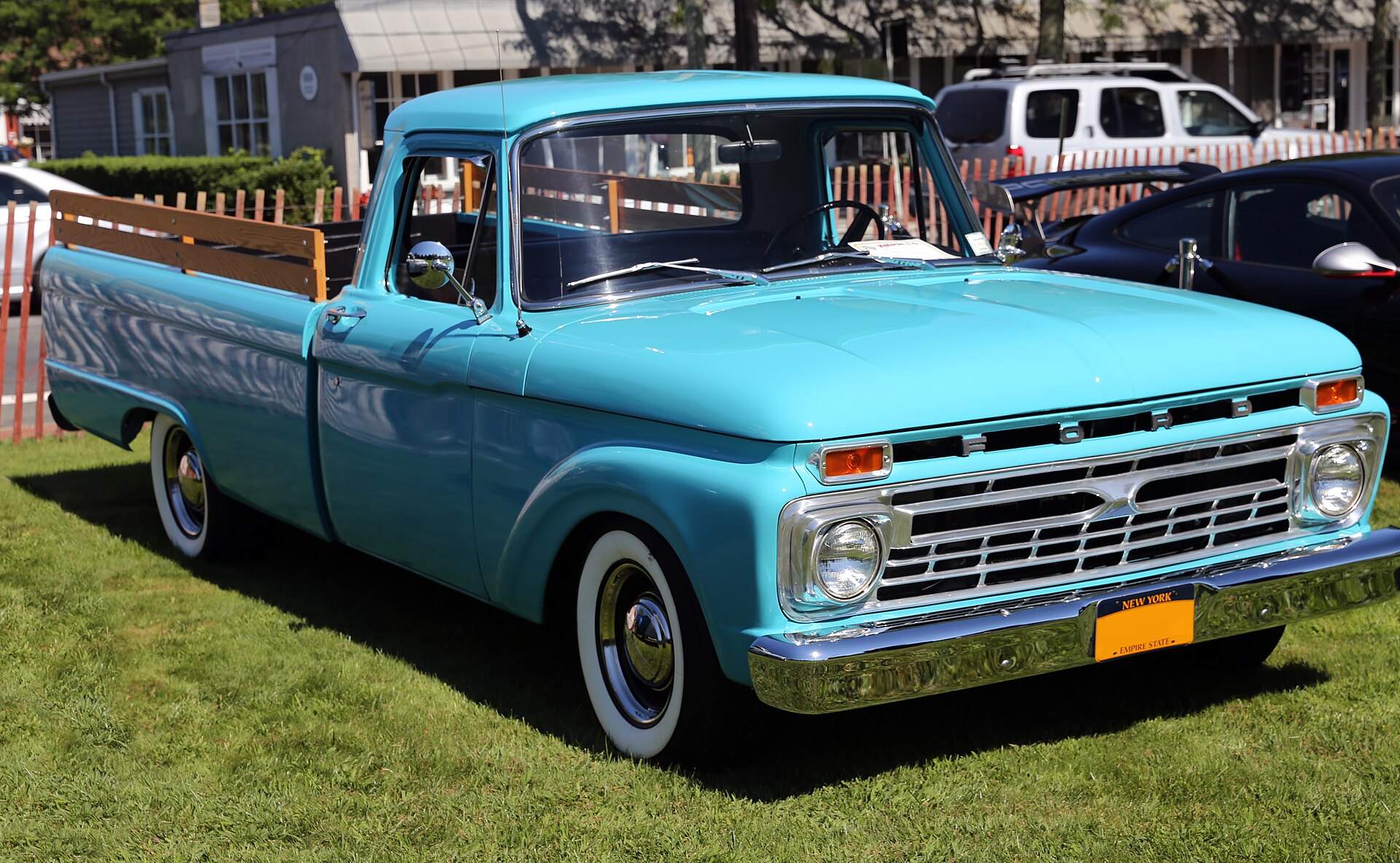
-
1957
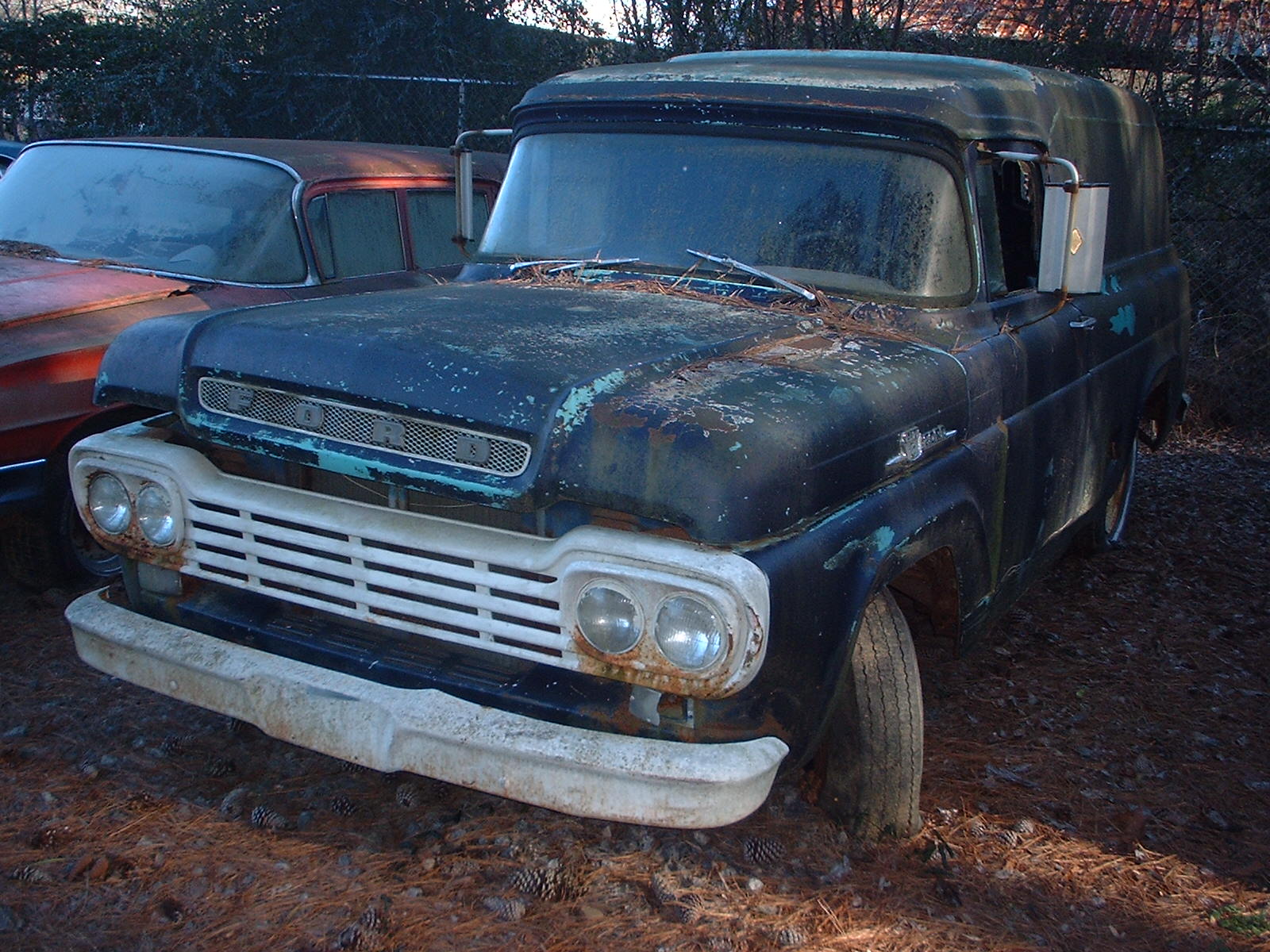
-
1953
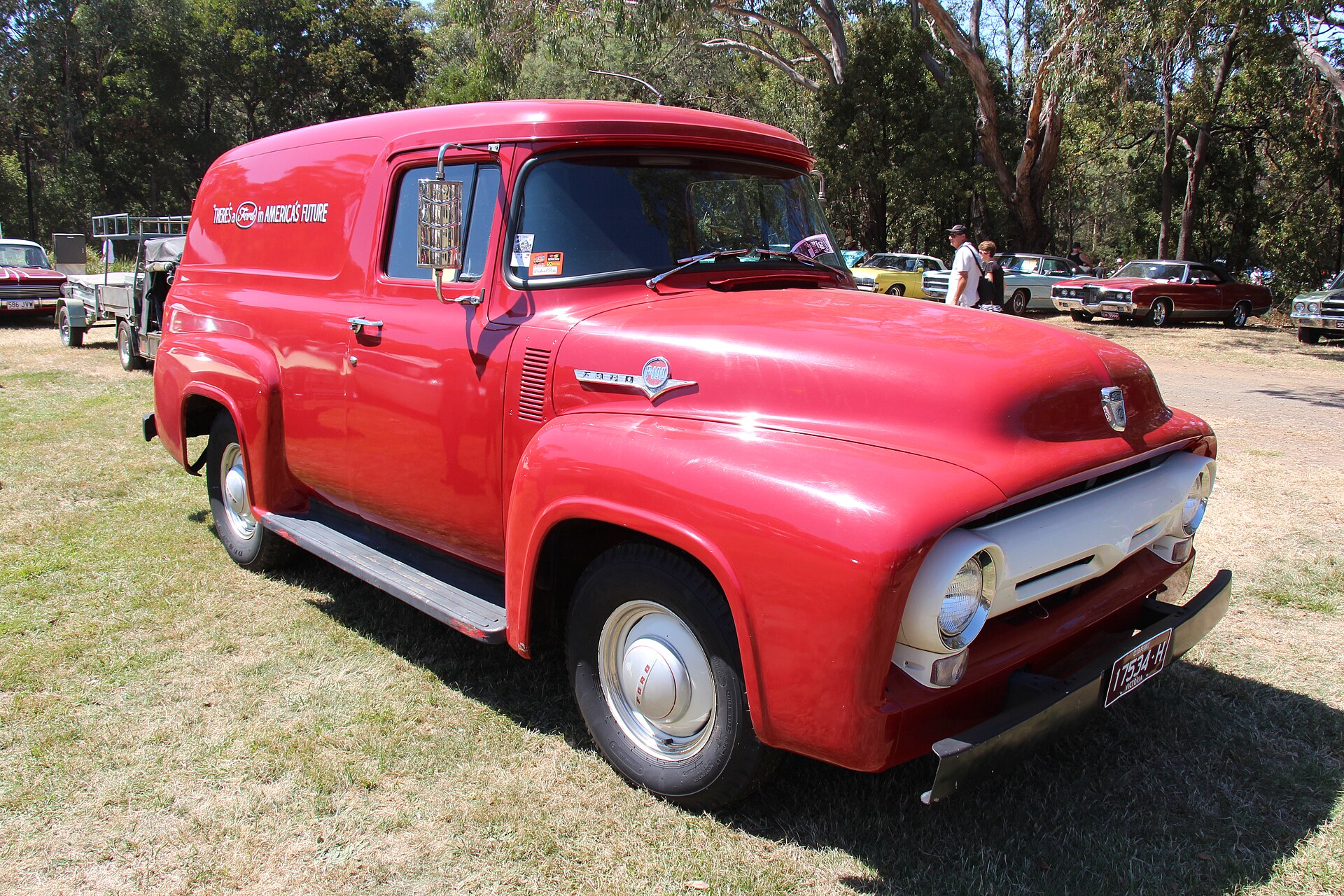


All generations by year: F-100 VI (1980–1983) · F-100 V (1973–1979) · F-100 IV (1967–1972) · F-100 III (1961–1966) · F-100 II (1957–1960) · F-100 I (1953–1956)
Which one is mine?
Pick the year of first registration to see which generation it is.
Check by VINThe Ford F-100 was the half-ton, entry-level model of Ford's F-Series pickups for thirty model years, from 1953 to 1983. It covered six generations of the F-Series, from the rounded trucks of the 1950s to the squarer, more aerodynamic 1980 design. In that time it introduced the Styleside bed, factory four-wheel drive and Twin I-Beam front suspension to Ford's light trucks. It was retired once the heavier-rated F-150, added in 1975, had taken its place as the best-selling version.
In short
- Name created in 1953, when Ford renumbered its trucks: the F-1 became the F-100, alongside the F-250 and F-350.
- Six generations: 1953–1956, 1957–1960, 1961–1966, 1967–1972, 1973–1979 and 1980–1983.
- Engines ranged from a 75 kW (101 hp) six of 1953 to FE big-block V8s; the 352 FE of 1964 was the first F-Series engine above 149 kW (200 hp), with 155 kW (208 hp).
- Since 1977 the F-Series has been America's best-selling pickup line; the F-100 itself was dropped after the 1983 model year.
Specs by version
| Version | Engine | Power | Drive | Production years |
|---|---|---|---|---|
| F-100 I · I6 215 cu in | 3.5 l · 6 cyl · Petrol 3,523 cc | 75 kW 102 PS101 hp | Rear-wheel drive | 1953 |
| F-100 I · flathead V8 239 cu in | 3.9 l · 8 cyl · Petrol 3,916 cc | 75 kW 102 PS101 hp | Rear-wheel drive | 1953 |
| F-100 I · I6 223 cu in Mileage Maker | 3.7 l · 6 cyl · Petrol 3,654 cc | 86 kW 117 PS115 hp | Rear-wheel drive | 1954–1955 |
| F-100 I · Y-block V8 239 cu in | 3.9 l · 8 cyl · Petrol 3,916 cc | 97 kW 132 PS130 hp | Rear-wheel drive | 1954–1955 |
| F-100 I · Y-block V8 272 cu in | 4.5 l · 8 cyl · Petrol 4,457 cc | 128 kW 174 PS172 hp | Rear-wheel drive | 1956 |
| F-100 III · I6 223 cu in | 3.7 l · 6 cyl · Petrol 3,654 cc | 85 kW 116 PS114 hp | Rear-wheel drive | 1961–1964 |
| F-100 III · I6 240 cu in | 3.9 l · 6 cyl · Petrol 3,933 cc | 112 kW 152 PS150 hp | Rear-wheel drive | 1965–1966 |
| F-100 III · Y-block V8 292 cu in | 4.8 l · 8 cyl · Petrol 4,785 cc | 127 kW 173 PS170 hp | Rear-wheel drive | 1961–1964 |
| F-100 III · I6 300 cu in | 4.9 l · 6 cyl · Petrol 4,916 cc | 127 kW 173 PS170 hp | Rear-wheel drive | 1965–1966 |
| F-100 III · FE V8 352 cu in | 5.8 l · 8 cyl · Petrol 5,768 cc | 155 kW 211 PS208 hp | Rear-wheel drive | 1964–1966 |
| F-100 IV · I6 300 cu in | 4.9 l · 6 cyl · Petrol 4,916 cc | 127 kW 173 PS170 hp | Rear-wheel drive | 1967–1972 |
| F-100 IV · Windsor V8 302 cu in | 4.9 l · 8 cyl · Petrol 4,949 cc | 153 kW 208 PS205 hp | Rear-wheel drive | 1969–1972 |
| F-100 IV · FE V8 360 cu in | 5.9 l · 8 cyl · Petrol 5,899 cc | 160 kW 218 PS215 hp | Rear-wheel drive | 1968–1972 |
| F-100 IV · FE V8 390 cu in | 6.4 l · 8 cyl · Petrol 6,391 cc | 190 kW 258 PS255 hp | Rear-wheel drive | 1968–1972 |
| F-100 V · I6 300 cu in | 4.9 l · 6 cyl · Petrol 4,916 cc | 87 kW 118 PS117 hp | Rear-wheel drive | 1973–1979 |
| F-100 V · V8 302 cu in | 4.9 l · 8 cyl · Petrol 4,949 cc | 97 kW 132 PS130 hp | Rear-wheel drive | 1973–1979 |
| F-100 V · FE V8 360 cu in | 5.9 l · 8 cyl · Petrol 5,899 cc | 107 kW 145 PS143 hp | Rear-wheel drive | 1973–1976 |
| F-100 V · V8 351M | 5.8 l · 8 cyl · Petrol 5,752 cc | 116 kW 158 PS156 hp | Rear-wheel drive | 1977–1979 |
| F-100 V · V8 400 cu in | 6.6 l · 8 cyl · Petrol 6,555 cc | 126 kW 171 PS169 hp | Rear-wheel drive | 1977–1979 |
| F-100 V · V8 460 cu in | 7.5 l · 8 cyl · Petrol 7,538 cc | 149 kW 203 PS200 hp | Rear-wheel drive | 1973–1979 |
| F-100 VI · V6 3.8 l | 3.8 l · 6 cyl · Petrol 3,797 cc | 82 kW 111 PS110 hp | Rear-wheel drive | 1982–1983 |
| F-100 VI · V8 255 cu in (4.2 l) | 4.2 l · 8 cyl · Petrol 4,183 cc | 86 kW 117 PS115 hp | Rear-wheel drive | 1981–1982 |
| F-100 VI · I6 300 cu in | 4.9 l · 6 cyl · Petrol 4,916 cc | 87 kW 118 PS117 hp | Rear-wheel drive | 1980–1983 |
| F-100 VI · V8 302 cu in (5.0) | 4.9 l · 8 cyl · Petrol 4,949 cc | 99 kW 135 PS133 hp | Rear-wheel drive | 1980–1983 |
Verified Manufacturer and type-approval data from our catalog · Sources and methodology
Ford F-100 at a glance
| Item | Ford F-100 |
|---|---|
| Maker | Ford Motor Company, USA |
| Model years | 1953–1983 |
| Class | half-ton (1/2 ton) full-size pickup |
| Predecessor / successor | Ford F-1 / Ford F-150 |
| Bodies | pickup (Flareside and Styleside beds), panel truck, chassis cab; SuperCab from 1974 |
| Layout | front engine, rear-wheel drive; four-wheel drive from the third generation |
| Engines | straight-six, V6 and V8 petrol engines, 3.5 to 7.5 litres |
| Gearboxes | three- and four-speed manual, overdrive, Ford-O-Matic and later three-speed automatics |
| Wheelbase (1953) | 110 in (2,794 mm) |
Production timeline
| Year | Event |
|---|---|
| 1953 | F-1 renamed F-100; Ford-O-Matic automatic offered |
| 1954 | overhead-valve Y-block V8 replaces the flathead |
| 1956 | wraparound windscreen and 12-volt electrics |
| 1957 | third generation with integrated front wings and the Styleside bed |
| 1961 | fourth generation; optional one-piece cab and bed (dropped in 1963) |
| 1965 | new frame and Twin I-Beam front suspension; 300 cu in six; Ranger trim |
| 1967 | fifth generation, three inches wider cab |
| 1973 | sixth generation; SuperCab follows for 1974 |
| 1975 | F-150 added above the F-100 |
| 1977 | F-Series becomes the best-selling pickup line in the USA |
| 1980 | seventh generation, first complete redesign since 1965 |
| 1983 | last F-100 |

The first F-100 (1953–1956)
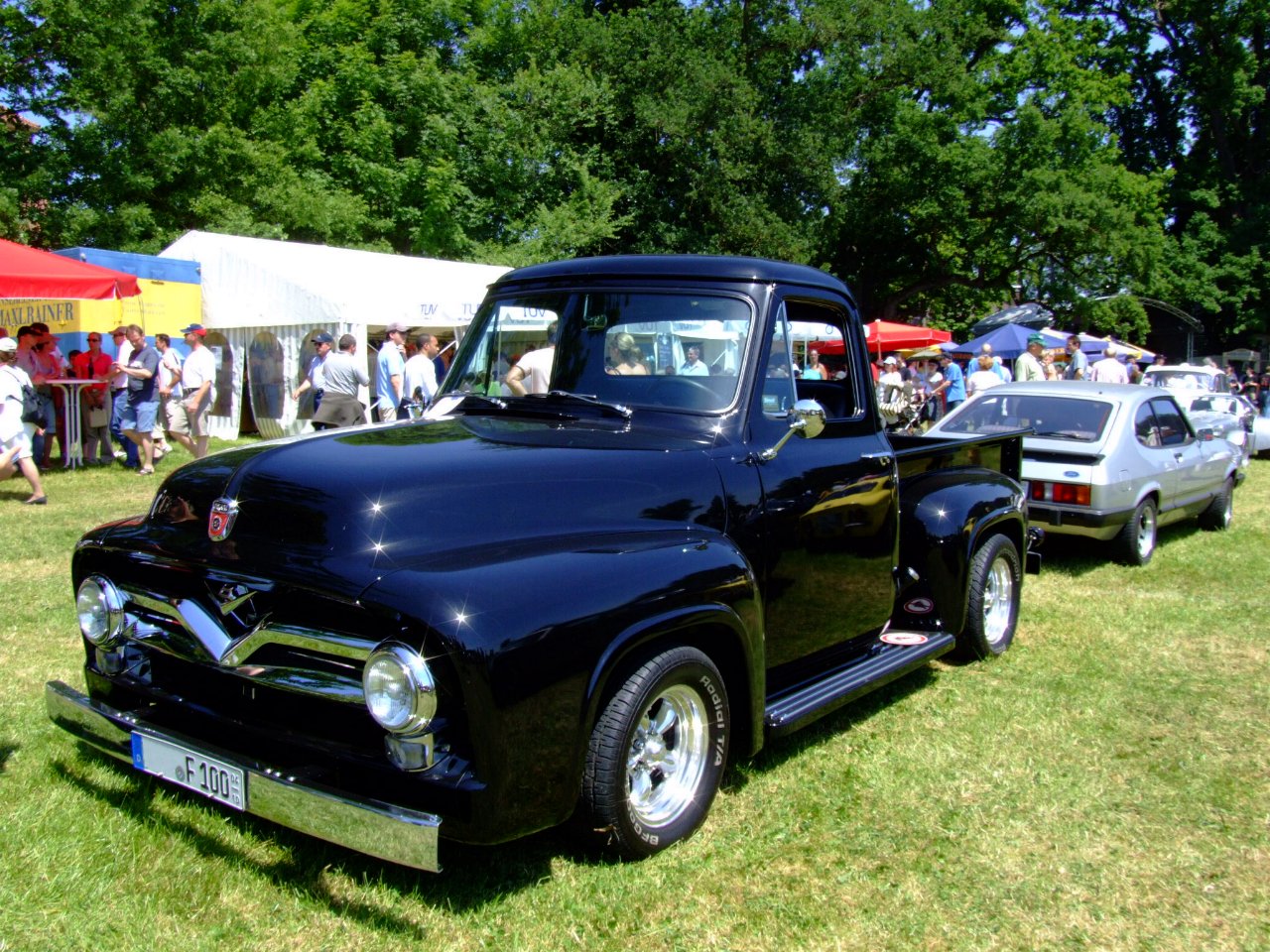
For 1953 Ford replaced its one-digit truck numbers with three digits, a system it still uses. The half-ton F-1 became the F-100, the F-2 and F-3 became the F-250 and the F-4 the F-350. The new trucks were sold as the "Triple Economy" series. They had a wider cab, a larger windscreen and rear window, and a wheelbase cut from 114 to 110 inches, with the front axle set further back. A seat for three with fore-and-aft adjustment and power brakes were also new. The 1953 trucks wore a horn-button emblem marking Ford's 50th anniversary.
Ford-O-Matic, a three-speed automatic, became available in 1953, at first only with the 239 cu in flathead V8. The other options were a three-speed manual with overdrive and a four-speed manual with a low first gear. For 1954 the flathead gave way to the overhead-valve Y-block V8. The 1956 model has a vertical windscreen pillar and a wraparound windscreen, used for that year only, plus electric wipers and a 12-volt system.
These trucks are nicknamed "Effies". According to CJ Pony Parts, more than 100,000 F-100s were built in each model year of the generation. Wikipedia lists fourteen American assembly plants, and Ford Brazil built the line in São Paulo from 1957 to 1962.

Styleside and factory four-wheel drive (1957–1960)
The 1957 redesign merged the cab and front wings into one wide body and introduced a clamshell bonnet that stayed on the F-Series for two decades. Buyers could choose the traditional "Flareside" bed with separate rear wings or the new "Styleside", whose bed sides were flush with the cab. CJ Pony Parts puts the Styleside's extra cargo space at 8%. This was also the only F-Series generation with quad headlamps.
Ford began building four-wheel-drive F-Series trucks itself; before that, the conversion had been done by Marmon-Herrington, and Ford was the first of the "Big Three" to build its own. CJ Pony Parts dates the first factory 4x4 to 1959. Engines were the 223 cu in "Mileage Maker" six and Y-block V8s of 272 and then 292 cu in. Argentina built the F-100 from 1959 to 1961 and Brazil from 1962 to 1971.

Unibody experiment and Twin I-Beam (1961–1966)
The fourth generation, built from October 1960, offered a one-piece cab and bed as an option on two-wheel-drive F-100 and F-250 Stylesides. Buyers did not take to it, and there were reports of doors jamming shut, so Ford dropped it during the 1963 model year. In Canada the same trucks were sold as the Mercury M-Series.
For 1965 Ford introduced a new frame and Twin I-Beam independent front suspension, with coil springs on two-wheel-drive trucks; this layout stayed in use on the F-150 until 1996. New 240 and 300 cu in straight-sixes arrived, and the 352 cu in FE V8 with 155 kW (208 hp) took F-Series output above 149 kW (200 hp) for the first time. The Ranger name appeared in 1965 as a trim package with bucket seats, and a Camper Special package with heavier-duty parts was offered for slide-in campers.

The "Bumpside" years (1967–1972)
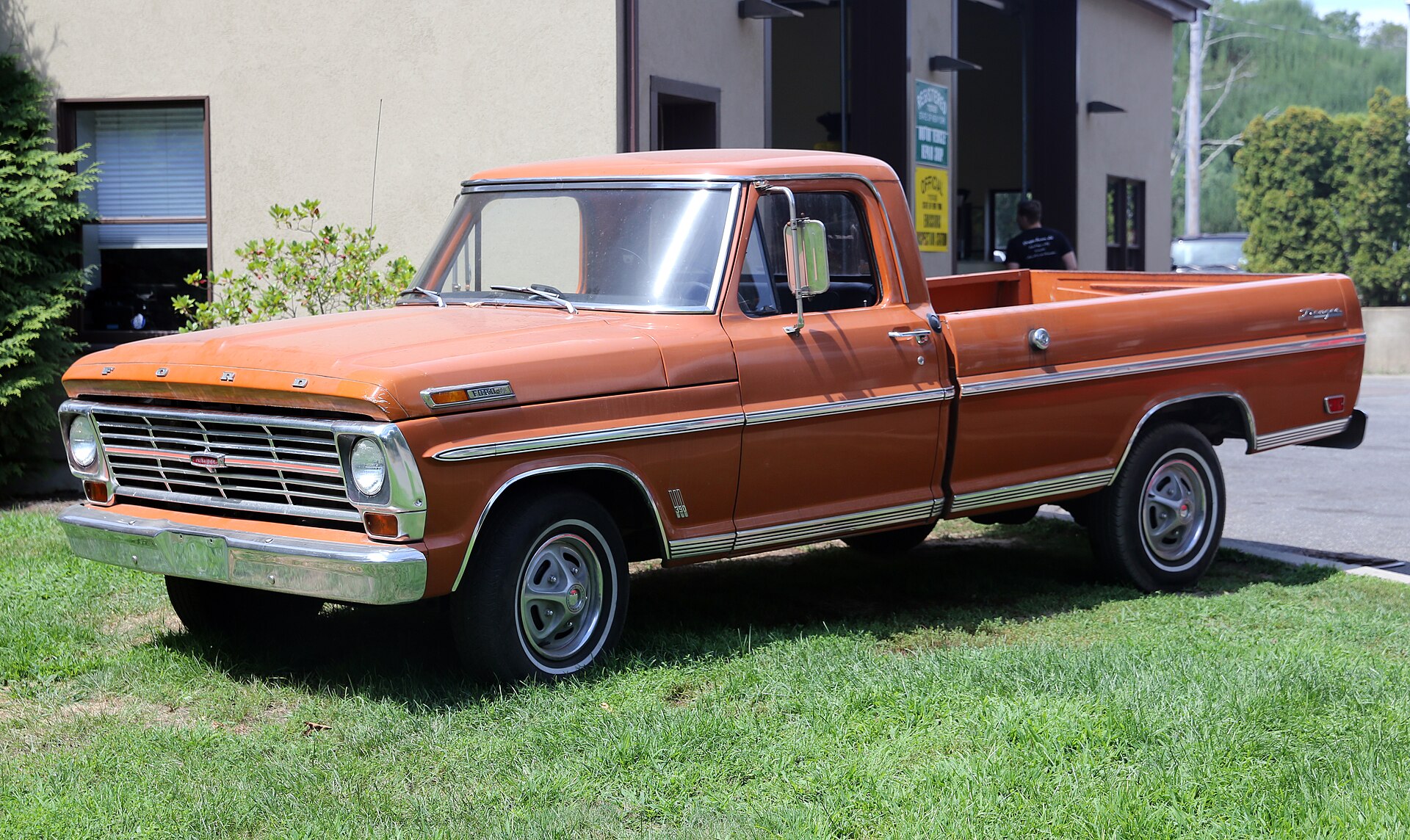
The fifth generation, which CJ Pony Parts calls the "Bumpside", had a cab three inches wider and a heavier frame, and it changed little from year to year:
- 1968: side marker reflectors, 360 and 390 FE V8s, factory air conditioning for the first time;
- 1969: new grille and the 302 Windsor V8;
- 1970: mid-cycle update, Sport Custom trim and Ranger XLT as the top level;
- 1971: AM/FM radio option;
- 1972: final North American year.
Lower-priced trims such as the Explorer Special packed Ranger-style trim pieces into a cheaper truck. The F-100 4x4 had a maximum gross vehicle weight rating of 5,600 lb (2,540 kg). Brazil continued to build this generation until 1992.
The F-150 arrives (1973–1979)
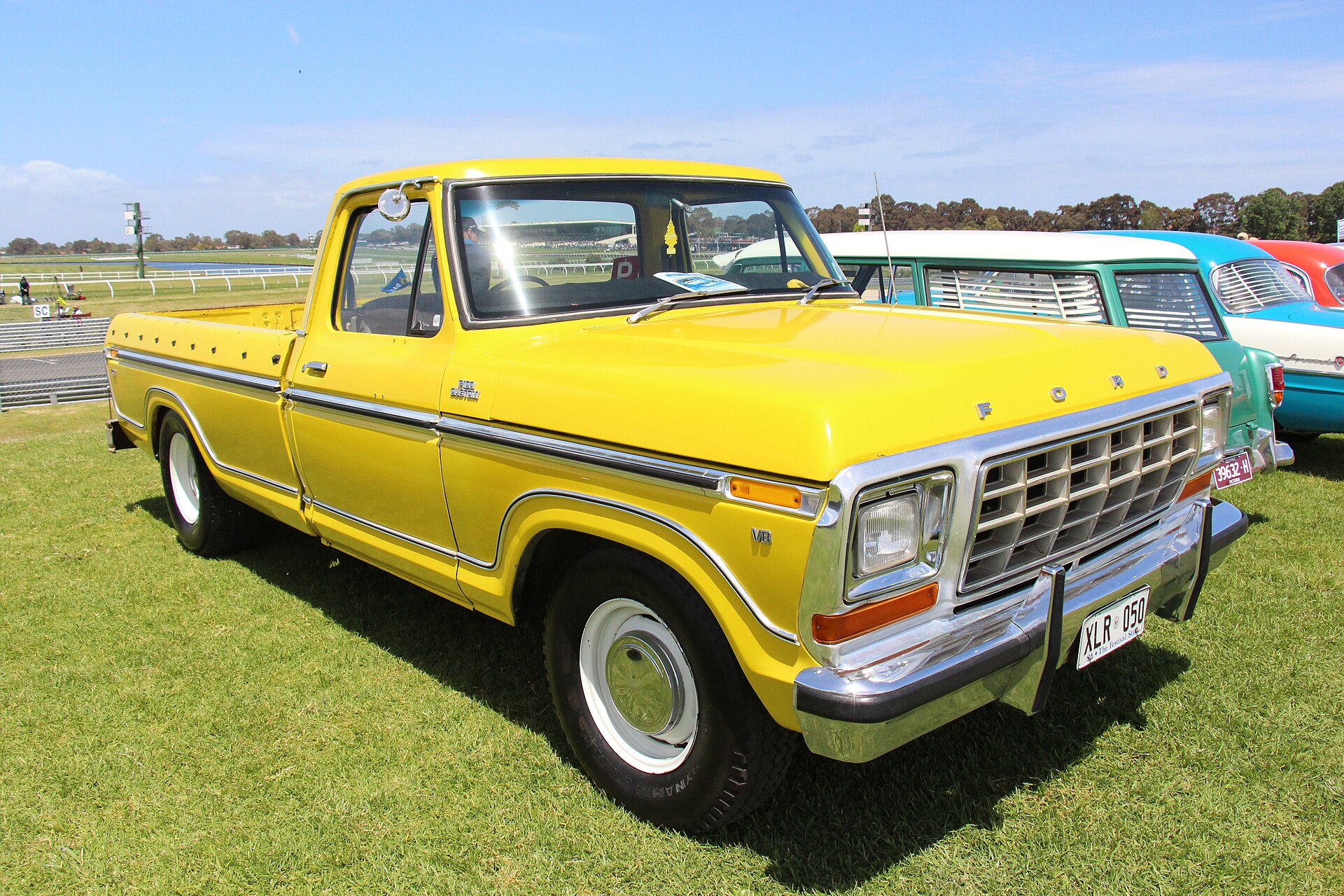
The sixth generation brought the SuperCab for 1974, announced on 21 September 1973: the first extended-cab F-Series, with room for six in a shorter body than the crew cab. For 1975 Ford added the F-150, a heavier-rated half-ton with a gross weight rating over 6,000 lb (2,722 kg). Wikipedia describes it as intended to circumvent emissions standards that applied to lighter trucks. The F-150 soon became the best-selling version.
In 1977 the F-Series passed the Chevrolet C/K to become America's best-selling truck line, and it has held that position since. The 1978 facelift replaced the split grille with a single wide grille and moved the headlamps into outboard housings; from 1979 every version had rectangular headlamps.

The last F-100 (1980–1983)
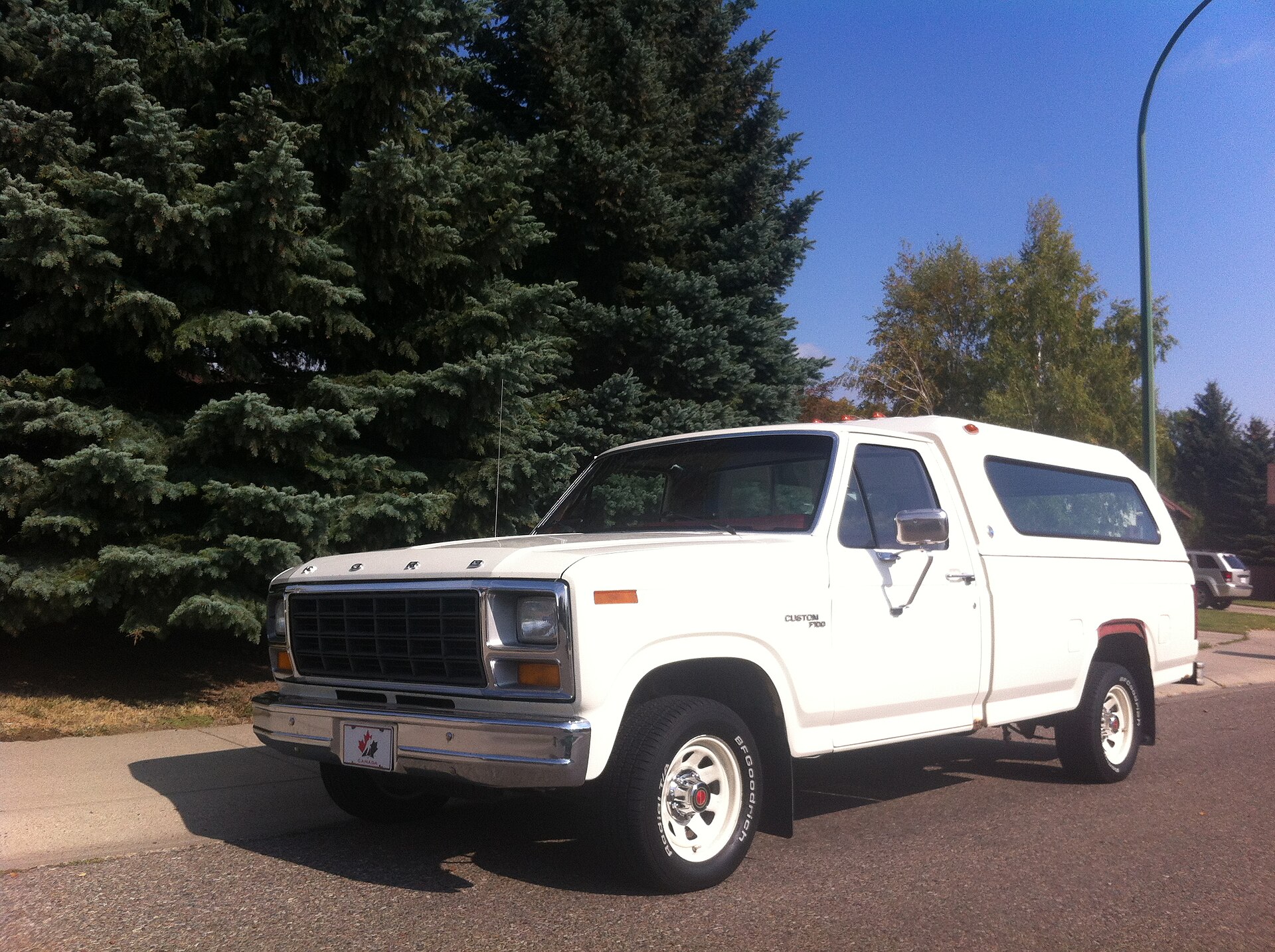
Production of the seventh generation began in September 1979. It was the first complete redesign of the F-Series since 1965. The bonnet was faired into the wings for better aerodynamics in place of the old clamshell, while the grille became flatter and the windscreen more steeply angled. The 1982 facelift moved the Blue Oval badge into the centre of the grille, replacing the FORD letters on the bonnet.
The F-100 now carried Ford's smallest truck engines: a 4.2-litre V8 with 86 kW (115 hp), offered only on the F-100 in 1981–1982. From 1982 a 3.8-litre V6 with 82 kW (110 hp) as standard. By then the F-150 and the new compact Ranger covered almost the same payload range. The 1983 model year was the last for the F-100.
Engines over three decades
| Engine | Years (F-100) | Power | Rating |
|---|---|---|---|
| 215 cu in straight-six | 1953 | 75 kW (101 hp) | gross |
| 239 cu in flathead V8 | 1953 | 75 kW (100 hp) | gross |
| 223 cu in straight-six | 1954–1955 | 86 kW (115 hp) | gross |
| 239 cu in Y-block V8 | 1954–1955 | 97 kW (130 hp) | gross |
| 272 cu in Y-block V8 | 1956 | 125–128 kW (167–172 hp) | gross |
| 292 cu in Y-block V8 | 1961–1964 | 127 kW (170 hp) | gross |
| 300 cu in straight-six | 1965–1966 | 127 kW (170 hp) | gross |
| 352 cu in FE V8 | 1964–1967 | 155 kW (208 hp) | gross |
| 390 cu in FE V8 | 1968–1972 | 190 kW (255 hp) | gross |
| 302 cu in Windsor V8 | 1969–1972 | 153 kW (205 hp) | gross |
| 300 cu in straight-six | 1973–1979 | 87 kW (117 hp) | net |
| 460 cu in V8 (2WD) | 1973–1979 | 149–178 kW (200–239 hp) | net |
| 3.8-litre V6 | 1982–1983 | 82 kW (110 hp) | net |
Gross ratings, used until the early 1970s, are higher than the later net figures for the same engine, so the two cannot be compared directly. For 1956 Wikipedia gives two outputs for the 272 V8, which is why the table shows a range. Our power converter switches between kW and hp.
Collecting an F-100 today
CJ Pony Parts names the 1953–1956 trucks as the most collectable. They sold well but worked hard, so few survive in good condition. The rounded bonnet and large headlamps give them a look of their own, and the 1956 is the easiest year to recognise because of its one-year windscreen. Later Bumpside and sixth-generation trucks are more common, and the 1965–1966 trucks introduced the frame used until 1979 and the Twin I-Beam suspension.
What to look for depends on the use:
- For originality: a second-generation truck with documents that confirm its original engine and gearbox.
- For regular driving: a 1967–1979 truck; factory air conditioning arrived in 1968, and automatic gearboxes and power brakes were available.
- For four-wheel drive: a third-generation truck or later, built with Ford's own 4x4 system.
More classic trucks and cars by decade are collected in our 1950s classics guide; for the company behind the F-Series, read our history of Ford, and the full model list is in the Ford catalogue.
Ford F-100 evolution in numbers
Did you know?
- The Ford F-100 ran for 30 years, from 1953 to 1983, over 6 generations in our catalog.
- The longest-running generation is the F-100 V (1973–1979): 6 years.
- The biggest jump in power came with the F-100 IV: up to 190 kW (258 PS), 35 kW more than the F-100 III.
- The most powerful Ford F-100 is not the newest: the F-100 IV (1967–1972) offered up to 190 kW (258 PS), the F-100 VI up to 99 kW (135 PS).
Most powerful version, kW
Figures from the 1cars catalog: power is the strongest version of each generation; generations without the figure are left out.
Ford F-100: first vs latest generation
| Spec | F-100 I | F-100 VI | Change |
|---|---|---|---|
| Years | 1953–1956 | 1980–1983 | 27 years apart |
| Most powerful version | 128 kW (174 PS) | 99 kW (135 PS) | −29 kW (−23%) |
Oldest and newest generation in the 1cars catalog. Power is the strongest version of each; other rows are shown only when both generations have the figure.
Image credits · Photos from Wikimedia Commons under free licences
- Ford F-100 IV · Photo: Mr.choppers / Wikimedia Commons, CC BY-SA 3.0
- Ford F-100 VI · Photo: dave_7 from Lethbridge, Canada / Wikimedia Commons, CC BY 2.0
Ford F-100 in our rankings
More powerful than 30% of ranked pickup trucks in the 1CARS catalog (No. 14 of 20).
FAQ
When was the Ford F-100 made?
From the 1953 to the 1983 model year, across six generations of the F-Series.
Why did Ford stop making the F-100?
The F-150, added in 1975 with a higher weight rating, became the best-selling version, and by the early 1980s the F-150 and the compact Ranger covered almost the same payload range. The F-100 was dropped after 1983.
What was the most powerful F-100 engine?
Among the gross-rated engines, the 390 cu in FE V8 with 190 kW (255 hp) offered from 1968. In the sixth generation the net-rated 460 V8 gave up to 178 kW (239 hp) in two-wheel-drive pickups.
When did the F-100 get four-wheel drive?
With the third generation (1957–1960), when Ford began building its own 4x4 trucks; CJ Pony Parts dates the first one to 1959.
What is an "Effie"?
A nickname for the 1953–1956 F-100, the first generation to carry the F-100 name.
Data sources
Data checked by an editor against the sources below.
- Wikipedia — Ford F Series
- Wikipedia — Ford F Series (second generation)
- Wikipedia — Ford F Series (third generation)
- Wikipedia — Ford F Series (fourth generation)
- Wikipedia — Ford F Series (fifth generation)