
 Citroen GS
All generations, specs and history
Published Sources (1) Report an error
By Felix Hartmann, Automotive Technology & EV Contributor
- Built
- 1970–1986
- Generations
- 2
- Top power
- 79 kW (107 PS)
Timeline
GS generations
Click a generation for its own page
- GS I 1970–1979 · Sedan, Station wagon · 40–79 kW (54–107 PS)
- GSA 1979–1986 · Hatchback, Station wagon · 42–48 kW (57–65 PS)
Newest first · 2 generations since 1970
- 1979 A 1979–1986 · Hatchback, Station wagon · 42–48 kW (57–65 PS)
- 1970 I 1970–1979 · Sedan, Station wagon · 40–79 kW (54–107 PS)
All generations by year: GSA (1979–1986) · GS I (1970–1979)
Which one is mine?
Pick the year of first registration to see which generation it is.
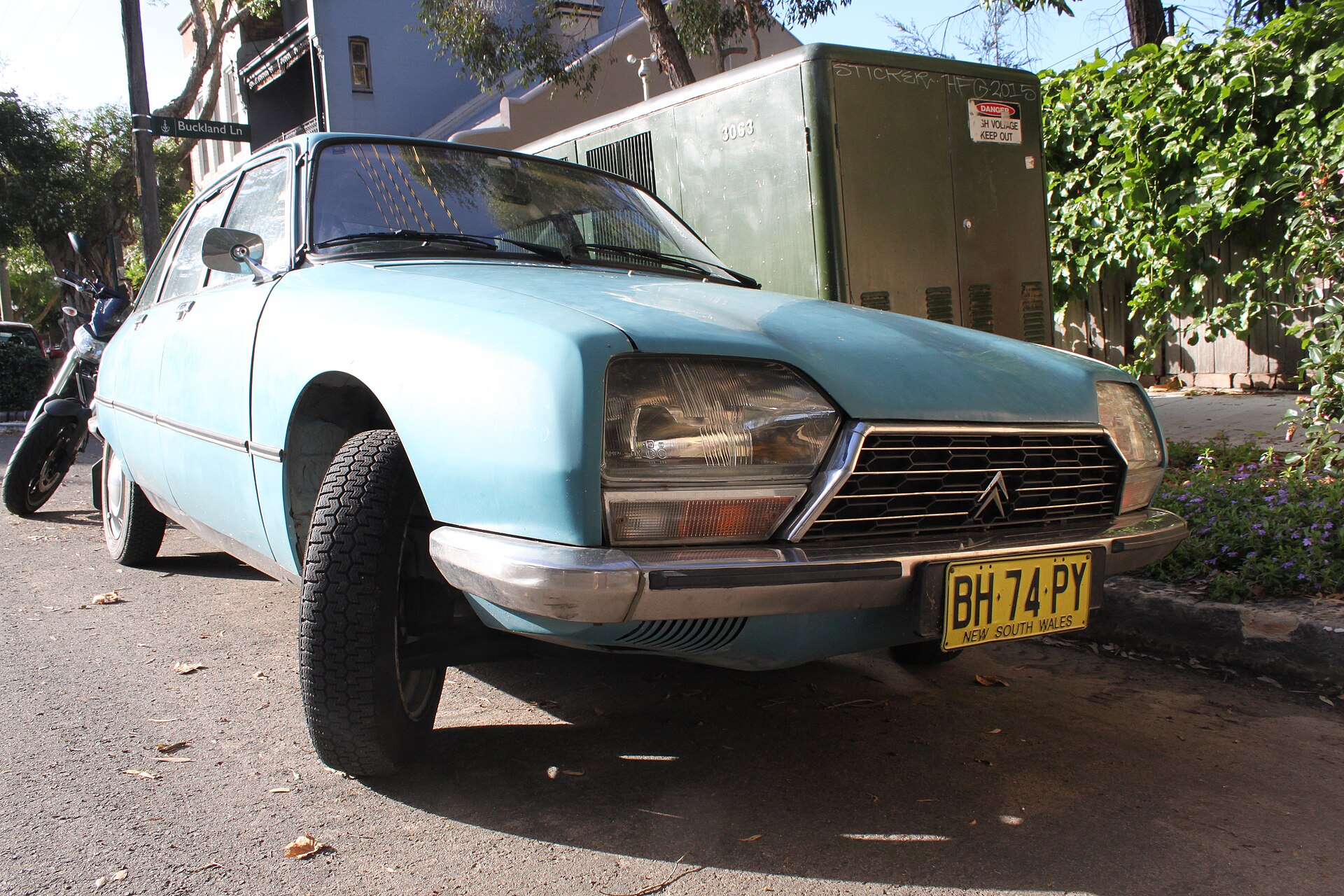
Check by VINThe Citroën GS is a mid-size family car that Citroën built from 1970, with the GSA hatchback version continuing until 1986. It filled the gap between the 2CV-based small cars and the DS with an air-cooled flat-four, hydropneumatic suspension and four disc brakes. Robert Opron's fastback won European Car of the Year 1971, and about 2.47 million GS and GSA cars were made.
In short
- GS saloon and estate from autumn 1970 to August 1979; GSA hatchback and estate from September 1979 to July 1986.
- 1,896,742 GS and 576,757 GSA built, mostly at Rennes-la-Janais in Brittany.
- Air-cooled flat-fours from 1,015 to 1,299 cc, 40 to 48 kW (54 to 65 PS); the Wankel GS Birotor had 79 kW (107 PS).
- Drag coefficient of 0.318, an unusually low figure for a family car of 1970.
Size at a glance
| Dimensions | Citroen GS I |
|---|---|
| Length | 4,120 mm162.2 in |
| Width | 1,600 mm63.0 in |
| Height | 1,340 mm52.8 in |
| Wheelbase | 2,550 mm100.4 in |
Specs by version
Engines
| Version | Engine | Power | Torque | Gearbox | Drive | Production years |
|---|---|---|---|---|---|---|
| GS I · GS 1015 | 1.0 l · 4 cyl · Petrol 1,015 cc | 40 kW 54 PS54 hp | 72 Nm53 lb-ft | 4-sp Manual | Front-wheel drive | 1970–1977 |
| GS I · GS 1220 | 1.2 l · 4 cyl · Petrol 1,222 cc | 44 kW 60 PS59 hp | - | - | Front-wheel drive | 1972–1979 |
| GS I · GS Birotor | Petrol | 79 kW 107 PS106 hp | 137 Nm101 lb-ft | - | Front-wheel drive | 1973–1975 |
| GSA 1300 | 1.3 l · 4 cyl · Petrol 1,299 cc | 48 kW 65 PS64 hp | - | 5-sp Manual | Front-wheel drive | 1979–1986 |
Performance
Show all 3 versions
| Version | 0–100 km/h | Top speed |
|---|---|---|
| GS I · GS 1220 | - | 151 km/h94 mph |
| GS I · GS Birotor | 14.7 s 0–62 mph | 176 km/h109 mph |
| GSA 1300 | - | 164 km/h102 mph |
Dimensions and weight
Show all 3 versions
| Version | Length | Width | Height | Wheelbase | Kerb weight |
|---|---|---|---|---|---|
| GS I · GS 1015 | 4,120 mm162.2 in | 1,600 mm63.0 in | 1,340 mm52.8 in | 2,550 mm100.4 in | 900 kg1,984 lb |
| GS I · GS Birotor | - | - | - | - | 1,140 kg2,513 lb |
| GSA 1300 | - | - | - | - | 950 kg2,094 lb |
Verified Manufacturer and type-approval data from our catalog · Sources and methodology
Citroën GS at a glance
| Item | Citroën GS / GSA |
|---|---|
| Production | 1970-1979 (GS), 1979-1986 (GSA); assembly outside France until mid-1990 |
| Numbers built | 1,896,742 GS and 576,757 GSA, about 2.47 million in total |
| Plants | Rennes-la-Janais (France); Vigo (Spain, about 385,000); Mangualde, Koper, Arica and others |
| Body styles | four-door fastback saloon, five-door estate, van; GSA five-door hatchback and estate |
| Designer | Robert Opron |
| Layout | front-mounted air-cooled flat-four, front-wheel drive |
| Engines | 1,015, 1,129, 1,222 and 1,299 cc flat-fours; twin-rotor Wankel in the Birotor |
| Power | 40 to 48 kW (54 to 65 PS); Birotor 79 kW (107 PS) |
| Kerb weight | about 900 kg (saloon), 950 kg (GSA hatchback) |
| Top speed | about 151 km/h (GS 1220) to 164 km/h (GSA) |
| Acceleration | 0-60 mph in 14.9 s (GS 1220, Autocar test of March 1973) |
| Price new | DM 11,950 for a GSA Spécial in West Germany in 1981 |
Filling the gap between the 2CV and the DS
For most of the 1960s Citroën had nothing between the Ami and the DS, and buyers who wanted a family car of about 1.0 to 1.3 litres went elsewhere. The GS took roughly 14 years from first idea to launch. It was announced on 24 August 1970, was one of the stars of that autumn's Paris Motor Show, and was voted European Car of the Year for 1971. British buyers could order it from March 1971; the car was never officially sold in the USA.
Opron's body measured 4.12 m in length, 1.60 m in width and 1.34 m in height, with a 2,550 mm wheelbase and an unladen weight of about 900 kg. Its fastback shape gave a Cd of 0.318, which helped a small engine reach a steady 151 km/h. A five-door estate followed in 1971, and a van version was also built. Production was centred on the Rennes-la-Janais factory in Brittany, while the Vigo plant in Spain added about 385,000 cars.
A small car with DS engineering
The GS took its suspension principle from the DS. Hydropneumatic struts with double wishbones at the front and trailing arms at the rear kept the car level whatever the load, and the driver could raise the body for rough tracks. Four disc brakes, with the front discs mounted inboard next to the gearbox, were fed by the same hydraulic circuit, which also adjusted braking to the load. The handbrake was on the dashboard and the standard tyres were Michelin ZX 145 SR 15.
Under the bonnet sat a new air-cooled flat-four with overhead camshafts driven by toothed belts. The first 1,015 cc engine produced 40 kW (54 PS) at 6,500 rpm and 72 Nm at 3,500 rpm, which made the car slow: Autocar's test recorded 0-60 mph in 18.0 seconds. The 1,222 cc engine became optional in 1972 and cut the 0-60 mph time to 14.9 seconds in the magazine's March 1973 test, with overall consumption of about 11.4 l/100 km (24.8 mpg). Gearbox choices were a four-speed manual and, from 1973 in the UK, the three-speed C-Matic semi-automatic.

GS engines and the Birotor
| Version | Engine | Power | Years |
|---|---|---|---|
| GS 1015 | 1,015 cc flat-four | 40 kW (54 PS) | 1970-1977 |
| GS 1220 | 1,222 cc flat-four | 44 kW (60 PS) | 1972-1979 |
| GS after the 1977 facelift | 1,129 cc flat-four | 40 kW (55 PS) | 1977-1979 |
| Late GS (some markets) | 1,299 cc flat-four | 48 kW (65 PS) | late 1970s |
| GS Birotor | twin-rotor Wankel | 79 kW (107 PS) | 1973-1975 |
| GSA 1.1 | 1,129 cc flat-four | 42 kW (57 PS) | 1979-1981 |
| GSA 1.3 | 1,299 cc flat-four | 48 kW (65 PS) | 1979-1986 |
The Birotor, sold from September 1973 to October 1975, used a twin-rotor Wankel from Comotor, the joint venture of NSU and Citroën. It produced 79 kW (107 PS) and 137 Nm, and Automobil Revue measured 176.5 km/h and 0-100 km/h in 14.7 seconds in April 1974. The car weighed 1,140 kg, cost about as much as a DS and roughly 70% more than a standard GS, and arrived just as the 1973 oil crisis hit. Only 847 were sold, and German sources estimate that about 250 survive in Europe.
Trim levels for the GS ran from the G Spécial and Club to the sporty X and the plush Pallas. The 1977 facelift replaced the 1,015 cc unit with a 1,129 cc engine. A Basalte special edition of 5,000 cars in black with red stripes followed in 1978.
The GSA hatchback and the BX
The GSA of September 1979 finally gave the car the tailgate many owners had asked for. It also brought plastic bumpers, new rear lights and door handles, and a dashboard with control satellites on each side of the wheel; a diagnostic socket under the bonnet made servicing easier. The Club and Pallas gained a five-speed gearbox, the X1 and X3 were sporty versions with a rear spoiler, and the GSA was faster at about 164 km/h. From autumn 1981 only the 1,299 cc engine was offered in Germany, where a GSA Club cost DM 13,930 and a Pallas DM 14,990 in February 1981.
Special editions kept the car fresh: 2,500 GSA Tuners in 1982 and 2,000 Break Cottage estates in 1984. The BX arrived in 1982, and the GSA saloon ended in June 1985 and the estate in July 1986. Rivals of the GS years included the Audi 80 and the Ford Escort, both simpler cars with conventional springs.

Citroën GS today: what to check when buying
Rust is the main issue, and Classics World assumes most survivors have been welded. Check the front wings and wheelarches, lower rear arches, inner wings, door bottoms, tops of the rear wings, front valance, A-pillars, windscreen surround, sills, floor and boot floor, as well as the subframes. A wax injection is worth considering once the body is sound.
The flat-four is suited to home servicing but needs oil and filter changes about every 3,000 miles (4,800 km), and the camshaft belts every three years or 24,000 miles (39,000 km). Oil leaks from hardened return-tube seals are common, and neglected valve adjustment wears the camshafts. Listen for knocking driveshaft joints, check the suspension rises and falls properly, and refresh the LHM fluid every three years. Calipers and the handbrake can seize, and replacing the inboard front discs can take nearly five hours. Steering is unassisted and heavy when parking.
Parts are generally available through the Citroën Car Club and specialists. Classics World's buyer's guide, referenced to a June 2024 auction, put a good car at about EUR 3,300 (GBP 2,800) in 2024 and the very best at no more than EUR 8,200 (GBP 7,000) in 2024. Auction results listed by classic.com are higher on the Continent: a 1972 GS 1220 Club sold for EUR 11,148 in March 2025, and a 1974 Birotor made EUR 24,260 in the same March 2025 sale. The Citroën catalogue lists the other models, the Citroën 2CV shows the small-car side of the range, and our classic cars section covers more period family cars.
Citroen GS: first vs latest generation
| Spec | GS I | GSA | Change |
|---|---|---|---|
| Years | 1970–1979 | 1979–1986 | 9 years apart |
| Most powerful version | 79 kW (107 PS) | 48 kW (65 PS) | −31 kW (−39%) |
| Lightest kerb weight | 900 kg | 950 kg | +50 kg |
| Top speed | 176 km/h | 164 km/h | −12 km/h |
Oldest and newest generation in the 1cars catalog. Power is the strongest version of each; other rows are shown only when both generations have the figure.
Citroen GS in our rankings
- No. 5 of 75 · Lightest sedans (900 kg)
- No. 10 of 80 · Lightest hatchbacks (950 kg)
- No. 18 of 419 · Lightest cars (900 kg · top 6%)
- No. 11 of 118 · Smallest sedans (4,120 mm · top 10%)
- No. 93 of 559 · Smallest cars (4,120 mm · top 17%)
- No. 51 of 74 · Power-to-weight: sedans (69 kW/t · top 69%)
Lighter than 94% of ranked cars in the 1CARS catalog (No. 18 of 419).
FAQ
When was the Citroën GS made?
The GS was made from autumn 1970 to August 1979, and the GSA hatchback from September 1979 to July 1986. The GSA saloon ended in June 1985 and the estate a year later, while assembly outside France continued until mid-1990.
How many Citroën GS and GSA were built?
Wikipedia EN gives 1,896,742 GS and 576,757 GSA, about 2.47 million together. Stellantis heritage material rounds this to around 2.5 million. Most were built at Rennes-la-Janais, with about 385,000 from Vigo in Spain.
What was the Citroën GS Birotor?
The Birotor was a GS with a twin-rotor Wankel engine from Comotor, sold from 1973 to 1975. It produced 79 kW (107 PS) and reached 176.5 km/h, but it cost about as much as a DS, and only 847 were sold.
What is the difference between the GS and the GSA?
The GSA of 1979 added a tailgate, plastic bumpers, a new dashboard with control satellites and a five-speed gearbox on most versions. It used 1,129 and 1,299 cc engines, the larger one alone from autumn 1981.
Data sources
Data checked by an editor against the sources below.
- Wikipedia - Citroën GS


