
 Citroen Méhari
Specs, engines and history
Published Sources (2) Report an error
By Sarah Whitmore, Senior Automotive Writer
- Built
- 1968–1987
- Top power
- 21 kW (29 PS)
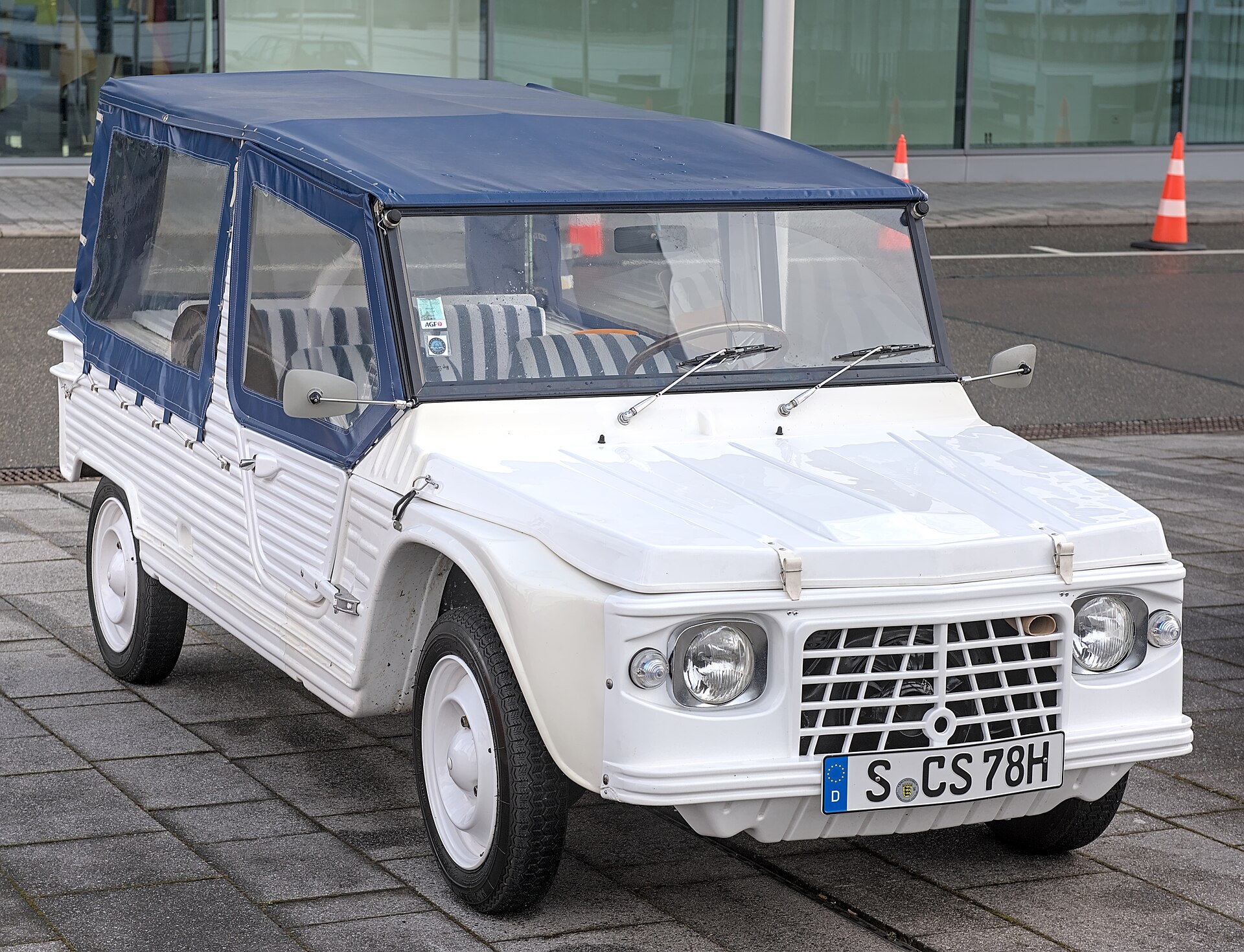
The Citroën Méhari is an open utility car with a body of coloured ABS plastic, built from May 1968 to 1987 on the mechanicals of the Dyane and 2CV. Designed by the industrialist and former fighter pilot Roland de La Poype, it used the 602 cc air-cooled flat-twin, weighed about 525-570 kg and reached 144,953 units, including 1,213 four-wheel-drive cars and 7,064 for the French Army.
In short
- Unveiled at the Deauville golf course in May 1968 as the "Dyane 6 Méhari", at FF 6,996 including VAT.
- 602 cc flat-twin with 19 kW (26 PS DIN), from 1979 21 kW (29 PS); front-wheel drive, four-speed gearbox.
- 144,953 built, 91,788 of them at Forest in Belgium; 4x4 version 1979-1983.
- Never type-approved in Britain or West Germany; sold in the US only for 1969-1970, classed as a truck.
Size at a glance
| Dimensions | Citroen Méhari I |
|---|---|
| Length | 3,520 mm138.6 in |
| Width | 1,530 mm60.2 in |
| Height | 1,640 mm64.6 in |
| Wheelbase | 2,400 mm94.5 in |
Running cost
Fuel · Méhari 602 (1968)
about 1,600 EUR fuel a year at 15,000 km
6.0 l/100 km · petrol at 1.75 EUR/l · change mileage, fuel price or version
Specs by version
Engines
| Version | Engine | Power | Torque | Gearbox | Drive | Production years |
|---|---|---|---|---|---|---|
| 602 (1968) | 0.6 l · 2 cyl · Petrol 602 cc | 19 kW 26 PS25 hp | 43 Nm32 lb-ft | 4-sp Manual | Front-wheel drive | 1968–1978 |
| 602 twin-choke (1979) | 0.6 l · 2 cyl · Petrol 602 cc | 21 kW 29 PS28 hp | - | 4-sp Manual | Front-wheel drive | 1979–1987 |
| 4x4 602 | 0.6 l · 2 cyl · Petrol 602 cc | 21 kW 29 PS28 hp | - | Manual | All-wheel drive | 1979–1983 |
Performance
Show all 1 versions
| Version | Fuel consumption |
|---|---|
| 602 (1968) | 6.0 l/100 km39.2 mpg US · 47.1 mpg UK |
Dimensions and weight
Show all 2 versions
| Version | Length | Width | Height | Wheelbase | Kerb weight |
|---|---|---|---|---|---|
| 602 (1968) | 3,500 mm137.8 in | - | - | - | 525 kg1,157 lb |
| 602 twin-choke (1979) | 3,520 mm138.6 in | 1,530 mm60.2 in | 1,640 mm64.6 in | 2,400 mm94.5 in | - |
Verified Manufacturer and type-approval data from our catalog · Sources and methodology
Citroën Méhari at a glance
| Item | Citroën Méhari |
|---|---|
| Years | May 1968 to 1987 |
| Production | 144,953 (including 1,213 Méhari 4x4) |
| Plants | Forest (Belgium); Rennes, Levallois, Ivry and Bezons (France); Vigo (Spain); Mangualde (Portugal); kits assembled abroad |
| Body | Open two-seater, optional rear bench; ABS plastic panels on a steel tube frame |
| Designer | Roland de La Poype, SEAB |
| Layout | Front engine, front-wheel drive; 4x4 1979-1983 |
| Engine | 602 cc air-cooled flat-twin |
| Power | 19 kW (26 PS DIN), from 1979 21 kW (29 PS) |
| Weight | 525 kg (Citroën, 1968); 570 kg in other sources |
| Top speed | About 105 km/h (Classic Trader) |
| 0-100 km/h | No figure in the sources consulted |
| Price new | FF 6,996 including VAT (FF 5,830 before VAT) in 1968 |
A fighter pilot's plastic utility car
Roland de La Poype flew with the Normandie-Niemen fighter group in the Second World War and later ran a plastics business. His company SEAB (Société d'Études et d'Applications des Brevets) developed a working prototype before presenting it to Citroën. One inspiration was the Baby-Brousse, a 2CV-based utility built in Abidjan from 1963. Citroën had also looked at Heuliez's Dyane Tout Chemin prototype in 1967 and chose the SEAB design instead.
The body panels were thermoformed from ABS plastic, sold under trade names such as Kralastic and Cycolac, and coloured through the material. Citroën's launch release of 17 May 1968 stressed that the body could not rust, needed no paint and would spring back after a light knock. The original colours were ochre sand, bright red and forest green; later ones carried desert names such as Rouge Hopi, Vert Tibesti and Jaune Atacama, and Vert Montana stayed in the range for all 18 years.
The car was unveiled at the Deauville golf course in May 1968; Classic & Sports Car gives 16 May, French Wikipedia and Citroën's 2018 anniversary release 11 May. The strikes of May 1968 meant the launch went almost unnoticed. Because the Méhari could be registered as a utility vehicle, it suited farmers, councils and tradesmen, but buyers on the coast quickly adopted it as a beach car.
Dyane mechanicals under an open body
Underneath, the Méhari was a Dyane 6: the same 2,400 mm wheelbase, front-wheel drive, four-speed gearbox, interconnected suspension and 602 cc AK2 flat-twin. The steering wheel and wheels came from the 2CV. Citroën quoted 21 kW (28 hp), 4.4 mkg (43 Nm) of torque at 3,500 rpm and 5.5-6 l/100 km in 1968; French sources give 19 kW (26 PS) DIN, raised to 21 kW (29 PS) in 1979 with a twin-choke carburettor. Friction dampers gave way to telescopic units during production.
The Méhari is 3,520 mm long, 1,530 mm wide and 1,640 mm high. The base car had two seats, and a rear bench for four cost roughly 5-10 per cent extra. ENAC offered hardtop, soft top and pick-up conversions, and a removable winter enclosure with a heater was listed from the start.
The Méhari 4x4 and the French Army
The Méhari 4x4 appeared on 23 May 1979. It drove all four wheels from the same engine, added a reduction gearbox, independent suspension on all wheels and rear disc brakes, and could climb gradients of up to 60 per cent. It cost about twice as much as the two-wheel-drive car, and only 1,213 were built before production stopped in June 1983.
The French Army ordered 7,064 two-wheel-drive Méharis from 1972, including 691 driving-school cars; military cars ran 24-volt electrics with two 12-volt batteries in series for radio equipment. The Irish Defence Forces bought 12 in the late 1970s. On film, Méharis served as police cars in Louis de Funès's gendarme comedies.
The car also took part in long-distance rallies: Liège-Dakar-Liège in 1969, Paris-Kabul-Paris in 1970, Paris-Persepolis-Paris in 1971 and the Paris-Dakar in 1980.
Where Méharis were built, and where they were banned
| Plant | Units built |
|---|---|
| Forest, Belgium | 91,788 |
| Mangualde, Portugal | 17,500 |
| Vigo, Spain (1969-1980) | 12,480 |
| CKD kits assembled abroad | 9,355 |
| Rennes-La Janais, France | 7,846 |
| ENAC, Bezons, France | 2,500 |
| Ivry (ex-Panhard), France | 1,763 |
| Levallois, France | 1,659 |
| SEAB, Villejuif, France | 62 |
Output peaked in 1974 at 13,910 cars and fell to 381 in 1987. Mangualde built the yellow Méhari Plage for Spain and Portugal, and the white-and-blue Azur, first planned as a 700-car edition, joined the regular range; French Wikipedia dates it to the 1986 model year. In South America, Citroën Argentina built 3,997 between 1971 and 1980, and Nordex in Uruguay produced about 14,000.
Regulations limited the Méhari's reach. West Germany refused type approval because the ABS body is flammable, Britain withheld approval, and in the United States it was sold only for 1969 and 1970, classed as a truck so that it needed no seat belts; French Wikipedia counts about 214 US sales in 1970. Citroën revived the idea in 2016 with the electric E-Méhari.
Citroën Méhari today: what to check when buying
Rust attacks the steel platform chassis and the tubular front and rear frames, whereas the plastic body is immune to it. Inspect the chassis and frames first, because they carry everything. New parts are available: in November 2026 the Méhari Club Cassis listed an original-pattern platform chassis at EUR 1,550 with cataphoresis coating or EUR 1,650 galvanised, a Méhari 4x4 chassis from EUR 3,800 and front and rear frames at EUR 1,690, before discounts.
For the body, the 2CV-Méhari Club warned in 2018 that aftermarket panels in PMMA-type plastic are cheaper and glossier but more brittle and heavier than the original ASA-grade ABS, and that non-original bodies often fit poorly. The club bought SEAB's original tooling, so check whether a car's panels are original grade, look for cracks around mounting points and ask what has been replaced. Mechanically the Méhari shares the Dyane's flat-twin, gearbox and front brakes, so oil-change history, kingpin play and front brake adjustment matter as much as on the saloon. Confirm a 4x4 by its AYCE type designation, because only 1,213 were built.
Values are far above those of the Dyane. In November 2026, Classic Trader listings ranged from EUR 20,950 to 34,900, with most cars between EUR 21,000 and 30,000 in 2026.
The Méhari is part of our Citroën catalogue, and its mechanical roots are explained in our Citroën 2CV history. It also belongs among the best classic cars of the 1960s, and more cars of the period are in our classic cars section. The firm that took up SEAB's design in 1968 is profiled in our history of Citroën.
Photo gallery


Citroen Méhari in our rankings
- No. 1 of 17 · Most economical convertibles and roadsters (6.0 l/100 km)
- No. 2 of 35 · Smallest convertibles and roadsters (3,500 mm)
- No. 2 of 27 · Lightest convertibles and roadsters (525 kg)
- No. 2 of 414 · Lightest cars (525 kg)
- No. 12 of 552 · Smallest cars (3,500 mm · top 3%)
- No. 207 of 1136 · Longest-running car nameplates (19 years · top 20%)
Lighter than 99% of ranked cars in the 1CARS catalog (No. 2 of 414).
FAQ
Who designed the Citroën Méhari?
Roland de La Poype, a former Normandie-Niemen fighter pilot who ran the plastics company SEAB. SEAB built a working prototype on Dyane mechanicals and offered it to Citroën, which launched the car in May 1968.
How many Citroën Méharis were built?
144,953 between 1968 and 1987, according to French and English Wikipedia. The Belgian plant at Forest built 91,788 of them, and the total includes 1,213 Méhari 4x4 cars made from 1979 to 1983.
What engine does the Méhari have?
The 602 cc air-cooled flat-twin of the Dyane 6, with 19 kW (26 PS DIN) and, from 1979, 21 kW (29 PS) with a twin-choke carburettor. Citroën's 1968 release quoted 21 kW (28 hp) and 5.5-6 l/100 km.
Why was the Méhari not sold in Germany or Britain?
West German authorities refused type approval because the ABS plastic body is flammable, and the car was never type-approved for sale in the UK. Individual cars have since been imported privately.
Data sources
Data checked by an editor against the sources below.
- Wikipedia - Citroën Méhari
- Motor1 - Communique Original Citroen Mehari


