
 Citroen Dyane
Specs, engines and history
Published Sources (2) Report an error
By Sarah Whitmore, Senior Automotive Writer
- Built
- 1967–1983
- Top power
- 26 kW (35 PS)
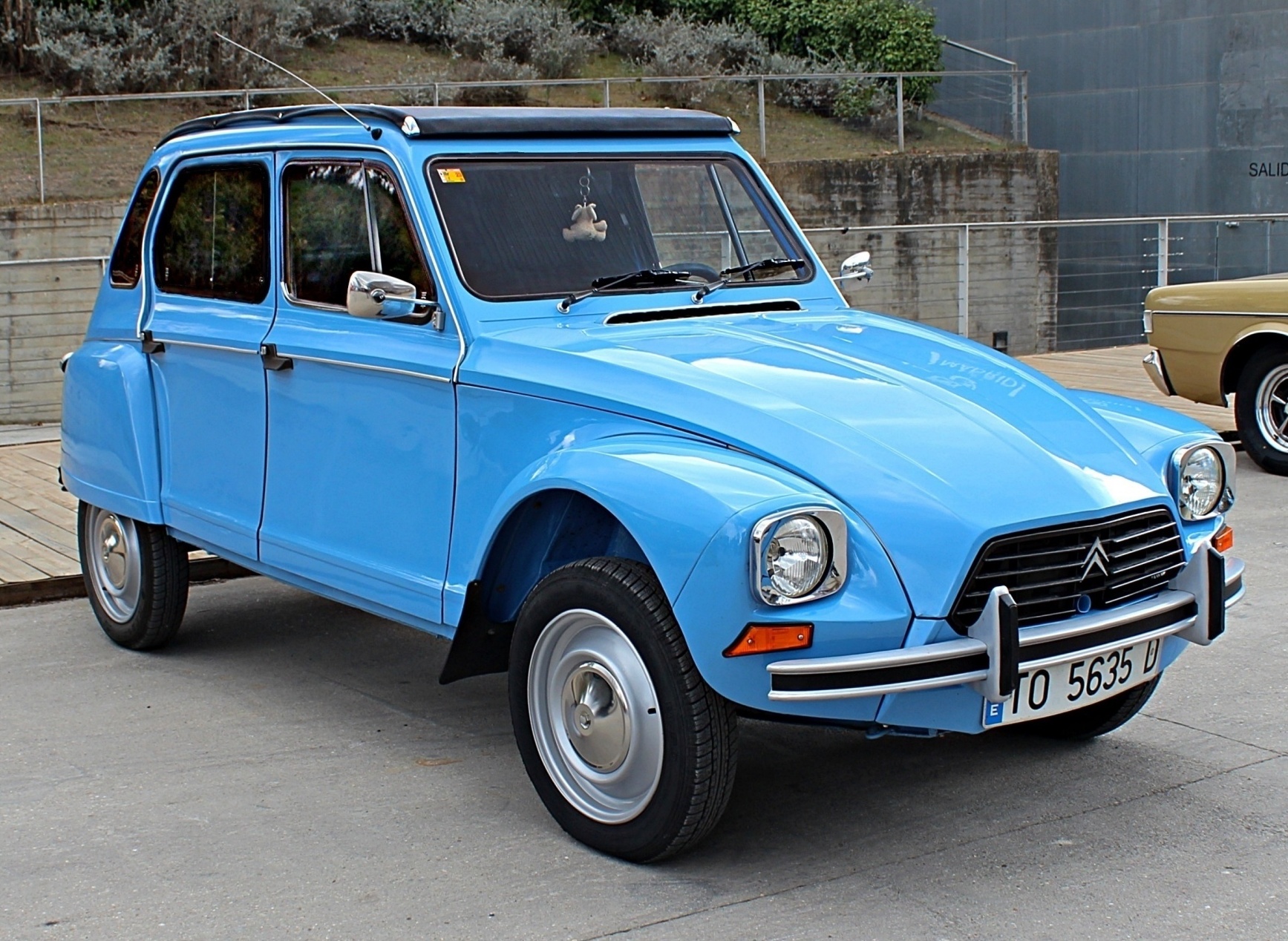
The Citroën Dyane is a small four-door hatchback that Citroën built from August 1967 to 1983 on the chassis of the 2CV. Styled from a Panhard proposal and meant to answer the Renault 4, it used air-cooled flat-twins of 425, 435 and 602 cc. About 1.44 million were made, plus some 250,000 Acadiane vans, yet the older 2CV outsold it from 1970 and outlived it.
In short
- Built 1967-1983 in Rennes and in Spain, Portugal, Yugoslavia and Iran; about 1,443,583 Dyanes in total.
- Engines: 425 cc (16 kW, 21 bhp SAE), 435 cc Dyane 4 (19 kW, 26 bhp) and 602 cc Dyane 6 (21-26 kW, 28-35 bhp).
- Same 2,400 mm wheelbase and interconnected suspension as the 2CV, with a tailgate and angular body panels.
- The Motor measured 110 km/h and 0-60 mph in 30.8 s in 1969, when a Dyane cost GBP 648 in Britain.
Specs by version
Engines
| Version | Engine | Power | Gearbox | Drive | Production years |
|---|---|---|---|---|---|
| Dyane 425 | 0.4 l · 2 cyl · Petrol 425 cc | 16 kW 22 PS21 hp | 4-sp Manual | Front-wheel drive | 1967–1968 |
| Dyane 4 (435) | 0.4 l · 2 cyl · Petrol 435 cc | 19 kW 26 PS25 hp | 4-sp Manual | Front-wheel drive | 1968–1975 |
| Dyane 6 (602, 1968) | 0.6 l · 2 cyl · Petrol 602 cc | 21 kW 29 PS28 hp | 4-sp Manual | Front-wheel drive | 1968–1969 |
| Dyane 6 (602, from 1970) | 0.6 l · 2 cyl · Petrol 602 cc | 26 kW 35 PS35 hp | 4-sp Manual | Front-wheel drive | 1970–1983 |
Performance
Show all 1 versions
| Version | Top speed |
|---|---|
| Dyane 6 (602, 1968) | 110 km/h68 mph |
Dimensions and weight
Show all 3 versions
| Version | Length | Width | Wheelbase | Kerb weight |
|---|---|---|---|---|
| Dyane 425 | - | - | 2,400 mm94.5 in | - |
| Dyane 4 (435) | - | - | 2,400 mm94.5 in | - |
| Dyane 6 (602, 1968) | 3,899 mm153.5 in | 1,499 mm59.0 in | 2,400 mm94.5 in | 594 kg1,310 lb |
Verified Manufacturer and type-approval data from our catalog · Sources and methodology
Citroën Dyane at a glance
| Item | Citroën Dyane |
|---|---|
| Years | August 1967 to 1983 (Acadiane van 1978 to July 1987) |
| Production | About 1,443,583 Dyanes (figures vary between sources); about 250,000 Acadianes |
| Plants | Rennes (France); Vigo (Spain); Mangualde (Portugal); Koper (Yugoslavia); SAIPA, Tehran (Iran) |
| Body styles | Four-door saloon with tailgate (hatchback) |
| Design | Louis Bionier's Panhard studio, reworked by Robert Opron's Citroën team |
| Layout | Front engine, front-wheel drive, 2CV platform |
| Engines | Air-cooled flat-twin: 425 cc, 435 cc, 602 cc |
| Power | 16-26 kW (21-35 bhp) |
| Weight | About 594 kg |
| Top speed | 110.4 km/h (Dyane 6, The Motor, 1969) |
| 0-100 km/h | Not published; 0-60 mph 30.8 s (The Motor, 1969) |
| Price new | GBP 648 in Britain in 1969 |
Why Citroën needed a better 2CV
The Renault 4 of 1961 hurt 2CV sales, and Citroën wanted a modern-looking car that would sit between the 2CV and the Ami and might eventually replace the 2CV. The brief was strict: the new car had to stay in the 2 CV fiscal class, while the Renault 4 was rated at four, and it could not be wider than the 2CV. Citroën had taken control of Panhard, whose non-military business was absorbed into Citroën in 1965, so the first proposal came from Louis Bionier's Panhard design department. Citroën's design chief Robert Opron reworked it before launch, Jacques Charreton refined the nose and tail, and Henry Dargent drew the dashboard. The round headlamps sit in square surrounds because that was cheaper than new square lamps.
Under the new skin the Dyane kept the 2CV's platform, its interconnected suspension and its flat-twin engines. The visible gains were a lifting tailgate and a flatter, more angular body. Two trims were offered, Luxe and Confort; in 1967 the Confort cost 615 francs more, just over 10 per cent.
From 425 cc to the Dyane 6
The first Dyane of August 1967 used the 2CV's 425 cc twin, rated at 16 kW (21 bhp SAE); French sources give 13 kW (18 PS) DIN. Citroën then moved quickly. The Dyane 6 with the 602 cc engine of the Ami 6 appeared at the Brussels Motor Show in January 1968, and in March 1968 the Dyane 4 replaced the original car with a new 435 cc engine of 19 kW (26 bhp). An improved 602 cc unit followed in September 1968, and only the 602 cc car was taxed as a 3 CV.
Citroenet records the Dyane 6 rising to 25 kW (33 bhp) in 1969 and 26 kW (35 bhp) in 1970, the year a twin-choke carburettor and 9:1 compression arrived. In 1970 the Dyane also gained small windows in the rear pillars, turning it into a six-light saloon. The centrifugal Trafficlutch remained an option until 1982.
| Year | Version | Engine | Power |
|---|---|---|---|
| 1967 | Dyane | 425 cc | 16 kW (21 bhp SAE) |
| 1968 | Dyane 4 | 435 cc | 19 kW (26 bhp SAE) |
| 1968 | Dyane 6 | 602 cc | 21 kW (28 bhp SAE) |
| 1969 | Dyane 6 | 602 cc | 25 kW (33 bhp) |
| 1970 | Dyane 6, twin-choke carburettor | 602 cc | 26 kW (35 bhp) |
Later changes were small: a single-spoke steering wheel in 1973, a new grille in 1975, the end of the Dyane 4 in 1975 or 1976, and front disc brakes from 1977 or 1978, depending on the source.
How the Dyane sold against the 2CV
The plan worked for two years. In 1968, its first full year, Citroën built 98,769 Dyanes and 57,473 2CVs, and in 1969 the figures were 95,434 against 72,044. In 1970 the 2CV, at 121,096, overtook the Dyane at 96,456 and stayed ahead. The Dyane's best year was 1974 with 126,854 cars.
Production spread well beyond Rennes. Vigo built cars for Spain, Mangualde for Portugal and Tomos, later Cimos, at Koper in Yugoslavia. In Iran SAIPA assembled about 120,000 as the Jian from 1968 to 1980, including a pick-up. Spain also produced the limited Capra (600 cars) and Edelweiss (750) in 1981, while France had the 1977 Cabane edition of 1,500.
The Dyane also gave rise to two other models. The Méhari of May 1968 used its mechanicals under a plastic body, and the Acadiane van of 1978 kept the front of the car and lasted until July 1987. Dyane production ended in summer 1983; the 2CV continued until 1990.

Period road tests and motorsport
The Motor tested a Dyane 6 in July 1969 and recorded a top speed of 110.4 km/h (68.6 mph), 0-60 mph in 30.8 seconds and an overall 7.8 l/100 km (36 mpg), improving to 5.5 l/100 km with gentle driving. At GBP 648 it cost the same as a Mini 1000 Super. LRO's classic review lists the later 602 cc car at 25 kW (33 bhp) at 5,750 rpm, 120 km/h (75 mph) and 0-60 mph in 27 seconds. Practical Classics owners still describe cruising flat out all day at that speed, helped by the Dyane's better aerodynamics compared with the 2CV.
A Dyane even started the 1976 Monte Carlo Rally: Michel Peyret and Jean-Jacques Cornelli finished 80th of 84 classified cars, out of 148 starters.
Citroën Dyane today: what to check when buying
The chassis and body decide a Dyane's value. LRO warns that thin steel and poor rustproofing make corrosion common. Thump the full length of the chassis: a rattle points to rotten internal strengthening members. Then check the floor, sills, bulkhead, C-pillars, inner rear wings, windscreen surround, the area under the bonnet and the spare-wheel well, plus the edges of the doors and tailgate. Replacement panels are available, many of them bolt-on, and right-hand-drive cars usually had a stronger chassis. Parts swap easily between 2CV-family models, so check that a car is what its papers say.
The 602 cc M28 engine used from 1968 is tough if the oil is changed every 3,000 miles (about 5,000 km), and an external oil filter arrived in 1970. Fumes in the cabin can mean leaking cylinder heads, which have no gasket and need lapping in and re-torquing; blue smoke at start-up points to valve stem seals or rings. First gear has no synchromesh and third-gear synchro can fail at high mileage. Grease the kingpins and driveshafts, check for play at both front wheels, and remember that the inboard front brakes and the front-wheel handbrake are often badly adjusted. The suspension cans need vegetable oil, because mineral oil damages the seals.
Club and specialist support for the 2CV family is good. According to Classic Trader's market overview in November 2026, realistic prices run from about EUR 6,500 to 12,000, against EUR 4,500 to 7,000 for most offers in 2021; projects sell for less and cars above EUR 20,000 were rare in 2026.
The Dyane appears in our Citroën catalogue, and our Citroën 2CV history explains the car it was meant to replace. The wider story of the company is in our history of Citroën, the Renault 4's maker is covered in our Renault history, and more period cars are in the classic cars section.
Photo gallery

Citroen Dyane in our rankings
- No. 1 of 77 · Lightest hatchbacks (594 kg)
- No. 2 of 405 · Lightest cars (594 kg)
- No. 38 of 542 · Smallest cars (3,899 mm · top 8%)
- No. 272 of 1124 · Longest-running car nameplates (16 years · top 26%)
- No. 30 of 96 · Smallest hatchbacks (3,899 mm · top 32%)
- No. 70 of 96 · Longest hatchbacks (3,899 mm · top 73%)
Lighter than 99% of ranked cars in the 1CARS catalog (No. 2 of 405).
FAQ
Was the Citroën Dyane a replacement for the 2CV?
It was meant to be. Citroën placed the Dyane between the 2CV and the Ami in 1967 and expected it to take over, but the 2CV outsold it from 1970, outlived it by seven years and stayed in production until 1990.
What engine does a Citroën Dyane have?
An air-cooled flat-twin from the 2CV family: 425 cc at launch, 435 cc in the Dyane 4 and 602 cc in the Dyane 6. The Dyane 6 grew from 21 kW (28 bhp) in 1968 to about 26 kW (35 bhp) from 1970.
How many Citroën Dyanes were built?
About 1.44 million between 1967 and 1983; English Wikipedia gives 1,443,583 in its infobox and 1,443,493 in its production table. Some 250,000 Acadiane vans derived from the Dyane are counted separately.
How fast is a Citroën Dyane 6?
About 110-120 km/h. The Motor timed 110.4 km/h in 1969 with 0-60 mph in 30.8 seconds; later 25 kW (33 bhp) cars are quoted at 120 km/h and 27 seconds by LRO.
Data sources
Data checked by an editor against the sources below.
- Wikipedia - Citroën Dyane
- Org - Dyane


