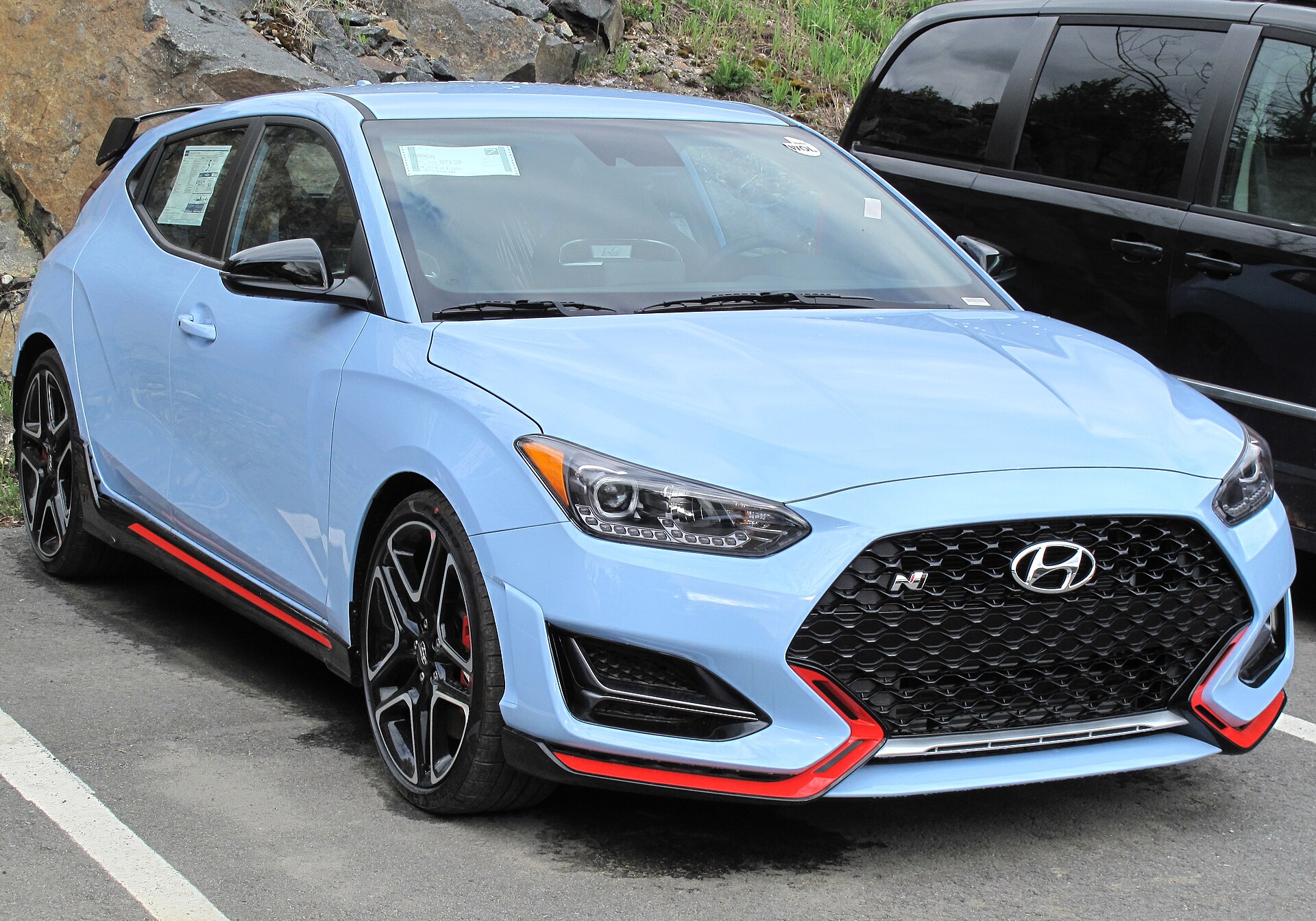
 Hyundai Veloster N
Specs, engines and history
Published Sources (5) Report an error
By Sarah Whitmore, Senior Automotive Writer
- Built
- 2018–2022
- Top power
- 202 kW (275 PS)
Which Veloster N to choose
Our verdict · Sarah Whitmore
- For pure driving: a 2019–2020 car with the six-speed manual and the Performance Package, which brings the limited-slip differential.
- For daily use in traffic: a 2020–2022 car with the eight-speed DCT, the quickest version to 100 km/h.
- To avoid: a base 184 kW car without the differential, unless the price is clearly lower.
- For buyers in Europe, where the Veloster was not sold: Hyundai's compact hatchback is covered in our Hyundai i30 article.
- To weigh it against other hot hatches: use our comparison tool.
- For a Japanese rival of the same size: the Honda Civic Si.
Hyundai's other cars are collected in our Hyundai catalogue; the company's own story is in our history of Hyundai.
The Hyundai Veloster N is the high-performance version of the second-generation Veloster, an unusual hatchback with one door on the left and two on the right. It was shown in January 2018, reached buyers in 2019 and was built at Ulsan in South Korea until July 2022. A 2.0-litre turbo engine with 184 or 202 kW drove the front wheels through a six-speed manual or, from 2020, an eight-speed dual-clutch gearbox.
In short
- Years: 2018–2022; the first N model sold in North America, never offered in Europe.
- Engine: 2.0 T-GDi with 184 kW (250 PS) or 202 kW (275 PS) with the Performance Package, 353 Nm.
- 0–100 km/h in 6.4 s (184 kW manual), 6.1 s (202 kW manual) and 5.6 s with the DCT; top speed 250 km/h.
- Price in the US: from US$26,900 (about €24,000) for the 2019 model year.
Specs by version
Engines
| Version | Engine | Power | Torque | Gearbox | Drive | Production years |
|---|---|---|---|---|---|---|
| 2 L 4 cyl Automatic (AM-S8) · 2022 (EPA) | 2.0 l · 4 cyl 2,000 cc | — | — | 8-sp Dual-clutch | Front-wheel drive | 2022 |
| 2 L 4 cyl Manual 6-spd · 2022 (EPA) | 2.0 l · 4 cyl 2,000 cc | — | — | 6-sp Manual | Front-wheel drive | 2022 |
| 2 L 4 cyl Automatic (AM-S8) · 2021 (EPA) | 2.0 l · 4 cyl 2,000 cc | — | — | 8-sp Dual-clutch | Front-wheel drive | 2021 |
| 2 L 4 cyl Manual 6-spd · 2021 (EPA) | 2.0 l · 4 cyl 2,000 cc | — | — | 6-sp Manual | Front-wheel drive | 2021 |
| 2 L 4 cyl Manual 6-spd · 2020 (EPA) | 2.0 l · 4 cyl 2,000 cc | — | — | 6-sp Manual | Front-wheel drive | 2020 |
| 2 L 4 cyl Manual 6-spd · 2019 (EPA) | 2.0 l · 4 cyl 2,000 cc | — | — | 6-sp Manual | Front-wheel drive | 2019 |
| N 2.0 T-GDi | 4 cyl · Petrol | 184 kW 250 PS247 hp | 353 Nm260 lb-ft | 6-sp Manual | Front-wheel drive | 2018–2020 |
| N Performance Package 2.0 T-GDi | 4 cyl · Petrol | 202 kW 275 PS271 hp | 353 Nm260 lb-ft | 6-sp Manual | Front-wheel drive | 2018–2022 |
| N 2.0 T-GDi DCT | 4 cyl · Petrol | 202 kW 275 PS271 hp | 353 Nm260 lb-ft | 8-sp Dual-clutch | Front-wheel drive | 2020–2022 |
Performance
Show all 9 versions
| Version | 0–100 km/h | Fuel consumption |
|---|---|---|
| 2 L 4 cyl Automatic (AM-S8) · 2022 (EPA) | — | 10.7 l/100 km22.0 mpg US · 26.4 mpg UK |
| 2 L 4 cyl Manual 6-spd · 2022 (EPA) | — | 9.4 l/100 km25.0 mpg US · 30.1 mpg UK |
| 2 L 4 cyl Automatic (AM-S8) · 2021 (EPA) | — | 10.7 l/100 km22.0 mpg US · 26.4 mpg UK |
| 2 L 4 cyl Manual 6-spd · 2021 (EPA) | — | 9.4 l/100 km25.0 mpg US · 30.1 mpg UK |
| 2 L 4 cyl Manual 6-spd · 2020 (EPA) | — | 9.4 l/100 km25.0 mpg US · 30.1 mpg UK |
| 2 L 4 cyl Manual 6-spd · 2019 (EPA) | — | 9.4 l/100 km25.0 mpg US · 30.1 mpg UK |
| N 2.0 T-GDi | 6.4 s 0–62 mph | — |
| N Performance Package 2.0 T-GDi | 6.1 s 0–62 mph | — |
| N 2.0 T-GDi DCT | 5.6 s 0–62 mph | — |
Dimensions and weight
Show all 1 versions
| Version | Length | Width | Wheelbase | Kerb weight |
|---|---|---|---|---|
| N 2.0 T-GDi | 4,239 mm166.9 in | 1,803 mm71.0 in | 2,642 mm104.0 in | 1,377 kg3,036 lb |
Verified Manufacturer and type-approval data from our catalog · Sources and methodology
Veloster N at a glance
| Parameter | Value |
|---|---|
| Production | 2018 – July 2022, Ulsan Plant 1, South Korea |
| Body | three-door hatchback (one door left, two right), four seats |
| Engine | 2.0-litre Theta II T-GDi turbo four-cylinder |
| Power | 184 kW (250 PS) or 202 kW (275 PS); 205 kW (275 hp) as rated in North America |
| Torque | 353 Nm from 1,450 to 4,700 rpm |
| Gearboxes | six-speed manual with rev matching; eight-speed wet DCT from 2020 |
| Drive | front wheels, electronically controlled limited-slip differential with the Performance Package |
| Kerb weight | about 1,377 kg (2019, manual) |
| Size | about 4,240 mm long, 1,800 mm wide, 2,640 mm wheelbase |
Launch and development
The second-generation Veloster, code JS, made its debut at the Detroit motor show in January 2018, and the N version was presented alongside it. The Veloster N went on sale in 2019 and became the first N car sold in North America. It was never offered in Europe.
The Veloster range was cut back early. Canada dropped all versions except the N in August 2020. In July 2021 Hyundai announced that only the N would stay in the US range for 2022, because the regular car was selling slowly. Production of the whole second generation ended in July 2022.

The 2.0 T-GDi engine and gearboxes
All Veloster N cars use the same 2.0-litre turbocharged petrol engine from the Theta II family. It came in two states of tune:
| Version | Power | Torque | Gearbox | 0–100 km/h |
|---|---|---|---|---|
| Veloster N (base) | 184 kW (250 PS) at 6,000 rpm | 353 Nm | 6-speed manual | 6.4 s |
| Veloster N Performance Package | 202 kW (275 PS) at 6,000 rpm | 353 Nm | 6-speed manual | 6.1 s |
| Veloster N DCT (2020–2022) | 202 kW (275 PS) | 353 Nm | 8-speed wet DCT | 5.6 s |
North American cars were rated at 205 kW (275 hp). Top speed with the 184 kW engine is 250 km/h. The full torque arrives at only 1,450 rpm, so the car pulls hard from low revs. On the 1,377 kg of a 2019 manual car, 184 kW works out at about 134 kW per tonne, and 202 kW at about 147 kW per tonne. In the US the base N was rated at 22 mpg in town and 29 mpg on the highway.
The manual has an automatic rev-matching function for downshifts. The eight-speed wet dual-clutch gearbox arrived in 2020 and cut the 0–100 km/h time by half a second. It adds about 64 kg (141 lb), so drivers who value low weight still chose the manual. From 2021 the Performance Package was standard.

Chassis and the Performance Package
The base car rides on 18-inch wheels with 225/40 tyres and has disc brakes of 13 inches (330 mm) at the front and 12 inches (305 mm) at the rear. Its suspension is electronically controlled.
The Performance Package, priced at US$2,100 for 2019, added these parts:
- 202 kW instead of 184 kW;
- the N Corner Carving Differential, an electronically controlled limited-slip differential;
- larger brakes, 345 mm front and 315 mm rear;
- 19-inch wheels with 235/35 summer tyres;
- a variable exhaust valve system.
The limited-slip differential is the most important item, because it limits wheelspin of the inside front wheel when the driver accelerates out of a corner. Owners and reviewers praised the sound and the way the car changes character between normal and N modes. The usual complaint was an interior that feels less premium than the performance suggests.
Prices and markets
| Market and year | Price |
|---|---|
| US, 2019 model year, N manual | US$26,900 (about €24,000) |
| US, 2019, Performance Package | + US$2,100 |
| US, 2020 model year, base | US$27,600 |
| US, 2021 model year, base | US$32,250 (about €27,300) |
The car was sold in South Korea, the United States and Canada; Hyundai did not offer the second-generation Veloster in Europe. The US base price climbed by about 20 percent between 2019 and 2021, partly because the Performance Package became standard.
Veloster N ETCR: the electric race car
Hyundai also built an electric touring car that carried the Veloster N name. The Veloster N ETCR was shown at the Frankfurt IAA in September 2019. Work on it had started in November 2018, and the prototype first ran in August 2019. Unlike the road car, it has a mid-mounted electric motor driving the rear wheels. The cars were built in Alzenau, Germany.
It raced in the FIA ETCR series from its first season in 2021 and was Hyundai's first electric race car. Jean-Karl Vernay finished second in the 2021 PURE ETCR standings, and Hyundai was third of three manufacturers. The car raced again in 2022, when the series became the eTouring Car World Cup.
Photo gallery

Hyundai Veloster N in our rankings
- No. 3 of 18 · Fastest Korean cars (250 km/h)
- No. 4 of 46 · Fastest hatchbacks (250 km/h)
- No. 5 of 19 · Quickest Korean cars, 0–100 (5.6 s)
- No. 7 of 53 · Power-to-weight: hatchbacks (134 kW/t)
- No. 20 of 106 · Most powerful hatchbacks (202 kW · top 19%)
- No. 91 of 420 · Smallest cars (4,239 mm · top 22%)
Better power-to-weight than 86% of ranked hatchbacks in the 1CARS catalog (No. 7 of 53).
FAQ
How much power does the Hyundai Veloster N have?
184 kW (250 PS) in base form and 202 kW (275 PS) with the Performance Package; torque is 353 Nm in both cases.
Is the Veloster N automatic or manual?
A six-speed manual with rev matching was standard. An eight-speed wet dual-clutch automatic was added in 2020.
How fast is the Veloster N from 0 to 100 km/h?
Hyundai quoted 6.4 s for the 184 kW manual, 6.1 s for the 202 kW manual and 5.6 s with the DCT.
Why was the Veloster N discontinued?
Sales of the Veloster range were low. Hyundai cut the model back to the N version in North America and ended production of the second generation in July 2022.
Was the Veloster N sold in Europe?
No. The second-generation Veloster, including the N, was not offered in European markets.
Data sources
Data checked by an editor against the sources below.
- Wikipedia — Hyundai Veloster
- Cars
- US EPA fueleconomy.gov — 43831.shtml
- US EPA fueleconomy.gov — 43832.shtml
- US EPA fueleconomy.gov — 42927.shtml