 Ford Consul Classic
Specs, engines and history
Published Sources (3) Report an error
By Sarah Whitmore, Senior Automotive Writer
- Built
- 1961–1964
- Top power
- 44 kW (60 PS)
Which Consul Classic to choose
Our verdict · Sarah Whitmore
- For easier use: a 1,498 cc car from late 1962 or 1963, with the stronger five-bearing engine and synchromesh on all forward gears.
- For originality: a four-door De Luxe with the column change, the version The Motor tested in 1961.
- For value growth: a Consul Capri, and above all a documented GT, which Classics World values well above the saloon.
More British and European cars of the decade are listed in our 1960s classics guide and in our pick of the top classic cars from the sixties. For the wider story, read our history of Ford or browse the Ford catalogue.
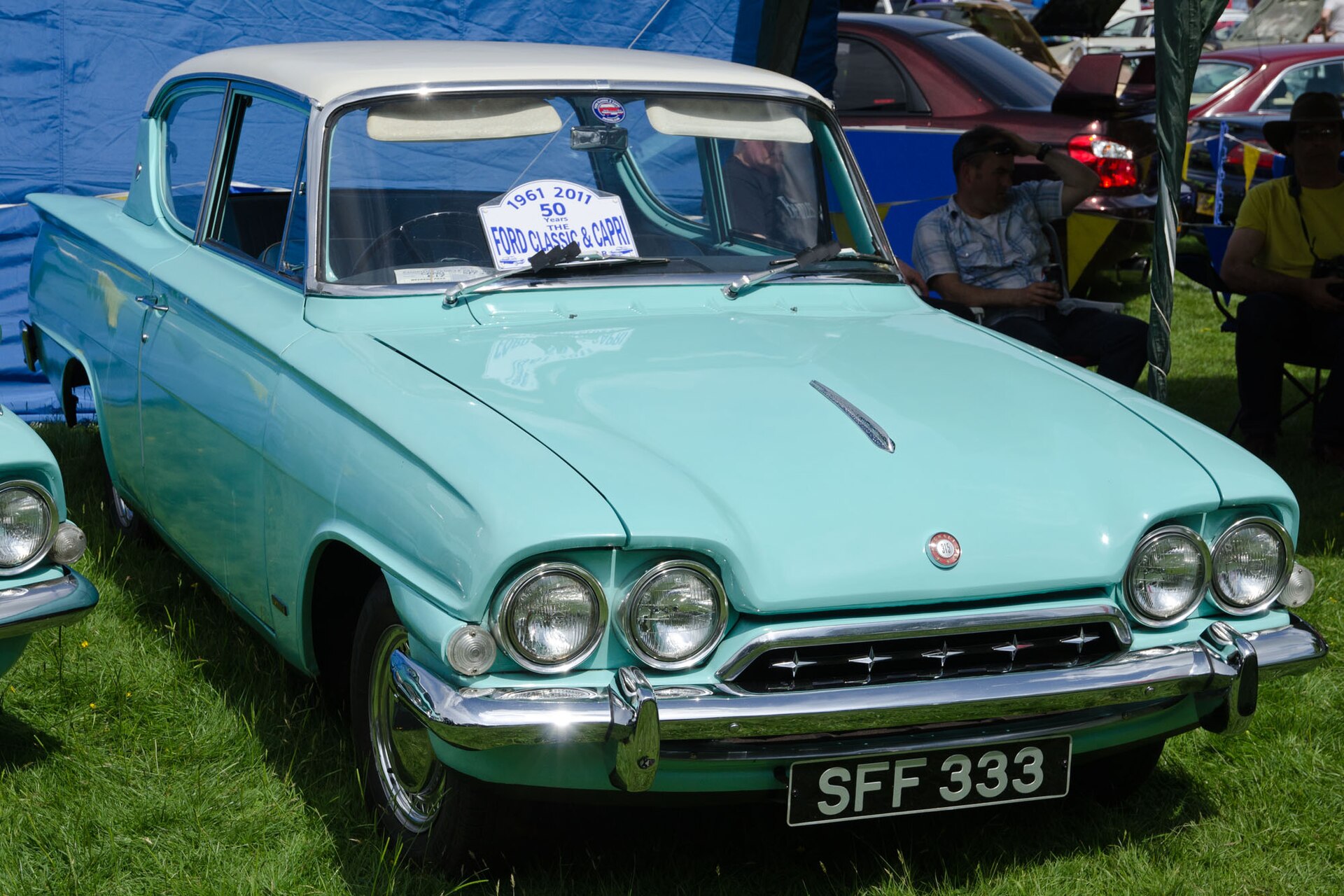
The Ford Consul Classic was a family saloon built by Ford of Britain from May 1961 to the autumn of 1963. Styled in the American manner, it had quad headlamps and the same backward-raked rear window as the Anglia on a larger body. It lasted barely two and a half years: the Cortina of 1962 took its buyers, and the Corsair replaced it. A total of 111,225 saloons were built, plus about 19,000 of the Consul Capri coupé derived from it.
In short
- Built 1961–1963 in Britain as two- and four-door saloons, in Standard and De Luxe trim; export name Consul 315.
- Kent four-cylinder engines: 1,340 cc with 40 kW (53–54 bhp), then 1,498 cc with 44 kW (59 bhp) from summer 1962.
- First British Ford with quad headlamps; front disc brakes and a 21 cu ft boot as standard.
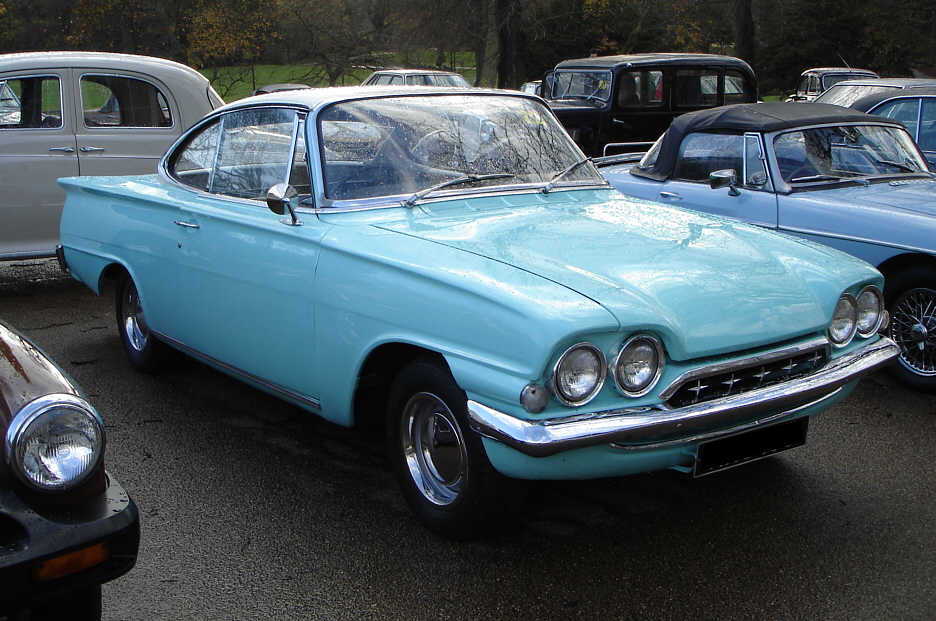
- The two-door Consul Capri coupé (1961–1964) used the same platform; 2,002 were GT versions with 58 kW (78 bhp).
Size at a glance
| Dimensions | Ford Consul Classic 315 |
|---|---|
| Length | 4,337 mm170.7 in |
| Width | 1,651 mm65.0 in |
| Height | 1,422 mm56.0 in |
| Wheelbase | 2,515 mm99.0 in |
Specs by version
Engines
| Version | Engine | Power | Gearbox | Drive | Production years |
|---|---|---|---|---|---|
| 1,340 cc Kent (109E) | 1.3 l · 4 cyl · Petrol 109E | 40 kW 54 PS54 hp | 4-sp Manual | Rear-wheel drive | 1961–1962 |
| 1,498 cc Kent (116E) | 1.5 l · 4 cyl · Petrol 116E | 44 kW 60 PS59 hp | 4-sp Manual | Rear-wheel drive | 1962–1963 |
Performance
Show all 1 versions
| Version | Top speed |
|---|---|
| 1,340 cc Kent (109E) | 126 km/h78 mph |
Dimensions and weight
Show all 2 versions
| Version | Length | Width | Height | Wheelbase | Kerb weight |
|---|---|---|---|---|---|
| 1,340 cc Kent (109E) | 4,337 mm170.7 in | 1,651 mm65.0 in | 1,422 mm56.0 in | 2,515 mm99.0 in | 940 kg2,072 lb |
| 1,498 cc Kent (116E) | 4,337 mm170.7 in | 1,651 mm65.0 in | 1,422 mm56.0 in | 2,515 mm99.0 in | 940 kg2,072 lb |
Verified Manufacturer and type-approval data from our catalog · Sources and methodology
Ford Consul Classic at a glance
| Parameter | Metric | Imperial |
|---|---|---|
| Production | May 1961 – autumn 1963 | - |
| Body | two- or four-door saloon | - |
| Engine | 1,340 cc, later 1,498 cc, straight-four | 81.8 / 91.4 cu in |
| Power | 40 kW (53–54 bhp), later 44 kW (59 bhp) | - |
| Gearbox | four-speed manual, floor or column lever | - |
| Wheelbase | 2,515 mm | 99 in |
| Length | 4,337 mm | 170.75 in |
| Width / height | 1,651 mm / 1,422 mm | 65 in / 56 in |
| Kerb weight | 940 kg | 2,070 lb |
| Boot | about 595 litres | 21 cu ft |
| Built | 111,225 saloons | - |
Development and launch
Styling work began in 1956 under Colin Neale; the Capri coupé was later drawn by Charles Thompson. Lancaster Insurance describes the result as a fusion of the 1958 Lincoln and the 1960 Galaxie, and Motor Sport's first report in June 1961 also found it reminiscent of the American Galaxie. Ford had planned to launch the car in the summer of 1960, but the strong sales of the Anglia 105E pushed the date back.
The Consul Classic went on sale in May 1961. It was the first British Ford with four headlamps, and its "Breezeway" rear window, raked forwards like the Anglia's, came from the 1958 Lincoln Continental. Its rivals were the Vauxhall Victor FB and Singer Vogue, both new in 1961, and more conservative cars such as the Austin A60 Cambridge, Morris Oxford Series VI and Hillman Minx.
Production timeline
| Year | Event |
|---|---|
| 1956 | styling work begins under Colin Neale |
| 1961 | Consul Classic launched in May; Consul Capri announced for export in September |
| 1962 | Capri on sale in Britain from January; 1,498 cc engine with all-synchromesh gearbox from August |
| 1963 | Capri GT announced in February; Capri assembly moves to Halewood; Classic replaced by the Corsair in the autumn |
| 1964 | Consul Capri discontinued in July |
Design and engineering
The Classic used MacPherson strut front suspension and a rigid rear axle on semi-elliptic springs. Front brakes were 9.5-inch (241 mm) Girling discs, with 9-inch drums at the rear. It ran on 13-inch wheels with 5.60 tyres.
Inside there was a split front bench and a choice of floor or column gear change; Motor Sport praised the column change for its "positive feel and absolute precision". The boot held 21 cu ft, about 15% more than a Zodiac Mk II according to Grace's Guide. The De Luxe added two-tone paint, a cigar lighter, twin sun visors, screen washers and chrome horn rings, while a heater remained an extra-cost option on both trims.
Motor Sport's first drive, on Ford's Boreham test track, found a good ride over bumps but a lot of body roll, with roll oversteer under hard cornering. The magazine judged the car under-engined for racing or rallying and noted that Ford's works team had no plans to rally it. The Classic was aimed at families who needed five seats and a big boot. The disc brakes needed about 10% more pedal pressure than the Anglia's drums, though their stopping power was described as excellent.


Engines and performance
| Engine | Years | Code (RHD / LHD) | Power | Notes |
|---|---|---|---|---|
| 1,340 cc Kent (pre-crossflow) | 1961–1962 | 109E / 110E | 40 kW (54 bhp) at 4,900 rpm | synchromesh on upper three gears |
| 1,498 cc Kent | 1962–1963 | 116E / 117E | 44 kW (59 bhp) | five-bearing crankshaft, all-synchromesh gearbox |
| 1,498 cc Kent GT (Capri only) | 1963–1964 | - | 58 kW (78 bhp) | Cosworth-developed, twin-choke Weber carburettor |
The first engine had a stroke of 65.07 mm, against 48.41 mm in the Anglia 105E, and an 8.5:1 compression ratio. Motor Sport quoted 40 kW (54 bhp) at 4,900 rpm, while Classics World gives 40 kW (53 bhp).
The Motor tested a four-door De Luxe in 1961 and recorded 126 km/h (78.4 mph) and 7.9 l/100 km (35.8 mpg). Its 1962 test of the Consul Capri gave 127 km/h (79.0 mph) and 7.7 l/100 km (36.7 mpg). To compare these outputs with today's cars, use our power converter.

Consul Capri and other variants
| Variant | Years | Body / purpose | Engine | Notes |
|---|---|---|---|---|
| Classic Standard / De Luxe | 1961–1963 | two- or four-door saloon | 1,340 / 1,498 cc | export name Consul 315 |
| Consul Capri (335) | 1961–1964 | two-door coupé | 1,340 / 1,498 cc | bodies by Pressed Steel; about 19,000 built |
| Consul Capri GT | 1963–1964 | two-door coupé | 1,498 cc, 58 kW | 2,002 built |
| Hughes estate | 1960s | estate conversion | as saloon | 17 converted by a Ford dealer in Nairobi, Kenya |
Capri bodies were sub-assembled by Pressed Steel, with final assembly at Dagenham and, from February 1963, at Halewood. Production figures differ slightly: English Wikipedia gives 18,716 in its summary and 19,421 in the text, and Classics World also uses 19,421, in each case including the GTs. In New Zealand, Ford assembled the Consul 315 at Petone from kits.
Why it was replaced so soon
In 1962 Ford launched the Consul Cortina to fill the gap between the Anglia and the Classic. It took sales from the Classic, especially after the 1,498 cc Cortina Super arrived in January 1963. In the autumn of 1963 Ford replaced the Classic with the Corsair, built largely from Cortina components. The Capri lasted until July 1964.
Prices tell part of the story. In 1961 The Motor's four-door De Luxe cost £801 including tax, and a two-door Standard £745; the 1962 Capri cost £915 including tax of £288.
Owning a Consul Classic today
Classics World's buyer's guide (December 2025, updated February 2026) lists the usual rust areas. Check the sills inside and out, door bottoms, wheel arches and the rear of the front wings, then the headlamp surrounds, the waistline and the tail fins. On the Kent engine, look for blue smoke under load, heavy breathing from the oil filler, bottom-end rumble, a rattling timing chain and overheating caused by blocked water passages; a rebuild costs about £1,500 (2025).
Parts supply is mixed. Mechanical parts for the Kent engine are mostly available, but new front discs, steering boxes and body panels are scarce; a front wing cost £970 plus VAT in 2025.
The guide's 2025 values for the Classic start at about £1,000 for a project. A solid average car was worth £5,000–7,000 in 2025 (roughly €5,800–8,100). The best restored or highly original saloons reached £12,000 in 2025, about €13,900. Capris are worth more: in 2025 a good one with its original interior cost about £20,000 (€23,000), and concours cars £25,000–30,000.
Photo gallery


Ford Consul Classic in our rankings
- No. 5 of 53 · Lightest sedans (940 kg)
- No. 17 of 304 · Lightest cars (940 kg · top 6%)
- No. 16 of 86 · Smallest sedans (4,337 mm · top 19%)
- No. 131 of 420 · Smallest cars (4,337 mm · top 32%)
- No. 305 of 420 · Longest cars (4,337 mm · top 73%)
- No. 72 of 86 · Longest sedans (4,337 mm · top 84%)
Lighter than 94% of ranked cars in the 1CARS catalog (No. 17 of 304).
FAQ
When was the Ford Consul Classic produced?
Sales began in May 1961, and production ended in the autumn of 1963, when the Corsair replaced it. The related Consul Capri coupé was built until July 1964.
How many Ford Consul Classics were built?
111,225 saloons. About 19,000 Consul Capris were built in addition, including 2,002 GTs.
What engine does the Consul Classic have?
A four-cylinder Kent engine. Early cars have the 1,340 cc unit, and from August 1962 the 1,498 cc version with a five-bearing crankshaft took over.
What is the difference between the Consul Classic and the Consul Capri?
The Classic is the two- or four-door saloon; the Capri is a two-door coupé on the same 99-inch wheelbase, sold in Britain from January 1962.
Is the Consul Classic collectable?
Yes, but it is far rarer than the Anglia, and body panels are scarce. Classics World put average saloons at £5,000–7,000 in 2025–2026.
Data sources
Data checked by an editor against the sources below.
- Wikipedia - Ford Consul Classic
- Motorsportmagazine - The Ford Consul Classic 315
- Co - Ford Consul Classic Capri Buyers Guide