Chevrolet Corvette C4 — Digital Dash, ZR-1 and the Road Back to Speed
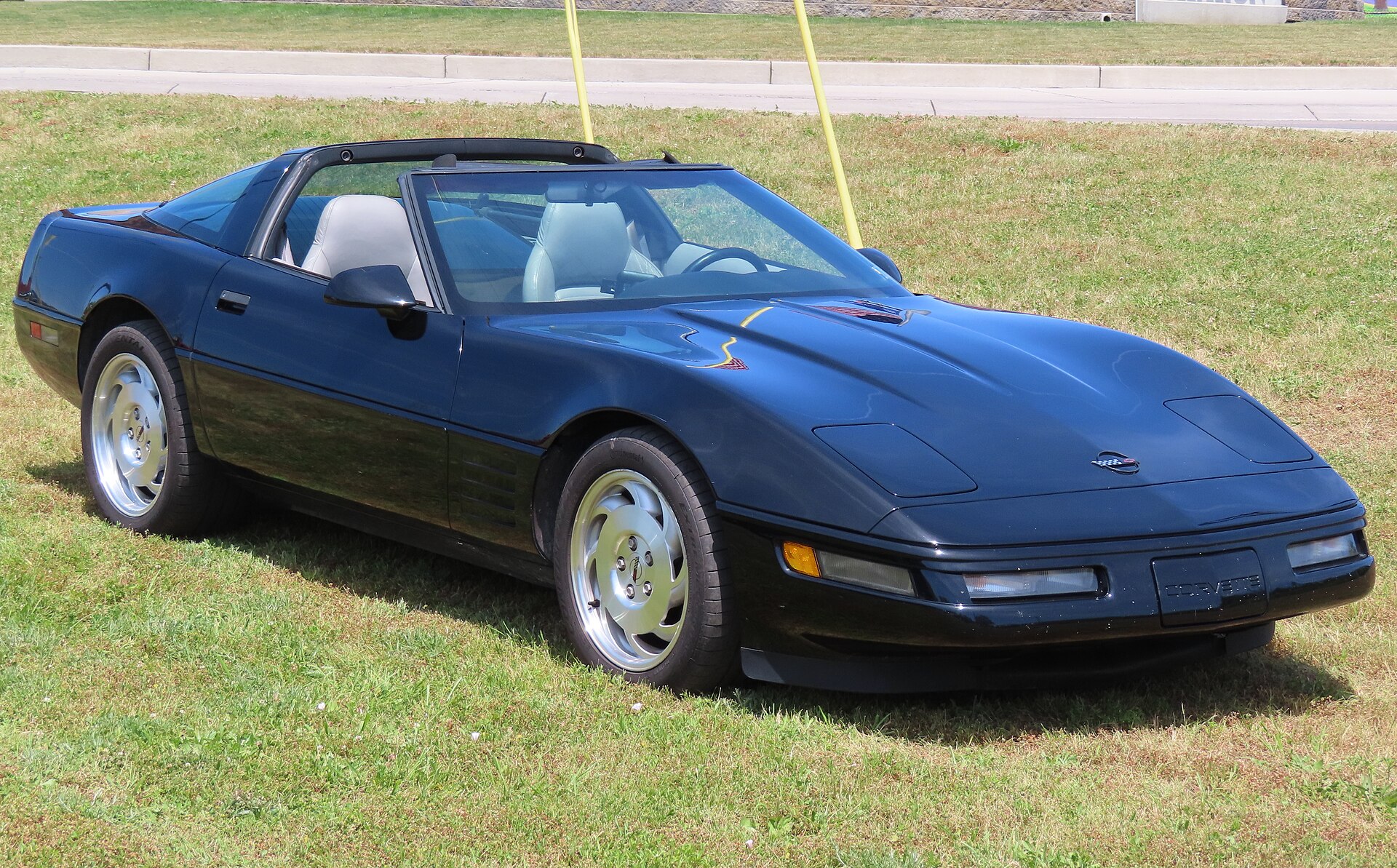
The Chevrolet Corvette C4 is the fourth-generation Corvette, built in Bowling Green, Kentucky, for the 1984 to 1996 model years. It was the first Corvette since 1963 on a completely new chassis: a lower, wedge-shaped coupé with a glass hatch, a lightweight "uniframe" chassis and a digital instrument panel. Over thirteen seasons it went from the 153 kW Cross-Fire engine to the 302 kW ZR-1, and 358,180 were built.
Key takeaways
- Regular production began on 3 January 1983, but the car was sold as a 1984 model; only 43 cars carry a 1983 VIN.
- Targa-top coupé throughout, convertible from 1986; 74,651 of the 358,180 cars were convertibles.
- V8s from the 153 kW (205 hp) L83 to the 246 kW (330 hp) LT4; the Lotus-designed ZR-1 reached 302 kW (405 hp).
- A ZR-1 set a 24-hour world speed record in 1990, averaging just over 283 km/h.
Chevrolet Corvette C4 at a glance
| Specification | Chevrolet Corvette C4 |
|---|---|
| Model years | 1984–1996 (production 3 January 1983 – 20 June 1996) |
| Plant | Bowling Green, Kentucky |
| Cars built | 358,180, including 74,651 convertibles |
| Body | two-seat targa-top coupé with glass hatch; convertible from 1986 |
| Design | Jerry Palmer; chief engineer Dave McLellan |
| Engines | 5.7-litre (350 cu in) V8: L83, L98, LT1, LT4 and the ZR-1's LT5 |
| Power | 153–302 kW (205–405 hp, SAE net) |
| Gearboxes | 4+3 manual, ZF six-speed manual, four-speed automatic |
| Wheelbase / length | 2,440 mm / 4,480 mm (1984–1989) |
| Width / height | 1,800 mm / 1,190 mm (coupé) |
| Kerb weight | 1,469 kg (base coupé) |
| Drag coefficient | 0.34 (German Wikipedia) |
| Predecessor / successor | C3 / C5 |
Why there is no 1983 Corvette
The C4 was meant to arrive for 1983, but its development ran late. Chevrolet built 43 pre-production cars with 1983 VINs and then started regular production on 3 January 1983 under the 1984 model year, giving the first C4 an unusually long sales season. Only one 1983 car survives, and it is displayed at the National Corvette Museum in Bowling Green.
Size at a glance
Chevrolet Corvette C7
The Chevrolet Corvette C8 is 137 mm longer and 56 mm wider than the Chevrolet Corvette C7.
| Dimensions | Chevrolet Corvette C8 | Chevrolet Corvette C7 | Difference |
|---|---|---|---|
| Length | 4,630 mm182.3 in | 4,493 mm176.9 in | +137 mm+5.4 in |
| Width | 1,933 mm76.1 in | 1,877 mm73.9 in | +56 mm+2.2 in |
| Height | 1,234 mm48.6 in | 1,234 mm48.6 in | Same |
| Wheelbase | 2,723 mm107.2 in | 2,710 mm106.7 in | +13 mm+0.5 in |
Chief engineer Dave McLellan, who had succeeded Zora Arkus-Duntov in 1975, led the programme; Jerry Palmer's studio drew the body. The first year started strongly: 51,547 cars were built for 1984, a figure no later C4 season came close to.

Chassis, body and the digital cockpit
Underneath, the C4 had a steel perimeter "uniframe" with fully independent suspension. Instead of coil springs it used transverse fibreglass mono-leaf springs, a third of the weight of the coils they replaced. The glass hatch and the single removable roof panel made the coupé practical by sports-car standards.
The cabin was pure 1980s. A liquid-crystal digital instrument cluster was standard, and the stiff frame brought high sills on both sides of the cabin. For 1986 the convertible returned for the first time since 1975, together with anti-lock brakes, a third brake light, electronic climate control and the Pass-Key anti-theft system with fifteen resistor values. All 7,315 convertibles built in 1986 carried an Indianapolis 500 pace car console badge.
Gearboxes were a mixed story. The early manual was the Doug Nash "4+3": a four-speed with an overdrive on the top three gears, used from 1984 to 1988. A six-speed manual made by ZF replaced it for 1989. Automatics were the 700R4 four-speed and, from 1994, the electronically controlled 4L60-E.

Engines and performance by year
Every C4 engine was a 5.7-litre (350 cu in) V8. The figures below are Chevrolet's SAE net ratings as listed by Wikipedia.
| Engine | Years | Fuel system | Power | Torque |
|---|---|---|---|---|
| L83 | 1984 | Cross-Fire throttle-body injection | 153 kW (205 hp) | 393 Nm |
| L98 | 1985–1986 | tuned-port injection | 172 kW (230 hp) | 447 Nm |
| L98 | 1987–1989 | tuned-port injection | 179 kW (240 hp) | 468 Nm |
| L98 | 1990–1991 | tuned-port injection | 183 kW (245 hp) | 468 Nm |
| LT1 | 1992–1996 | sequential injection | 224 kW (300 hp) | 447–461 Nm |
| LT4 | 1996, manual only | sequential injection | 246 kW (330 hp) | 461 Nm |
| LT5 (ZR-1) | 1990–1992 | 32-valve, four camshafts | 280 kW (375 hp) | 502 Nm |
| LT5 (ZR-1) | 1993–1995 | 32-valve, four camshafts | 302 kW (405 hp) | 522 Nm |
The 1984 car kept the Cross-Fire Injection carried over from the last C3, and the tuned-port L98 of 1985 was the first real step forward. Automatic coupés with a 3.07 axle got a 186 kW (250 hp) version of the L98 for 1990–1991. Wikipedia notes that the L98 held the car back until the second-generation LT1 arrived for 1992; with 224 kW (300 hp) the ordinary C4 finally matched the performance of its rivals. Traction control, called ASR, followed in the early 1990s. To see how these outputs compare with today's sports cars, browse the 1cars rankings.
ZR-1: the "King of the Hill"
General Motors bought Group Lotus in 1986, and the British company designed a new all-aluminium V8 for a top Corvette. The LT5 had four overhead camshafts, 32 valves and an 11.0:1 compression ratio, and it needed 12 quarts of oil, seven more than the L98. Its machining was so specialised that Mercury Marine assembled the engines in Stillwater, Oklahoma. The ZR-1 was shown at the 1989 Geneva Motor Show and sold from the 1990 model year.
Outside, the main difference was a wider rear body, 11 cm across the back according to German Wikipedia. It rode on 315/35ZR17 Goodyear tyres, had Bosch ABS and adjustable Bilstein dampers, and weighed about 91 kg more than a standard C4. Chevrolet's own figures were 4.4 seconds from 0 to 100 km/h and 290 km/h flat out; Road & Track measured 288 km/h (179 mph) and 4.9 seconds to 60 mph, while Car and Driver timed 4.5 seconds.
On 1 March 1990 a near-stock ZR-1 ran at the Fort Stockton test track in Texas under FIA observation. It covered 6,793.453 km in 24 hours at an average of 283.059 km/h, a world record, and also set records over 5,000 km and 5,000 miles. Power rose to 302 kW (405 hp) for 1993, but the high price limited demand. After 6,939 cars the ZR-1 was dropped at the end of the 1995 model year.


Callaway Twin Turbo and other tuned C4s
From 1987 to 1991 Chevrolet dealers could order a factory-approved Callaway Twin Turbo conversion under option code B2K. More than 500 cars were converted, and the option cost US$26,995 on top of the car. Rated output climbed from about 257 kW (345 hp) in 1987 to 301 kW (403 hp) in 1990–1991. A one-off derivative, the Callaway SledgeHammer, reached 410 km/h (254.76 mph) in 1988.
Anniversary and limited editions
| Edition | Year | Built | Key features |
|---|---|---|---|
| 35th Anniversary "Triple White" | 1988 | 2,050 | white paint, wheels and interior |
| 40th Anniversary | 1993 | 6,749 | anniversary package, option price US$1,455 |
| Indianapolis 500 Pace Car | 1995 | 527 | convertible replica |
| Grand Sport | 1996 | 1,000 (810 coupés, 190 convertibles) | Admiral Blue, white stripe, LT4 engine |
| Collector Edition | 1996 | 5,412 (1,381 convertibles) | Sebring Silver paint, US$1,250 extra |
The Grand Sport name recalled the lightweight racing C2 of 1963. Its LT4 came only with the six-speed manual, and it is now one of the most wanted C4 versions.
Production and US prices by model year
| Model year | Cars built | US base price |
|---|---|---|
| 1984 | 51,547 | US$21,800 |
| 1986 | 35,109 | US$27,027 |
| 1988 | 22,789 | US$29,480 |
| 1990 | 23,646 | US$32,479 |
| 1992 | 20,479 | US$33,635 |
| 1994 | 23,330 | US$36,185 |
| 1996 | 21,537 | US$37,225 |
By our calculation the base price rose by about 71 % between 1984 and 1996, while yearly output fell by more than half. Prices are original US stickers, not adjusted for inflation.
Buying a C4 today
A C4 is one of the cheapest ways into a Corvette with modern fuel injection and a six-speed manual. Hagerty's 2026 estimates quoted by vette-vues put a 1984 base coupé at about US$8,900 in good condition and US$20,400 in excellent condition; a 1990 ZR-1 coupé at about US$22,800 and US$53,300; and a 1996 Grand Sport convertible at about US$33,400 and US$61,900. The same source says an automatic gearbox lowers the value of a 1984 coupé by about 8 %.
Points that shape reliability, service costs and value:
- Engine choice: the 1984 Cross-Fire car is the slowest and least valued; LT1 cars from 1992 offer the best mix of performance and price.
- Gearbox: the 4+3 manual of 1984–1988 is regarded as the weak spot; the ZF six-speed from 1989 is the preferred manual.
- ZR-1: the LT5 is a specialised engine; budget for a specialist and ask for maintenance records.
- Collectability: the 1996 Grand Sport and LT4 six-speed cars are the most sought after by collectors.
Compare a C4 with its successor or with a period rival in the 1cars comparison tool.
How the C4 fits the Corvette line
The C4 followed the long-lived C3 and handed over to the C5 of 1997, whose rear-mounted gearbox and LS1 engine moved the car further towards modern standards. The early cars are covered in the Corvette C1 guide, and the last front-engined generation in the Corvette C7 guide. The whole family is listed on the Chevrolet Corvette catalogue page.
Photo gallery


FAQ
Why was there no 1983 Corvette?
The C4 was delayed, so Chevrolet skipped the 1983 model year. It built 43 cars with 1983 VINs; one survives at the National Corvette Museum.
What is the fastest C4 Corvette?
The ZR-1 of 1993–1995, with 302 kW (405 hp). Chevrolet quoted 0–100 km/h in 4.4 seconds and 290 km/h.
How many C4 ZR-1s were made?
6,939 between the 1990 and 1995 model years. The LT5 engines were assembled by Mercury Marine in Oklahoma.
Which C4 engine is best?
For most buyers the 224 kW (300 hp) LT1 of 1992–1996. The 1996 LT4 with 246 kW (330 hp) is rarer and came only with the six-speed manual.
How many C4 Grand Sports were built?
1,000 in 1996: 810 coupés and 190 convertibles, all in Admiral Blue with a white stripe.