 Hyundai ix35
Specs, engines and history
Published Sources (1) Report an error
By Sarah Whitmore, Senior Automotive Writer
Verdict
Our verdict · Sarah Whitmore
With the facelift, Hyundai did not attempt sweeping changes but improved the car point by point. The pleasant, understated looks, decent ground clearance, comfortable cabin and available all-wheel drive remained. It is not a real off-roader, but leaving the tarmac is no longer intimidating. The equipment and safety level are impressive for an affordable model; the firm suspension and cheap plastics are the main weak points, and the price helps to forgive them. The ix35 made a significant contribution to Hyundai's history.
The Hyundai ix35 is a compact crossover with front- or all-wheel drive, built by Hyundai Motor Company as the second generation of the Hyundai Tucson. Hyundai unveiled it at the Frankfurt motor show in 2009 as the replacement for the first Tucson. In most markets outside South Korea and North America it was sold as the ix35; at home and in North America it kept the Tucson name. A facelift followed in 2013, and in 2015 the ix35 was replaced by the third-generation Tucson, which reverted to the Tucson name worldwide.
In short
- Second-generation Tucson (LM), built from 2009 to 2015 and sold as the ix35 in most markets.
- Petrol engines from 99 to 130 kW (135–177 PS) and diesels from 85 to 135 kW (116–184 PS).
- Front-wheel drive or on-demand AWD with a lockable multi-plate clutch; six-speed manual or automatic gearboxes.
- 591 litres of boot space (1,436 litres with the rear seats folded) and a full-size spare wheel.
Hyundai ix35 at a glance
The ix35 shares its platform and many engines with the Kia Sportage of the same period. The facelift of 2013 changed the car only in detail, but it also brought technical improvements. More Hyundai models are listed in our Hyundai catalogue, its successor is covered in our Hyundai Tucson article, and the company's background is told in our history of Hyundai.
| Item | Detail |
|---|---|
| Generation | Second-generation Tucson, code LM |
| Debut | Frankfurt motor show, 2009 |
| Facelift | 2013 |
| Successor | Third-generation Tucson, revealed March 2015 |
| Body | Five-door crossover |
| Drive | Front or all-wheel |
Exterior
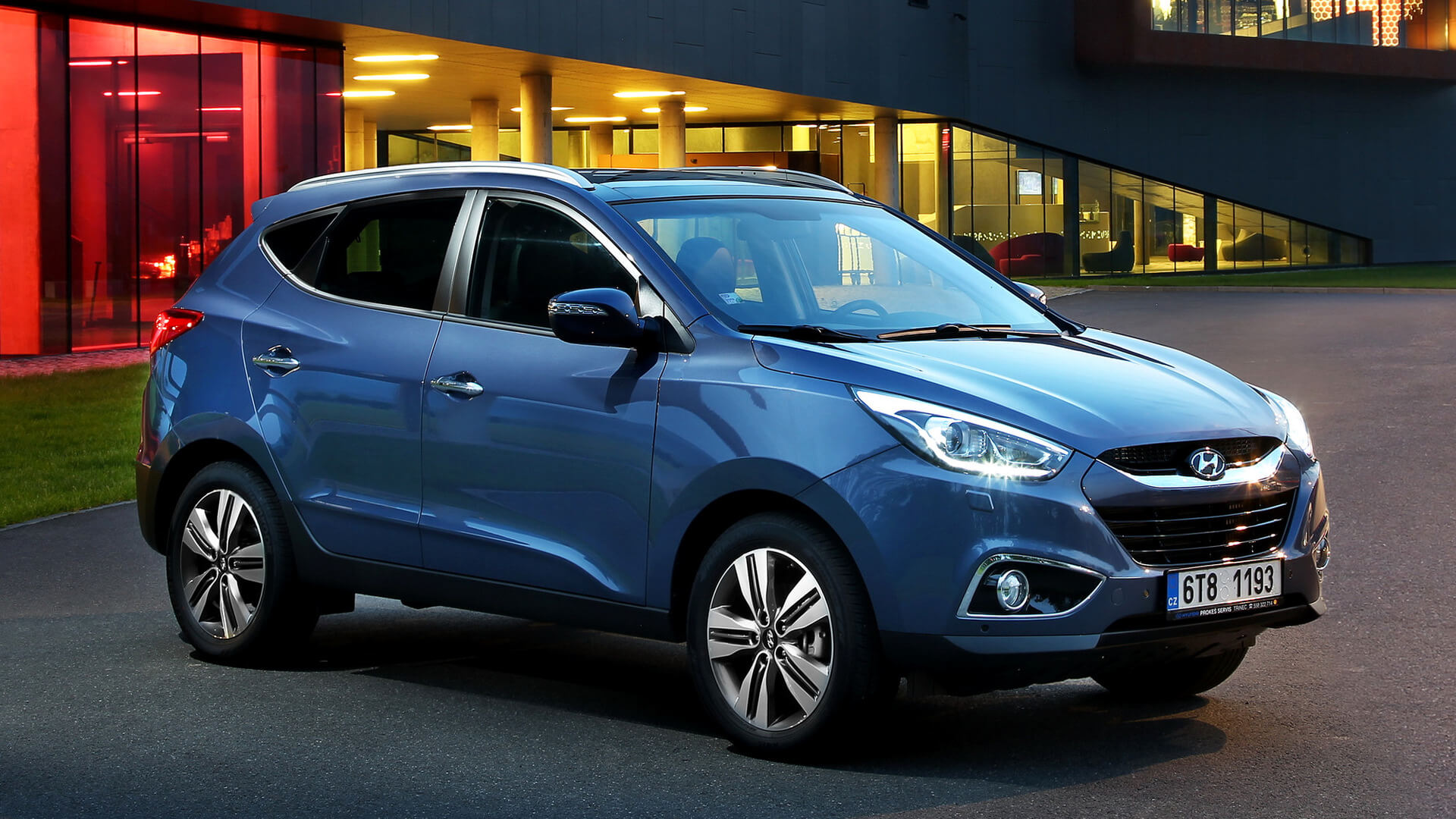
Hyundai's designers did a good job with the ix35, and many people consider the result a success. Moving away from the tired shapes of earlier crossovers to the "fluidic sculpture" design language made the new car far more distinctive and recognisable. It has almost nothing in common with the first Tucson.
Stylish LED daytime running lights with a sporty, technical look blend into the overall design. The headlights and the creases along the sides of the bonnet follow the conventions of the time. The grille, with chrome and gloss-black elements, emphasises the car's character. In profile the ix35 combines strength and elegance, with flowing side lines that suggest forward motion. The neat mirrors are electrically adjustable and heated and have integrated indicators. The upper and lower window lines converge towards the rear, adding to the sense of speed, and chrome door handles make the car look more expensive.
The round wheel arches house 17- or 18-inch alloy wheels with silica-compound tyres for better grip. Ground clearance is an average 175 mm — enough for city driving. The rear has a spoiler with an integrated brake light, LED tail lights, fog lamps and roof rails, plus a small tailgate window, a plastic lower section and large reflectors. After the facelift, the European ix35 received new headlights and tail lights; overall, the update is well judged and balanced.
Interior
The cabin changed more than the exterior. It is simple but cosy, functional and pleasant to look at, and the materials improved: soft-touch plastics dominate, with cloth or a combination of leather and leatherette upholstery. Sound insulation was noticeably better too.
The driver has a pleasant four-spoke steering wheel with buttons for various functions. The Supervision instrument cluster now has a 4.2-inch colour trip-computer display, and all information is easy to read. Heated seats front and rear, a height-adjustable steering wheel, heated mirrors, electric windows all round and air conditioning are standard. The front seats are comfortable but could offer firmer side support, and the backrest profile is not ideal: even with lumbar adjustment, the perfect driving position is hard to find and the driver's back can get tired on long trips. A round start-stop button makes everyday use easier.
On higher trims the centre console carries a 7-inch touchscreen with CD, MP3, Bluetooth, radio, a subwoofer, GPS navigation and a rear camera. Simpler versions have a monochrome trip computer and a 4.3-inch colour audio display with CD, MP3, radio, rear camera and six speakers; the base car has a simple radio with CD/MP3. USB and AUX sockets are standard. Below are the heating and air-conditioning or climate controls, and the tunnel carries a cigarette lighter, sockets, the manual or automatic gear lever, the parking-brake lever, two cupholders and a compact armrest with a small storage box.
The rear bench is comfortable, with legroom, width and headroom that most rivals envy and an almost flat floor; the transmission tunnel is low. The ironic result is that everyone sits comfortably except the driver. The boot holds 591 litres with five seats in use, loaded to the cover, and 1,436 litres with the rear seats folded. The floor is not flat, but there is a full-size spare wheel.
Engines and transmissions
| Engine | Fuel | Power (kW / PS) | Torque | Years |
|---|---|---|---|---|
| 1.6 GDI (Gamma) | Petrol | 99 kW / 135 PS | 164 Nm | 2009–2015 |
| 2.0 MPI (Theta II) | Petrol | 122 kW / 166 PS | 197 Nm | From 2009 |
| 2.0 GDI (Nu) | Petrol | 122 kW / 166 PS | 205 Nm | 2013–2015 |
| 2.4 MPI (Theta II) | Petrol | 130 kW / 177 PS | 227 Nm | 2009–2015 |
| 1.7 CRDi (U II) | Diesel | 85 kW / 116 PS | 260 Nm | 2009–2015 |
| 2.0 CRDi (R) | Diesel | 100 kW / 136 PS | 320 Nm | From 2009 |
| 2.0 CRDi (R), high output | Diesel | 135 kW / 184 PS | 392 Nm | From 2009 |
The facelift added a new-generation petrol engine and improved the diesels. The 2.0 Nu petrol engine is a 16-valve four-cylinder; in some markets it was offered with port injection and lower output. Combined consumption for the 2.0 petrol is about 7.3–7.4 l/100 km. The updated 2.0 CRDi diesels became more economical thanks to a new low-pressure exhaust-gas recirculation system (LP-EGR) and use about 6.0 l/100 km.
Petrol engines are paired with a six-speed manual or a six-speed automatic, and in many markets the diesels came with an automatic and all-wheel drive. The AWD system uses an electromagnetically controlled multi-plate clutch with a lock function that disengages automatically at 40 km/h. Depending on the version, the ix35 reaches 100 km/h in 9.8–12.1 seconds, and top speed is up to 195 km/h.
Chassis
The engineers did not change the suspension much in the facelift, but retuned some components and replaced several bushes. The monocoque body has independent MacPherson-strut front suspension with an anti-roll bar and an independent multi-link rear axle. More expensive versions get variable-rate dampers. The electric power steering gained Flex Steer, which offers three modes — Normal, Comfort and Sport — with different weighting and response. All-wheel-drive versions have disc brakes on all four wheels (ventilated at the front), with ABS, EBD and stability control.
Safety
Stability control intervenes as soon as it detects that the driver is losing control, manages engine torque and distributes braking force; ABS prevents the wheels from locking. Even before the facelift the ix35 was well equipped for its class, and it earned a Top Safety Pick from the US Insurance Institute for Highway Safety (IIHS) in 2010. It also received five stars in Euro NCAP testing.
Six airbags are fitted — two front, two side and two curtain airbags — together with active head restraints that reduce the risk of neck and head injuries in a collision. Downhill brake control and hill-start assist are included. Depending on the version, equipment also includes cruise control, a rear camera, GPS navigation, rain and light sensors, bi-xenon headlights, fog lamps, an immobiliser, central locking and an alarm. Higher trims add leather upholstery, keyless start, Flex Steer, tinted windows and a heated steering wheel.
What owners say
Owners liked the ix35 for its competitive price, economy, decent performance and pleasant, modern design, and consider it good value for money. The comfortable, roomy cabin and big boot are praised, and all-wheel drive combined with decent ground clearance gives confidence beyond the tarmac. The conventional automatic (not a CVT) has a good reputation, as do the sound insulation and the fast-warming cabin in winter.
On the downside, owners note the unclear behaviour of the all-wheel-drive system — petrol versions lack brake-based simulated differential locks — and a budget feel with creaking plastics. The suspension is a little firm with short travel, the automatic sometimes hesitates and some engine versions feel underpowered.
Rivals
The ix35 competed with the Mitsubishi Outlander, Kia Sportage, Ford Kuga, Honda CR-V, Jeep Compass, Mazda CX-5, Nissan X-Trail, Opel Antara, Subaru Forester, Suzuki Grand Vitara, Toyota RAV4 and Volkswagen Tiguan.
Hyundai ix35 in our rankings
In production longer than 31% of ranked nameplates in the 1CARS catalog (No. 573 of 912).
FAQ
Is the Hyundai ix35 the same as the Hyundai Tucson?
Yes. The ix35 is the second-generation Tucson (LM), sold under the ix35 name in most markets outside South Korea and North America.
When was the Hyundai ix35 built?
From 2009, when it debuted in Frankfurt, until 2015, when the third-generation Tucson replaced it. It was facelifted in 2013.
What engines does the Hyundai ix35 have?
Petrol engines from 1.6 to 2.4 litres with 99–130 kW (135–177 PS) and 1.7 and 2.0 diesels with 85–135 kW (116–184 PS).
How big is the Hyundai ix35 boot?
591 litres with five seats and 1,436 litres with the rear seats folded.
Data sources
Data checked by an editor against the sources below.