
 Daewoo Matiz M100/M150 (1998–2005)
Specs, engines, safety and known problems
Published Sources (4) Report an error
By Sarah Whitmore, Senior Automotive Writer Reviewed by Oleksandr Hnatiuk
- Power
- 38–47 kW (52–64 PS)
- Euro NCAP
- 3 stars · 2000
- Generation
- 1 of 2
Model timeline
Where the M100/M150 sits in the Matiz story
Successor Matiz II (M200) (2005–2009)


Newest first · 2 generations since 1998
-
2005
-
1998
All generations by year: Matiz II (M200) (2005–2009) · Matiz M100/M150 (1998–2005)
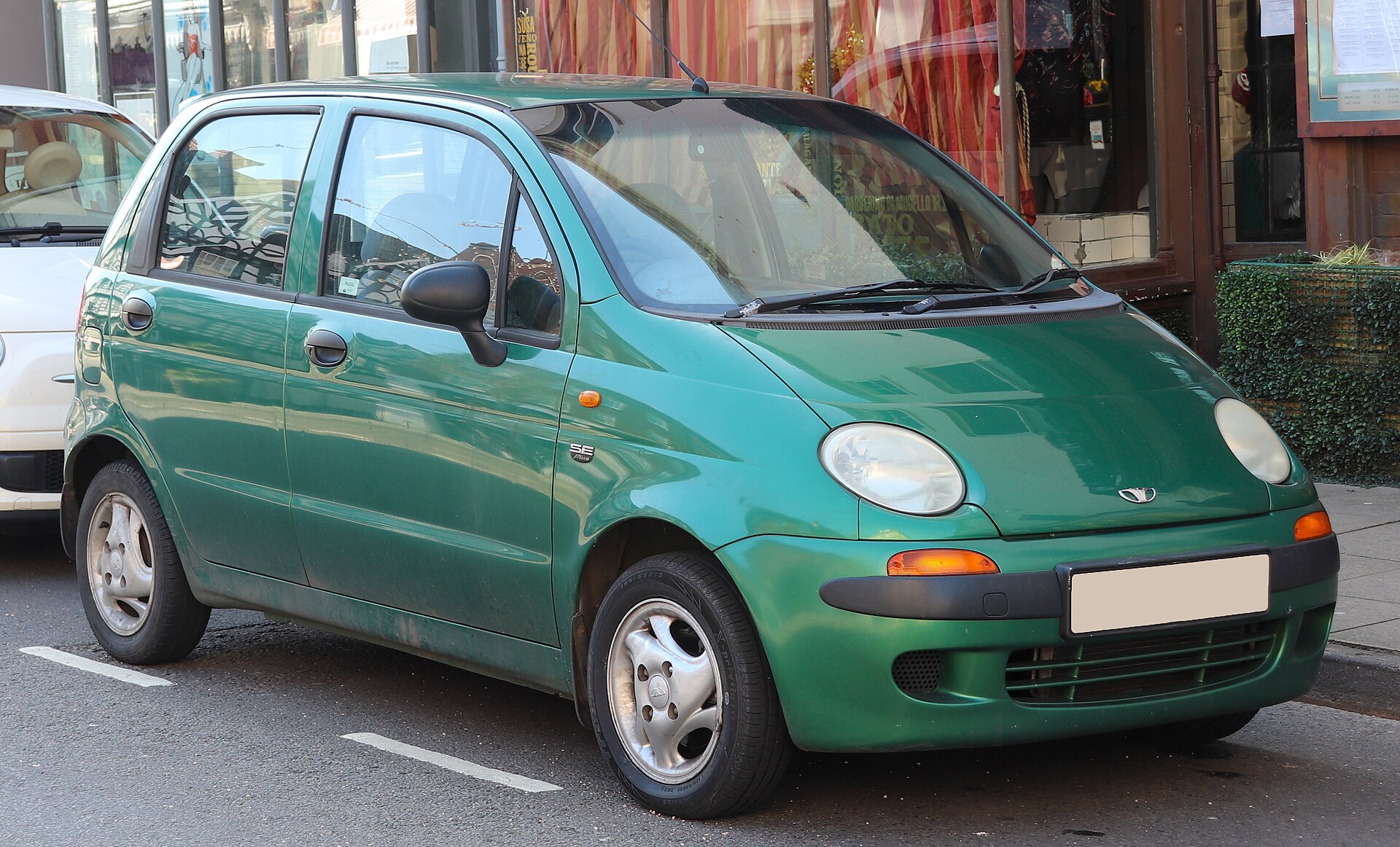
The first-generation Daewoo Matiz covers the original M100 of 1998 and the M150 facelift that followed around 2001. Both are narrow five-door city cars with a three-cylinder 0.8-litre engine, joined later by a 1.0-litre four-cylinder. In Germany the car was on sale from June 1998, and it wore Daewoo badges until early 2005, when the Chevrolet name took over.
In short
- M100 launched in 1998; the M150 facelift arrived in Korea in late 2000 and was exported from 2001.
- Engines: 796 cc three-cylinder with 38 kW (51 PS) and, in Germany from January 2003, a four-cylinder 1.0 with 47 kW (64 PS).
- ADAC data: 3,495 mm long, 1,495 mm wide, 851 kg for the 0.8, boot 145 L with the rear seats in place.
- Euro NCAP rated it three adult stars in 2000; production continued outside Korea long after 2005.
Size at a glance
Lifan Smily 330
The Daewoo Matiz M100/M150 is 278 mm shorter, 125 mm narrower and 420 mm taller than the Lifan Smily 330.
| Dimensions | Daewoo Matiz M100/M150 | Lifan Smily 330 | Difference |
|---|---|---|---|
| Length | 3,497 mm137.7 in | 3,775 mm148.6 in | −278 mm−10.9 in |
| Width | 1,495 mm58.9 in | 1,620 mm63.8 in | −125 mm−4.9 in |
| Height | 1,850 mm72.8 in | 1,430 mm56.3 in | +420 mm+16.5 in |
| Wheelbase | 2,340 mm92.1 in | 2,340 mm92.1 in | Same |
Matiz M100/M150 specs by version
Engines
| Version | Engine | Power | Torque | Production years |
|---|---|---|---|---|
| 0.8 three-cylinder | 0.8 l · 3 cyl · Petrol 800 cc | 38 kW 52 PS51 hp | 69 Nm51 lb-ft | 2003 |
| 1.0 38 kW (52 PS) Hatchback | 1.0 l 955 cc | 38 kW 52 PS51 hp | — | — |
| 1.0 four-cylinder | 1.0 l · 4 cyl 1,000 cc | 46 kW 63 PS62 hp | 87 Nm64 lb-ft | 2003 |
Performance
Show all 2 versions
| Version | 0–100 km/h | Top speed |
|---|---|---|
| 0.8 three-cylinder | 17.0 s 0–62 mph | 144 km/h89 mph |
| 1.0 four-cylinder | 12.9 s 0–62 mph | 152 km/h94 mph |
Dimensions and weight
Show all 3 versions
Verified Manufacturer and type-approval data from our catalog · Sources and methodology
Safety
-
Euro NCAP 2000
Older protocol · Full Euro NCAP result
Stars from different years and organisations are not directly comparable: test protocols change every few years.
Tico underpinnings in a 1.5-metre body
The M100 is a new body on old foundations. Its platform and suspension came from the Daewoo Tico, itself a licensed Suzuki Alto, so the Matiz inherited a width of just under 1.5 m that suited Japanese kei-car rules.
What Daewoo added was the shape and the packaging. Italdesign's Lucciola study, once intended for Fiat, gave the car its tall, rounded profile, and the engineering work was carried out at Daewoo's technical centre in Worthing, England. The result has five doors on a 2,340 mm (92.1 in) wheelbase and seats for four adults, with a fifth belt in the middle of the rear bench. For the wider story of the model and its later versions, see the Daewoo Matiz overview.
Early German cars came in S and SE trims. The 1998 SE had driver and passenger airbags and power steering as standard, while ABS cost extra (EUR 353 according to the ADAC catalogue).
How the M150 facelift changed the first Matiz
The M150 was more than a cosmetic update. Wikipedia's account says the front-end structure was reworked so that a four-cylinder engine would fit, although that engine only arrived after General Motors took control of Daewoo in 2002. Sources disagree on the facelift date: Korea in late 2000, export markets from 2001, while German Wikipedia gives 2002. The ADAC price list changes in December 2000, which fits the earlier date for Germany.
Two later steps matter to buyers:
- January 2003: the 1.0 SE with 47 kW (64 PS) joined the German range, followed in September 2003 by a better-equipped 1.0 SE plus.
- January 2005: the same car was sold as the Chevrolet Matiz. ADAC lists Chevrolet-badged 0.8 SE, 1.0 SE and 1.0 SE plus versions only from January to June 2005, at EUR 7,890, 8,990 and 9,420.
A short-lived Matiz Open (July 2002 to July 2003, EUR 9,599 in Germany) had central locking, electric front windows and a split folding rear seat as standard. ADAC lists it as a regular five-door hatchback; what the Open name referred to is not stated.
The 0.8 three-cylinder and the later 1.0 four
Every first-generation Matiz in Europe drives its front wheels through a five-speed manual gearbox, with a transverse petrol engine. Wikipedia notes an automatic in some markets; ADAC lists none for Germany.
| Engine | Displacement | Power | Torque | Top speed | 0–100 km/h | NEDC combined |
|---|---|---|---|---|---|---|
| 0.8 three-cylinder | 796 cc (48.6 cu in) | 38 kW (51 PS) at 5,900 rpm | 69 Nm (51 lb-ft) at 4,600 rpm | 144 km/h (89 mph) | 17.6 s | 6.1–6.3 L/100 km (37.3–38.6 mpg US) |
| 1.0 four-cylinder | 995 cc (60.7 cu in) | 47 kW (64 PS) at 5,400 rpm | 87 Nm (64 lb-ft) at 4,200 rpm | 152 km/h (94 mph) | 12.9–13.7 s | 6.4–6.6 L/100 km (35.6–36.8 mpg US) |
Figures are manufacturer data from the ADAC catalogue; ranges reflect different model years. German Wikipedia gives the 1.0 as 955 cc and quotes 52 PS for the 0.8, so small differences between sources are normal.
The three-cylinder is a Suzuki-derived design, and its 17-plus seconds to 100 km/h show its limits once the car is loaded. The four-cylinder cuts that time by about four seconds and adds 18 Nm (13 lb-ft) of torque, the more useful change on hills. Emissions moved from Euro 2 on the 1998 SE to Euro 3 on later cars.
Matiz M100/M150 dimensions and capacities
The body hardly changed between M100 and M150; ADAC lists the same main dimensions for both. The table uses the 0.8 SE.
| Parameter | Metric | Imperial |
|---|---|---|
| Length | 3,495 mm | 137.6 in |
| Width (with mirrors) | 1,495 mm (1,715 mm) | 58.9 in (67.5 in) |
| Height | 1,485 mm | 58.5 in |
| Wheelbase | 2,340 mm | 92.1 in |
| Kerb weight, EU (0.8 / 1.0) | 851 kg / 871 kg | 1,876 lb / 1,920 lb |
| Gross vehicle weight | 1,210 kg | 2,668 lb |
| Boot, seats up | 145 L | 5.1 cu ft |
| Boot, seats folded (to window / to roof) | 480 L / 830 L | 17.0 / 29.3 cu ft |
| Fuel tank | 35 or 38 L (sources differ) | 9.2 or 10.0 US gal |
| Turning circle | 9.2 m | 30.2 ft |
| Tyres | 145/70 R13 or 155/65 R13 |
Boot figures depend on how they are measured. ADAC's 145 L is with the rear bench in place; other guides quote between 104 and 155 L. The fuel tank is listed as 38 L by ADAC but 35 L by Spanish and Dutch data.
Euro NCAP 2000: the first-generation result
Euro NCAP tested a right-hand-drive Matiz SE+ in 2000, and the car earned three stars for adult occupant protection. The datasheet applies to cars built from January 2000.
The weaker areas were children and pedestrians. With the child seats used in the test, protection for the 18-month-old dummy was rated poor and for the three-year-old very poor. Lower-leg protection for pedestrians was also poor. The car had front airbags, belt pretensioners and load limiters, but the centre rear seat had only a lap belt; Daewoo introduced improved rear belts from June 2000.
This rating belongs to the first generation only. The Chevrolet Matiz tested in 2005 was a different car and its result does not apply here. Ratings from 2000 also cannot be compared with current ones, which use a different protocol.
Recalls and ageing issues on early Matiz cars
Independent reliability statistics for the first Matiz are scarce, so the evidence comes from recalls and buying guides.
- Fuel filter: in Ireland about 4,600 cars were recalled in 2000 because the fuel filter could corrode, with a risk of leaks and fire.
- Clutch cable and idle speed: further Irish recalls in 2003 and 2004.
- Timing belt: the same 2005 Irish Times column recommended a change at 40,000 miles (64,000 km).
- Side winds: a Dutch guide calls the car economical and problem-free in daily use, but sensitive to crosswinds because of its height.
Recall coverage differed between countries, so check the service book or ask a dealer to confirm that any campaign for the car's VIN was done.
Where the first Matiz was built
The M100/M150 outlived its Korean production by many years. South Korean output ran from 1998 to 2005, with other plants carrying on:
- FSO in Poland, 1998 to 2007, partly from kits.
- Rodae in Romania, 1999 to 2008.
- India, 1998 to 2002.
- GM Uzbekistan (formerly UzDaewooAuto), 2001 to 2018.
- China, as the Chevrolet and later Baojun Lechi, 2010 to 2016.
The car also appeared as the Pontiac Matiz in Mexico and the Formosa Matiz in Taiwan. Within Daewoo's European range it sat below the Daewoo Nexia, and the story of Daewoo Motors explains how the company passed to GM.
Choosing a first-generation Matiz today
Pick by engine first. The 1.0 four-cylinder from 2003 onwards is the better car for mixed driving, while a late 0.8 suits town use and has the lowest running costs.
- Best all-rounder: 1.0 SE or SE plus (2003 to 2005), with 47 kW (64 PS) and noticeably quicker acceleration.
- City use only: a post-2000 0.8 S or SE, ideally with ABS, which was optional on early cars.
- Paperwork: proof of the timing-belt change and of recall work.
- Body: look for rust and accident repairs, as with any small car of this age.
More small cars from the period are grouped under classic cars of the 1990s, and the full line-up is in the Daewoo catalogue.
Image credits · Photos from Wikimedia Commons under free licences
- Daewoo Matiz M100/M150 · Photo: Vauxford / Wikimedia Commons, CC BY-SA 4.0
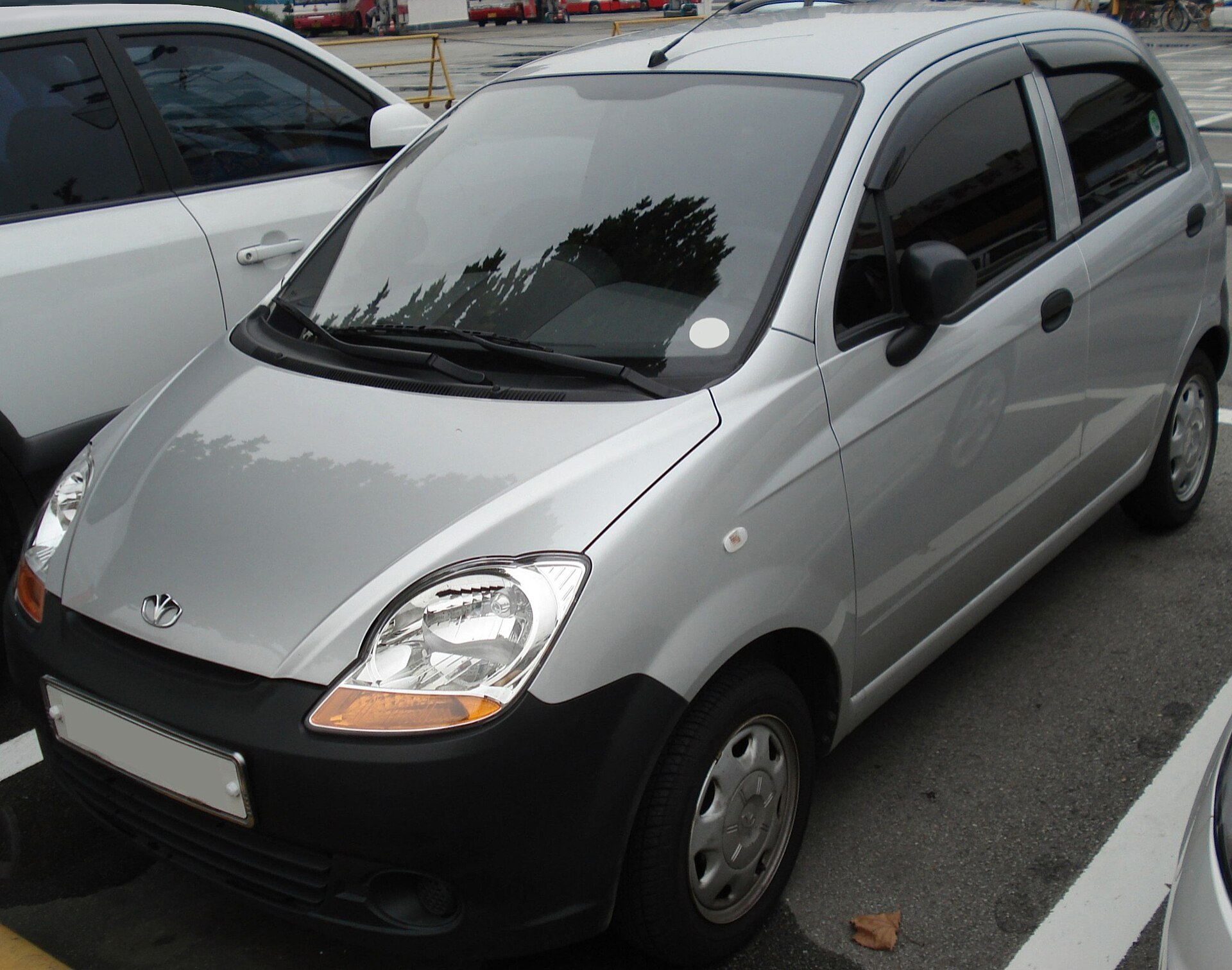
- Daewoo Matiz II (M200) · Photo: Chu / Wikimedia Commons, CC BY-SA 3.0
M100/M150 rivals
-
Ended 2011
- Years
- 2002–2011
- Body
- Hatchback
- Fuel
- Petrol
- Power
- 33–58 kW (45–79 PS)
-
Ended 2018
- Years
- 2013–2018
- Body
- Hatchback
- Fuel
- Petrol
- Power
- 65 kW (88 PS)
-
EV version
Ended 2024
- Years
- 1998–2024
- Body
- Hatchback, Convertible
- Fuel
- Petrol, Diesel, Electric
- Power
- 30–66 kW (41–90 PS)
3 generations
- I
- II
- III


Popular comparisons
FAQ
What is the difference between the Matiz M100 and M150?
The M100 is the original 1998 car. The M150 facelift, introduced in Korea in late 2000, reworked the front structure to take a four-cylinder engine, and the 1.0 arrived in Germany in 2003.
How much power does the first Daewoo Matiz have?
The 796 cc three-cylinder produces 38 kW (51 PS) and 69 Nm. The 995 cc four-cylinder in later cars has 47 kW (64 PS) and 87 Nm, according to ADAC data.
How big is the boot of the first-generation Matiz?
ADAC lists 145 litres with the rear seats up, 480 litres to the window line and 830 litres to the roof with the bench folded. Other sources quote slightly different seats-up figures.
When did the Daewoo Matiz become the Chevrolet Matiz?
In Europe at the start of 2005. ADAC lists Chevrolet-badged first-generation cars from January to June 2005, before the redesigned M200 replaced them.
How safe is the first-generation Matiz?
Euro NCAP gave a 2000 Matiz SE+ three stars for adult occupant protection. Child protection with the test seats was rated poor to very poor, and pedestrian leg protection was poor.
Data sources
Data checked by an editor against the sources below.
- 1cars archive: Daewoo Matiz: The Giugiaro-Designed City Car and Its Generations
- The text of this article (1cars archive)
- Wikipedia — Daewoo Matiz
- Euro NCAP — Daewoo Matiz 2000


