
 Daewoo Nexia
Specs, engines and history
Updated Published Sources (3) Report an error
By Sarah Whitmore, Senior Automotive Writer Reviewed by Oleksandr Hnatiuk

- Built
- 1994–2016
- Top power
- 80 kW (109 PS)
The Daewoo Nexia is a compact front-wheel-drive sedan and hatchback built on the Opel Kadett E, the GM T-platform car first shown in 1984. Daewoo sold it in Europe from 1994 to 1997, but the name lasted far longer in Uzbekistan, where the N100 was built from 1996 and the facelifted Nexia II (N150) until 2016.
In short
- Origins: a licence-built Opel Kadett E, sold in Korea as the LeMans, Racer and Cielo before the Nexia name reached Europe.
- Two Daewoo generations on one base: N100 (Europe 1994/95–1997, Uzbekistan 1996–2008) and N150 (2008–2016, sedan only).
- Engines: 1.5 and 1.6 petrol, from 51 to 80 kW (70 to 109 PS), front-wheel drive, 5-speed manual as standard.
- Safety: we found no Euro NCAP result for the Nexia.

Size at a glance
ZAZ Chance
The Daewoo Nexia is 245 mm longer, 16 mm narrower and 39 mm lower than the ZAZ Chance.
| Dimensions | Daewoo Nexia | ZAZ Chance | Difference |
|---|---|---|---|
| Length | 4,482 mm176.5 in | 4,237 mm166.8 in | +245 mm+9.6 in |
| Width | 1,662 mm65.4 in | 1,678 mm66.1 in | −16 mm−0.6 in |
| Height | 1,393 mm54.8 in | 1,432 mm56.4 in | −39 mm−1.5 in |
| Wheelbase | 2,520 mm99.2 in | 2,520 mm99.2 in | Same |
| Boot | 530 L18.7 cu ft | - | - |
Lada Granta
The Daewoo Nexia is 235 mm longer, 38 mm narrower and 107 mm lower than the Lada Granta.
| Dimensions | Daewoo Nexia | Lada Granta | Difference |
|---|---|---|---|
| Length | 4,482 mm176.5 in | 4,247 mm167.2 in | +235 mm+9.3 in |
| Width | 1,662 mm65.4 in | 1,700 mm66.9 in | −38 mm−1.5 in |
| Height | 1,393 mm54.8 in | 1,500 mm59.1 in | −107 mm−4.2 in |
| Wheelbase | 2,520 mm99.2 in | 2,476 mm97.5 in | +44 mm+1.7 in |
| Boot | 530 L18.7 cu ft | 520 L18.4 cu ft | +10 L+0.4 cu ft |
Specs by version
Engines
| Version | Engine | Power | Torque | Production years |
|---|---|---|---|---|
| 1.5 G15MF 55 kW (75 PS) Sedan | 1.5 l G15MF | 55 kW 75 PS74 hp | - | 1998 |
| 1.5 59 kW (80 PS) Sedan | 1.5 l · Petrol 1,500 cc | 59 kW 80 PS79 hp | 123 Nm91 lb-ft | - |
| 1.6 80 kW (109 PS) Sedan | 1.6 l · Petrol 1,600 cc | 80 kW 109 PS107 hp | 150 Nm111 lb-ft | - |
Performance
Show all 2 versions
| Version | 0–100 km/h | Top speed |
|---|---|---|
| 1.5 59 kW (80 PS) Sedan | 12.5 s 0–62 mph | 175 km/h109 mph |
| 1.6 80 kW (109 PS) Sedan | 11.0 s 0–62 mph | 185 km/h115 mph |
Dimensions and weight
Show all 3 versions
| Version | Length | Width | Height | Wheelbase | Kerb weight | Boot |
|---|---|---|---|---|---|---|
| 1.5 G15MF 55 kW (75 PS) Sedan | 4,482 mm176.5 in | 1,662 mm65.4 in | 1,393 mm54.8 in | 2,520 mm99.2 in | 1,025 kg2,260 lb | 530 l18.7 cu ft |
| 1.5 59 kW (80 PS) Sedan | 4,482 mm176.5 in | 1,662 mm65.4 in | 1,393 mm54.8 in | 2,520 mm99.2 in | 969 kg2,136 lb | 530 l18.7 cu ft |
| 1.6 80 kW (109 PS) Sedan | 4,482 mm176.5 in | 1,662 mm65.4 in | 1,393 mm54.8 in | 2,520 mm99.2 in | 1,025 kg2,260 lb | 530 l18.7 cu ft |
Verified Manufacturer and type-approval data from our catalog · Sources and methodology
At a glance: what the Nexia is and where it was built
The Nexia is a badge-engineered Opel Kadett E. Daewoo built the Kadett under licence in South Korea from 1986, first as the LeMans and the three-door Racer, then as the facelifted Cielo from 1994. Export markets got the same car as the Nexia, and North America had it as the Pontiac LeMans from the 1988 model year. German sources describe the body as largely identical to the Kadett E.

Korean production ended in February 1997, after more than a million cars had been built, according to Wikipedia. By then assembly had spread well beyond Korea: Craiova in Romania (1996–2007), Uzbekistan (1996–2016), India, Vietnam, Egypt and Iran are all listed. The plant at Asaka, run by the UzDaewooAuto joint venture founded in 1992, started production on 19 July 1996 and became the car's long-term home after Daewoo Motors collapsed in 1999. That collapse is covered in our history of Daewoo Motors.
In the catalogue the Nexia sits beside the smaller Daewoo Matiz city car and the Daewoo Gentra, a later Uzbek-built sedan based on the Lacetti rather than the Kadett.
Three Nexias, one name
The Nexia name covers three different cars, and only the first two share the Kadett base.

| Version | Years | Built in | Body | Engines | Power |
|---|---|---|---|---|---|
| Nexia (N100), Europe and UK | 1994/95–1997 | South Korea | 3- and 5-door hatchback, sedan | 1.5 8v, 1.5 16v; 1.8 in some markets | 51–66 kW (70–90 PS); 1.8: 74 kW (101 PS) |
| Nexia (N100), Uzbekistan | 1996–2008 | Asaka, Uzbekistan | sedan | 1.5 SOHC, 1.5 DOHC | 56–62 kW (75–83 hp) |
| Nexia II (N150) | 2008–2016 | Asaka, Uzbekistan | sedan | 1.5 8v SOHC, 1.6 16v DOHC | 59 kW (80 PS), 80 kW (109 PS) |
| Ravon Nexia R3 / Chevrolet Nexia (T250) | 2015/16–2023 | Uzbekistan | sedan | a different, Aveo-based car | not covered here |
The N150 was presented in Tashkent in 2008 and is best read as a facelift of the N100 on the same Kadett-derived base, with newer engines. Its production spans the UzDaewooAuto years and the GM Uzbekistan era, from March 2008.
The last row is a separate model. From 2015/16 the Nexia name moved to the Ravon Nexia R3, a sedan based on the Aveo (T250), which later carried Chevrolet badges and was discontinued in 2023. It shares only the name with the Kadett-based cars.
The Nexia in the UK: selling cars direct
The Nexia launched in the UK in 1995 and stayed on sale until 1997. Daewoo's approach there was unusual: it sold cars directly from its own premises at fixed, no-haggle prices, making the Nexia one of the first mass-market cars sold this way. According to a 2020 Hagerty feature by Giles Chapman, buyers got a three-year warranty, three years' servicing and AA membership, and the first 1,000 could exchange their car within five months.

Daewoo took about 1% of the UK new-car market in 1996, and around 40,000 Nexias had been sold by 1997. UK buyers could choose GLi and GLXi trims with sedan, three-door and five-door hatchback bodies, and an automatic was available. The Lanos replaced it in 1997 or 1998; RAC gives September 1997, while Hagerty says 1998. Both cars are listed with all Daewoo models in our catalogue.
From Kadett to Cielo: the engineering
Mechanically the Nexia is Kadett E throughout: a transverse four-cylinder petrol engine driving the front wheels, with 8-valve SOHC or 16-valve DOHC heads. The Kadett E itself was named European Car of the Year in 1985 and gave way to the Astra F in 1991. That lineage runs on through the Opel Astra.

The 5-speed manual uses a hydraulic clutch, and German sources note that its ratios match the Opel F13CR and F16CR gearboxes. The optional 4-speed automatic was the same unit used in the Astra F. Front-wheel drive was the only layout offered; there was never an all-wheel-drive or hybrid Nexia.
From the 1997 model year European cars were brought up to Euro 2 with an EGR valve, a revised engine control unit and an extra resonator, while earlier German cars are described as roughly Euro 1. The N150 switched to Euro 3 engines taken from the Lanos, whose suspension had in turn been developed from the Nexia's.
Engines and performance
The European N100 used 1.5-litre engines. The 8-valve SOHC unit in the GLi produced 59 kW (80 PS) at 5,400 rpm, and the 16-valve DOHC in the GLXi 66 kW (90 PS) at 4,800 rpm. A single-point-injection version gave 51 kW (70 PS), and German data list the 8-valve car at 55 kW (75 PS). A 1.8 with 74 kW (101 PS) was offered in some countries, but not in Germany.

For the UK 1.5 16v, a spec aggregator gives 137 Nm (101 lb-ft), 0–100 km/h in 12.2 seconds, 171 km/h (106 mph) and 38.7 mpg UK combined, or about 7.3 L/100 km. Uzbek N100 sedans are usually listed with a 1.5 SOHC rated at 56 kW (75 hp) and a 1.5 DOHC at 62 kW (83 hp).
The N150 kept two engines, both paired with a 5-speed manual:
| Nexia II (N150) | 1.5 8v SOHC | 1.6 16v DOHC |
|---|---|---|
| Displacement | 1,498 cc | 1,598 cc |
| Power | 59 kW (80 PS) at 5,600 rpm | 80 kW (109 PS) at 5,800 rpm |
| Torque | 123 Nm (91 lb-ft) at 3,200 rpm | 150 Nm (111 lb-ft) at 4,000 rpm |
| 0–100 km/h (0–62 mph) | 12.5 s | 11.0 s |
| Top speed | 175 km/h (109 mph) | 185 km/h (115 mph) |
| Combined consumption | 8.1 L/100 km (34.9 mpg UK) | 8.9 L/100 km (31.7 mpg UK) |
The aggregator behind these consumption figures does not name the test cycle, so treat them as a rough guide. Equipment varied by market: UK cars had power steering, an alarm, a driver's airbag, ABS and an RDS radio as standard, while Romanian-built cars never had ABS or airbags.
Dimensions and space
The N150 sedan is 4,482 mm long on a 2,520 mm wheelbase, with a 530-litre (18.7 cu ft) boot. The older N100 hatchback is shorter at 4,256 mm (167.6 in) on the same wheelbase, weighs about 1,002 kg (2,209 lb) and offers 390–720 L (13.8–25.4 cu ft) of luggage space depending on the rear seat position.

Key specifications: Nexia II (N150) sedan
| Parameter | Metric | Imperial |
|---|---|---|
| Engines | 1.5 8v (1,498 cc) / 1.6 16v (1,598 cc) petrol | 91.4 / 97.5 cu in |
| Power | 59 kW (80 PS) / 80 kW (109 PS) | 79 / 107 hp |
| Torque | 123 / 150 Nm | 91 / 111 lb-ft |
| Gearbox and drive | 5-speed manual, front-wheel drive | 5-speed manual, front-wheel drive |
| Length | 4,482 mm | 176.5 in |
| Width | 1,662 mm | 65.4 in |
| Height | 1,393 mm | 54.8 in |
| Wheelbase | 2,520 mm | 99.2 in |
| Kerb weight | 969 kg (1.5) / 1,025 kg (1.6) | 2,136 / 2,260 lb |
| Boot | 530 L | 18.7 cu ft |
| Fuel tank | 50 L | 11.0 UK gal |
Safety and what reviewers said
We found no Euro NCAP result for the Nexia in any form. The Lanos was tested by Euro NCAP in 1998, but it is a different car, and its score should not be applied to the Nexia.

British reviewers were never enthusiastic. RAC's 2005 used-car review called value for money the Nexia's strongest suit and the Vauxhall-derived mechanicals well proven, but criticised the clonky gearchange; it scored the car 4.5 out of 10 overall and 3 out of 10 for safety. Looking back in 2020, Hagerty described a harsh ride, mushy handling, a cramped cabin, cheap materials and steep depreciation. Written 15 years apart, both reviews describe sound, simple mechanics in a dated chassis.
Which Nexia to look at
For most buyers the N150 1.6 is the obvious pick. It has the most power at 80 kW (109 PS) and the shortest 0–100 km/h time, and like the 1.5 it has a Euro 3 engine. The 1.5 uses less fuel on paper and weighs 56 kg less, but it needs 1.5 seconds longer to reach 100 km/h.

Among European N100s, a UK GLXi is the best-equipped choice, with the 16-valve engine, a driver's airbag and ABS. On any Nexia, condition and records matter more than the version:
- Confirm which safety equipment the car actually has, especially on Romanian-built examples.
- Ask for a service history and check that the gearchange selects every gear cleanly.
- Check the emissions class against any low-emission zone you drive in.
- Inspect the body and underside closely, as any car of this age may have corrosion.
Similar cars are listed among the sedans in our catalogue.
Rivals
Compare with…
Compare Daewoo Nexia with
- ZAZ Chance quick spec comparison
- Lada VAZ-2110 quick spec comparison
- Chevrolet Cobalt quick spec comparison
-
Ended 2015
- Years
- 2009–2015
- Body
- Sedan, Hatchback
- Fuel
- Petrol
- Power
- 51–74 kW (69–101 PS)
-
Ended 2007
- Years
- 1995–2007
- Body
- Sedan
- Fuel
- Petrol
- Power
- 52–67 kW (71–91 PS)
-
In production
- Years
- 2011–present
- Body
- Sedan
- Fuel
- Petrol
- Power
- 64–77 kW (87–105 PS)
-
In production
- Years
- 2011–present
- Body
- Sedan, Hatchback
- Fuel
- Petrol
- Power
- 64–87 kW (87–118 PS)


Popular comparisons
Daewoo Nexia in our rankings
- No. 7 of 61 · Lightest sedans (969 kg)
- No. 10 of 67 · Biggest boot: sedans (530 l)
- No. 24 of 391 · Lightest cars (969 kg · top 7%)
- No. 158 of 1082 · Longest-running car nameplates (22 years · top 16%)
- No. 65 of 321 · Biggest boot: cars (530 l · top 21%)
- No. 24 of 101 · Smallest sedans (4,482 mm · top 24%)
Lighter than 93% of ranked cars in the 1CARS catalog (No. 24 of 391).
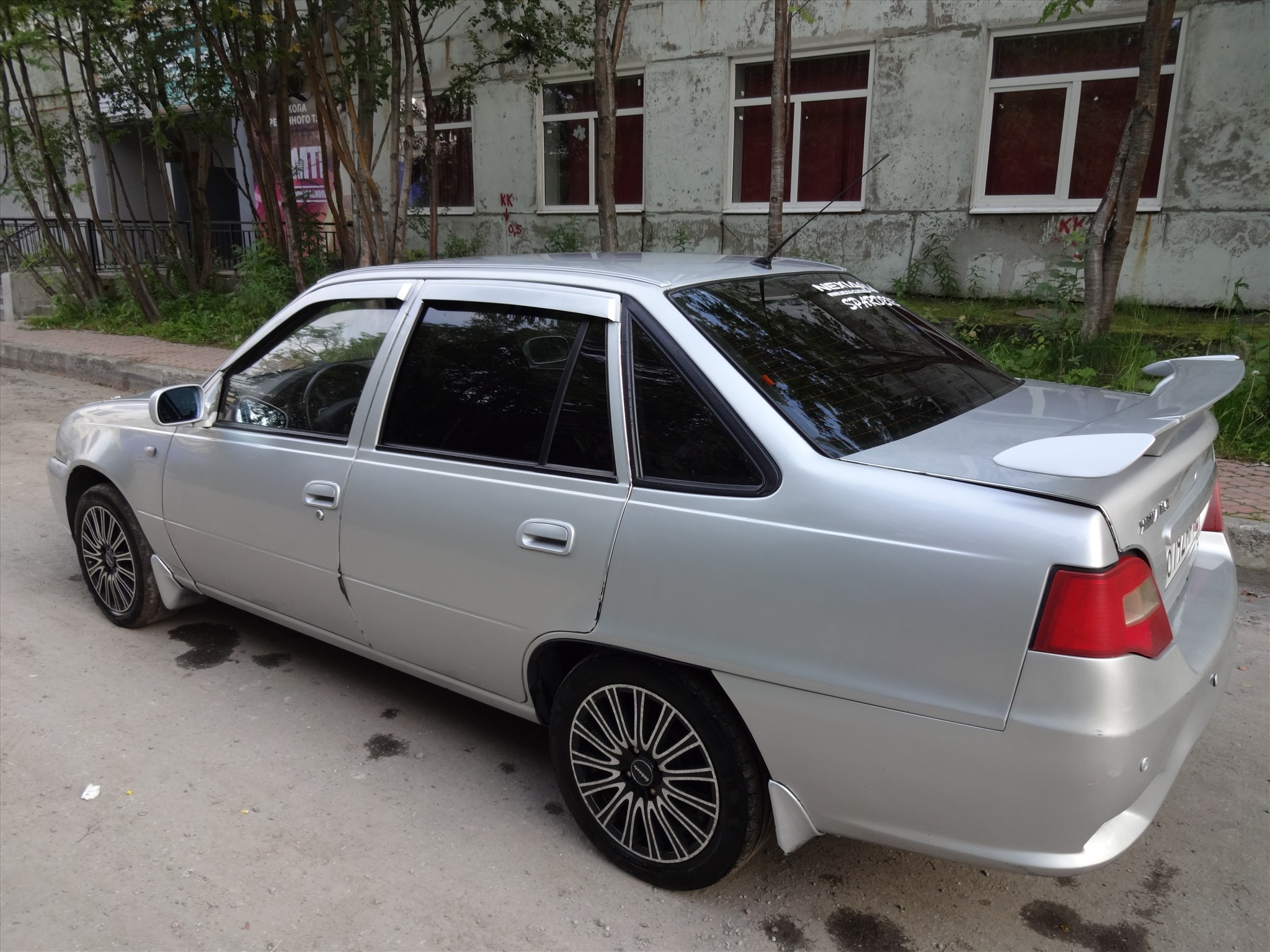
Daewoo Nexia photos 26



Daewoo Nexia videos 5

Daewoo Nexia video 1

Daewoo Nexia video 2

Daewoo Nexia video 3

Daewoo Nexia video 4

Daewoo Nexia video 5
FAQ
Is the Daewoo Nexia based on an Opel?
Yes. The Nexia is a licence-built Opel Kadett E on GM's T platform, with Opel-based engines and gearboxes.
What is the difference between the Nexia and the Cielo?
They are the same Kadett-based car under different names. Cielo was the name of the 1994 facelift sold in South Korea, while Nexia was used in Europe and later for the sedans built in Uzbekistan.
What is the fuel consumption of the Daewoo Nexia?
A UK spec aggregator lists the N150 at 8.1 L/100 km (34.9 mpg UK) combined for the 1.5 and 8.9 L/100 km (31.7 mpg UK) for the 1.6. The UK-market N100 1.5 16v is quoted at 38.7 mpg UK, about 7.3 L/100 km.
Is the Daewoo Nexia available with all-wheel drive or as a hybrid?
No. Every Nexia has front-wheel drive and a petrol engine. A 5-speed manual was standard, and a 4-speed automatic was offered on European N100 cars.
What are the main rivals of the Daewoo Nexia?
The natural comparison is with the Opel Kadett and Vauxhall Astra it was derived from; the Rivals block on this page lists comparable models from the catalogue.
What replaced the Daewoo Nexia?
In Europe the Lanos replaced it in 1997–98. In Uzbekistan the Nexia II (N150) ran until 2016, after which the name passed to the Ravon Nexia R3, an unrelated Aveo-based sedan.
Data sources
Data checked by an editor against the sources below.
- The text of this article (1cars archive)
- Wikipedia - Daewoo Nexia
- Fastcarcheck


