
 Hafei Brio
Specs, engines and history
Updated Published Sources (2) Report an error
By Oleksandr Hnatiuk, Automotive Editor & Used Car Specialist Reviewed by Felix Hartmann

- Built
- 2002–2011
- Top power
- 58 kW (79 PS)
Verdict: is a Hafei Brio worth buying?
Our verdict · Oleksandr Hnatiuk
The Brio suits buyers who want a cheap, simple city car and can find parts locally, ideally a 1.1 or 1.3 from the later production years. Its weak points are safety and the future of spare parts: Hafei stopped building cars in 2015 and ceased to exist as a separate company in 2018. For a similar budget, a better-supported small car is usually the safer choice; see the best small city cars. Other practical small cars are grouped under hatchbacks, Chinese brands and models are collected under Chinese cars, and the remaining Hafei models are in the Hafei catalogue.
The Hafei Brio is an export name of the Hafei Lobo (Lubao in China), a five-door city car built by Hafei Motor in Harbin from 2002 to 2011. Pininfarina designed it, and its small petrol engines of 1.0 to 1.3 litres produce 33.5 to about 58 kW (45 to 79 hp). The car is 3,588 mm long and weighs around 900 kg.
In short
- Built 2002–2011 as the Hafei Lobo; sold as the Brio and under other names in export markets, and assembled in Malaysia as the Naza Sutera.
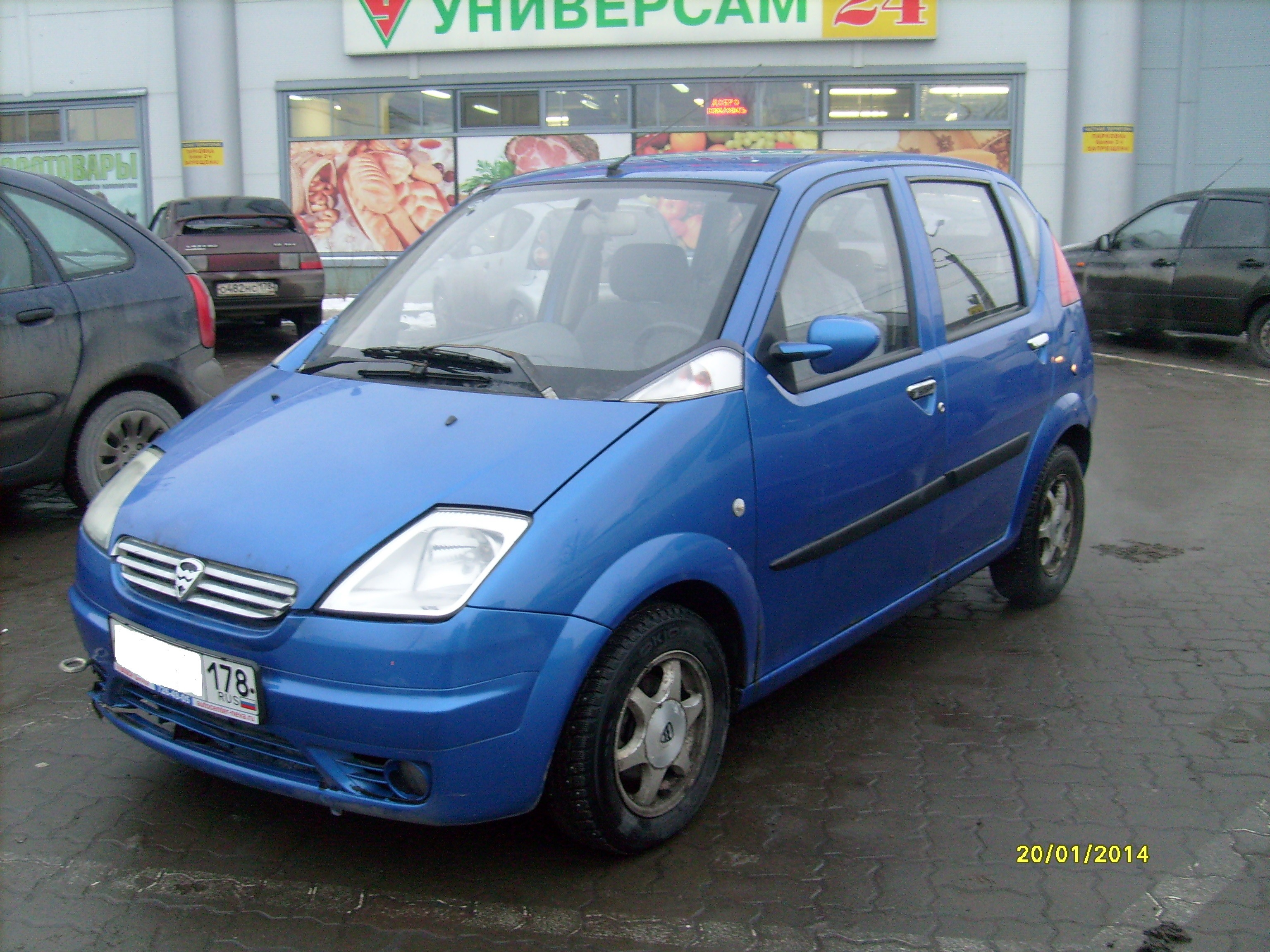
- Styling by Pininfarina, close to its 1999 Metrocubo concept, with triangular lights, mirrors and side repeaters.
- Engines: 1.0 (33.5 kW, 45 hp), 1.1 (48 kW, 64 hp) and 1.3 (about 58 kW, 79 hp), five-speed manual or automatic.
- 3,588 mm long on a 2,335 mm wheelbase, 40-litre tank, boot of 230 to 950 litres.

Hafei Brio at a glance
| Fact | Value |
|---|---|
| Maker | Hafei Motor, Harbin, China |
| Production | 2002–2011 |
| Also called | Hafei Lobo, Lubao (China), Naza Sutera and Naza Forza (Malaysia, Thailand), Micro Trend (Sri Lanka) |
| Body | 5-door city car (hatchback) |
| Design | Pininfarina |
| Engines | 1.0, 1.1 and 1.3 l petrol, four cylinders |
| Gearbox | 5-speed manual or 5-speed automatic |
| Predecessor | Hafei Baili |
Hafei began as a maker of microvans within the Harbin aircraft industry and later became part of Changan. The full story is in the history of Hafei and Changan's history.

Lobo and Brio: one car, several names
The car appeared in 2002 as the Hafei Lobo, in Chinese Lubao. According to the old 1cars text, the early cars sold poorly and drew negative reviews, and Hafei revised the car in 2006. The revised car kept the Pininfarina body and improved the details. A further facelift came for the 2010 model year, with a minor update in 2011; the facelifted front end looks much like the second-generation Toyota Vitz.

| Market | Name | Notes |
|---|---|---|
| China | Hafei Lobo / Lubao | Built at Pingfang, Harbin |
| Export markets | Hafei Brio | Imported from China |
| Malaysia | Naza Sutera (also Forza) | Assembled by Naza in Gurun, 2006–2011 |
| Thailand | Naza Forza | Malaysian-built car |
| Sri Lanka | Micro Trend | Sold by Micro Cars Limited |
| Iran | – | Assembled in Kashan |
Pininfarina design
The design came from Pininfarina in Italy, not from a Chinese studio, and it closely follows the Italian firm's 1999 Metrocubo concept. The old 1cars text points out that the triangle is the theme of the whole car: the rear lights, the door mirrors and the side indicator repeaters near the windscreen all have triangular shapes. Some sources say the chassis was developed with the help of Lotus. The short bonnet, tall roof and wheels at the corners make the most of a small footprint.

Brio engines and gearboxes
| Engine | Type | Power | Torque | Top speed | 0–100 km/h |
|---|---|---|---|---|---|
| 1.0 DA465Q-2 | I4, 8 valves, Euro II | 33.5 kW (45 hp) | 72 Nm | about 121 km/h | 13.7 s |
| 1.1 DA468Q | I4, 16 valves | 48 kW (64 hp) | 88 Nm | about 140 km/h | 13.5 s |
| 1.3 DA471QL | I4 | about 58 kW (79 hp) | – | about 150 km/h | – |
A second 1.0-litre engine, the DAK10A, also appears in the line-up. The gearbox is a five-speed manual or a five-speed automatic. The old 1cars text gives about 5 l/100 km in town for the Brio and calls the 79 hp version adequate in a straight line but far from sporty. By our calculation, the 1.1 with a kerb weight of 895 kg carries about 18.6 kg per kW, while the 1.0 at 920 kg carries about 27.5 kg per kW, so the 1.1 and 1.3 are the better choices for motorway driving.

Dimensions and practicality
| Dimension | Value |
|---|---|
| Length | 3,588 mm |
| Width | 1,563 mm |
| Height | 1,533–1,574 mm |
| Wheelbase | 2,335 mm |
| Ground clearance | 150 mm (1.3) |
| Kerb weight | 895–920 kg |
| Boot | 230–950 l |
| Fuel tank | 40 l |
Inside, the Brio seats five, and the tall roof keeps headroom good for its size. The boot takes the shopping plus two or three medium-sized bags. With the rear seat backrest folded flush with the floor, it offers a much larger load space, and roof rails allow a roof box. Compared with the length of 3,588 mm, the 2,335 mm wheelbase is long, which helps cabin space.
Equipment and safety
Depending on version, equipment included power steering, front fog lights, a heated rear window, height-adjustable seat belts, airbags, head restraints and child locks on the rear doors, according to the old 1cars text. By today's standards the safety equipment is basic, so buyers should check exactly which airbags a given car has.

Checking a used Brio
A Brio today is a low-cost car, and most surviving examples have done many years of city driving. Points to check before buying:
- body and underside for corrosion, especially sills, wheel arches and the rear floor;
- engine: cold start, smooth idle and no oil leaks; ask for the service history of the timing drive;
- gearbox: clean shifts on the manual, no slipping or harsh changes on the automatic;
- electrics, lights and the heated rear window, since small faults are common on budget cars of this age;
- the supply of parts in your country: body panels and trim are harder to find than service parts.

Cars sold as the Naza Sutera share their parts with the Lobo and Brio, which can help in markets where Naza was active. Any candidate can be set against other small cars in the comparison tool.
Brio strengths and weak points

| Strengths | Weaknesses |
|---|---|
| Pininfarina styling and clever packaging | Weak 1.0 engine |
| Low running costs and simple mechanics | Basic safety equipment by modern standards |
| Good headroom and folding rear seat | Uncertain parts supply after Hafei's car business ended |
| Light and economical in town | Early cars drew poor reviews |
Rivals
Compare with…
Compare Hafei Brio with
- Daewoo Matiz quick spec comparison
-
Ended 2009
- Years
- 1998–2009
- Body
- Hatchback
- Fuel
- Petrol
- Power
- 38–49 kW (52–67 PS)

Hafei Brio in our rankings
- No. 531 of 1194 · Longest-running car nameplates (9 years · top 49%)
- No. 144 of 161 · Most powerful hatchbacks (58 kW · top 90%)
- No. 1076 of 1133 · Most powerful cars (58 kW · top 95%)
In production longer than 51% of ranked nameplates in the 1CARS catalog (No. 531 of 1194).
Hafei Brio photos 14


Hafei Brio videos 2

Test drive

Video overview
FAQ
Is the Hafei Brio the same as the Hafei Lobo?
Yes. Brio is an export name of the Hafei Lobo, called Lubao in China. The same car was also sold as the Naza Sutera or Forza in Malaysia and Thailand and as the Micro Trend in Sri Lanka.
Who designed the Hafei Brio?
The Italian design house Pininfarina styled the car, and it closely resembles Pininfarina's 1999 Metrocubo concept. Triangular rear lights, mirrors and indicator repeaters are typical details of the design.
What engines does the Hafei Brio have?
It uses four-cylinder petrol engines: a 1.0 with 33.5 kW (45 hp), a 1.1 with 48 kW (64 hp) and a 1.3 with about 58 kW (79 hp). Buyers could choose a five-speed manual or a five-speed automatic.
How big is the Hafei Brio?
The car is 3,588 mm long, 1,563 mm wide and 1,533 to 1,574 mm high, with a 2,335 mm wheelbase. The boot holds 230 litres, or 950 litres with the rear seat folded.
When did Hafei stop making the Brio?
Production of the Lobo and its export versions ended after the 2011 model year. Hafei itself stopped making cars in 2015, several years after becoming part of Changan.
Data sources
Data checked by an editor against the sources below.
- The text of this article (1cars archive)
- Wikipedia - Hafei Lobo


