
Ford Mustang Fastback vs Chevrolet Camaro (1967–69)
Updated Report an error By Sarah Whitmore

Chevrolet · 1966–1969
Camaro I
- Power
- 216 kW294 PS

Ford · 1964
Mustang Fastback
- Power
- 202 kW275 PS
Verdict Opinion
The Mustang Fastback is the pioneer and the cultural icon, with the Shelby and Bullitt connections. It also had the wider choice of bodies, and many more cars were built, which helps when looking for parts and documented examples. The first Camaro is the more focused muscle car of the two, with bigger V8 options in its SS and the race-bred Z/28.
Compare engine codes, documentation and originality rather than headline horsepower: with gross ratings and widespread engine swaps, the paperwork tells you more than the badge.
- Sarah Whitmore
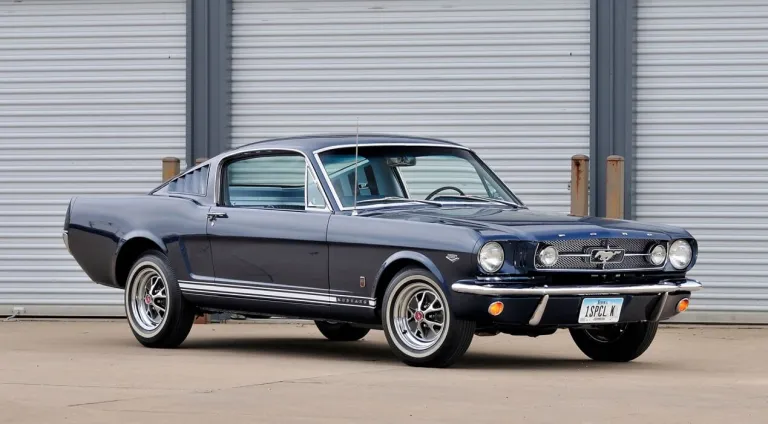
The rivalry between the Ford Mustang and the Chevrolet Camaro is the original pony-car war, and it started with the Mustang Fastback and the first Camaro. Ford introduced the Mustang on 17 April 1964 at the New York World's Fair, as a hardtop and a convertible, and the fastback followed in August 1964. Taking 22,000 orders on the first day, the Mustang created a new class of compact, sporty and affordable cars built on everyday mechanicals, in Ford's case those of the Falcon.
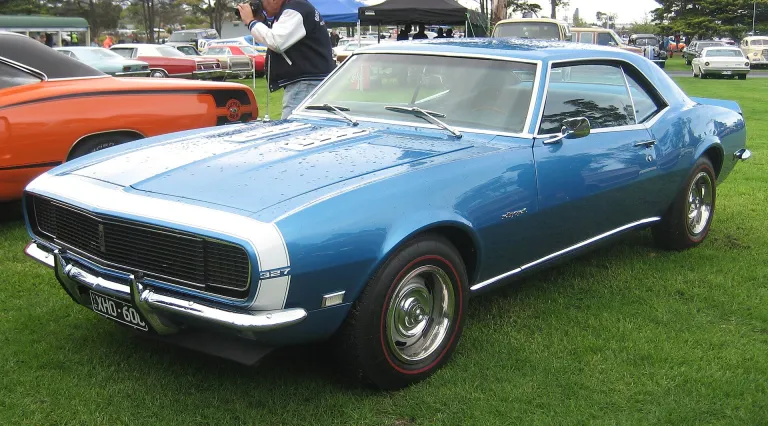
Chevrolet's response arrived two and a half years later. The first Camaro went into production on 29 September 1966 as a 1967 model and was built until November 1969, on the F-body platform it shared with the Pontiac Firebird. It came as a two-door hardtop coupé and a convertible; unlike the Mustang, it had no fastback.
Mustang Fastback vs first Camaro: key differences
Engines and how to read the figures
All power figures of this era are SAE gross ratings, measured on an engine without accessories or a full exhaust. They are noticeably higher than the net figures American makers quoted from the early 1970s. The Mustang's range started with a 200 cu in (3.3 L) six of 89 kW (120 hp gross). The 289 cu in (4.7 L) V8s gave 149 kW (200 hp) or 168 kW (225 hp), and the high-performance K-code 289 had 202 kW (271 hp). The 390 cu in (6.4 L) V8 arrived for 1967 with 239 kW (320 hp), and the 428 Cobra Jet of 1968 had 250 kW (335 hp). The Camaro started with a 230 cu in (3.8 L) six of 104 kW (140 hp). The SS offered a 350 cu in (5.7 L) V8 with 220 kW (295 hp) and 396 cu in (6.5 L) big blocks of up to 280 kW (375 hp). The Z/28 used a 302 cu in (4.9 L) V8 rated at 216 kW (290 hp). Per litre, the K-code 289 and the Z/28's 302 are almost level at about 43 and 44 kW. For 1969, special COPO orders put 427 cu in (7.0 L) engines of 317 kW (425 hp) and 321 kW (430 hp) into a small number of cars.
Body styles and famous versions
The Mustang offered three bodies, and the fastback 2+2 became the basis of its most famous derivatives. The Shelby GT350 of 1965 was available only as a fastback, the Shelby GT500 followed for 1967, and Steve McQueen drove a modified 1968 Mustang GT 2+2 Fastback in the film Bullitt. The Camaro's best-known options were the Rally Sport package with concealed headlights, the SS and the Z/28, and an RS/SS convertible with the 396 engine paced the 1967 Indianapolis 500.
Sales
Ford built 559,451 Mustangs for the 1965 model year and 607,568 for 1966. Chevrolet built 121,051 Camaros in 1967, 159,087 in 1968 and 150,078 in 1969, a strong result that still left the Mustang clearly ahead.
Full specifications
| Chevrolet Camaro I | Ford Mustang Fastback | |
|---|---|---|
| General | ||
| Version | Z/28 302 (290 hp gross) · 216 kW (294 PS) | 289 HiPo K-code (271 hp gross) · 202 kW (275 PS) |
| Production years | 1966–1969 | 1964 |
| Body | Coupe, Convertible | Coupe |
| Class | Sports car | No data |
| Country | United States | United States |
| Performance | ||
| Power Why it matters: More power means stronger acceleration and easier overtaking, especially with a full load. | 216 kW (294 PS) 290 hp Better | 202 kW (275 PS) 271 hp |
| Power, all versions | 104–321 kW (141–436 PS) 139–430 hp | 202 kW (275 PS) 271 hp |
| Engine and transmission | ||
| Fuel | Petrol | Petrol |
| Engine | 4,900 cc · 8 cyl 4.9 l | 4,700 cc · 8 cyl 4.7 l |
| Gearbox | No data | 4-speed manual |
| Drive | Rear-wheel drive | No data |
| Dimensions and weight | ||
| Length | 4,691 mm 184.7 in | No data |
| Width | 1,842 mm 72.5 in | No data |
| Height | 1,306 mm 51.4 in | No data |
| Wheelbase | 2,743 mm 108.0 in | No data |
These cars do not differ in the data we have.
Equal rows hidden (2): Country, Fuel.
Better marks the stronger figure - only for measurable specs (power, torque, 0–100 km/h, consumption, boot, weight).
In plain words
Chevrolet Camaro I has more power: 216 kW (294 PS) against 202 kW (275 PS) for Ford Mustang Fastback. Ford Mustang Fastback is the older design (from 1964); Chevrolet Camaro I arrived in 1966.
Which one to choose
Choose the Ford Mustang Fastback if you want the car that started the pony-car class, a fastback roofline and access to the larger pool of surviving cars and parts.
Choose the 1967–69 Chevrolet Camaro if you want a big-block SS or a Z/28, a convertible or the Rally Sport's hidden headlights, and the more muscular image of the later pony-car era.
Frequently asked questions
Which came first, the Mustang or the Camaro?
The Mustang. It was introduced on 17 April 1964; the Camaro followed as a 1967 model, with production starting on 29 September 1966.
Were the horsepower figures comparable to modern ones?
Not directly. Both makers quoted SAE gross figures, measured without accessories, which are higher than the net figures used from the early 1970s and today.
Was there a Camaro fastback?
No. The first-generation Camaro was offered as a hardtop coupé and a convertible. The Mustang had a hardtop, a convertible and a fastback.
What was the most powerful engine in each?
In regular production, the Mustang's 428 Cobra Jet with 250 kW (335 hp gross) and the Camaro's 396 with up to 280 kW (375 hp gross). Special 1969 COPO Camaros had 427 engines of up to 321 kW (430 hp gross).