
Camaro Z28 vs Firebird Trans Am: the 1970–1981 F-bodies
Updated Report an error By Felix Hartmann

Chevrolet · 1970–1981
Camaro II
- Power
- 183 kW249 PS
- Kerb mass
- —

Pontiac · 1970–1981
Trans Am II
- Power
- 216 kW294 PS
- Kerb mass
- 1,746 kg
Photo: MercurySable99 / Wikimedia Commons, CC BY-SA 4.0
At a glance
Who suits what, worked out from the catalog figures of the versions above.
Categories won: Camaro II 1 Trans Am II 1
- City Camaro II Length: 4,775 mm vs 4,999 mm
- Off-road Trans Am II Drive and body: Rear-wheel drive · Coupe vs Rear-wheel drive · Coupe
Verdict Opinion
The Trans Am is the stronger pick for big-engine character. Pontiac kept large-displacement V8s longer than Chevrolet, the 1973–74 SD-455 is one of the last true high-performance engines of the decade, and the 1977–1979 cars carry the film fame and record sales of 1979.
The Camaro Z28 is the purer driver's car of the two in its early form. The 1970 LT-1, rated at 268 kW (360 hp gross), was the strongest Z28 engine of the generation, and the Z28 came back in 1977 after a two-year break. Chevrolet's sales volume also means more cars and parts on the market.
— Felix Hartmann
The second-generation Chevrolet Camaro and Pontiac Firebird are the same car underneath. Both sit on General Motors' F-body platform, both arrived late, in February 1970, which earned them the "1970½" nickname, and both stayed in production until 1981. The sporting versions, Chevrolet's Z28 and Pontiac's Trans Am, became rivals inside one showroom family and outlived almost every other muscle car of the period.
In short: the Camaro Z28 relied on Chevrolet's 350 small-block, and the Camaro range was the bigger seller. The Trans Am used Pontiac's own large V8s, including the 455 Super Duty of 1973–74, and after the 1977 film Smokey and the Bandit it reached a record 117,108 cars in 1979. Read more about each in our catalogue: second-generation Camaro and Pontiac Firebird Trans Am.
Camaro Z28 vs Trans Am: engines by year, sales and size
One platform, two engine programmes
Chevrolet and Pontiac shared the body structure, but each division used its own engines. In 1970 the Z28 got the 350 LT-1 V8, rated at 268 kW (360 hp gross). The Trans Am started with Pontiac's 400 Ram Air III at 250 kW (335 hp) and the Ram Air IV at 257 kW (345 hp), the latter exclusive to the Trans Am. Chevrolet still offered the big-block SS 396 in the Camaro until 1972, when only 970 were built.
The emissions years
Lower compression and the switch to net ratings cut both cars' figures. The LT-1 dropped to 246 kW (330 hp gross), or 205 kW (275 hp net), in 1971, and to 190 kW (255 hp net) in 1972. In 1973 the Z28's 350 produced 183 kW (245 hp). Pontiac took the opposite route with displacement: the 455 HO followed in 1971, and the 455 Super Duty of 1973–74 was rated at 216 kW (290 hp net) with 536 Nm (395 lb-ft). Only 252 Trans Ams received the SD-455 in 1973, out of 4,802 built that year.
- 1973 Camaro Z28: 350 V8, 183 kW (245 hp net)
- 1973 Trans Am SD-455: 455 V8, 216 kW (290 hp net), 536 Nm
- 1973 SD-455 Trans Am weight: 1,746 kg
The Z28 break and the Bandit boom
Chevrolet sold 13,802 Z28s in 1974 and then dropped the option for 1975. The Z28 returned in spring 1977 with the LM1 350, rated at 138 kW (185 hp), or 130 kW (175 hp) with California equipment. That same year the Trans Am special edition appeared in Smokey and the Bandit, and Pontiac sold 68,744 Trans Ams out of 155,735 Firebirds. Its W72 "T/A 6.6" 400 produced 149 kW (200 bhp). For 1979 the Trans Am reached 117,108 cars, its best year, while Camaro sales as a whole peaked at 282,571.
Size and weight
The Camaro of this generation is 4,775 mm long on a 2,743 mm wheelbase and 1,890 mm wide, with a curb weight of 1,501 kg in its basic form. A 1978 Trans Am measures 4,999 mm in length on a 2,748 mm wheelbase and 1,864 mm in width. The Camaro grew seven inches longer for 1974, and the Firebird gained weight that year with 5 mph bumpers.
The last years
For 1980 and 1981 Pontiac replaced the big V8s with a turbocharged 4.9-litre 301 using a Garrett turbocharger, rated at 157 kW (210 hp) and sold only with an automatic gearbox. Chevrolet kept the 350 V8 in the Z28; by 1981 most US cars had 130 kW (175 hp) and an automatic, while a four-speed manual came with a 305 of 123 kW (165 hp).
Size and weight
Side view to scale, all cars from the front bumper.
| Camaro II | Trans Am II | |
|---|---|---|
| Length | 4,775 mm188.0 in † | 4,999 mm196.8 in † +224 mm +8.8 in +4.7% |
| Width | 1,890 mm74.4 in † | 1,864 mm73.4 in † −26 mm −1.0 in −1.4% |
| Height | 1,273 mm50.1 in † | 1,252 mm49.3 in † −21 mm −0.8 in −1.6% |
| Wheelbase | 2,743 mm108.0 in | 2,748 mm108.2 in † +5 mm +0.2 in +0.2% |
| Fits a standard garage? | Tight | Tight |
Difference vs Camaro II (±). Garage check: a standard single garage takes a car up to about 5.0 m (16 ft 5 in) long and 1.9 m (6 ft 3 in) wide (width as listed in the catalog; some makers include the mirrors). Leave about 0.6 m (2 ft) to open the doors. † from another version of this generation.
Full specifications
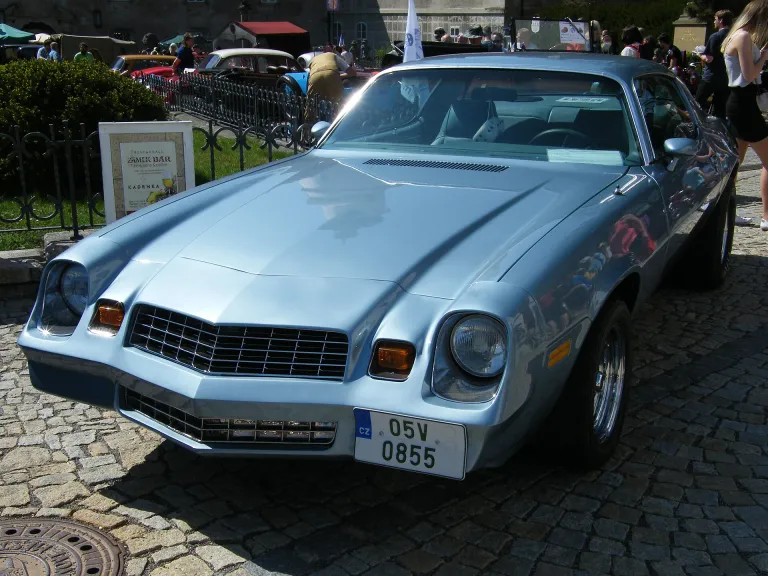
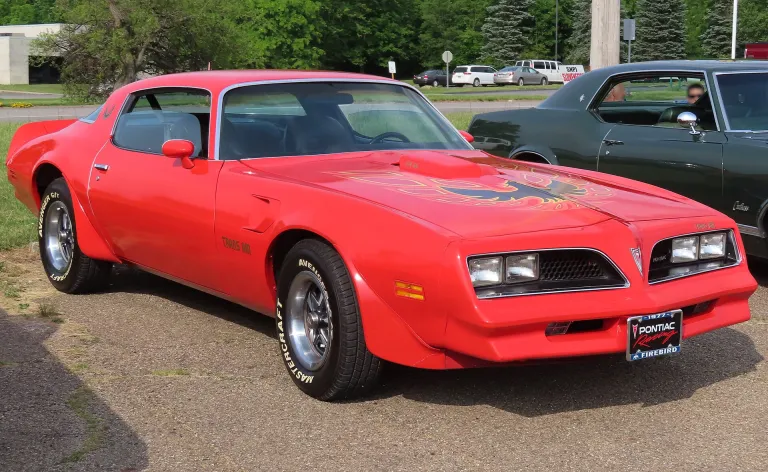
| Chevrolet Camaro II | Pontiac Trans Am II | |
|---|---|---|
| General | ||
| Version | 350 V8 (Z28) · 183 kW (249 PS) | 455 Super Duty V8 · petrol · 216 kW (294 PS) |
| Production years | 1970–1981 | 1970–1981 |
| Body | Coupe | Coupe |
| Class | Sports car | Sports car |
| Country | United States | United States |
| Performance | ||
| Power Why it matters: More power means stronger acceleration and easier overtaking, especially with a full load. | 183 kW (249 PS) 245 hp | 216 kW (294 PS) 290 hp Better |
| Power, all versions | 89–280 kW (121–381 PS) 119–375 hp | 149–257 kW (203–349 PS) 200–345 hp |
| Torque Why it matters: Torque is the pulling force you feel when accelerating from low revs, towing or climbing hills. | No data | 536 Nm 395 lb-ft |
| Power per tonne | No data | 124 kW/t 150 hp/ton calculated |
| Engine and transmission | ||
| Fuel | Petrol | Petrol |
| Engine | 5,700 cc 5.7 l | 7,457 cc · 8 cyl 7.5 l |
| Drive | Rear-wheel drive | Rear-wheel drive |
| Dimensions and weight | ||
| Length | 4,775 mm 188.0 in † | 4,999 mm 196.8 in † |
| Width | 1,890 mm 74.4 in † | 1,864 mm 73.4 in † |
| Height | 1,273 mm 50.1 in † | 1,252 mm 49.3 in † |
| Wheelbase | 2,743 mm 108.0 in | 2,748 mm 108.2 in † |
| Kerb weight Why it matters: A lighter car is usually more agile and uses less energy. | No data | 1,746 kg 3,849 lb |
These cars do not differ in the data we have.
Equal rows hidden (6): Production years, Body, Class, Country, Fuel, Drive.
Better marks the stronger figure — only for measurable specs (power, torque, 0–100 km/h, consumption, boot, weight).
† from another version of this generation.
In plain words
Pontiac Trans Am II has more power: 216 kW (294 PS) against 183 kW (249 PS) for Chevrolet Camaro II. Pontiac Trans Am II is 224 mm longer than Chevrolet Camaro II (4,999 mm vs 4,775 mm). On the catalog figures, the Chevrolet Camaro II is the pick for city; the Pontiac Trans Am II is the pick for off-road. Our catalog has no kerb mass for the Chevrolet Camaro II yet, so some checks above leave it out.
Which one to choose
Choose the Chevrolet Camaro Z28 if you want the high-revving 1970–1972 LT-1 small-block, a wide supply of parts, or a late-1970s Z28 that is usually easier to find than a sought-after Trans Am.
Choose the Pontiac Firebird Trans Am if a large Pontiac V8 matters most, if you are after a rare SD-455, or if the shaker-scoop, big-bird look of the Smokey and the Bandit era is the point of the purchase.
The first-generation rivalry with Ford is in Camaro vs Mustang Fastback (1967–69), and the long-running pony car battle in Chevrolet Camaro vs Ford Mustang.
Frequently asked questions
Are the Camaro and the Firebird the same car?
They share General Motors' F-body platform and body structure. The engines, styling and many details differ: Chevrolet used its own V8s in the Camaro and Pontiac its own in the Firebird.
Which was more powerful in 1973?
The Trans Am SD-455, rated at 216 kW (290 hp net) and 536 Nm. The 1973 Camaro Z28's 350 produced 183 kW (245 hp).
Why was there no Z28 in 1975 and 1976?
Chevrolet dropped the Z28 option after 1974, when 13,802 were sold. It returned in spring 1977 as a separate model with the LM1 350 rated at 138 kW (185 hp).
Which car was in Smokey and the Bandit?
A 1977 Pontiac Firebird Trans Am special edition. Trans Am sales reached 68,744 in 1977 and a record 117,108 in 1979.
Which one is bigger?
The Firebird. A 1978 Trans Am is 4,999 mm long on a 2,748 mm wheelbase; the Camaro of the generation is listed at 4,775 mm on 2,743 mm.