
 Hyundai KONA Electric
All generations, specs and history
Published Sources (1) Report an error
By Oleksandr Hnatiuk, Automotive Editor & Used Car Specialist
- Built
- 2018–present
- Generations
- 2 · OS to SX2
- Top power
- 160 kW (218 PS)
Timeline
KONA Electric generations
Click a generation for its own page

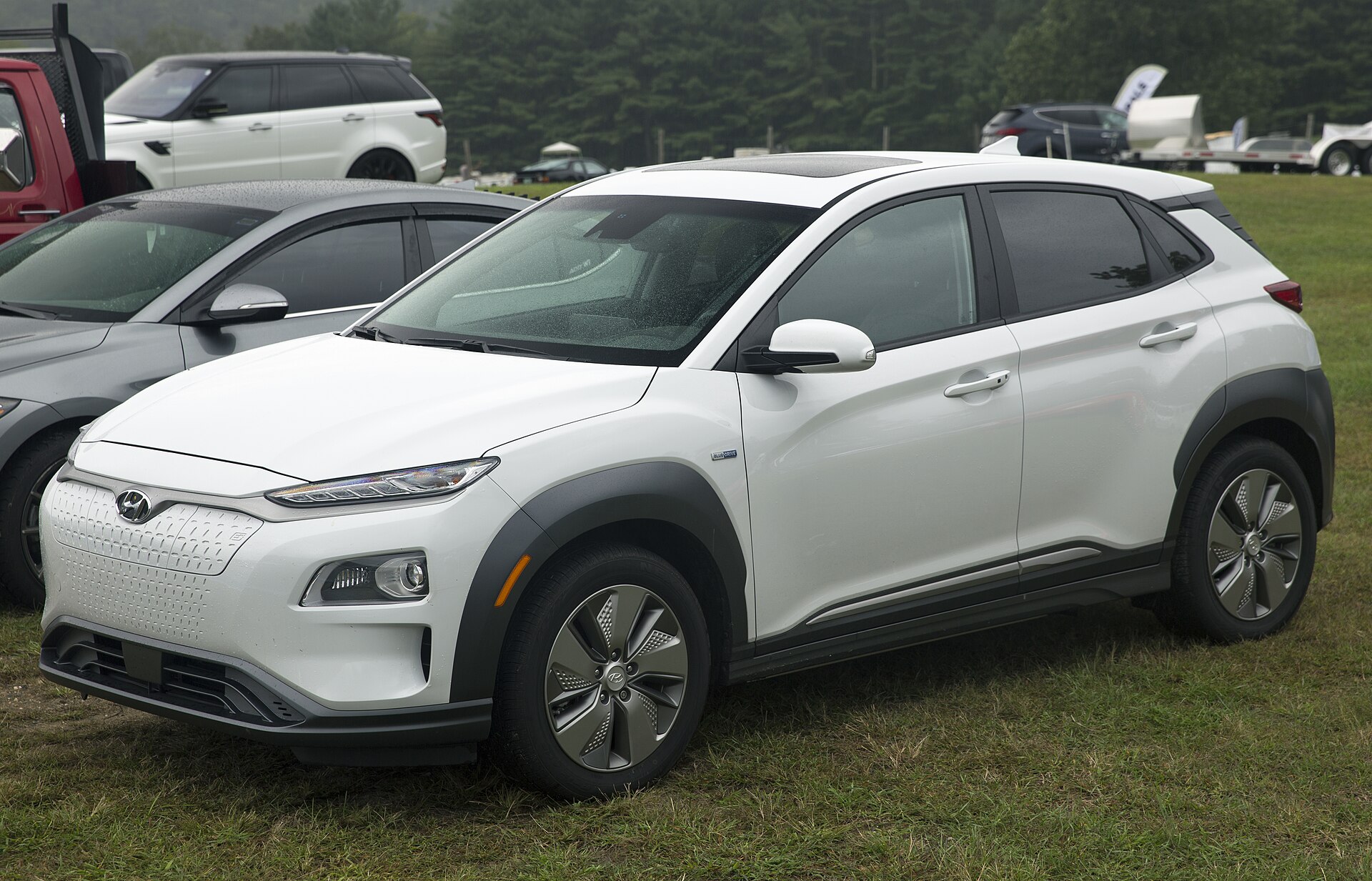
- Kona Electric OS 2018–2023 · SUV · 100–150 kW (136–204 PS)
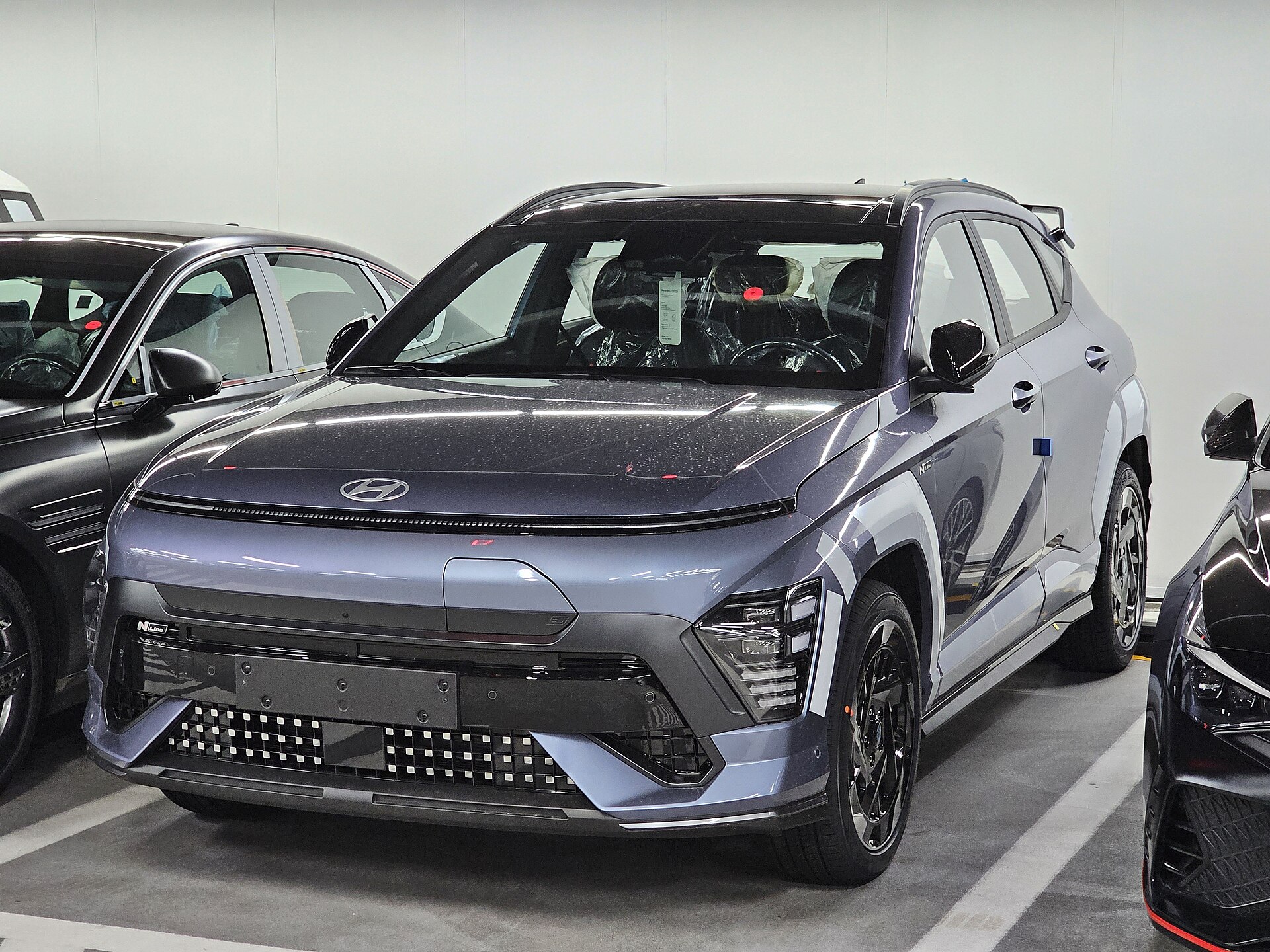
- Kona Electric SX2 Current 2023–now · SUV · 99–160 kW (135–218 PS)
Newest first · 2 generations since 2018
-
2023
- 2018 ⚡OS 2018–2023 · SUV · 100–150 kW (136–204 PS)
All generations by year: Kona Electric SX2 (2023–now) · Kona Electric OS (2018–2023)
Which one is mine?
Pick the year of first registration to see which generation it is.
The Hyundai Kona Electric is the battery-electric version of Hyundai's small Kona SUV, on sale since 2018 in two generations. The first (OS) came with a 39.2 or 64 kWh battery and 100 or 150 kW. The second (SX2), revealed in December 2022, uses 48.4 or 65.4 kWh packs with up to 160 kW, still driving the front wheels only.
In short
- First generation 2018-2023 (India until mid-2024), second generation from April 2023 in Europe and September 2023 in North America.
- Front-wheel drive only; outputs from 99 kW (135 PS) to 160 kW (218 PS).
- Range from 289 km WLTP (39.2 kWh, launch figure) to about 490 km WLTP (65.4 kWh); EPA 261 miles (420 km) for the 2025 US Long Range.
- About 429,000 sold worldwide in 2018-2025 (yearly figures listed by Wikipedia).
Specs by version
Engines
| Version | Engine | Power | Torque | Gearbox | Drive | Production years |
|---|---|---|---|---|---|---|
| OS · 2018–2023 | ||||||
| OS · Electric 39.2 kWh 100 kW | Electric | 100 kW 136 PS134 hp | - | Single-speed | Front-wheel drive | 2018–2023 |
| OS · Electric 64 kWh 150 kW | Electric | 150 kW 204 PS201 hp | 394 Nm291 lb-ft | Single-speed | Front-wheel drive | 2018–2023 |
| SX2 · 2023–present | ||||||
| SX2 · Electric 48.4 kWh 99 kW | Electric | 99 kW 135 PS133 hp | 255 Nm188 lb-ft | Single-speed | Front-wheel drive | 2023 |
| SX2 · Electric 48.4 kWh 115 kW | Electric | 115 kW 156 PS154 hp | 255 Nm188 lb-ft | Single-speed | Front-wheel drive | 2023 |
| SX2 · Electric 65.4 kWh 150 kW | Electric | 150 kW 204 PS201 hp | - | Single-speed | Front-wheel drive | 2023 |
| SX2 · Electric 65.4 kWh 160 kW | Electric | 160 kW 218 PS215 hp | - | Single-speed | Front-wheel drive | 2023 |
Performance
Show all 5 versions
| Version | 0–100 km/h | Top speed | Range |
|---|---|---|---|
| OS · 2018–2023 | |||
| OS · Electric 39.2 kWh 100 kW | 9.9 s 0–62 mph | 155 km/h96 mph | 289 km180 mi |
| OS · Electric 64 kWh 150 kW | 7.6 s 0–62 mph | 167 km/h104 mph | 449 km279 mi |
| SX2 · 2023–present | |||
| SX2 · Electric 48.4 kWh 115 kW | 8.8 s 0–62 mph | 162 km/h101 mph | - |
| SX2 · Electric 65.4 kWh 150 kW | 7.9 s 0–62 mph | - | - |
| SX2 · Electric 65.4 kWh 160 kW | 7.8 s 0–62 mph | 172 km/h107 mph | 490 km304 mi |
Dimensions and weight
Show all 6 versions
| Version | Boot | Battery |
|---|---|---|
| OS · 2018–2023 | ||
| OS · Electric 39.2 kWh 100 kW | 332 l11.7 cu ft | 39 kWh |
| OS · Electric 64 kWh 150 kW | 332 l11.7 cu ft | 64 kWh |
| SX2 · 2023–present | ||
| SX2 · Electric 48.4 kWh 99 kW | - | 48 kWh |
| SX2 · Electric 48.4 kWh 115 kW | 466 l16.5 cu ft | 48 kWh |
| SX2 · Electric 65.4 kWh 150 kW | 466 l16.5 cu ft | 65 kWh |
| SX2 · Electric 65.4 kWh 160 kW | 466 l16.5 cu ft | 65 kWh |
Verified Manufacturer and type-approval data from our catalog · Sources and methodology
Hyundai Kona Electric at a glance
| Specification | Hyundai Kona Electric |
|---|---|
| Body and segment | five-door small SUV, electric version of the Kona |
| Generations | OS (2018-2023), SX2 (since 2023) |
| Production | Nošovice, Czech Republic (from March 2020); Cikarang, Indonesia (from July 2024) |
| Drive | front-wheel drive, one electric motor |
| Power | 100 or 150 kW (OS); 99, 115, 150 or 160 kW (SX2) |
| Battery | 39.2 or 64 kWh (OS); 48.4 or 65.4 kWh (SX2), quoted as 48.6 and 64.8 kWh in the USA |
| Range | 289-449 km WLTP at launch, 484 km after the 2020 update (OS); up to about 490 km WLTP (SX2) |
| DC charging | about 74 kW (48.4 kWh) or 102 kW (65.4 kWh), 10-80% in about 41-43 minutes (SX2) |
| Boot | 332 l (OS); 466 l plus a 27 l front boot (SX2) |
| Euro NCAP | 4 stars (SX2, 2023) |
| Price from | USD 34,470 (USA, 2025); GBP 35,000 (UK, 2026) |
Two generations of the Kona Electric
The first Kona was revealed in June 2017, and the electric version went on sale in South Korea in the first half of 2018. Europe followed in 2018, the USA in 2019, Thailand in March 2019 and India in July 2019. In China the same car was sold as the Encino EV from November 2019, with a 64.2 kWh battery and a quoted NEDC range of 500 km. Hyundai started building the Kona Electric for Europe at Nošovice in the Czech Republic in March 2020, with a plan for 30,000 cars a year. A facelift announced in September 2020 introduced the N Line trim.
The second generation (SX2) was revealed in December 2022. It was offered with petrol and hybrid versions alongside. It reached Europe in April 2023, North America in September 2023 as a 2024 model, Japan in November 2023 and Australia on 9 January 2024. An N Line version of the Kona Electric followed on 17 January 2024. In July 2024 Hyundai Motor Manufacturing Indonesia in Cikarang began building it with batteries from the HLI Green Power cell plant in Karawang.
| Market | Generation on sale | Notes |
|---|---|---|
| Europe | OS 2018-2023, SX2 since April 2023 | built in Nošovice from 2020; sold as Kauai in Portugal |
| USA | OS 2019-2023, SX2 since September 2023 | SEL, Limited, N Line and Long Range dropped for 2026 |
| India | OS 39.2 kWh, July 2019 to mid-2024 | replaced by the Creta Electric |
| China | OS as Encino EV from November 2019 | 64.2 kWh, 500 km NEDC |
| Indonesia | SX2, built locally from July 2024 | 48.6 or 64.8 kWh |
The rest of the model, including petrol, hybrid and N versions, is covered in our Hyundai Kona guide.

Kona Electric batteries, power and range
Two battery sizes have been offered in each generation, and motor output follows the pack. The first generation paired 39.2 kWh with 100 kW (136 PS) and 64 kWh with 150 kW (204 PS); the bigger car developed about 395 Nm (291 lb-ft). The second generation has more output steps; Wikipedia gives 255 Nm (188 lb-ft) for the Standard Range version.
| Version | Battery | Power | Range (cycle) | 0-100 km/h |
|---|---|---|---|---|
| OS 39.2 kWh | 39.2 kWh | 100 kW (136 PS) | 289 km (WLTP, launch figure); 452 km (ARAI, India) | 9.7-9.9 s |
| OS 64 kWh | 64 kWh | 150 kW (204 PS) | 449 km (WLTP, launch figure), 484 km after the 2020 update; 415 km (EPA) | 7.6-7.9 s |
| SX2 Standard Range | 48.4 kWh | 99 kW (135 PS) or 115 kW (156 PS) | 377 km (234 miles, UK); 322 km (200 miles, US SE) | 8.8 s (115 kW) |
| SX2 Long Range | 65.4 kWh | 150 kW (204 PS) | 420 km (261 miles, US) | 7.9 s |
| SX2 Long Range | 65.4 kWh | 160 kW (218 PS) | up to about 490-513 km (WLTP, by wheel size) | 7.8 s |
The German Wikipedia says the launch WLTP figures of 289 and 449 km were later corrected downward in December 2018, so treat them as launch numbers. Range also varies with market and wheel size: carwow quotes 319 miles (513 km) for the entry UK Long Range trim and 282 miles (454 km) on larger wheels. Top speed is 155 or 167 km/h for the first generation and 162 or 172 km/h for the second.
India got only the small-battery first-generation car: CarDekho lists 39.2 kWh, 100 kW (134 bhp) and an ARAI range of 452 km. In 2020 Hyundai Europe drove a 64 kWh car 1,026 km on one charge at the Lausitzring, at an average speed of 30 km/h.


Charging the Kona Electric
The first-generation car has a 7.2 kW on-board charger. On a Level 2 home wallbox a 2022 US Kona Electric needs about nine hours from 10% to full, and Hyundai quoted about 47 minutes for 10-80% on a DC fast charger. In India the 39.2 kWh car takes 57 minutes to 80% on a 50 kW DC charger and 6 hours 10 minutes on 7.2 kW AC.
The SX2 stays on a 400-volt system, so it charges more slowly than Hyundai's 800-volt models. Peak DC power is about 74 kW for the 48.4 kWh pack and 102 kW for the 65.4 kWh pack. Kelley Blue Book gives about 43 minutes for 10-80% with either battery and 5.1 to 6.9 hours on a 240-volt home charger. Vehicle-to-load (V2L) lets the car power appliances from its battery.
Kona Electric prices by market
| Market and year | Version | Price |
|---|---|---|
| USA, 2025 | SE (48.6 kWh) | USD 34,470 |
| USA, 2025 | SEL (64.8 kWh) | USD 38,470 |
| USA, 2025 | N Line | USD 39,870 |
| USA, 2025 | Limited | USD 42,645 |
| UK, 2026 | Advance 65 kWh, 160 kW | GBP 35,000 |
| UK, 2026 | N Line S 65 kWh | GBP 39,720 |
| India, 2024 | Premium 39.2 kWh (ex-showroom, New Delhi) | INR 23.84 lakh (INR 2,384,000) |
For the 2026 model year Wikipedia says the SEL, Limited and N Line trims and the Long Range battery option were discontinued in the USA. The UK trims carwow lists for 2026 (Advance, N Line, N Line S and a top trim) all use the 65 kWh battery and 160 kW motor.
Kona Electric safety ratings and the battery recall
Euro NCAP tested the second-generation Kona Electric in 2023 and gave it four stars: 80% for adult occupants, 83% for children, 64% for vulnerable road users and 60% for safety assistance. ANCAP's 2023 scores for the new Kona range are almost identical. In the USA the 2024-2026 Kona line is generally rated Good by IIHS, with Acceptable headlights; these ratings are not specific to the electric version. The first-generation Kona was an IIHS Top Safety Pick+ in 2018.
The first-generation Kona Electric had a high-voltage battery recall. In October 2020 Hyundai recalled more than 25,000 Kona Electrics in South Korea after reports of fires; Reuters counted 13 at the time. In February 2021 Hyundai confirmed about 55,000 more cars outside Korea, with an estimated cost of about USD 900 million. The suspected fault was a short circuit in cells made by LG Energy Solution in Nanjing, China, which a software update could not fix. In Australia, 615 Kona Electrics of 2018-2020 were recalled, with the battery replaced where the fault was found.
Buying a used Kona Electric: what to check
Ask for proof that the battery recall was carried out on any 2018-2020 car, or for a dealer check of the vehicle identification number. The 64 kWh version is the one to look for: the 39.2 kWh car was launched with 289 km WLTP and suits mainly short commutes. In the USA the 2025 car carries a battery warranty of 10 years or 100,000 miles (160,000 km); check what remains of it on an older car. Kelley Blue Book notes resale values below average, though no worse than the Kia Niro EV, so used prices are low. Carwow lists used cars in the UK from GBP 17,330. A list of the best used electric cars puts the Kona against other second-hand options.
Kona Electric vs Kia Niro EV and which version to buy
The closest rival is the Kia Niro EV. Carwow measures 475 litres of boot space for the Niro EV against 466 litres for the second-generation Kona Electric, while the Kona adds a 27-litre front boot.
For most buyers the second-generation Long Range is the version to choose: 65.4 kWh, 150 or 160 kW and up to about 490 km WLTP for GBP 35,000 in the UK in 2026. The Standard Range suits city use and is what remains of the US range for 2026. A used first-generation 64 kWh car remains the budget option, provided the recall paperwork is in order. Other electric and petrol models are listed in the Hyundai catalogue.
Photo gallery

Hyundai KONA Electric: first vs latest generation
| Spec | Kona Electric OS | Kona Electric SX2 | Change |
|---|---|---|---|
| Years | 2018–2023 | 2023–present | 5 years apart |
| Most powerful version | 150 kW (204 PS) | 160 kW (218 PS) | +10 kW (+7%) |
| Best 0–100 km/h | 7.6 s | 7.8 s | +0.2 s |
| Top speed | 167 km/h | 172 km/h | +5 km/h |
Oldest and newest generation in the 1cars catalog. Power is the strongest version of each; other rows are shown only when both generations have the figure.
Hyundai KONA Electric in our rankings
- No. 172 of 422 · Biggest boot: cars (466 l · top 41%)
- No. 15 of 34 · Quickest Korean cars, 0–100 (7.6 s · top 45%)
- No. 29 of 60 · Most powerful Korean cars (160 kW · top 49%)
- No. 71 of 139 · Longest-range electric cars (490 km · top 52%)
- No. 675 of 1337 · Longest-running car nameplates (8 years · top 52%)
- No. 248 of 498 · Oldest car models still on sale (8 years · top 52%)
Bigger boot than 59% of ranked cars in the 1CARS catalog (No. 172 of 422).
FAQ
Is the Hyundai Kona Electric all-wheel drive?
No. Every Kona Electric, first and second generation, drives the front wheels with a single electric motor. Kelley Blue Book confirms that the 2025 US car is front-wheel drive only in every trim, from SE to Limited.
What is the range of the Hyundai Kona Electric?
The 2025 US Kona Electric is rated at 200 miles (322 km) with the standard battery and 261 miles (420 km) with the long-range battery. Under WLTP the 65.4 kWh car reaches about 490 km, or more on the smallest wheels.
Was the Kona Electric battery recalled?
Yes. Hyundai recalled first-generation cars built between 2017 and 2020 because of a possible short circuit in LG Energy Solution cells. More than 25,000 cars in Korea and about 55,000 elsewhere were affected, at a cost of about USD 900 million.
Is the Kona Electric still sold in India?
No. The Kona Electric with the 39.2 kWh battery was discontinued in India in mid-2024, after being sold from July 2019. The Creta Electric took its place in Hyundai India's range.
How long does a Kona Electric take to charge?
A second-generation Kona Electric charges from 10 to 80% in about 41-43 minutes on a DC fast charger. On a 240-volt home charger a full charge takes about 5 hours (48.6 kWh) to 7 hours (64.8 kWh).
Data sources
Data checked by an editor against the sources below.
- Wikipedia - Hyundai Kona


