
 Hyundai Ioniq 9
Specs, engines and history
Published Sources (2) Report an error
By Felix Hartmann, Automotive Technology & EV Contributor
- Built
- 2025–present
- Top power
- 315 kW (428 PS)
Which Ioniq 9 to choose
Our verdict · Felix Hartmann
The RWD version gives the longest range, 620 km, and the largest front compartment, but it tows only 1,600 kg. Families who tow a caravan or boat should take the 226 kW AWD for its 2,500 kg limit and 6.7-second acceleration. The Performance adds 89 kW and 1.5 seconds less to 100 km/h for EUR 2,000 more than the Uniq AWD, with no loss of WLTP range. Other large family cars are compared in our list of the best 7-seater cars, and Hyundai's full range is in the Hyundai catalogue.
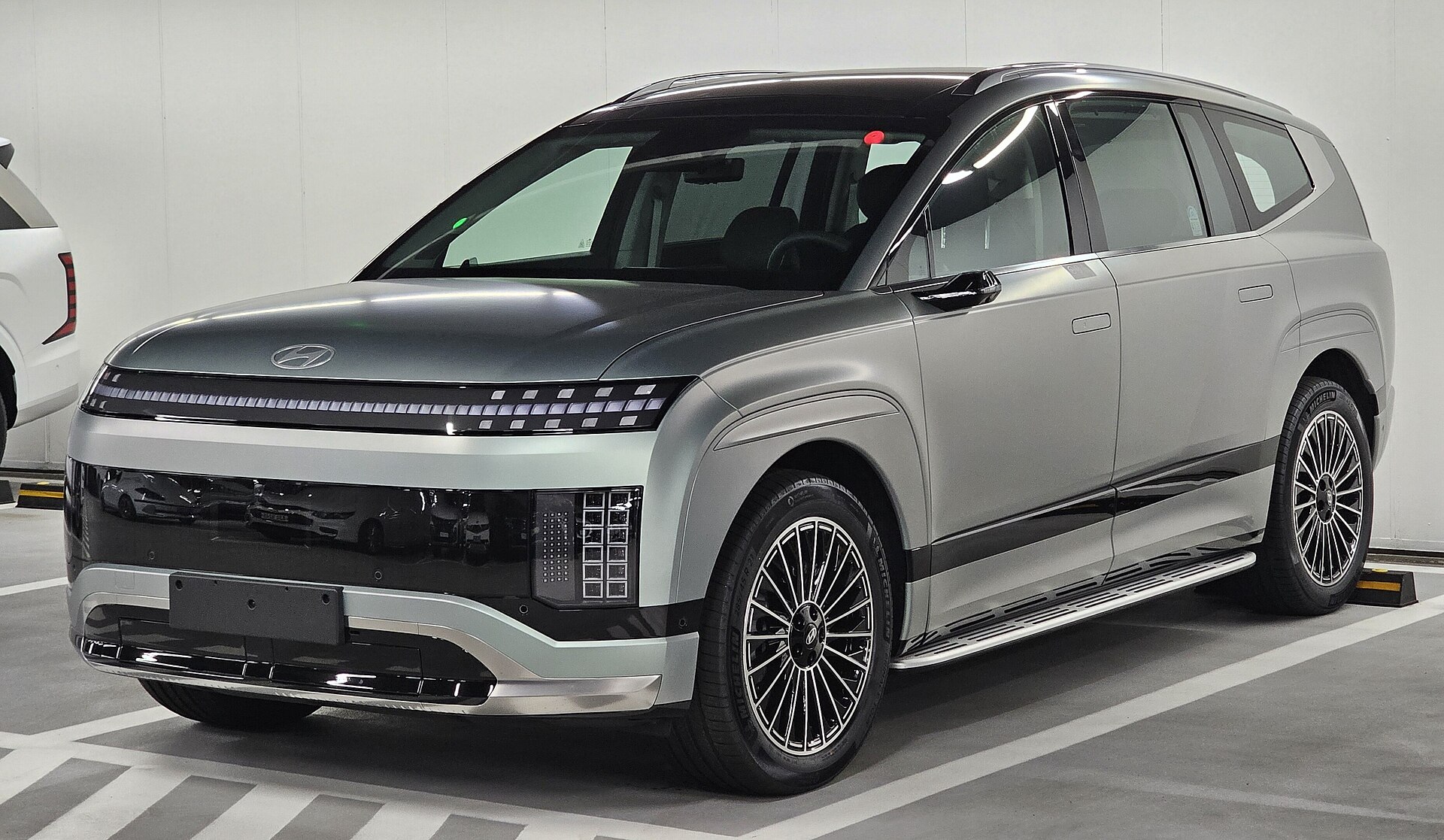
The Hyundai Ioniq 9 is a three-row electric SUV with six or seven seats and a 110.3 kWh battery. It was revealed at the Los Angeles Auto Show on 20 November 2024 and is built in Asan, South Korea, and at Hyundai's Metaplant America in Georgia. It uses the 800-volt E-GMP platform and reaches up to 620 km WLTP.
In short
- One generation (code ME1) since 2025; rear-wheel drive with 160 kW (218 PS) or all-wheel drive with 226 kW (307 PS) and 315 kW (428 PS) in Europe.
- 620 km WLTP for the RWD and 600 km for both AWD versions; 10-80% DC charging in 24 minutes.
- 5,060 mm (199.2 in) long on a 3,130 mm wheelbase; boot from 338 to 2,419 litres plus a front compartment.
- Five Euro NCAP stars (2025); from EUR 70,850 in Germany (July 2025) and US$58,955 in the US (2025).
Size at a glance
| Dimensions | Hyundai Ioniq 9 ME1 |
|---|---|
| Length | 5,060 mm199.2 in |
| Width | 1,980 mm78.0 in |
| Height | 1,790 mm70.5 in |
| Wheelbase | 3,130 mm123.2 in |
| Boot | 338 L11.9 cu ft |
Specs by version
Engines
| Version | Engine | Power | Torque | Gearbox | Drive | Production years |
|---|---|---|---|---|---|---|
| RWD 160 kW | Electric | 160 kW 218 PS215 hp | 350 Nm258 lb-ft | 1-sp Single-speed | Rear-wheel drive | 2025 |
| AWD 226 kW | Electric | 226 kW 307 PS303 hp | 605 Nm446 lb-ft | 1-sp Single-speed | All-wheel drive | 2025 |
| Performance AWD 315 kW | Electric | 315 kW 428 PS422 hp | 700 Nm516 lb-ft | 1-sp Single-speed | All-wheel drive | 2025 |
Performance
Show all 3 versions
| Version | 0–100 km/h | Top speed | Fuel consumption | Range |
|---|---|---|---|---|
| RWD 160 kW | 9.4 s 0–62 mph | 190 km/h118 mph | 19.9 kWh/100 km32.0 kWh/100 mi | 620 km385 mi |
| AWD 226 kW | 6.7 s 0–62 mph | 200 km/h124 mph | 20.6 kWh/100 km33.2 kWh/100 mi | 600 km373 mi |
| Performance AWD 315 kW | 5.2 s 0–62 mph | 200 km/h124 mph | 20.6 kWh/100 km33.2 kWh/100 mi | 600 km373 mi |
Dimensions and weight
Show all 3 versions
| Version | Length | Width | Height | Wheelbase | Kerb weight | Boot | Battery |
|---|---|---|---|---|---|---|---|
| RWD 160 kW | 5,060 mm199.2 in | 1,980 mm78.0 in | 1,790 mm70.5 in | 3,130 mm123.2 in | 2,549 kg5,620 lb | 338 l11.9 cu ft | 110 kWh |
| AWD 226 kW | 5,060 mm199.2 in | 1,980 mm78.0 in | 1,790 mm70.5 in | 3,130 mm123.2 in | 2,657 kg5,858 lb | 338 l11.9 cu ft | 110 kWh |
| Performance AWD 315 kW | 5,060 mm199.2 in | 1,980 mm78.0 in | 1,790 mm70.5 in | 3,130 mm123.2 in | 2,689 kg5,928 lb | 338 l11.9 cu ft | 110 kWh |
Verified Manufacturer and type-approval data from our catalog · Sources and methodology
Hyundai Ioniq 9 at a glance
| Specification | Hyundai Ioniq 9 |
|---|---|
| Segment and body | large three-row electric SUV, 6 or 7 seats |
| Production | since 2025, Asan (South Korea) and Bryan County, Georgia (US) |
| Platform | E-GMP, 800 volt with 400-volt compatibility |
| Drive | rear-wheel drive or dual-motor all-wheel drive |
| Power (Europe) | 160 kW (218 PS); 226 kW (307 PS); 315 kW (428 PS) |
| Battery | 110.3 kWh NCM |
| WLTP range | 600-620 km (373-385 miles) |
| Charging | up to 233 kW DC, 10-80% in 24 min; 11 kW AC |
| Length / wheelbase | 5,060 mm / 3,130 mm (123.2 in) |
| Boot | 338 / 908 / 2,419 l, plus 52-88 l front |
| Euro NCAP | 5 stars (2025) |
| Price from | EUR 70,850 in Germany (July 2025) |
From the Seven concept to Hyundai's electric flagship
Hyundai previewed the car as the Seven concept at the Los Angeles Auto Show in November 2021, and it was known as the Ioniq 7 until early 2024, when the name changed to Ioniq 9. The production SUV returned to Los Angeles for its debut in November 2024. Sales began in South Korea and the US in the first half of 2025, with the US release in May; German prices appeared in July 2025, and Australia followed on 15 July 2025.
The Ioniq 9 is 5,060 mm long, 1,980 mm wide and 1,790 mm tall, with a drag coefficient of 0.259. Digital side mirrors are optional in some markets. It was named the best large SUV at the 2026 Women's Worldwide Car of the Year awards and won the Premium category at the German Car of the Year 2026.
Three powertrains on one battery
| Version (Europe) | Power | Torque | WLTP range | 0-100 km/h |
|---|---|---|---|---|
| RWD | 160 kW (218 PS) | 350 Nm | 620 km | 9.4 s |
| AWD | 226 kW (307 PS) | 605 Nm | 600 km | 6.7 s |
| Performance AWD | 315 kW (428 PS) | 700 Nm | 600 km | 5.2 s |
Every version uses the same 110.3 kWh battery. The all-wheel-drive car adds a 66 kW (90 PS) front motor to the 160 kW rear motor, and its top speed is 200 km/h (124 mph) against 190 km/h for the RWD. ADAC lists combined WLTP consumption of 19.9 kWh/100 km for the RWD and 20.6 kWh/100 km for both AWD versions.
Outside Europe the outputs are slightly higher: Wikipedia gives 230 kW and 320 kW for the two AWD versions, and US cars are rated at 160, 226 and 315 kW (215, 303 and 422 hp). US EPA figures are 335 miles (539 km) for the RWD S, 320 miles (515 km) for the dual-motor SE and SEL and 311 miles (500 km) for the Performance trims.
Charging and real-world efficiency
The 800-volt system takes up to 233 kW, according to ADAC, and Hyundai quotes 24 minutes from 10 to 80 percent on a 350 kW charger. The car also accepts 400-volt chargers, and US versions have a NACS port for Tesla Superchargers. That compatibility has limits: on a Supercharger InsideEVs saw a steady 126 kW and went from 20 to about 75 percent in 25 minutes. At home the on-board charger handles 11 kW three-phase.
Over a summer test in New York, InsideEVs recorded 3.3 to 3.5 miles per kWh, which equals about 17.8 to 18.8 kWh/100 km and is better than the 19.9 to 20.6 kWh/100 km WLTP figures.
Six or seven seats and the boot
The Ioniq 9 seats six or seven, with reclining relaxation seats in the first and second rows. ADAC measures 338 litres behind the third row, 908 litres with the third row folded to window height and 2,419 litres to the roof with both rear rows folded. The front compartment holds 88 litres in the RWD car and 52 litres with the front motor of the AWD versions. Kerb weight runs from 2,549 kg for the RWD to 2,689 kg for the Performance; towing is limited to 1,600 kg braked for the RWD and 2,500 kg (5,512 lb) for the AWD versions.

Euro NCAP and ANCAP results
Euro NCAP tested an all-wheel-drive Ioniq 9 in 2025 and awarded five stars. It scored 84 percent for adult occupants, 87 percent for child occupants, 77 percent for vulnerable road users and 83 percent for safety assistance. ANCAP published closely matching scores, including 84 percent for adult occupants and 85 percent for safety assistance.
Prices in Germany and the US
| Version (Germany) | Power | List price | From |
|---|---|---|---|
| Ioniq 9, 7 seats | 160 kW | EUR 70,850 | 07/2025 |
| Centriq AWD, 7 seats | 226 kW | EUR 82,850 | 07/2026 |
| Uniq AWD, 6 seats | 226 kW | EUR 87,100 | 07/2025 |
| Performance Uniq AWD, 7 seats | 315 kW | EUR 88,100 | 07/2025 |
| Performance Blackline AWD, 6 seats | 315 kW | EUR 90,950 | 07/2026 |
In the US the 2026 model year started at US$58,955 before destination for the RWD S in 2025, and InsideEVs priced its Performance Limited test car at US$74,300.
Ioniq 9 or Kia EV9
The Kia EV9 shares the E-GMP platform and the three-row layout. ADAC lists the EV9 Air with 99.8 kWh and 150 kW from EUR 66,690 in January 2025, while the Ioniq 9 RWD costs EUR 70,850 in 2025 with 110.3 kWh and 160 kW. The EV9 is also sold with a smaller 76.1 kWh battery from EUR 63,690 in 2025, a cheaper entry point the Ioniq 9 does not offer. Within Hyundai, the three-row alternative with a combustion engine is the Hyundai Palisade.
Photo gallery

Hyundai Ioniq 9 in our rankings
- No. 7 of 31 · Quickest Korean cars, 0–100 (5.2 s)
- No. 8 of 53 · Most powerful Korean cars (315 kW)
- No. 19 of 514 · Heaviest cars (2,689 kg · top 4%)
- No. 16 of 248 · Longest SUVs and crossovers (5,060 mm · top 7%)
- No. 11 of 155 · Biggest batteries: electric cars (110 kWh · top 8%)
- No. 51 of 656 · Longest cars (5,060 mm · top 8%)
Heavier than 96% of ranked cars in the 1CARS catalog (No. 19 of 514).
FAQ
What is the range of the Hyundai Ioniq 9?
620 km (385 miles) WLTP for the rear-wheel-drive version and 600 km for both all-wheel-drive versions. In the US the EPA ratings are 335, 320 and 311 miles depending on trim.
How fast does the Ioniq 9 charge?
Hyundai quotes 24 minutes from 10 to 80 percent on a 350 kW charger, and ADAC lists a peak of 233 kW. On a 400-volt Tesla Supercharger InsideEVs saw about 126 kW.
How many seats does the Ioniq 9 have?
Six or seven, in three rows. With all seats up the boot holds 338 litres; folding the rear rows gives up to 2,419 litres, plus a front compartment of 52 or 88 litres.
Where is the Ioniq 9 built?
In Asan, South Korea, and at the Hyundai Motor Group Metaplant America in Bryan County, Georgia, which builds cars for the US market.
Data sources
Data checked by an editor against the sources below.
- Wikipedia - Hyundai Ioniq 9
- ADAC


