
 Subaru 360
Specs, engines and history
Published Sources (2) Report an error
By Sarah Whitmore, Senior Automotive Writer
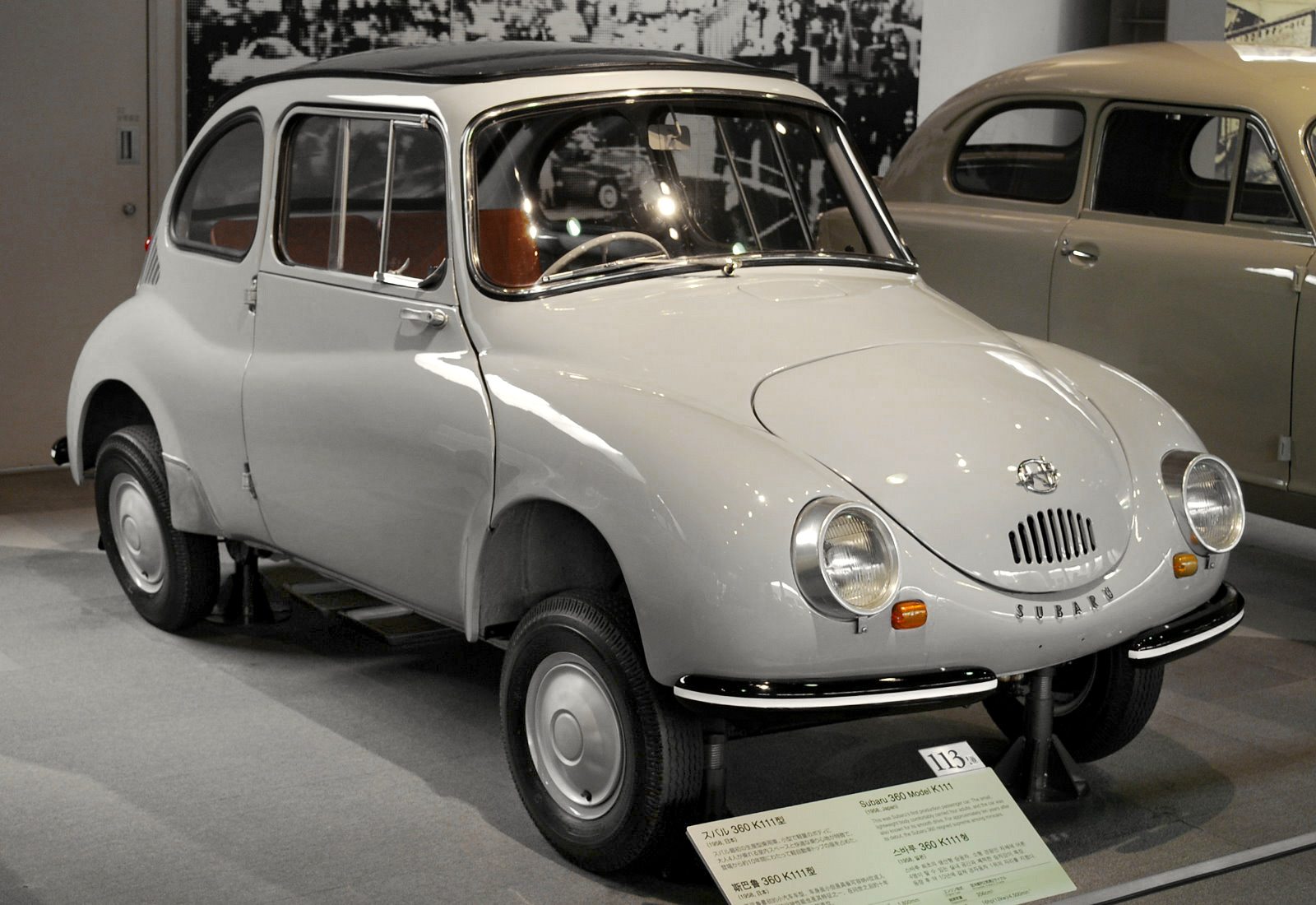
- Built
- 1958–1970
- Top power
- 26 kW (35 PS)
The Subaru 360 is the four-seat kei car that Fuji Heavy Industries built from 1958 to 1970. A 356 cc air-cooled two-stroke twin sits across the tail, and the launch car weighed 385 kg. About 392,000 were made, and its JPY 425,000 price put a four-seat car within reach of Japanese households.
In short
- Presented on 3 March 1958, priced at JPY 425,000, roughly a year's starting salary for a university graduate.
- Full monocoque body with 0.6 mm steel panels and a glass-fibre roof, designed by former aircraft engineers under Shinroku Momose.
- Power grew from 12 kW (16 PS) at launch to 18 kW (25 PS) in 1968; the Young SS had 26 kW (36 PS).
- About 392,000 built until May 1970; around 10,000 were imported to the USA by Malcolm Bricklin.
Size at a glance
| Dimensions | Subaru 360 K111 |
|---|---|
| Length | 2,990 mm117.7 in |
| Width | 1,300 mm51.2 in |
| Height | 1,379 mm54.3 in |
| Wheelbase | 1,801 mm70.9 in |
Specs by version
Engines
| Version | Engine | Power | Gearbox | Drive | Production years |
|---|---|---|---|---|---|
| 360 EK31 16 PS | 0.4 l · 2 cyl · Petrol EK31 | 12 kW 16 PS16 hp | 3-sp Manual | Rear-wheel drive | 1958 |
| 360 25 PS | 0.4 l · 2 cyl · Petrol 356 cc | 18 kW 24 PS24 hp | 4-sp Manual | Rear-wheel drive | 1968–1970 |
| 360 Young SS | 0.4 l · 2 cyl · Petrol EK32 | 26 kW 35 PS35 hp | - | Rear-wheel drive | 1968–1970 |
Performance
Show all 3 versions
| Version | Top speed |
|---|---|
| 360 EK31 16 PS | 83 km/h52 mph |
| 360 25 PS | 110 km/h68 mph |
| 360 Young SS | 120 km/h75 mph |
Dimensions and weight
Show all 2 versions
| Version | Length | Width | Height | Wheelbase | Kerb weight |
|---|---|---|---|---|---|
| 360 EK31 16 PS | - | - | - | - | 385 kg849 lb |
| 360 25 PS | 2,990 mm117.7 in | 1,300 mm51.2 in | 1,379 mm54.3 in | 1,801 mm70.9 in | - |
Verified Manufacturer and type-approval data from our catalog · Sources and methodology
Subaru 360 at a glance
| Specification | Subaru 360 |
|---|---|
| Years | 1958 to May 1970 (Wikipedia EN gives 1971) |
| Production | about 392,000 |
| Plant | Otakita plant, Ota, Gunma |
| Body styles | two-door saloon (K111), convertible, Custom three-door estate, van |
| Design team | Shinroku Momose (project leader), Kozo Murota (body engineering), Tatsuzo Sasaki (styling) |
| Layout | rear engine mounted transversely, rear-wheel drive, four-wheel independent suspension |
| Engine | 356 cc EK31 air-cooled two-stroke twin; EK32 on the Young SS |
| Power | 12 kW (16 PS) in 1958 to 18 kW (25 PS) from 1968; 26 kW (36 PS) Young SS |
| Weight | 385 kg at launch (Wikipedia JA); 410 kg (Wikipedia EN) |
| Length and width | 2,990 mm x 1,300 mm, wheelbase 1,801 mm |
| Top speed | about 83 km/h at launch; 110 km/h for the last standard model; 120 km/h Young SS |
| Price new | JPY 425,000 in 1958; USD 1,297 in the USA from 1968 |
Subaru 360 origins: a national car under the 360 cc limit
In 1954 Japan set the kei-car limits at 360 cc and a maximum size of 3,000 mm by 1,300 mm. In 1958 only about 3% of Japanese households owned a motor vehicle.
Fuji Heavy Industries grew out of the Nakajima aircraft company, and its engineers set out to fit four adults into the kei dimensions. The car was shown to the press on 3 March 1958 and went on sale in May. At JPY 425,000 it was still far from cheap: Best Car compares the price to a year of a graduate's starting pay, and a salesman then earned about JPY 16,000 a month. Only 385 cars were sold in 1958, but within three years annual sales exceeded 17,000. Japanese buyers called it the "ladybug" because of its round shape.
Aircraft methods in a 385 kg body
Shinroku Momose led a team that treated weight as the main enemy. The 360 has no separate chassis: its full monocoque uses steel panels only 0.6 mm thick, with a 1.2 mm floor, and the curves of the shell provide the stiffness. The roof is glass-fibre reinforced plastic, first held by rubber seals and later screwed down, and Japanese sources mention an aluminium bonnet. The target weight was 350 kg; the production car came in at 385 kg.
The suspension is independent at all four wheels, with trailing arms and transverse torsion bars plus a central coil spring, later simplified at the rear to torsion bars alone. The engine and gearbox sit across the back of the car, which frees the floor for four seats. At 2,990 mm long and 1,300 mm wide, it used the full kei footprint of the time.
Subaru 360 engines and versions from 1958 to 1970
| Year | Change |
|---|---|
| 1958 | launch with the EK31 356 cc engine, 12 kW (16 PS), three-speed gearbox |
| 1959 | Convertible with roll-back fabric roof (August) and van (December) |
| 1960 | synchromesh and H-pattern gearchange; Subaru 450 export model with 423 cc (October) |
| 1963 | Custom three-door estate |
| 1964 | Subarumatic automatic oil mixing; automatic clutch option (April); six-speed sub-transmission on Deluxe models |
| 1968 | standard engine raised to 18 kW (25 PS) in August; Young SS with 26 kW (36 PS) in November |
Between launch and 1968 the standard engine went from 12 kW (16 PS) to 13 kW (18 PS) and then 15 kW (20 PS). The air-cooled twin ran on a petrol and oil mixture. Early owners measured the oil by hand through a special filler cap, and from 1964 the Subarumatic system mixed it automatically. A sub-transmission on Deluxe and Super Deluxe models gave six forward ratios, and a four-speed gearbox later replaced the three-speed unit. The Young SS of 1968 used the EK32 engine with twin Mikuni Solex carburettors, 26 kW (36 PS) and a claimed 120 km/h.
The 360's engine also powered the Sambar light truck and van from 1961. Only 35-40 cars reached Australia in 1961 as the Maia, using the 423 cc engine of the Subaru 450.

Subaru 360 in the USA: Cheap and Ugly
Malcolm Bricklin brought the 360 to the USA from 1968 and advertised it as "Cheap and Ugly", at USD 1,297. Consumer Reports tested it for its April 1969 issue and rated it "Not Acceptable" for safety and lack of power. Its testers needed about 37 seconds from 0 to 80 km/h (50 mph), measured 25-35 mpg against Subaru's claim of 66 mpg, and saw the bumper reach the passenger compartment in a crash test against a large American car. Wikipedia counts about 10,000 cars imported; Lancaster Insurance puts US sales at about 6,000 by 1969.
The history of Subaru follows the company from its aircraft roots to the boxer engines and four-wheel drive that came after the 360.
Subaru 360 vs Honda N360, Fiat 500 and Mini
The Subaru R-2 replaced the 360 in August 1969, and production of the older car ended in May 1970 after about twelve years. By then the kei class was crowded: the Honda N360 had arrived in March 1967, nine years after the Subaru, and the Nissan Sunny (April 1966) and Toyota Corolla (November 1966) gave buyers a step up to a larger small car.
In Europe the closest equivalents were the rear-engined Fiat Nuova 500 of 1957 and the front-wheel-drive classic Mini of 1959. Both carried four people in a small footprint, but neither had to fit a 360 cc engine limit.
Subaru 360 today: what to check when buying
Most survivors are in Japan, so a car for Europe usually means an import and a full inspection. The 0.6 mm body panels leave little margin for corrosion, so the floor, sills, wheelarches, door bottoms and the panels around the rear engine bay need close checking. The glass-fibre roof is sealed with rubber, and failed seals let water into the cabin and floor.
On the engine, find out whether the car mixes oil automatically (Subarumatic, from 1964) or needs premixed fuel, and check that the oil pump works, because a two-stroke without oil seizes quickly. Compression on both cylinders, the condition of the cooling fan and ducting, and smoke on start-up show how the engine has been treated. Check that a claimed Young SS really has the twin-carburettor EK32 engine. Many parts have to come from Japan. No dated valuation from Hagerty or a similar guide was available when this page was written, so prices should be compared with recent sales. The Subaru catalogue lists the brand's later models.
Photo gallery

Subaru 360 in our rankings
- No. 1 of 136 · Smallest sedans (2,990 mm)
- No. 1 of 93 · Lightest sedans (385 kg)
- No. 1 of 683 · Smallest cars (2,990 mm)
- No. 1 of 543 · Lightest cars (385 kg)
- No. 383 of 1292 · Longest-running car nameplates (12 years · top 34%)
- No. 103 of 109 · Fastest sedans (120 km/h · top 95%)
Shorter than 99% of ranked sedans in the 1CARS catalog (No. 1 of 136).
FAQ
How much did the Subaru 360 cost when new?
It cost JPY 425,000 at its 1958 launch, about a year of a university graduate's starting salary in Japan at the time. In the USA, importer Malcolm Bricklin sold it from 1968 for USD 1,297.
What engine does the Subaru 360 have?
It has a 356 cc air-cooled two-stroke twin mounted transversely at the rear. Output rose from 12 kW (16 PS) in 1958 to 18 kW (25 PS) in 1968, and the twin-carburettor Young SS reached 26 kW (36 PS).
How many Subaru 360s were made?
About 392,000 were built between 1958 and 1970. Wikipedia JA dates the end of production to May 1970, while the English article and some others give 1971.
Why was the Subaru 360 called the ladybug?
The nickname came from Japanese buyers, who compared the small, round body to a ladybird. The shape was the result of a thin-walled monocoque in which curved panels provided the strength.
Data sources
Data checked by an editor against the sources below.
- Wikipedia - Subaru 360
- Wikipedia - スバル・360


