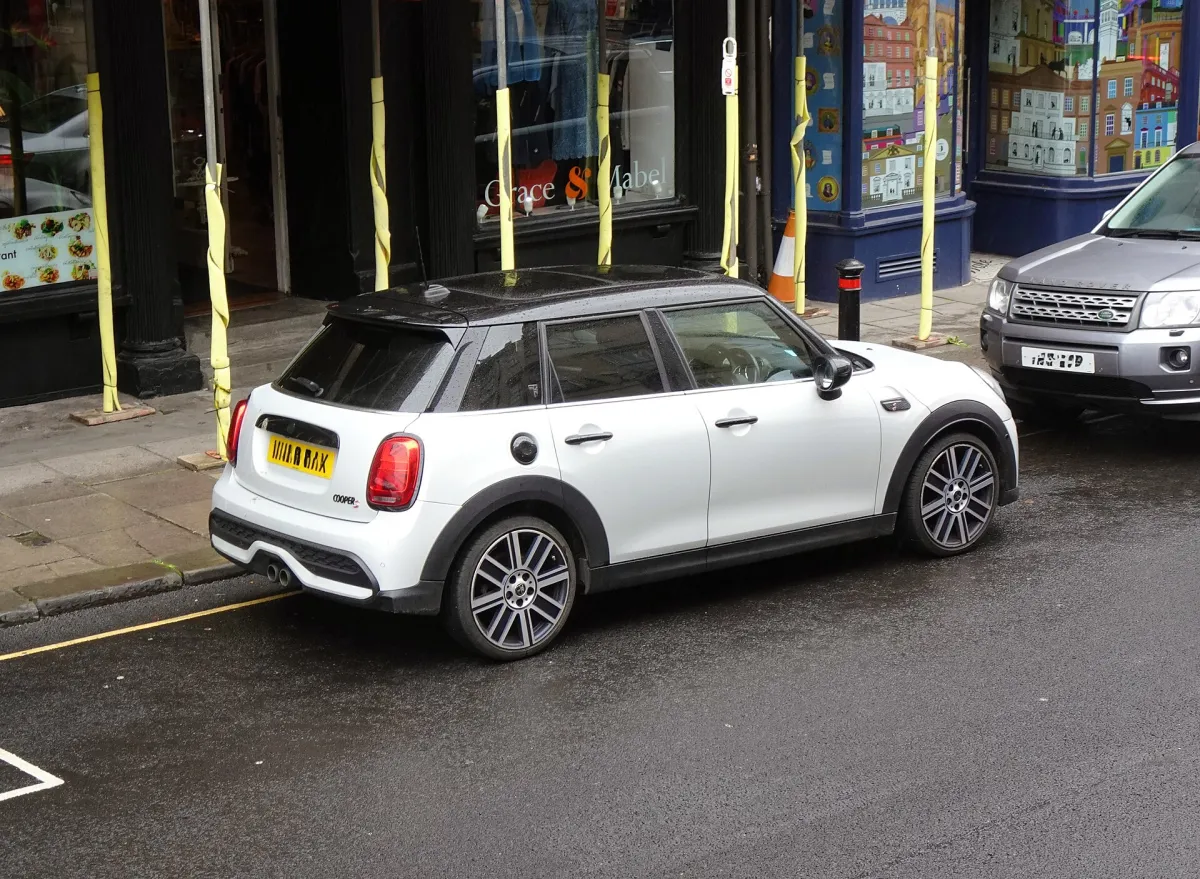
Mini
Specs, engines and history
Published Sources (1) Report an error
By Felix Hartmann, Automotive Technology & EV Contributor
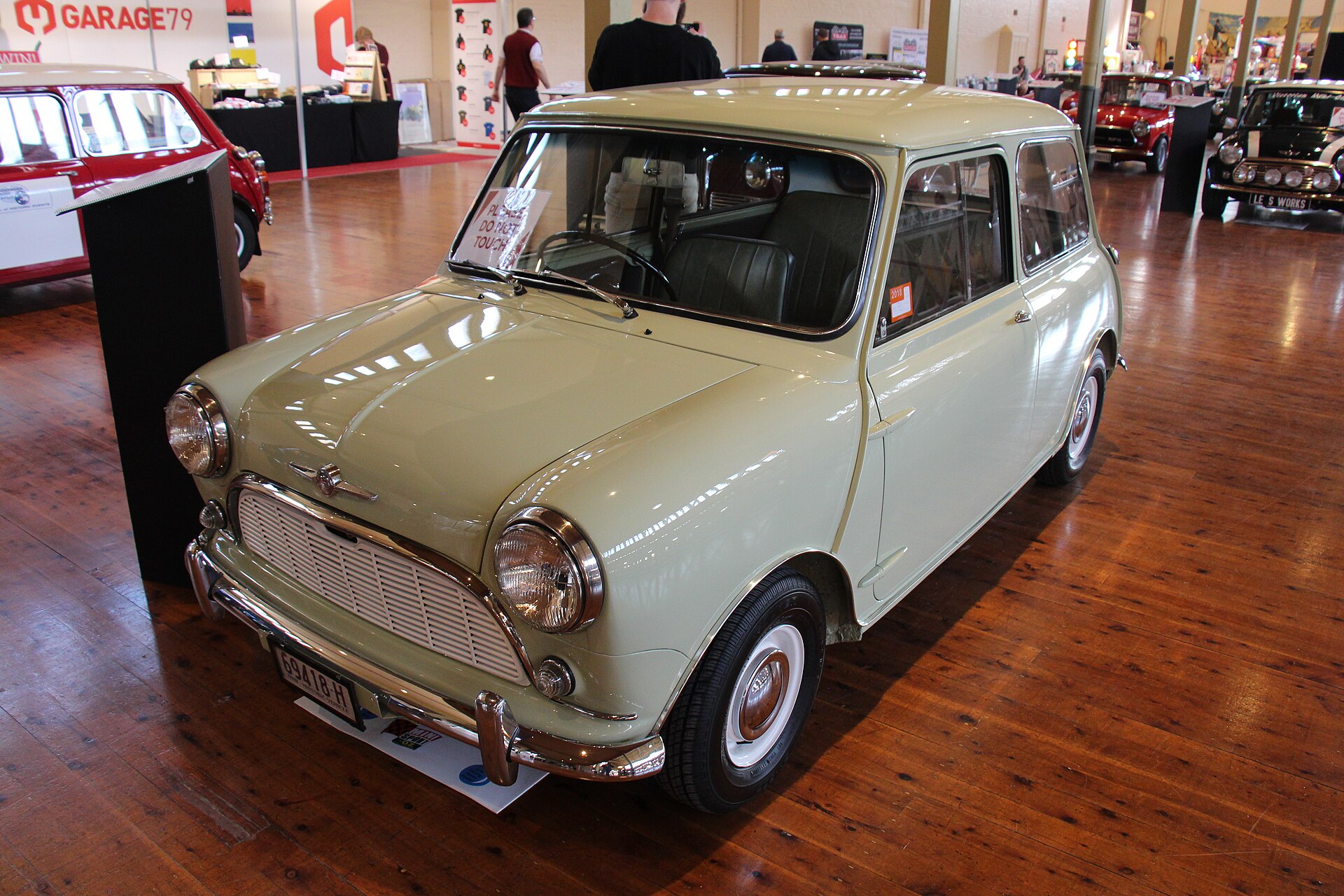
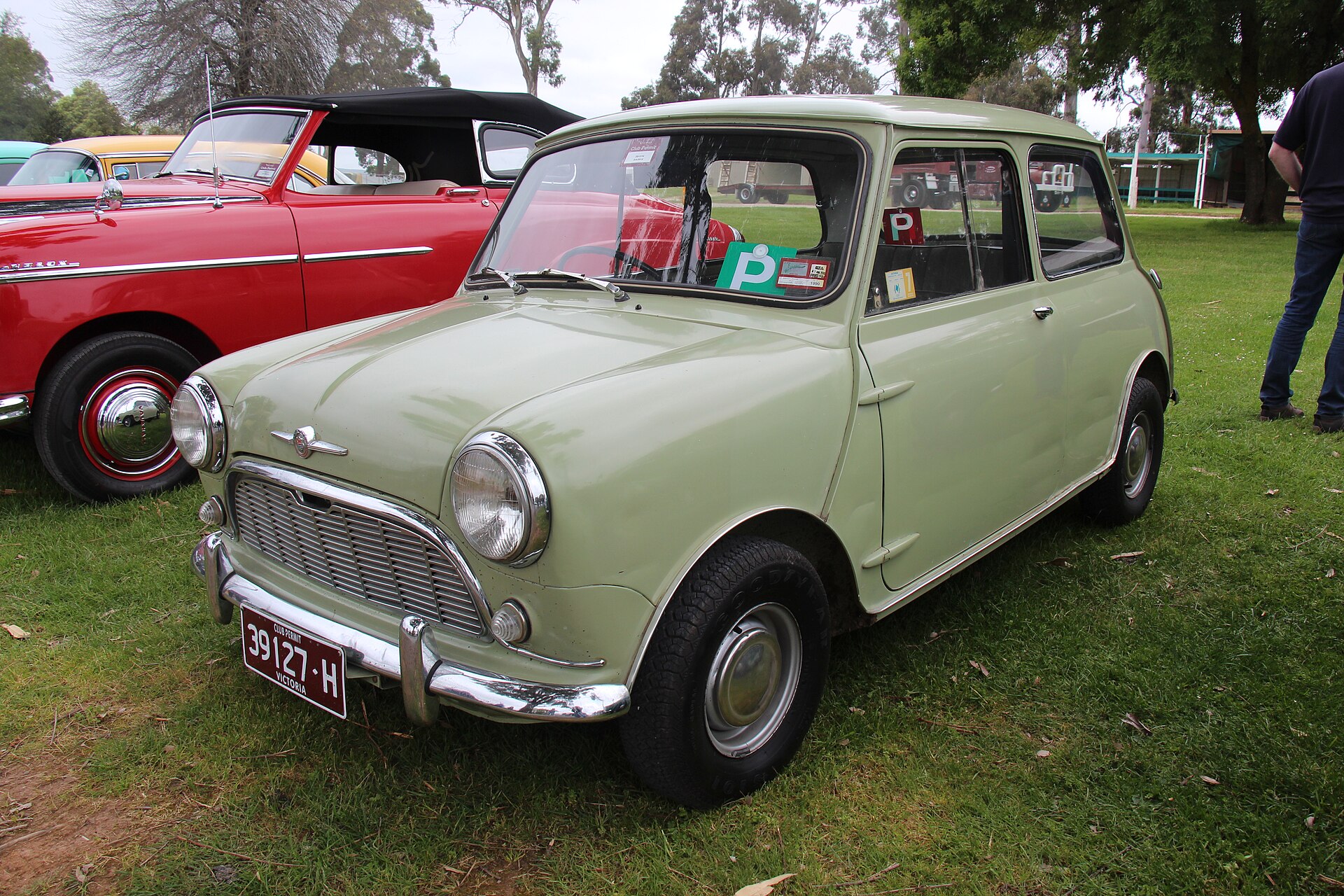
The original Mini is the small front-wheel-drive car that the British Motor Corporation (BMC) announced on 26 August 1959 and that its successors built until 4 October 2000. Designed by Alec Issigonis, it placed a transverse engine above its gearbox so that about 80% of a three-metre body was left for people and luggage. Sold first as the Austin Seven and Morris Mini-Minor, it became one of Britain's best-selling cars, a rally winner in Cooper S form and, in 1999, the European Car of the Century.
In short
- Built from 1959 to 2000 at Longbridge and Cowley and in about ten other countries; 5,387,862 made.
- A-Series four-cylinder engines from the 25 kW (34 bhp) 848 cc to the 1,275 cc unit, all transverse with the gearbox in the sump.
- Rubber cone suspension by Alex Moulton, Hydrolastic from 1964 to 1971, and 10-inch wheels.
- Monte Carlo Rally winner in 1964, 1965 and 1967; second in the 1999 global Car of the Century vote behind the Ford Model T.
Mini at a glance
| Specification | Mini (1959–2000) |
|---|---|
| Makers | BMC, British Leyland, Austin Rover, Rover Group |
| Production | 1959 – 4 October 2000 |
| Designer | Sir Alec Issigonis (project ADO15) |
| Purpose | economical four-seat small car |
| Body styles | two-door saloon, estate (Countryman / Traveller), van, pick-up, Moke |
| Engines | 848–1,275 cc A-Series straight-four |
| Layout | transverse front engine, front-wheel drive |
| Length / wheelbase (saloon) | 3,054 mm / 2,032 mm at launch |
| Built | 5,387,862 |
| Successor | MINI Hatch (BMW, 2001) |
The classic car is part of our Mini catalogue. The brand's whole story, including BMW's modern MINI, is told in the history of Mini, and the four BMW-era generations in our Mini Hatch guide.
Development and production history
| Year | Event |
|---|---|
| 1957 | Leonard Lord approves the car for production on 19 July |
| 1959 | announced on 26 August; about 2,000 cars already shown in nearly 100 countries |
| 1961 | Mini Cooper with a 997 cc engine (September) |
| 1963 | Cooper S with 1,071 cc |
| 1964 | Hydrolastic suspension; 1,275 cc Cooper S; first Monte Carlo win |
| 1965 | one million built; automatic gearbox optional from October |
| 1967 | Mark II at the British Motor Show |
| 1969 | Mark III with wind-up windows; Clubman and 1275 GT |
| 1971 | return to rubber cone suspension |
| 1976 | Mark IV |
| 1986 | five million built |
| 1990–1991 | Cooper revived; fuel injection for the 1,275 cc engine (November 1991) |
| 1996 | Mark VII with twin-point injection and a driver's airbag |
| 2000 | last car, a red Cooper Sport, built on 4 October |
The Mini was BMC's answer to the fuel shortages of the late 1950s. Leonard Lord's brief was a car inside a box of 10 × 4 × 4 feet, with six of the ten feet for the passengers. Issigonis's team built a prototype nicknamed the "Orange Box", and the production car was approved on 19 July 1957. In 1959 BMC and Issigonis received the Dewar Trophy for the design.
Production grew quickly: 500,000 by 1962, one million by 1965, two million by 1969 and five million by 1986. In the early 1990s Rover was still making about 40,000 a year, and Japan had become the largest export market. BMW took control of the Rover Group in January 1994, kept the Mini name when it sold Rover in May 2000, and ended production of the original car that October.

Design and engineering
Three ideas made the Mini small outside and roomy inside. The A-Series engine sat across the car rather than lengthways. The gearbox was built into the engine's sump, so engine and transmission shared one oil supply and took up very little length. The tiny 10-inch (254 mm) wheels were pushed to the corners, which kept wheel arches out of the cabin.
Instead of steel springs, Alex Moulton designed rubber cone springs, compact and light. From 1964 to 1971 most saloons used Moulton's Hydrolastic fluid system instead, before the rubber cones returned. The original car weighed about 590–600 kg unladen and just over 1,000 kg fully loaded, a 70% increase that shows how much of its own weight the little car could carry.
The engine was first planned at 948 cc but was reduced to 848 cc with a shorter stroke, giving 25 kW (34 bhp) in production. The prototype had reached about 80 mph (129 km/h); the production car managed about 75 mph (121 km/h).

Engine and drivetrain
| Version | Engine | Power | Years |
|---|---|---|---|
| Mini 850 | 848 cc A-Series | 25 kW (34 bhp) | 1959–1980 |
| Mini Cooper | 997 cc | 41 kW (55 bhp) | 1961–1964 |
| Mini Cooper | 998 cc | - | from 1964 |
| Mini Cooper S | 1,071 cc | 52 kW (70 bhp) | 1963–1964 |
| Mini Cooper S | 970 cc | - | 1964–1965 (963 built) |
| Mini Cooper S | 1,275 cc | 57 kW (76 bhp) | 1964–1971 |
| Mini 1000 / A-Plus | 998 cc | - | to 2000 (only engine from 1980 until the 1990s) |
| Mini Cooper 1.3i | 1,275 cc, injection | - | 1991–2000 |
A four-speed manual gearbox was standard. An AP four-speed automatic became optional in October 1965. From 1980 the 998 cc A-Plus was the only engine for most of the decade; the 1,275 cc engine returned with the revived Cooper and gained single-point injection in November 1991 and multi-point injection in 1997.

Mini specifications
| Parameter | Metric | Imperial |
|---|---|---|
| Length (saloon, 1959) | 3,054 mm | 120.2 in |
| Width (1959) | 1,422 mm | 56.0 in |
| Height (1959) | 1,397 mm | 55.0 in |
| Wheelbase (saloon) | 2,032 mm | 80.0 in |
| Wheelbase (estate, van) | 2,138 mm | 84.2 in |
| Kerb weight | 580–686 kg (by version) | 1,279–1,512 lb |
| Wheels | 254 mm | 10 in |
The infobox gives slightly different saloon figures for later cars (2,036 mm wheelbase, 1,410 mm width, up to 1,530 mm with sport wheel arches). Mark III cars weighed 610 kg with the 848 cc engine and 645 kg with the 1,275 cc engine.
Variants and derivatives
| Variant | Years | Body / purpose | Engine | Notes |
|---|---|---|---|---|
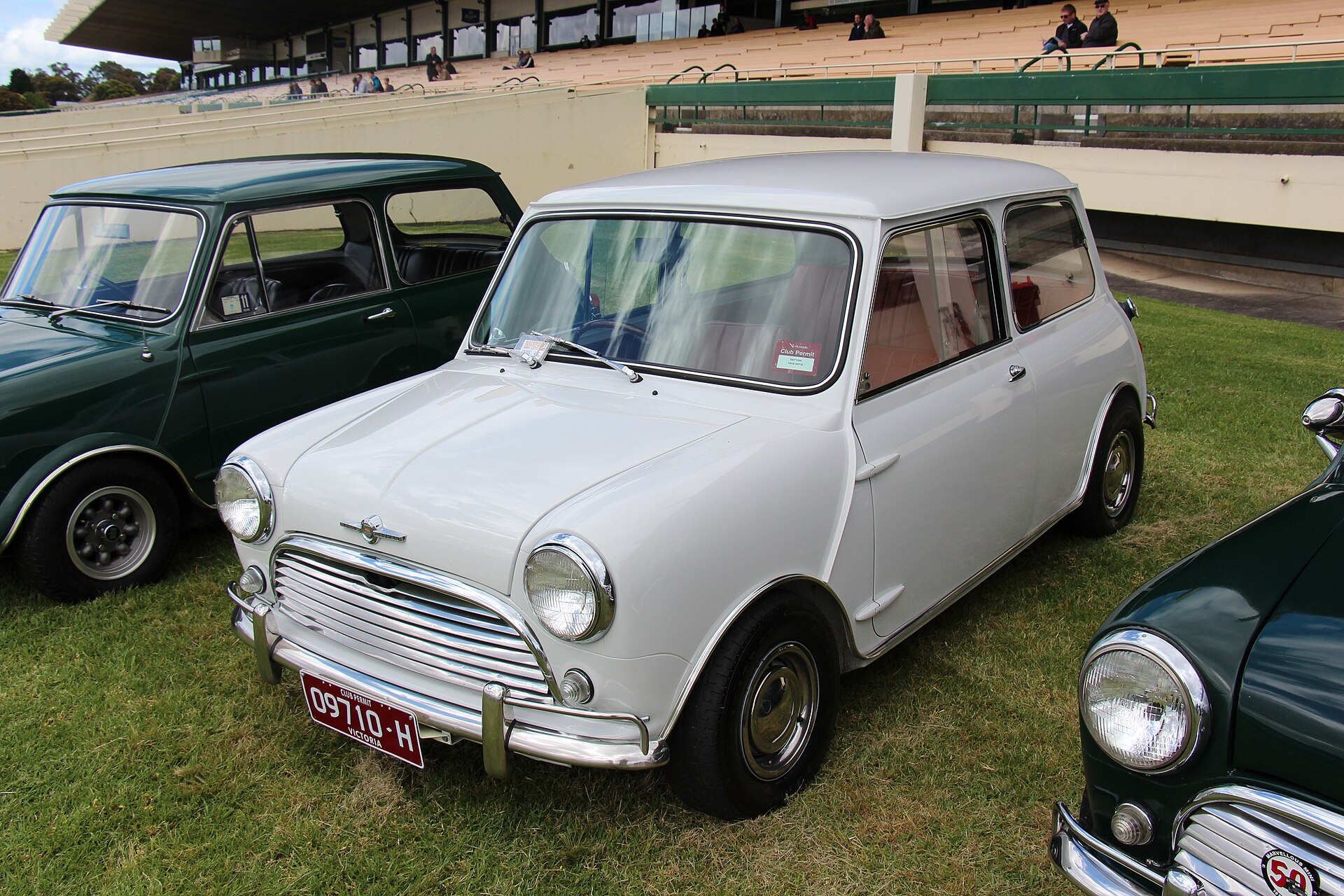
| Austin Seven / Morris Mini-Minor | 1959– | saloon | 848 cc | the original badge-engineered pair |
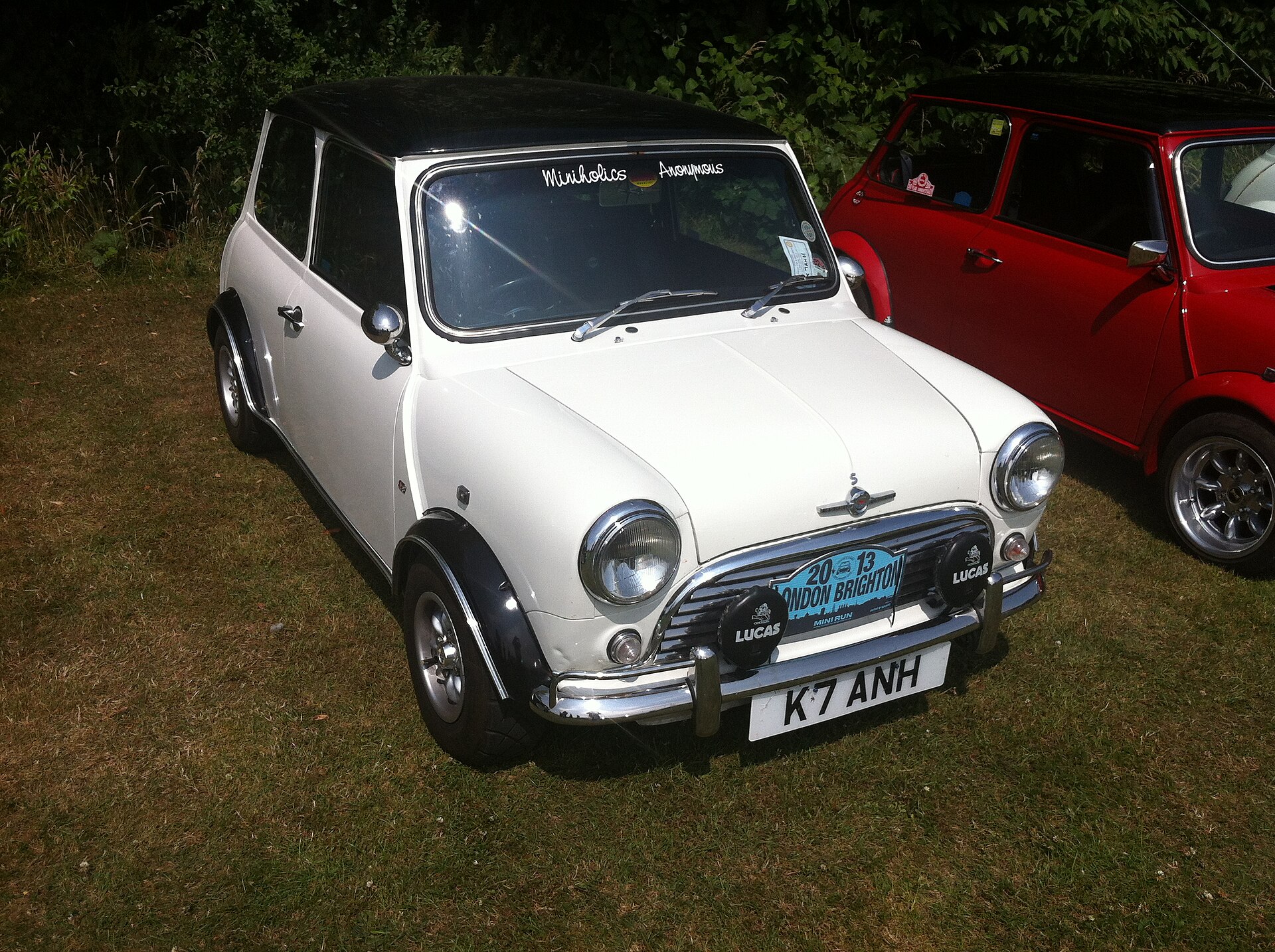
| Mini Cooper / Cooper S | 1961–1971, 1990–2000 | sports saloon | 997–1,275 cc | about 106,900 built in the 1960s and early 1970s |
| Countryman / Traveller | from 1960s | estate | A-Series | about 108,000 and 99,000 built |
| Mini Van / Pick-up | from 1960s | commercial | A-Series | 521,494 vans, 58,179 pick-ups |
| Riley Elf / Wolseley Hornet | to late 1969 | saloon with a longer boot | A-Series | 30,912 Elfs, 28,455 Hornets |
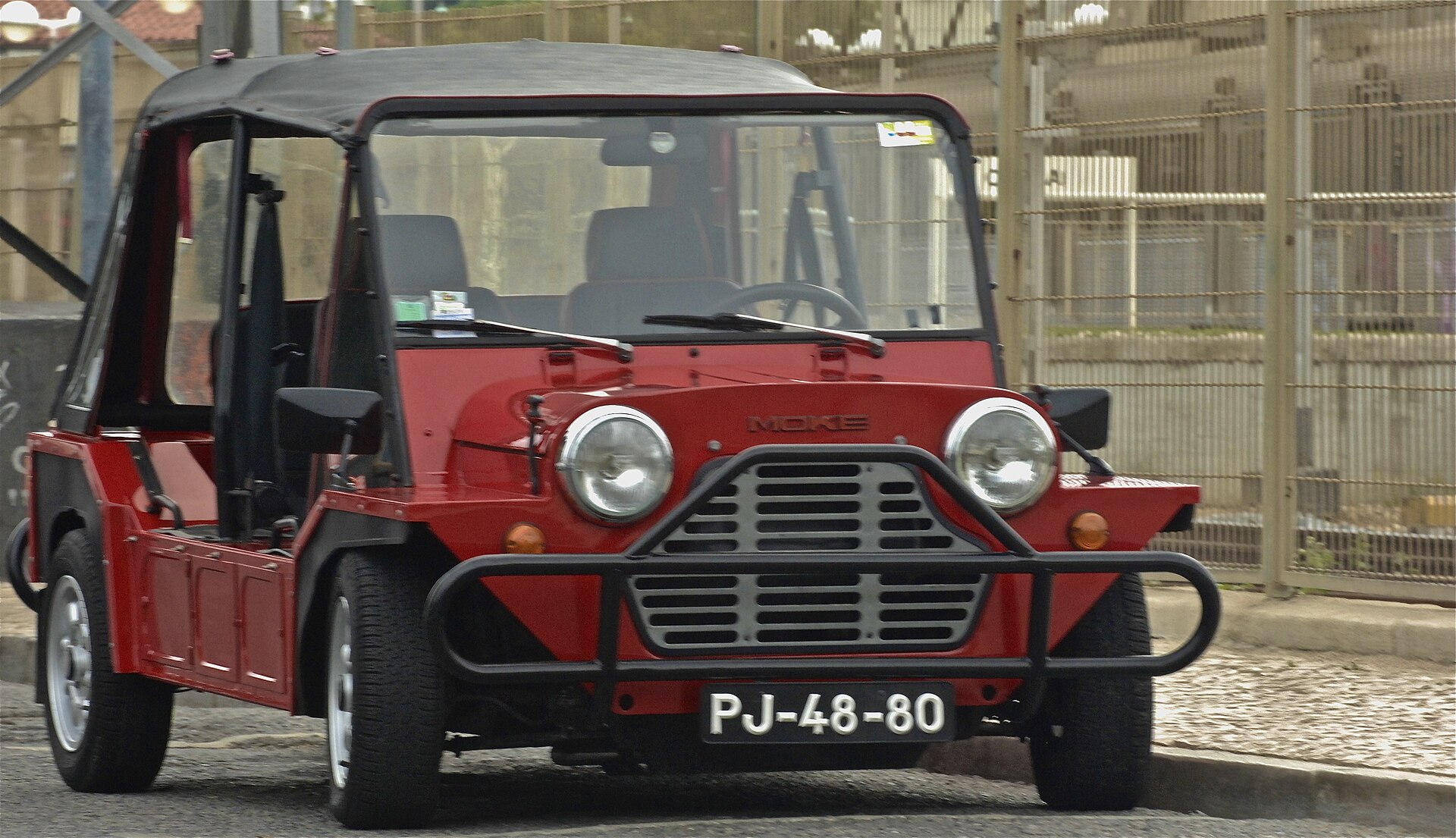
| Mini Moke | 1964–1989 | open utility | A-Series | about 50,000 in the UK, Australia and Portugal |
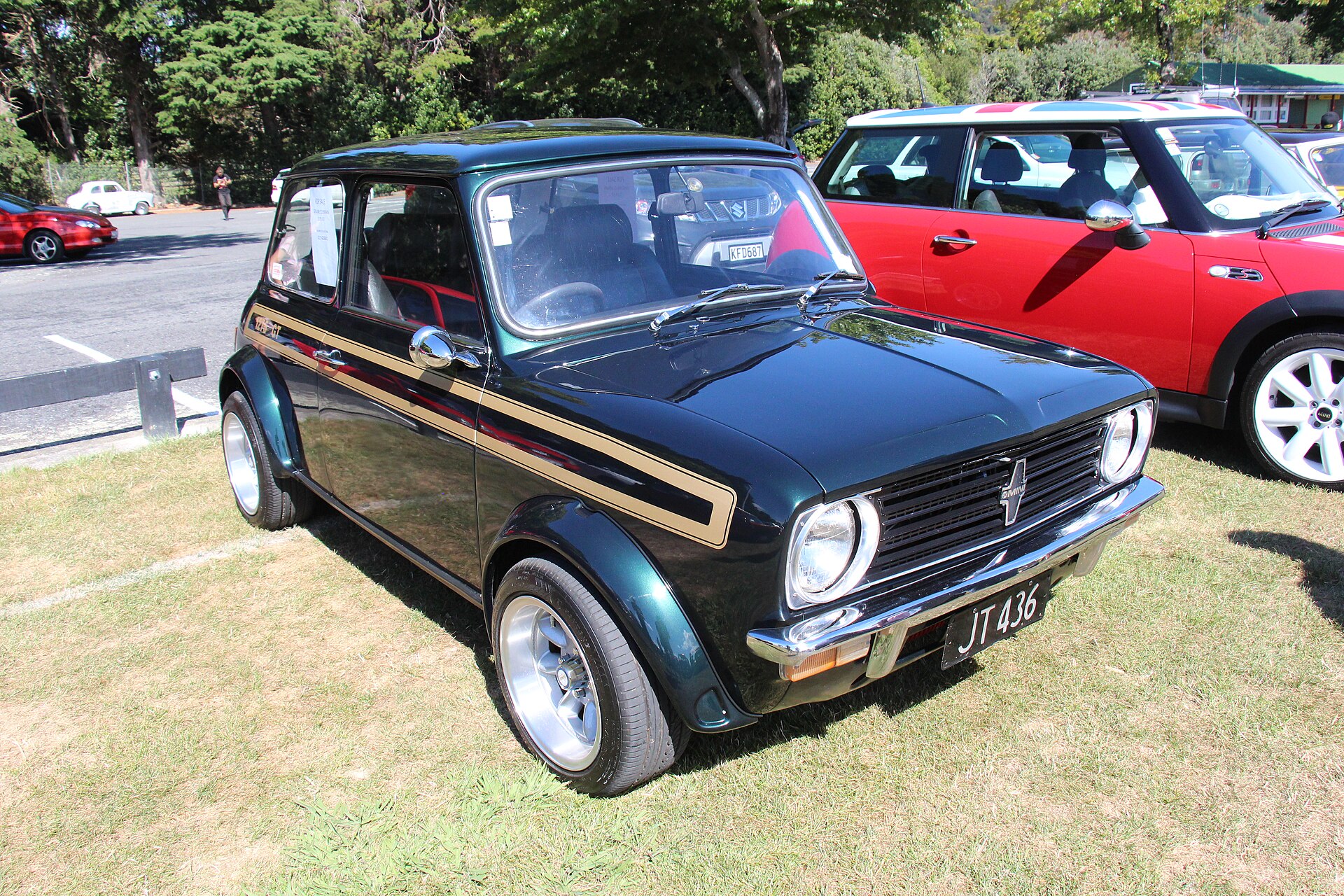
| Clubman / 1275 GT | from 1969 | longer-nosed saloon and estate | 998–1,275 cc | 275,583 saloons, 197,606 estates, 110,673 GTs |
The Clubman, a 1969 facelift by Roy Haynes, added a longer square nose. Its sporting version, the 1275 GT, reached 0–60 mph in 12.9 seconds and was the first Mini with a rev counter. Overseas, Minis were also built in Australia, Spain (Authi), Italy (Innocenti), South Africa, New Zealand, Belgium, Chile, Portugal, Yugoslavia and Malaysia, often with local changes.

In service: rallying, racing and legacy
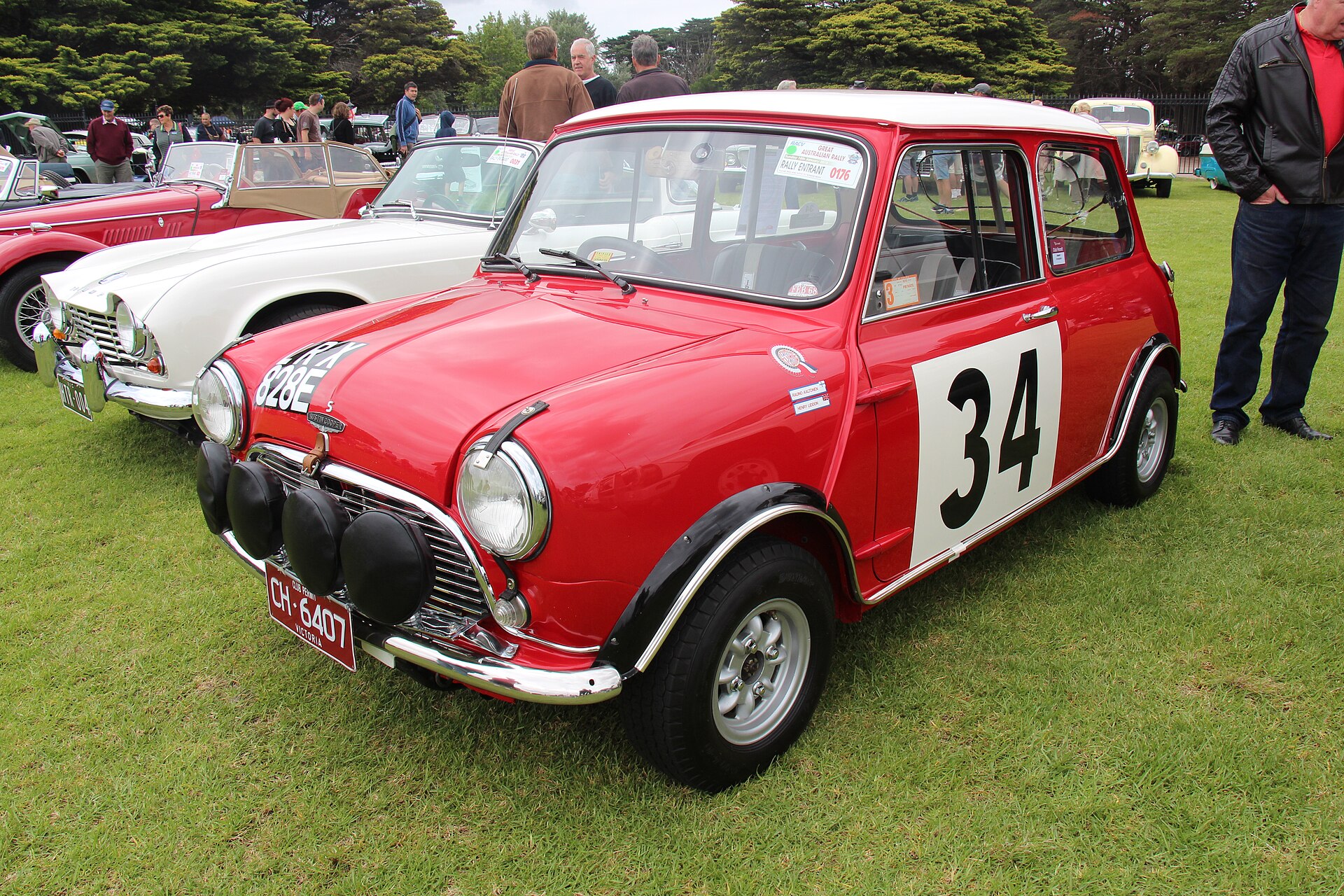
The Cooper S turned a family car into a giant-killer. Minis won the Monte Carlo Rally in 1964, 1965 and 1967; in 1966 the Minis were disqualified after the event. They also won the 1000 Lakes Rally three times (1965–1967), the European Rally Championship in 1965 and 1966, and the British Saloon Car Championship five times between 1961 and 1979. The Se7ens one-make series has run since 1966.
The Mini's packaging influenced almost every small car that followed. In the 1999 international Car of the Century vote it came second behind the Ford Model T and was chosen as European Car of the Century. Autocar had named it Car of the Century in 1995.
Preservation and collecting today
Works rally cars and early Mark I Coopers command the highest prices. Bonhams sold a works rally car for £100,500 in 2007, and a rare Mini Beach car (about 15 of a planned 20 were built in 1961–1962) reached US$230,000 on Bring a Trailer in 2019, about €205,000. Ordinary Mark III to Mark VII saloons remain affordable and are well supported by specialist parts suppliers.
Rust is the main enemy: buyers should check the subframe mountings, sills, floor pans and boot floor, and should confirm that a car sold as a Cooper or Cooper S is genuine, because many standard Minis were converted.
Photo gallery


Mini photos 6
FAQ
When was the original Mini produced, and where?
From 1959 to 4 October 2000, mainly at Longbridge (Birmingham) and Cowley (Oxford), with assembly in about ten other countries.
How many classic Minis were built?
5,387,862, which makes it one of the best-selling British cars ever.
What engine does the classic Mini have?
A transverse BMC A-Series four-cylinder with the gearbox in the sump: 848 cc in the first cars, up to 1,275 cc in the Cooper S, 1275 GT and the injected Coopers of the 1990s.
What variants of the Mini were made?
Saloon, Countryman and Traveller estates, van, pick-up, Moke, the Riley Elf and Wolseley Hornet, the Clubman and 1275 GT, and the Cooper and Cooper S.
Why is the Mini Cooper S famous?
It won the Monte Carlo Rally in 1964, 1965 and 1967 against much larger and more powerful cars.
Data sources
Data checked by an editor against the sources below.