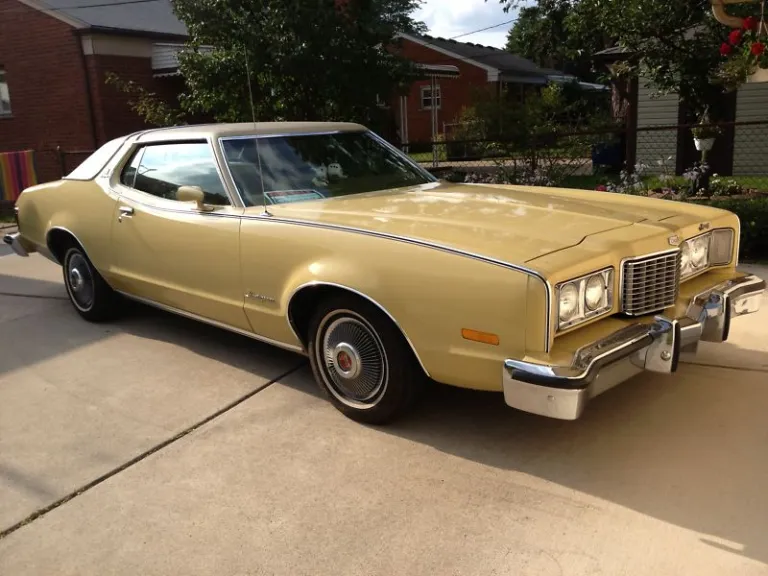
 Mercury Capri RS
Specs, engines and history
Published Sources (4) Report an error
By Felix Hartmann, Automotive Technology & EV Contributor
- Built
- 1979–1986
- Top power
- 157 kW (213 PS)
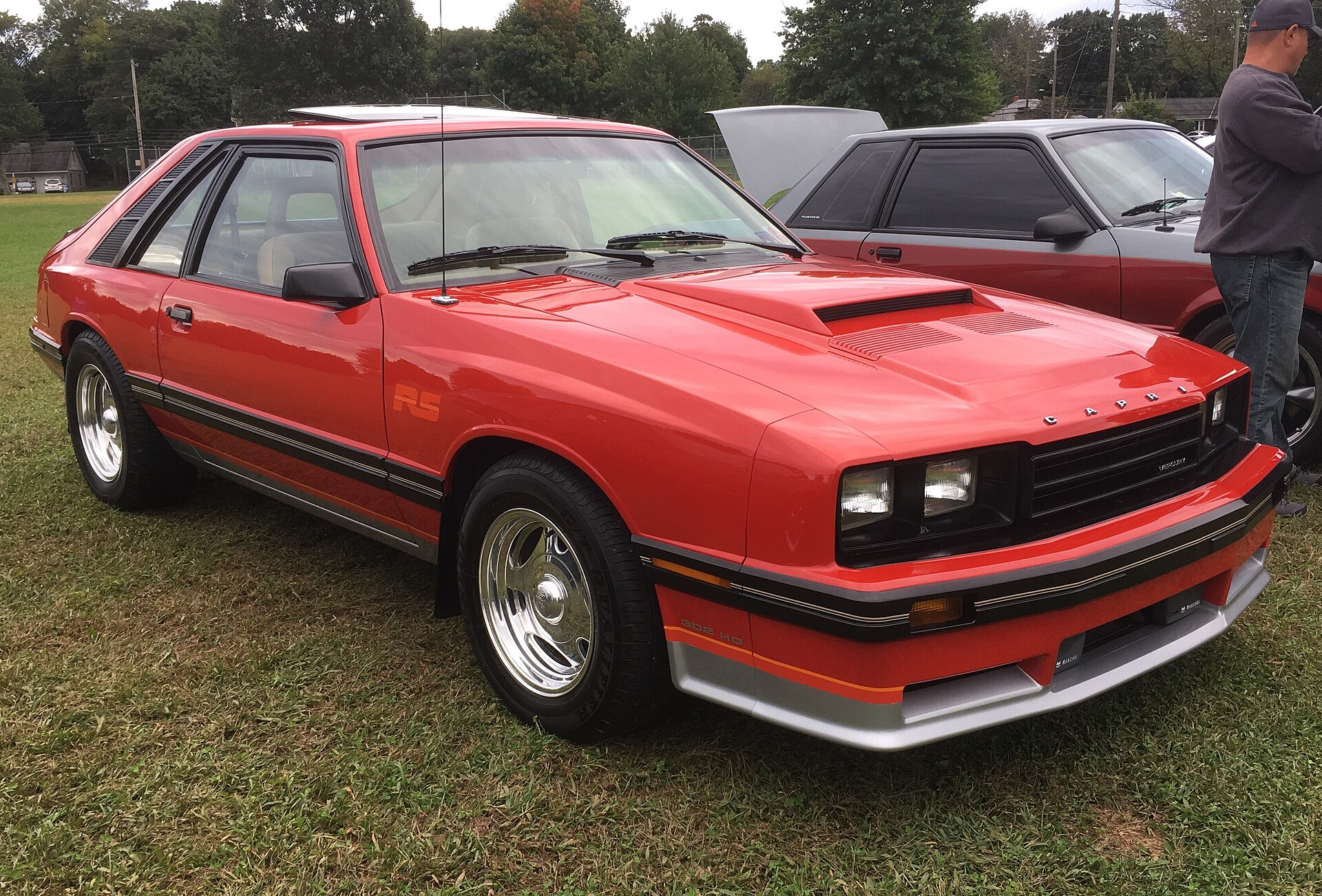
The Mercury Capri RS was the performance version of the Fox-body Capri, the three-door hatchback Mercury built from 1979 to 1986 alongside the Ford Mustang. It began with a turbocharged 2.3-litre four, gained the 5.0 L (302 cu in) High Output V8 for 1982 and ended as the Capri 5.0L, rated at 149 kW (200 hp, SAE net) with fuel injection in 1986.
In short
- Fox-platform hatchback, model years 1979-1986, built in Dearborn, Michigan, and until 1981 also in San Jose, California.
- The 5.0 HO V8 grew from 117 kW (157 hp) in 1982 to 157 kW (210 hp) with a four-barrel carburettor in 1985.
- In 1983 the RS listed at USD 9,241, USD 87 below a Mustang GT, and Consumer Guide lists it at 8.0 seconds to 60 mph.
- Capris won the SCCA Trans-Am championship in 1984 and 1985, the second title with Roush Racing and Wally Dallenbach Jr.
Specs by version
| Version | Engine | Power | Torque | Gearbox | Drive | Production years |
|---|---|---|---|---|---|---|
| 2.3 Turbo I4 (Turbo RS) | 2.3 l · 4 cyl · Petrol 2,294 cc | 97 kW 132 PS130 hp | - | 4-sp Manual | Rear-wheel drive | 1979–1980 |
| 5.0 HO V8 2-barrel | 4.9 l · 8 cyl · Petrol 4,942 cc | 117 kW 159 PS157 hp | - | 4-sp Manual | Rear-wheel drive | 1982 |
| 5.0 HO V8 4-barrel | 4.9 l · 8 cyl · Petrol 4,942 cc | 130 kW 177 PS174 hp | 332 Nm245 lb-ft | Manual | Rear-wheel drive | 1983–1984 |
| 5.0 V8 SEFI (Capri 5.0L) | 4.9 l · 8 cyl · Petrol 4,942 cc | 149 kW 203 PS200 hp | 386 Nm285 lb-ft | 5-sp Manual | Rear-wheel drive | 1986 |
| 5.0 HO V8 4-barrel | 4.9 l · 8 cyl · Petrol 4,942 cc | 157 kW 213 PS211 hp | 366 Nm270 lb-ft | 5-sp Manual | Rear-wheel drive | 1985 |
Verified Manufacturer and type-approval data from our catalog · Sources and methodology
Mercury Capri RS at a glance
| Specification | Mercury Capri RS and 5.0L |
|---|---|
| Model years | 1979-1986 (RS 1979 to mid-1985, then Capri 5.0L) |
| Body | three-door hatchback; bubble-back rear glass from 1983 |
| Platform | Ford Fox, 2,550 mm (100.4 in) wheelbase |
| Engines | 2.3 L turbo four (1979-1980, 1984); 4.2 L (255 cu in) V8 (1980-1981); 5.0 L (302 cu in) HO V8 (1982-1986) |
| Power | 117 kW (157 hp) in 1982 to 157 kW (210 hp) in 1985, SAE net |
| Torque | 332 Nm (245 lb-ft) in 1983; 386 Nm (285 lb-ft) in 1986 |
| Gearboxes | four-speed manual; Borg-Warner T-5 five-speed from 1983; three-speed or AOD four-speed automatic |
| Weight | 1,440 kg (3,175 lb), 1983 RS (Consumer Guide) |
| 0-60 mph | 8.0 s, 1983 RS (Consumer Guide); about 6.5 s for a 1986 5.0L manual (eightiescars) |
| Price new | USD 9,241 for the RS in 1983; USD 10,950 for the Capri 5.0L in 1986 |
Mercury's Mustang twin
Ford's new Fox-body Mustang of 1979 had a Mercury sibling from the first day. The Capri took over a name that Mercury dealers had used for the imported German Ford Capri from 1970, but the new car shared nothing with the European coupé; its lineage ran through the Mustang. Wikipedia calls it the first Mercury pony car since the 1970 Cougar.
The two cars shared the platform and the powertrains. Mercury gave the Capri its own nose with a narrower grille and four headlamps, dark ribbed taillights and wider front and rear wings with mild flares over the wheels. Only one body was offered, the three-door hatchback; Ford kept the notchback coupé and, from 1983, the convertible for the Mustang. Trims ran from the base car through Ghia, L and GS to the RS, which Mercury positioned as the counterpart of the Mustang GT.
Capri Turbo RS and the 1979-1981 cars
In 1979 and 1980 the RS was a sports package more than an engine choice. The 1980 car had a black grille, a non-functional bonnet scoop, a rear spoiler, upper bodyside stripes and RS badges on the wings, plus a sport-tuned radial suspension. Buyers could still order the base four or the six.
The Turbo RS added the 2.3-litre four with a carburettor feeding a turbocharger. The Mustang Cobra used the same engine, rated at about 97 kW (130 hp), although sources differ by a few horsepower. Forged aluminium metric wheels, a rally suspension and an 8,000 rpm tachometer came with the package. The carburettor sat ahead of the turbo inlet, which caused cold-start and drivability trouble, and Ford dropped the engine in 1981. The 5.0 L V8 also disappeared for 1980; in its place came a 4.2 L (255 cu in) V8 rated at 89 kW (120 hp) in the 1981 listings. Capri output fell from 79,984 cars in 1980 to 58,946 in 1981, according to conceptcarz, with 1980 prices of USD 5,250 to USD 5,550.
The 5.0 HO years, 1982 to 1986
Ford brought back the 5.0 L V8 for 1982 as the High Output engine, and the Capri RS received it in the same year as the Mustang GT. It had a two-barrel carburettor, 117 kW (157 hp) and the SROD four-speed manual as its only gearbox. For 1983 a four-barrel carburettor lifted output to 130 kW (175 hp), the Borg-Warner T-5 five-speed arrived during the season, and Mercury reworked the RS suspension. The HO V8 was standard on the RS and a USD 1,343 option on lesser Capris.
The 1983 body change gave the Capri its best-known feature. A large compound-curve rear window, the bubble-back, replaced the flat hatch glass, with new taillights, a new rear bumper cover and a new grille. For 1984 the RS added a front air dam with fog lamps, and that front end stayed until the end.
| Model year | Engine | Power (SAE net) | Torque | Gearbox |
|---|---|---|---|---|
| 1979 | 2.3 L turbo four, carburettor | about 97 kW (130 hp) | - | four-speed manual |
| 1982 | 5.0 HO V8, two-barrel | 117 kW (157 hp) | - | four-speed manual |
| 1983-1984 | 5.0 HO V8, four-barrel | 130 kW (175 hp) | 332 Nm (245 lb-ft) | four- or five-speed manual |
| 1984-1985 | 5.0 V8, central fuel injection | 123-134 kW (165-180 hp) | 332 Nm (245 lb-ft) | AOD four-speed automatic |
| 1985 | 5.0 HO V8, four-barrel | 157 kW (210 hp) | 366 Nm (270 lb-ft) | T-5 five-speed manual |
| 1986 | 5.0 HO V8, sequential fuel injection | 149 kW (200 hp) | 386 Nm (285 lb-ft) | T-5 manual or AOD automatic |
The figures are the Ford ratings published for the Mustang, whose powertrains the Capri shared. During 1985 Mercury dropped the RS name, and the V8 model became simply the Capri 5.0L. In 1986 it came with dual exhausts, a Traction-Lok axle and P225/60VR15 tyres on cast alloy wheels for USD 10,950, against USD 8,331 for the four-cylinder GS. EPA figures for the V8 with the five-speed were 17 mpg city and 25 mpg highway, or 13.8 and 9.4 L/100 km.


Turbo RS revival and special editions
The turbo returned for 1984 in fuel-injected form, rated at about 108 kW (145 hp). The one-year Charcoal Turbo RS of 1984 combined it with a Garrett turbocharger, Michelin TRX wheels and tyres, the 5.0 HO anti-roll bars, a 3.45:1 limited-slip axle and a bonnet scoop. It lacked the intercooler and the 130 kW (175 hp) of the Mustang SVO, the one Mustang with no Capri equivalent.
The Black Magic of 1981-1983 paired black paint with gold stripes, gold TRX wheels and a gold cat's head on the front valance, and the 1983 Crimson Cat used crimson red with gold striping. From 1984 to 1986 the American Sunroof Company built ASC McLaren coupés and convertibles from Capri hatchbacks. Wikipedia gives 10, 150 and 115 coupés for 1984, 1985 and 1986 and 557 convertibles over the three years.

Capri RS in Trans-Am racing
Capris with V8 engines won the SCCA Trans-Am championship in 1984 and 1985. Jack Roush's team ran 5.0-litre cars, and Wally Dallenbach Jr. took the 1985 title in a Roush Capri. A Motorsport Pace Car edition of 50 cars was built in 1985 for the Detroit Grand Prix.
Capri RS vs Mustang GT and Camaro, and the end in 1986
In the showroom the RS faced its own sibling, the Mustang GT, which Consumer Guide lists at 8.2 seconds to 60 mph in 1983 convertible form. General Motors answered with the third-generation Camaro and its Firebird twin, both with larger bodies. Buyers mostly chose the Ford: by 1986 Capri sales were about 9 per cent of Mustang sales, according to eightiescars. German Wikipedia gives 370,752 Fox-body Capris for the whole run, while Mustang output in 1986 alone was 224,410.
Mercury ended the Capri after the 1986 model year, when the Mustang received a facelift for 1987. The division moved its sporting image to the Cougar XR7 and offered no small sports coupé until the front-drive Cougar of 1999. The name returned once more on the Australian-built convertible of 1991-1994. The earlier imported model is covered in the Ford Capri history, and the other Mercury models are listed in the Mercury catalogue.
Mercury Capri RS today: what to check when buying
The VIN and the door data plate confirm the engine. The eighth VIN character is the engine code, and listings of documented 1982-1983 RS 5.0 cars show F in that position; many four- and six-cylinder Capris have since received V8s. Black Magic, Crimson Cat and Charcoal Turbo RS cars need paint and trim codes to match: the Black Magic interior code was YA, with TA for the optional Recaro seats of 1982. Fox-body Mustang parts fit most of the mechanical side, but Capri-only panels such as the wings, nose, taillights and bubble-back glass are harder to find. The Capri RS is one of ten cars in our list of the best malaise-era muscle cars.
Mercury Capri RS in our rankings
- No. 4 of 113 · Biggest engines: hatchbacks (4,942 cc)
- No. 31 of 117 · Most torque: hatchbacks (386 Nm · top 27%)
- No. 203 of 772 · Biggest engines: cars (4,942 cc · top 27%)
- No. 52 of 171 · Most powerful hatchbacks (157 kW · top 31%)
- No. 39 of 99 · Most powerful cars of the 1980s (157 kW · top 42%)
- No. 347 of 640 · Most torque: cars (386 Nm · top 55%)
Bigger engine than 96% of ranked hatchbacks in the 1CARS catalog (No. 4 of 113).
FAQ
Is the Mercury Capri RS a Mustang?
Mechanically yes. It used the Fox platform and the same engines and gearboxes as the 1979-1986 Mustang, with Mercury's own nose, wider wings, taillights and, from 1983, a bubble-back rear window. It was sold only as a hatchback.
How fast is a Mercury Capri RS?
Consumer Guide lists the 1983 Capri RS 5.0 at 8.0 seconds from 0-60 mph, slightly quicker than the 8.2 seconds it gives for a Mustang GT convertible of the same year. A 1986 Capri 5.0L manual is quoted at about 6.5 seconds.
How much power did the Capri RS 5.0 have?
117 kW (157 hp) in 1982, 130 kW (175 hp) in 1983-1984 and 157 kW (210 hp) with the four-barrel in 1985, all SAE net. The fuel-injected 1986 Capri 5.0L had 149 kW (200 hp) and 386 Nm (285 lb-ft).
When did the Capri RS become the 5.0L?
During the 1985 model year. Mercury dropped the RS name and sold the V8 car as the Capri 5.0L for the rest of 1985 and for 1986, the last year of the Fox-body Capri.
Why did Mercury drop the Capri?
Sales had fallen well behind the Mustang, to about 9 per cent of Mustang volume by 1986. When Ford updated the Mustang for 1987, Mercury ended the Capri and promoted the Cougar XR7 instead.
Data sources
Data checked by an editor against the sources below.
- Wikipedia - Mercury Capri
- Wikipedia - Ford Mustang (third generation)
- Curbsideclassic - Car Show Classic 1984 Mercury Capri Rs Turbo Ford Had Turbo Motors To Spare
- Eightiescars - 1986 Mercury Capri