
 Chevrolet Camaro Indy Pace Car
All generations, specs and history
Published Sources (4) Report an error
By Felix Hartmann, Automotive Technology & EV Contributor
- Built
- 1967–2016
- Generations
- 3
- Top power
- 224 kW (305 PS)
Timeline
Camaro Indy Pace Car generations
Click a generation for its own page
- First-generation pace cars 1967–1969 · Convertible
- Z28 Indy 500 Pace Car replica 1982 · Coupe · 108–123 kW (147–167 PS)
- Z28 Indy 500 Pace Car edition 1993 · Coupe · 205 kW (279 PS)
Newest first · 3 generations since 1967
-
1993
- 1982 Z28 Indy 500 Pace Car replica 1982 · Coupe · 108–123 kW (147–167 PS)
- 1967 First-generation pace cars 1967–1969 · Convertible

All generations by year: Z28 Indy 500 Pace Car edition (1993) · Z28 Indy 500 Pace Car replica (1982) · First-generation pace cars (1967–1969)
Which one is mine?
Pick the year of first registration to see which generation it is.
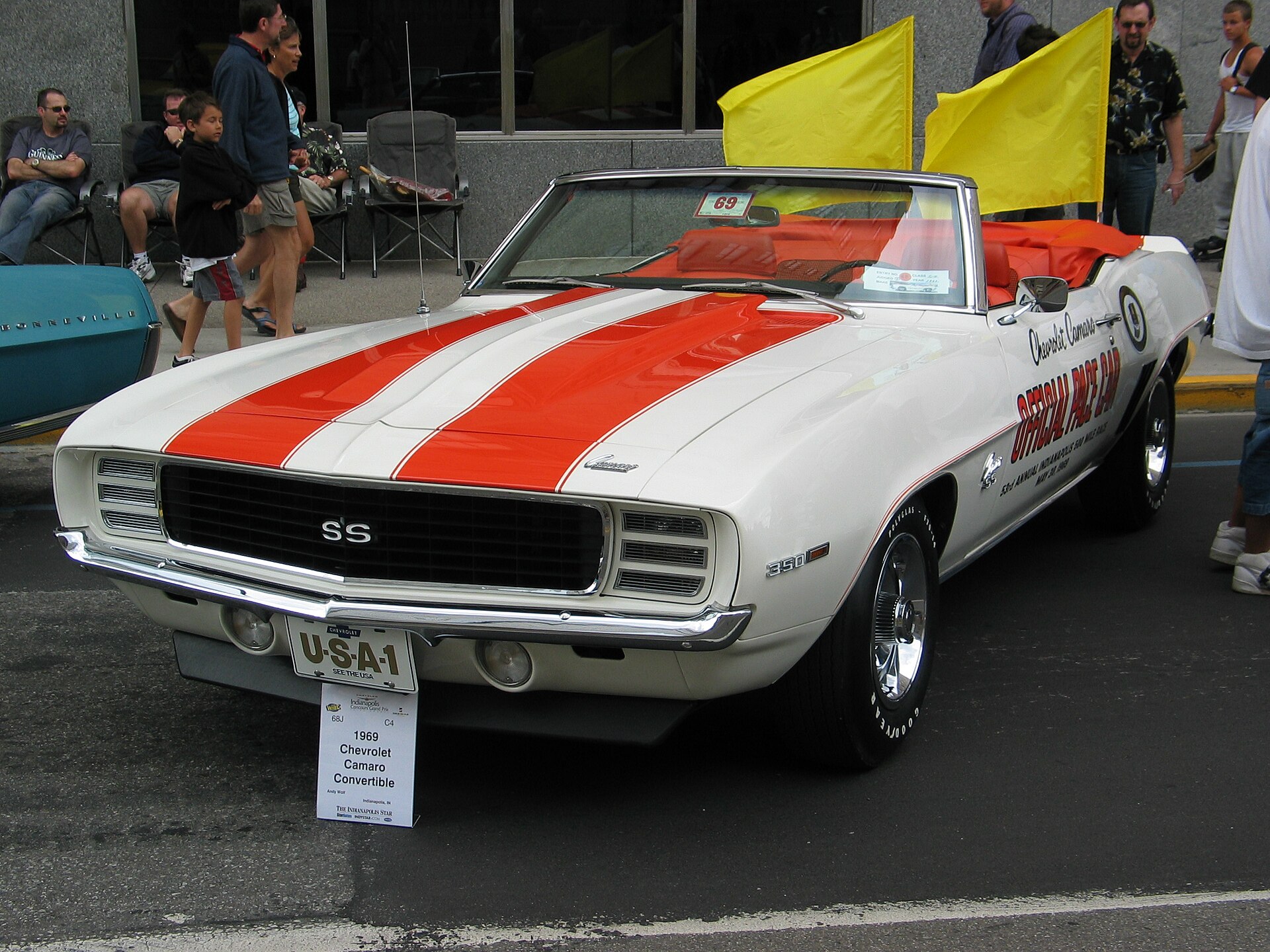
The Chevrolet Camaro Indy Pace Car is the family of Camaros that led the field at the Indianapolis 500 and the replicas Chevrolet sold afterwards. A Camaro paced the race nine times between 1967 and 2016, and the 1969 Z11 convertible is the best known, with 3,675 cars built. Later replica runs covered the 1982 and 1993 Z28 and the 2010 and 2011 Camaro SS.
In short
- Nine Camaro pace car appearances: 1967, 1969, 1982, 1993, 2009, 2010, 2011, 2014 and 2016.
- 1969: RPO Z11 "Indy 500 Pace Car Accents" for USD 36.90 on an RS/SS convertible; 3,675 built including track cars.
- 1982: more than 6,000 Z28 replicas in silver and blue; 1993: 645 Z28 replicas in black and white.
- Replica engines followed the production cars; the actual 1982 pace car had an aluminium 5.7 L V8 not sold to buyers.
Specs by version
| Version | Engine | Power | Gearbox | Drive | Production years |
|---|---|---|---|---|---|
| First-generation pace cars · 1969 Z11 SS 350 (SAE gross) | 5.7 l · 8 cyl · Petrol L48 | 224 kW 305 PS300 hp | 3-sp Manual | Rear-wheel drive | 1969 |
| Z28 Indy 500 Pace Car replica · 1982 Z28 replica 5.0 LG4 (SAE net) | 5.0 l · 8 cyl · Petrol LG4 | 108 kW 147 PS145 hp | - | Rear-wheel drive | 1982 |
| Z28 Indy 500 Pace Car replica · 1982 Z28 replica 5.0 LU5 Cross-Fire Injection (SAE net) | 5.0 l · 8 cyl · Petrol LU5 | 123 kW 167 PS165 hp | Automatic | Rear-wheel drive | 1982 |
| Z28 Indy 500 Pace Car edition · 1993 Z28 Pace Car 5.7 LT1 | 5.7 l · 8 cyl · Petrol LT1 | 205 kW 279 PS275 hp | - | Rear-wheel drive | 1993 |
Verified Manufacturer and type-approval data from our catalog · Sources and methodology
Camaro Indy Pace Car at a glance
| Specification | Camaro Indy 500 pace cars and replicas |
|---|---|
| Race years | 1967, 1969, 1982, 1993, 2009, 2010, 2011, 2014, 2016 |
| Replicas | about 100 (1967); 3,675 (1969); over 6,000 (1982); 645 (1993); about 200 (2010); 500 (2011) |
| Bodies | convertible (1967, 1969, 2011); coupe (1982, 1993, 2014) |
| Generations | first (1967, 1969), third (1982), fourth (1993), fifth (2009-2014), sixth (2016) |
| Engines, 1969 replicas | 5.7 L (350 cu in) SS 350 standard; 6.5 L (396 cu in) in an estimated 20-25 percent |
| Power, 1982 replicas | 108 kW (145 hp) LG4; 123 kW (165 hp) LU5 Cross-Fire Injection, SAE net |
| Power, 1993 replicas | 205 kW (275 hp) and 441 Nm (325 lb-ft), LT1 5.7 L |
| Gearboxes, 1969 | three-speed manual standard; four-speed or three-speed automatic optional |
| Price, 1969 | Z11 option USD 36.90; at least USD 3,700 for a base car, typically over USD 4,000 |
| Chevrolet's record | the 2016 car was Chevrolet's 27th Indy pace car since 1948 |
The 1967 RS/SS 396 convertible
Chevrolet brought the Camaro to Indianapolis in its first season, following the Mustang's example of using the race to promote a new pony car. It was only the third time a Chevrolet had paced the 500. The car was an RS/SS convertible with the 396 big-block, painted white with blue stripes and fitted with a blue interior. The retired racer Mauri Rose drove one of the three 396-powered cars prepared for the event.
Wikipedia counts about 100 replicas sold to the public. A story attached to the 1967 car involves A.J. Foyt, to whom the car was awarded: he is reported to have turned down the pace car he was awarded because it had no air conditioning and no power top, and Chevrolet built him another to his specification. The early cars belong to the first-generation Camaro story.
The 1969 Z11 convertible replicas
For 1969 Chevrolet turned the pace car into a production option. RPO Z11, listed on the window sticker as "Indy 500 Pace Car Accents", cost USD 36.90 and had to be combined with a set of required options:
- C05 white convertible top and D80 spoilers;
- Z22 Rally Sport and Z27 Super Sport;
- ZL2 special ducted bonnet and ZJ7 Rally wheels;
- Z87 custom interior and YA1 deluxe seat belts.
Every car was Dover White, paint code 50, with Hugger Orange stripes and an orange houndstooth interior, code 720. The base drivetrain was the SS 350 with a three-speed manual, though most buyers paid for a four-speed or an automatic. The Camaro Research Group estimates that 20 to 25 percent had the 396. A base car cost at least USD 3,700 and a typical optioned one over USD 4,000.
Production ran from the fourth week of February to the first week of May 1969. Of the 3,675 cars, about 3,200 to 3,300 came from Norwood, Ohio, and about 500 from Los Angeles. The total includes the race fleet: 43 SS 350 automatics for the festival, 7 for speedway officials, 5 for USAC officials, and 75 for visiting press and VIPs.
The two cars that led the field had L89 396 engines rated at 280 kW (375 hp), later fitted with L78 iron heads. Jim Rathmann drove them, and both survive.

The Z10 coupes that never went to Indy
Chevrolet also built a coupe with similar looks under RPO Z10, "Special Accent Striping", again for USD 36.90. These were Dover White RS/SS coupes with white rockers, sold mainly in Texas, Oklahoma, New Mexico and Arizona. The Camaro Research Group estimates 450 to 500 built, with just under 200 known. Most had the L48 350 with 224 kW (300 hp, SAE gross), none had the orange houndstooth interior, and none took part in the 1969 race.
The 1982 Z28 and the third generation
The third-generation Camaro arrived for 1982 and paced the race in its first year, again with Jim Rathmann at the wheel. The car on the track used a highly modified aluminium 5.7 L V8 that Chevrolet did not offer to buyers.
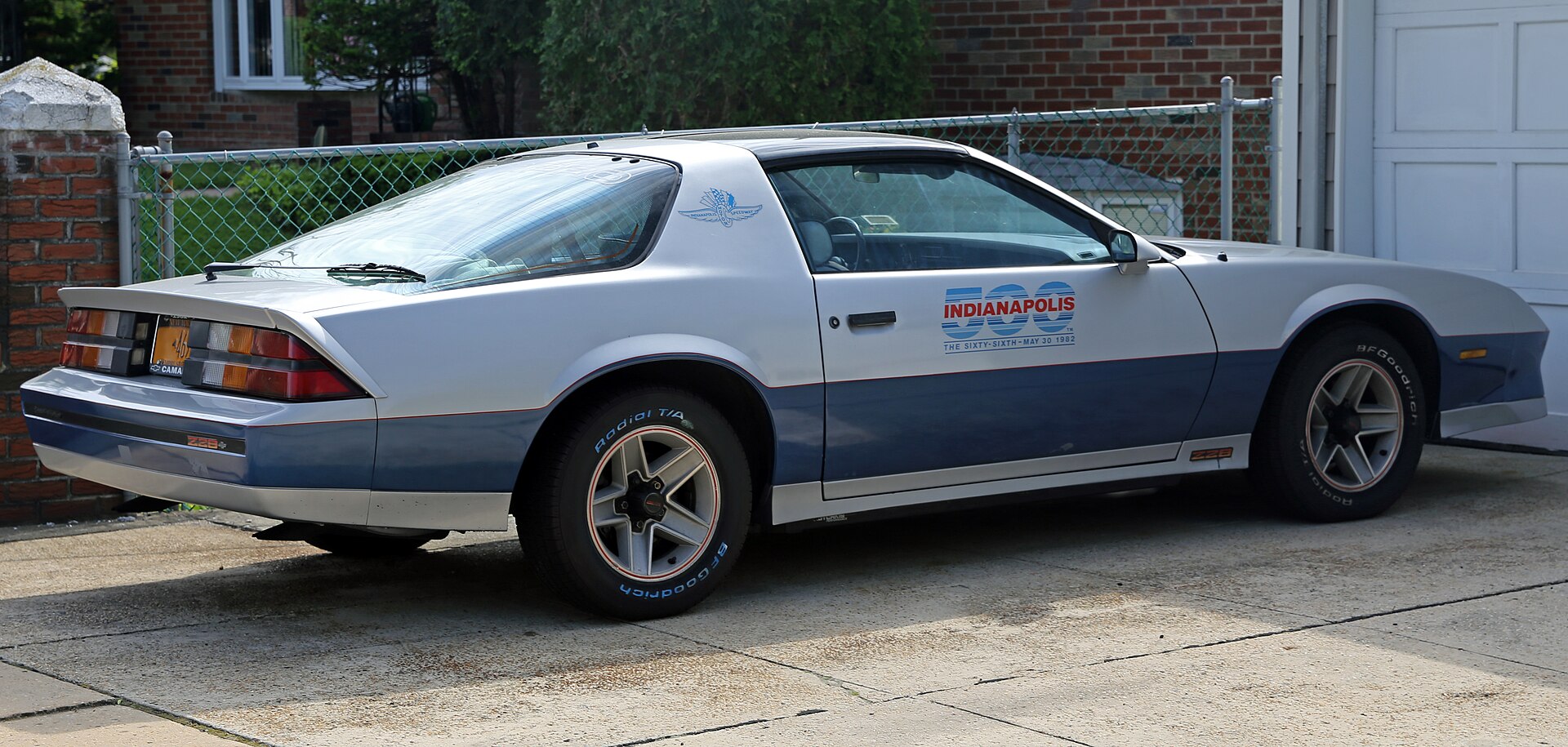
Dealers sold more than 6,000 appearance replicas. They had two-tone silver and blue paint, special striping, red pinstripes on the 15-inch Z28 wheels and a silver and blue interior with six-way manually adjustable Lear Siegler seats. Engines were those of the regular Z28: the LG4 5.0 L four-barrel with 108 kW (145 hp) or the LU5 Cross-Fire Injection 5.0 L with 123 kW (165 hp), the latter only with an automatic.

The 1993 Z28 and the fourth generation
The fourth-generation Camaro took the role in its launch year. The pace car edition of the 1993 Z28 had a black and white colour scheme, multicoloured ribbon graphics, white wheels and "Indy 500" lettering. Its LT1 was the production engine with 205 kW (275 hp) and 441 Nm (325 lb-ft). Chevrolet built 645, and 125 of them served as festival cars.

Pace duties from 2009 to 2016
| Race | Car | Driver | Engine | Replicas |
|---|---|---|---|---|
| 2009 | 2010 Camaro SS | Josh Duhamel | 6.2 L LS3, 318 kW (426 hp) | none; 25 festival cars |
| 2010 | 2010 Camaro SS, Inferno Orange | Robin Roberts | not stated | about 200, 50 as festival cars |
| 2011 | 2011 Camaro SS convertible, white and orange | A.J. Foyt | not stated | 500 |
| 2014 | Camaro Z/28 | Dario Franchitti | 7.0 L LS7, 377 kW (505 hp) | not stated |
| 2016 | 2017 Camaro SS 50th Anniversary, Abalone White | Roger Penske | not stated | four identical pace cars |
The 2009 car needed no performance changes. Robin Roberts became only the second woman to drive an Indy pace car in 2010, and 2009-2011 gave the Camaro three races in a row. The 2011 colours recalled the 1969 car. The 2014 Z/28 had carbon-ceramic brakes and 19-inch forged wheels, and the 2016 car marked the 100th running with special door graphics. The Camaro SS page covers the production cars behind most of these.
Camaro pace car replicas today: how to spot a genuine car
The Z11 package was mostly paint, stripes and trim, so a white 1969 RS/SS convertible can be dressed as a pace car, and the cowl tag is the main test: paint 50 and interior 720 on every genuine car, plus a Z11 stamp on Norwood cars; Los Angeles cars have no Z11 stamp and rely on the colour codes. As every pace car was an SS, cars without the L78 396 should have two fuel lines for the Rochester carburettor. Dr John Mansell recorded 55 pace car VINs at Indianapolis, the highest being 9N610726. For 1982 and 1993 replicas the engine should match the regular Z28 of the year, since no buyer received the race-car engines.
Chevrolet Camaro Indy Pace Car evolution in numbers
Did you know?
- The Chevrolet Camaro Indy Pace Car ran for 26 years, from 1967 to 1993, over 3 generations in our catalog.
- The longest-running generation is the First-generation pace cars (1967–1969): 2 years.
- The biggest jump in power came with the Z28 Indy 500 Pace Car edition: up to 205 kW (279 PS), 82 kW more than the Z28 Indy 500 Pace Car replica.
- The most powerful Chevrolet Camaro Indy Pace Car is not the newest: the First-generation pace cars (1967–1969) offered up to 224 kW (305 PS), the Z28 Indy 500 Pace Car edition up to 205 kW (279 PS).
Most powerful version, kW
Figures from the 1cars catalog: power is the strongest version of each generation; generations without the figure are left out.
Chevrolet Camaro Indy Pace Car: first vs latest generation
| Spec | First-generation pace cars | Z28 Indy 500 Pace Car edition | Change |
|---|---|---|---|
| Years | 1967–1969 | 1993 | 26 years apart |
| Most powerful version | 224 kW (305 PS) | 205 kW (279 PS) | −19 kW (−8%) |
Oldest and newest generation in the 1cars catalog. Power is the strongest version of each; other rows are shown only when both generations have the figure.
Chevrolet Camaro Indy Pace Car in our rankings
- No. 10 of 65 · Biggest engines: convertibles and roadsters (5,735 cc)
- No. 145 of 789 · Biggest engines: cars (5,735 cc · top 19%)
- No. 43 of 123 · Most powerful cars of the 1990s (205 kW · top 35%)
- No. 100 of 260 · Biggest engines: coupes (5,735 cc · top 40%)
- No. 36 of 98 · Most powerful convertibles and roadsters (224 kW · top 40%)
- No. 68 of 162 · Most powerful cars of the 1960s (224 kW · top 44%)
Bigger engine than 84% of ranked convertibles and roadsters in the 1CARS catalog (No. 10 of 65).
FAQ
How many 1969 Camaro pace car replicas were built?
3,675, including the cars used at the track. They were RS/SS convertibles with the Z11 option, Dover White paint and Hugger Orange stripes, built at Norwood and Los Angeles between February and May 1969.
How many times has a Camaro paced the Indianapolis 500?
Nine times: 1967, 1969, 1982, 1993, 2009, 2010, 2011, 2014 and 2016. The 2016 car, a 2017 Camaro SS 50th Anniversary, was Chevrolet's 27th pace car since 1948.
Did the 1982 pace car replicas have the race engine?
No. The car on the track used a modified aluminium 5.7 L V8. Replicas had the regular Z28 engines: the LG4 with 108 kW (145 hp) or the LU5 Cross-Fire Injection with 123 kW (165 hp).
What is a Z10 Camaro?
A 1969 RS/SS coupe with pace-car-style white paint and stripes, RPO Z10. About 450 to 500 were built, mainly for south-western dealers, and none were used at the Indianapolis 500.
Data sources
Data checked by an editor against the sources below.
- Wikipedia - Chevrolet Camaro (third generation)
- Conceptcarz - Supercars
- Camaros - 69pacer.shtml
- Wikipedia - Chevrolet Camaro (fourth generation)


