
 Dodge Challenger R/T 440
All generations, specs and history
Published Sources (4) Report an error
By Felix Hartmann, Automotive Technology & EV Contributor
- Built
- 1970–1971
- Generations
- 2
- Top power
- 291 kW (396 PS)
Timeline
Challenger R/T 440 generations
Click a generation for its own page
Challenger I R/T 440 and RT-E1 overlapped in 1970–1974, so RT-E1 sits on a second lane
- Challenger I R/T 440 1970–1974 · Coupe, Convertible
- Challenger R/T 440 RT-E1 1970–1971 · Coupe, Convertible · 280–291 kW (381–396 PS)
Newest first · 2 generations since 1970
-
1970
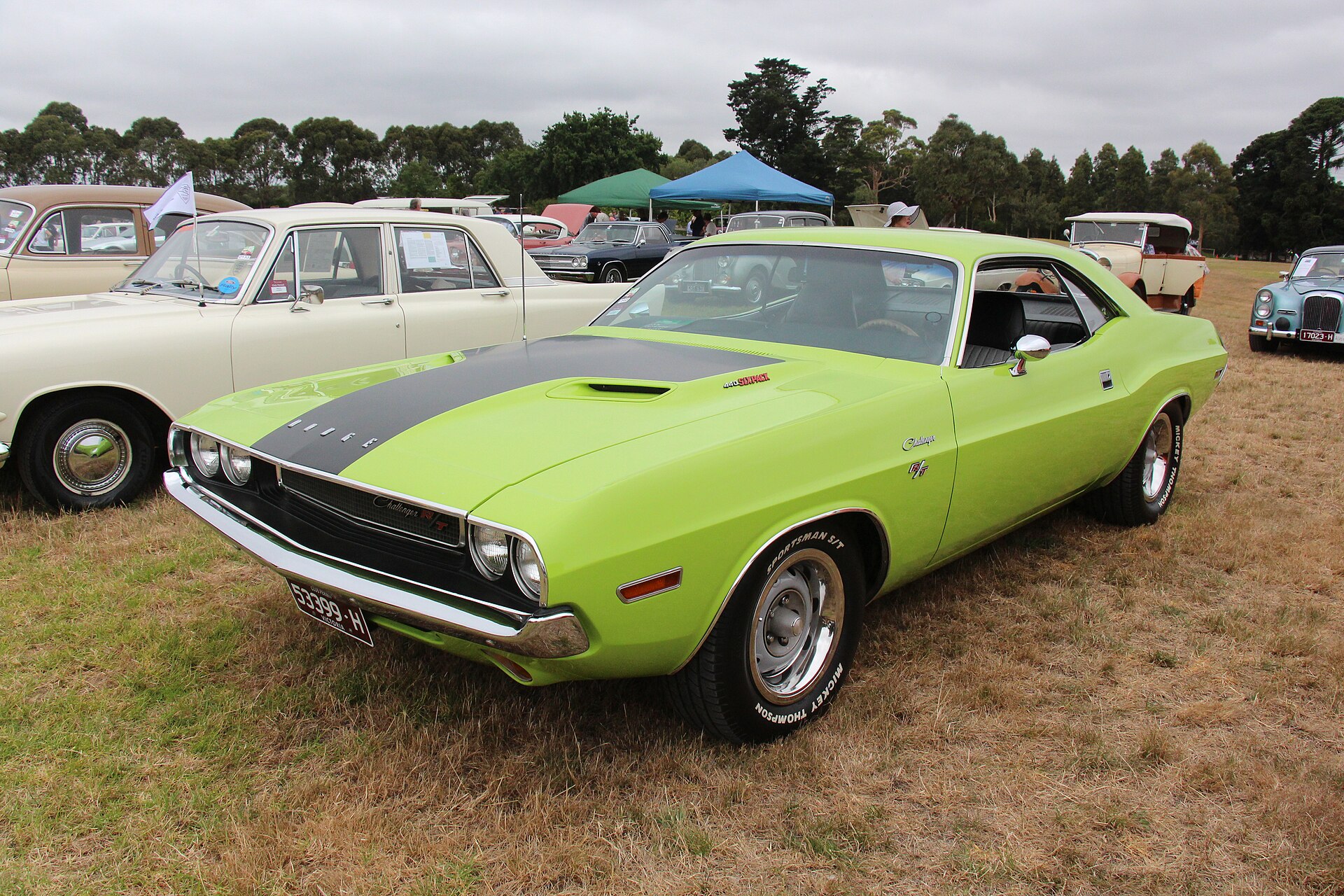
- 1970 RT-E1 1970–1971 · Coupe, Convertible · 280–291 kW (381–396 PS) Challenger I R/T 440 and RT-E1 overlapped in 1970–1974

All generations by year: Challenger I R/T 440 (1970–1974) · Challenger R/T 440 RT-E1 (1970–1971)
Which one is mine?
Pick the year of first registration to see which generation it is.
- Challenger I R/T 440 1970–1974
- RT-E1 1970–1971
The Dodge Challenger R/T 440 is the big-block R/T Dodge built on its E-body pony car for 1970 and 1971. A 6.3 L (383 cu in) Magnum V8 was standard; above it sat the 7.2 L (440 cu in) Magnum with 280 kW (375 hp), the triple-carburettor 440 Six Pack with 291 kW (390 hp) and the 426 Hemi, all SAE gross. A 1970 hardtop listed at USD 3,266.
In short
- Two model years: 1970 (hardtop, SE formal-roof hardtop, convertible) and 1971 (hardtop); the R/T series was replaced by the Rallye for 1972.
- Car Life timed a 440 Six Pack convertible at 7.1 s to 60 mph and 14.64 s at 97.82 mph over the quarter mile in December 1969.
- About 18,500 R/Ts were built for 1970 according to Wikipedia, and between 3,814 and 4,630 for 1971 depending on the source.
- The 440 Six Pack cost USD 249.55 over the 383 in 1970; the Hemi cost USD 778.75 before the heavy-duty items it required.
Specs by version
Engines
| Version | Engine | Power | Torque | Drive | Production years |
|---|---|---|---|---|---|
| Challenger I R/T 440 · 440 Magnum V8 4-barrel (SAE gross) | 7.2 l · 8 cyl · Petrol 7,200 cc | 280 kW 381 PS375 hp | 651 Nm480 lb-ft | - | 1970 |
| Challenger I R/T 440 · 440 Six Pack V8 (SAE gross) | 7.2 l · 8 cyl · Petrol 7,200 cc | 291 kW 396 PS390 hp | 664 Nm490 lb-ft | - | 1970 |
| RT-E1 · 1970–1971 | |||||
| RT-E1 · R/T 440 Magnum four-barrel (SAE gross) | 7.2 l · 8 cyl · Petrol 7,210 cc | 280 kW 381 PS375 hp | - | Rear-wheel drive | 1970 |
| RT-E1 · R/T 440 Six Pack (SAE gross) | 7.2 l · 8 cyl · Petrol 7,210 cc | 287 kW 390 PS385 hp | - | Rear-wheel drive | 1971 |
| RT-E1 · R/T 440 Six Pack (SAE gross) | 7.2 l · 8 cyl · Petrol 7,210 cc | 291 kW 396 PS390 hp | 664 Nm490 lb-ft | Rear-wheel drive | 1970 |
Dimensions and weight
Show all 5 versions
| Version | Length | Width | Wheelbase |
|---|---|---|---|
| Challenger I R/T 440 · 440 Magnum V8 4-barrel (SAE gross) | - | - | 2,794 mm110.0 in |
| Challenger I R/T 440 · 440 Six Pack V8 (SAE gross) | - | - | 2,794 mm110.0 in |
| RT-E1 · 1970–1971 | |||
| RT-E1 · R/T 440 Magnum four-barrel (SAE gross) | 4,864 mm191.5 in | 1,943 mm76.5 in | 2,794 mm110.0 in |
| RT-E1 · R/T 440 Six Pack (SAE gross) | 4,864 mm191.5 in | 1,943 mm76.5 in | 2,794 mm110.0 in |
| RT-E1 · R/T 440 Six Pack (SAE gross) | 4,864 mm191.5 in | 1,943 mm76.5 in | 2,794 mm110.0 in |
Verified Manufacturer and type-approval data from our catalog · Sources and methodology
Challenger R/T 440 at a glance
| Specification | Dodge Challenger R/T 440 |
|---|---|
| Model years | 1970-1971 |
| Built | 18,512 R/Ts in 1970 (Wikipedia); 3,814 or 4,630 in 1971 |
| Bodies | two-door hardtop, SE hardtop (1970), convertible (1970) |
| Platform | Chrysler E-body, 2,794 mm (110 in) wheelbase, 4,864 mm (191.5 in) long, 1,943 mm (76.5 in) wide |
| Engines | 6.3 L (383) Magnum, 7.2 L (440) Magnum, 7.2 L (440) Six Pack, 7.0 L (426) Hemi |
| Power (1970, gross) | 250 kW (335 hp), 280 kW (375 hp), 291 kW (390 hp), 317 kW (425 hp) |
| Torque | 664 Nm (490 lb-ft) for the 440 Six Pack and the Hemi |
| Gearboxes | four-speed manual with Hurst pistol-grip shifter; 727 TorqueFlite automatic |
| Rear axle | Dana 60 with ratios from 3.23:1 to 4.10:1 on Six Pack cars |
| Weight | about 1,769 kg (3,900 lb), Car Life 440 Six Pack convertible |
| 0-60 mph / quarter mile | 7.1 s; 14.64 s at 97.82 mph (Car Life, December 1969) |
| Price new | USD 3,266 (hardtop), USD 3,498 (SE), USD 3,535 (convertible) in 1970 |
Why Dodge put B-body engines in the Challenger R/T
Dodge arrived late in the pony car class, and when the Challenger appeared for 1970 it shared the new E-body with the Plymouth Barracuda. The Dodge used a wheelbase 51 mm (2 in) longer and was built at Hamtramck, Michigan, and Maywood, California. The R/T package gave the smaller car the big-block engines that Dodge also sold in the intermediate Charger R/T and Coronet R/T.
R/T stood for road and track. Beyond the engine, the package brought heavier suspension, heavy-duty brakes, a Rallye instrument cluster with a 150 mph speedometer, an 8,000 rpm tachometer and an oil pressure gauge, and a choice of three stripe designs or none. The shaker bonnet scoop cost USD 97 extra.
The four R/T engines and what they cost
| Engine | Carburettors | 1970 rating (gross) | 1970 option price |
|---|---|---|---|
| 383 Magnum | one four-barrel | 250 kW (335 hp) | standard |
| 440 Magnum | one four-barrel | 280 kW (375 hp) | USD 130.55 |
| 440 Six Pack | three two-barrel | 291 kW (390 hp), 664 Nm (490 lb-ft) | USD 249.55 |
| 426 Hemi | two four-barrel | 317 kW (425 hp) at 5,000 rpm, 664 Nm (490 lb-ft) at 4,000 rpm | USD 778.75 |
The 440 Six Pack carried the same torque rating as the Hemi for about a third of its option price. Old Cars Weekly puts the true cost of a Hemi R/T at USD 1,228 once the mandatory heavy-duty parts were added, while the TorqueFlite automatic added USD 227.05 to a Six Pack car. Dodge's Six Pack and Plymouth's 440+6 were the same engine under different names.


Hardtop, SE and convertible
The 1970 range had three bodies. The SE (Special Edition) added a vinyl roof, a smaller formal rear window, SE medallions on the roof pillars, leather and vinyl bucket seats and an overhead console with three warning lamps, and it could be combined with the R/T. The convertible was the rarest R/T.
| 1970 R/T body | Built (Wikipedia) | Built (RPM magazine) | Base price | Hemi cars |
|---|---|---|---|---|
| Hardtop | 13,796 | 14,889 | USD 3,266 | 287 |
| SE hardtop | 3,753 | 3,979 | USD 3,498 | 60 |
| Convertible | 963 | 1,070 | USD 3,535 | 9 |
Figures vary between sources, and the two sets of totals differ by about 1,400 cars. Neither source breaks down the 440 Magnum and 440 Six Pack cars, so engine splits for those versions are not given here. Only 356 Hemi R/Ts were built in 1970, 165 of them with four-speeds, according to RPM.

Car Life road test of the 440 Six Pack convertible
Car Life tested a Plum Crazy R/T convertible with the 440 Six Pack, the heavy-duty four-speed and a 3.54:1 Sure-Grip Dana axle from the Track Pak in its December 1969 issue. The figures were 3.1 seconds to 30 mph, 7.1 seconds to 60 mph, 15.7 seconds to 100 mph and 14.64 seconds at 97.82 mph over the quarter mile, with an average of 14.8 seconds. The engine pulled to 128 mph (206 km/h) at 6,100 rpm, and the car averaged 10.7 mpg (22.0 L/100 km).
Car Life also listed faults. The four-speed needed high pedal effort and a stiff lever, and the testers lost about a second per run waiting for the gears to line up. The car weighed about 1,769 kg (3,900 lb) on its own and 1,962 kg (4,325 lb) with two testers and equipment, the ride was harsh over dips, the seats gave little lateral support and the brakes faded by the eighth stop. The car had earlier bent its valves, which may explain why the engine felt short of its rating.
The 1971 R/T, last of the series
For 1971 the R/T became a hardtop-only model with a split grille and tail lamps that took over the reversing lights, at a base price of USD 3,273. Chrysler cut compression to run on regular fuel: the 383 fell to 224 kW (300 hp) gross, or 186 kW (250 hp) net, and the 440 Six Pack to 287 kW (385 hp) gross, or 254 kW (340 hp) net. The Hemi kept 317 kW (425 hp) gross and 261 kW (350 hp) net in its final year, and a 340 four-barrel became a no-cost alternative to the 383.
Sales collapsed. Musclecarfacts gives 4,630 R/Ts for 1971, Wikipedia 3,814 V8 R/Ts. The shaker scoop and the Hemi disappeared after 1971, and for 1972 Dodge replaced the R/T with the Rallye. The rest of the story, from the 1972 Rallye to the 2008 revival, is in the Dodge Challenger hub; the 1970 Trans-Am homologation car has its own page as the Challenger T/A.

Challenger R/T today: VIN codes, clones and what to check
A 1970 Chrysler VIN carries an engine letter in fifth place, V for the 440 Six Pack as on the Plymouth equivalent, so the code must match the engine the seller describes, and the fender tag and broadcast sheet should confirm the R/T package. Tribute cars built from base Challengers exist, and documentation is what separates them from real R/Ts. Six Pack cars should have the Dana 60 axle and the correct triple-carburettor intake. Old Cars Weekly describes the last 440 Six Pack R/T of 1970, built at Hamtramck in July 1970 as a dealer sales bank car without stripes and with whitewall tyres, which shows how much equipment can differ from the usual image of the car. The Plymouth Hemi 'Cuda is the E-body sibling, and the full range is in the Dodge catalogue.
Image credits · Photos from Wikimedia Commons under free licences
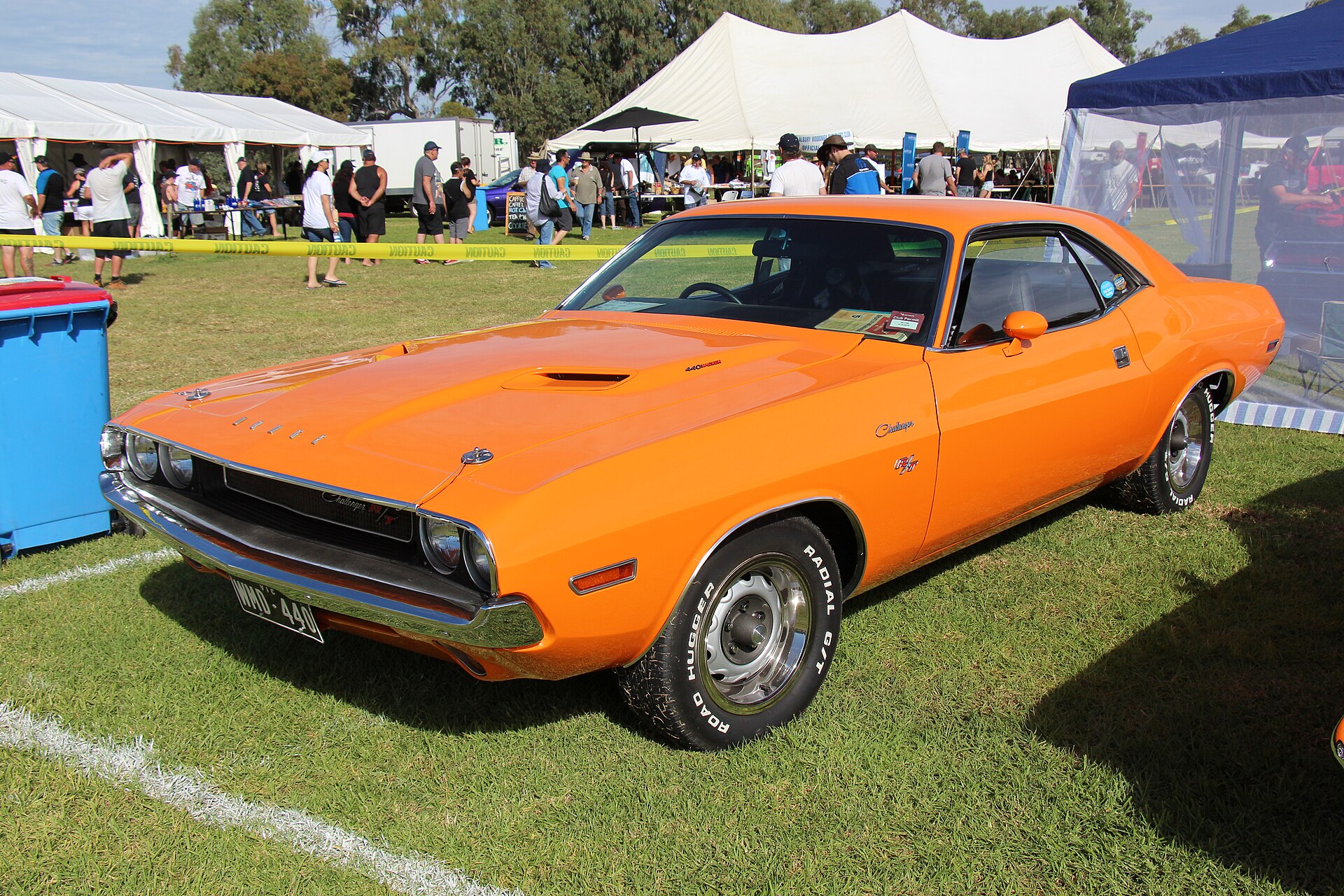
- Dodge Challenger I R/T 440 · Photo: Sicnag / Wikimedia Commons, CC BY 2.0
Dodge Challenger R/T 440 in our rankings
- No. 36 of 788 · Biggest engines: cars (7,210 cc · top 5%)
- No. 11 of 163 · Most powerful cars of the 1970s (291 kW · top 8%)
- No. 29 of 260 · Biggest engines: coupes (7,210 cc · top 12%)
- No. 20 of 126 · Longest coupes (4,864 mm · top 16%)
- No. 110 of 634 · Widest cars (1,943 mm · top 18%)
- No. 139 of 668 · Longest cars (4,864 mm · top 21%)
Bigger engine than 95% of ranked cars in the 1CARS catalog (No. 36 of 788).
FAQ
What engines did the 1970 Challenger R/T have?
The 383 Magnum with 250 kW (335 hp) was standard. Options were the 440 Magnum with 280 kW (375 hp), the 440 Six Pack with 291 kW (390 hp) and the 426 Hemi with 317 kW (425 hp), all SAE gross.
How many Challenger R/Ts were built?
Wikipedia gives 18,512 for 1970 (13,796 hardtops, 3,753 SE hardtops and 963 convertibles); RPM magazine's figures are higher. For 1971 sources give 3,814 or 4,630.
How fast was a Challenger R/T 440 Six Pack?
Car Life measured a 1970 R/T convertible with the 440 Six Pack and four-speed at 7.1 seconds to 60 mph and 14.64 seconds at 97.82 mph over the quarter mile, with a top speed of 128 mph.
What did the 440 Six Pack cost in 1970?
In 1970 the Six Pack cost USD 249.55 over the standard 383 Magnum, against USD 130.55 for the four-barrel 440 Magnum and USD 778.75 for the 426 Hemi before its required heavy-duty equipment.
Data sources
Data checked by an editor against the sources below.
- Wikipedia - Dodge Challenger (1970)
- Wikipedia - Dodge Challenger
- Wikipedia - Chrysler RB engine
- Curbsideclassic - Vintage Car Life Review 1970 Dodge Challenger R T Convertible With 440 Six Pack Genghis Grape


