 Toyota Previa
All generations, specs and history
Published Sources (2) Report an error
By Felix Hartmann, Automotive Technology & EV Contributor
- Built
- 1990–2019
- Generations
- 3 · XR10/XR20 to XR50
- Top power
- 202 kW (275 PS)
Timeline
Previa generations
Click a generation for its own page

- Previa XR10/XR20 1990–2000 · Minivan / MPV · 97–120 kW (132–163 PS)
- Previa XR30/XR40 2000–2006 · Minivan / MPV · 85–115 kW (116–156 PS)
- Previa XR50 2006–2019 · Minivan / MPV · 202 kW (275 PS)
Newest first · 3 generations since 1990
-
2006
- 2000 XR30/XR40 2000–2006 · Minivan / MPV · 85–115 kW (116–156 PS)
- 1990 XR10/XR20 1990–2000 · Minivan / MPV · 97–120 kW (132–163 PS)
All generations by year: Previa XR50 (2006–2019) · Previa XR30/XR40 (2000–2006) · Previa XR10/XR20 (1990–2000)
Which one is mine?
Pick the year of first registration to see which generation it is.
- XR50 2006–2019
- XR30/XR40 2000–2006
- XR10/XR20 1990–2000
Which one to buy
Our verdict · Felix Hartmann
- For character: a first-generation XR10 with the mid-engine and rear-wheel drive, ideally All-Trac.
- For family use: a 2003-2006 second-generation 2.0 D-4D, with 250 Nm, 7.2 l/100 km and two sliding doors.
- For performance: the supercharged 120 kW first generation, mainly found in the US.
- Outside Europe: a third-generation Estima or Tarago with the 3.5 V6 or the hybrid.
The Toyota Previa is a large minivan that Toyota built in three generations from January 1990 to October 2019. Japan knew it as the Estima and Australia as the Tarago. The first Previa was famous for its mid-mounted engine laid almost flat under the front seats; the second moved to a conventional front-drive Camry base, and the third was not sold in Europe at all.
In short
- Three generations: XR10/XR20 (1990-2000), XR30/XR40 (2000-2006), XR50 (2006-2019).
- European engines: 2.4 petrol from 97 kW (132 PS), later 115 kW (156 PS), and a 2.0 D-4D diesel with 85 kW (116 PS).
- Seven or eight seats; boot from 495 l to 3,250 l in the second generation (ADAC data).
- Estima Hybrid of 2001 was claimed by Toyota as the world's first hybrid minivan.
Toyota Previa at a glance
| Specification | Toyota Previa |
|---|---|
| Segment | Large MPV (minivan) |
| Production | January 1990 to October 2019 |
| Built in | Toyota Auto Body Fujimatsu plant, Kariya, Japan; hybrid also at Motomachi |
| Body | Four- or five-door minivan with sliding side door(s) |
| Seats | 6, 7 or 8 depending on generation and market |
| Other names | Estima (Japan), Tarago (Australia) |
| Sold in Europe | 1990-2006 |
| Successors | Sienna (North America), Granvia (Japan, Australia), Alphard (Asia) |
The name comes from the Italian previdenza, "providence" or "foresight". Estima is derived from "estimable". Other Toyota people carriers are listed in our Toyota catalogue.
Generations and model history
| Generation | Code | Years | Body styles | Engines | Power (kW / hp) |
|---|---|---|---|---|---|
| 1st | XR10/XR20 | 1990-2000 | 4-door minivan, one sliding door | 2.4 petrol, 2.4 supercharged, 2.2 turbodiesel (Japan) | 97-120 kW (132-163 PS) |
| 2nd | XR30/XR40 | 2000-2006 | 5-door minivan, two sliding doors | 2.4 petrol, 2.0 D-4D diesel, 3.0 V6 and 2.4 hybrid (Japan) | 85-115 kW (116-156 PS) |
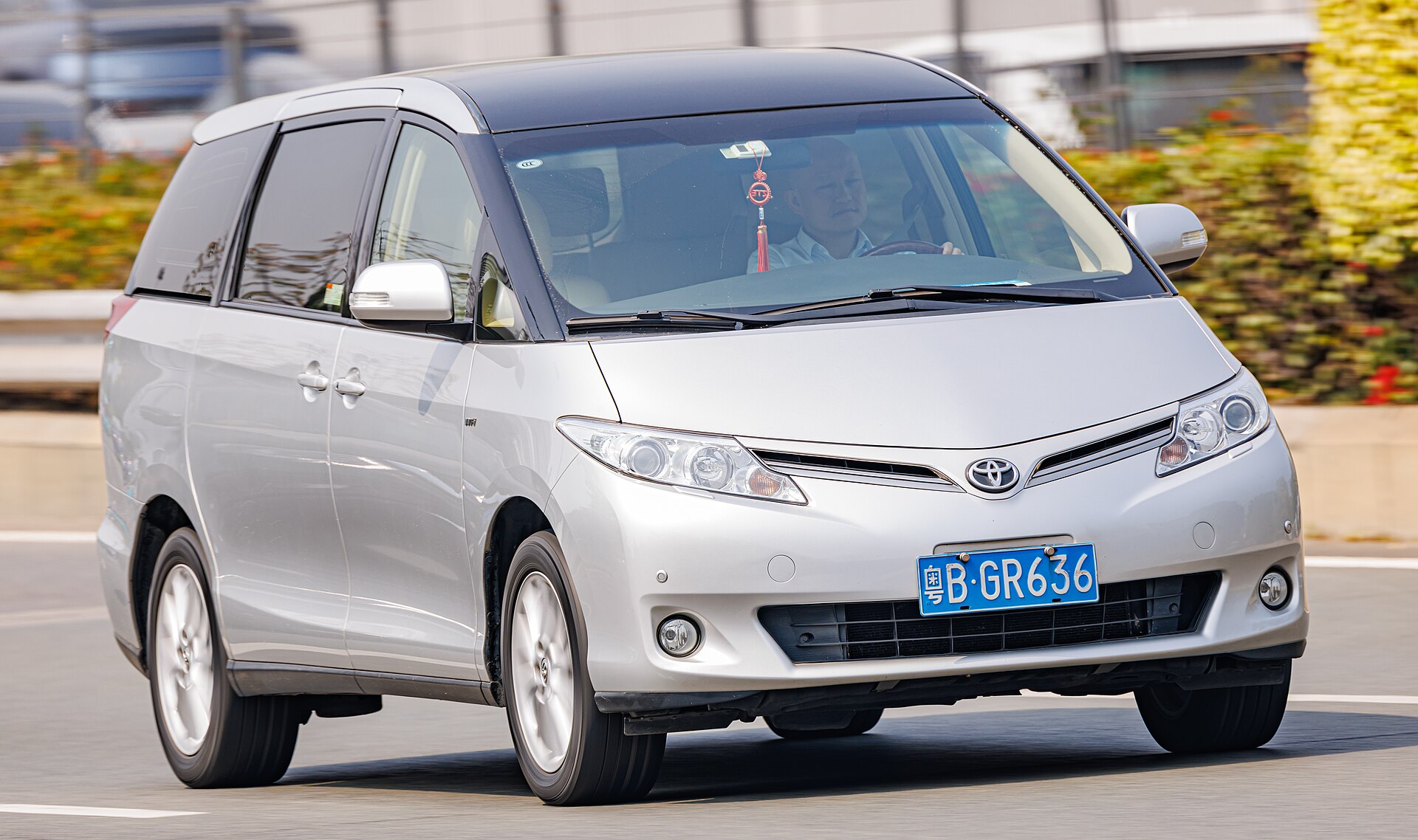
| 3rd | XR50 | 2006-2019 | 5-door minivan | 2.4 petrol, 3.5 V6, 2.4 hybrid | up to 202 kW (271 hp) |
First generation (1990-2000). Introduced on 27 January 1990, designed by Tokuo Fukuichi at Toyota and David Doyle at Calty. Sales began in the UK and Australia in September 1990 and in the USA in March 1990, where it was sold until 1997 before the Sienna took over. The 2.4-litre 2TZ-FE four sat under the front seats, canted 75 degrees from vertical, which gave an almost equal front-to-rear weight distribution. Belt-driven accessories were powered by a separate Supplemental Accessory Drive System. Rear-wheel drive was standard; the All-Trac four-wheel-drive version used a viscous-coupled centre differential. From 1994 a supercharged 2TZ-FZE gave 120 kW (163 PS) and 273 Nm. In Japan, the narrower Estima Lucida and Emina (from 1992) were sized for a lower tax band.
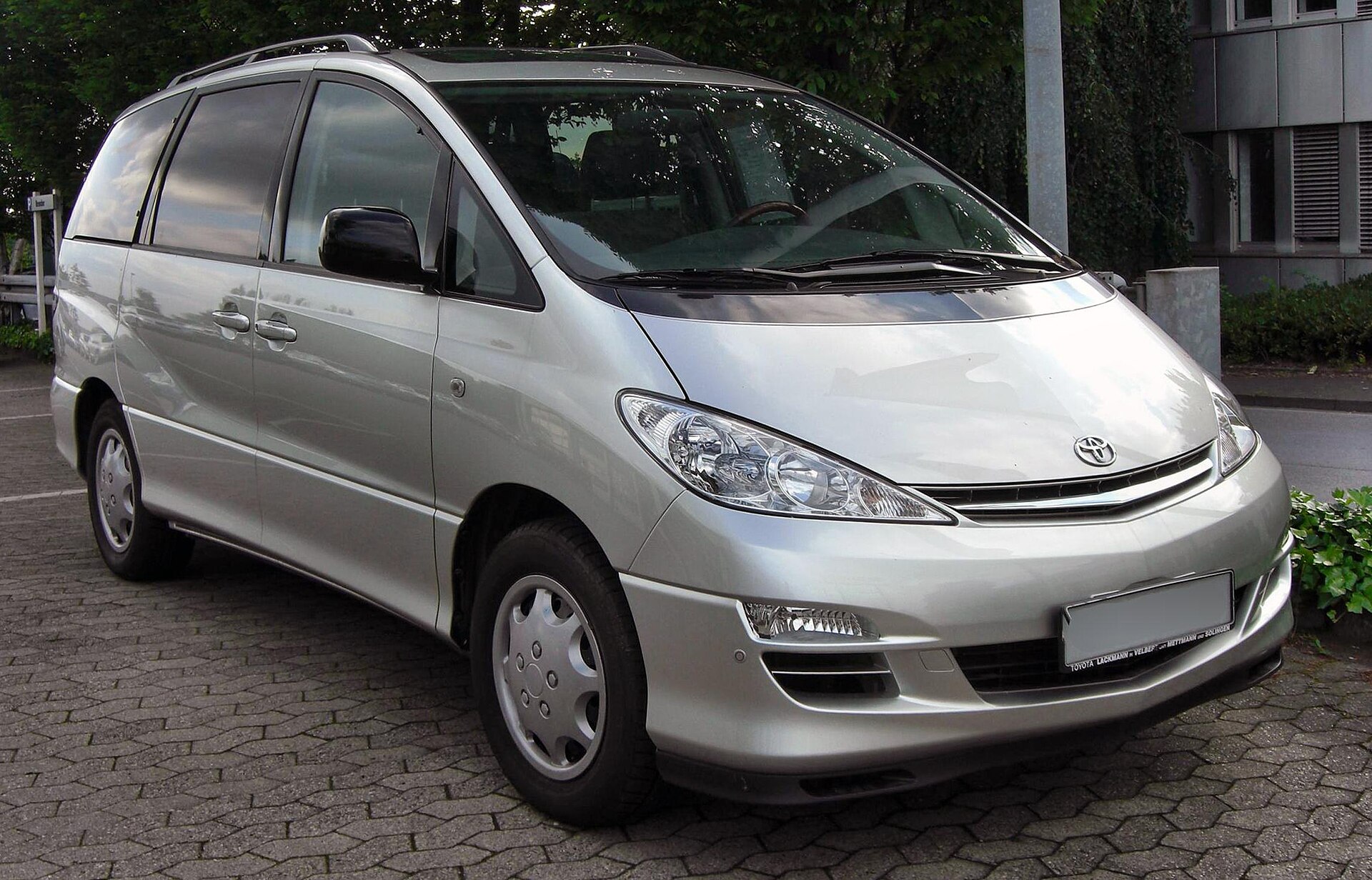
Second generation (2000-2006). It replaced the original outside the US on 8 January 2000. Toyota switched to front-wheel drive on the Camry (K) platform and added sliding doors on both sides. Europe received a 2.4-litre 2AZ-FE petrol with 115 kW (156 PS) and a 2.0-litre 1CD-FTV D-4D diesel with 85 kW (116 PS). A facelift followed in mid-2003. In Japan, the Estima Hybrid of June 2001 combined the 2.4 engine with a 13 kW front motor and an 18 kW rear motor.
Third generation (2006-2019). Sold as the Estima in Japan, the Tarago in Australia and the Previa in other markets, but not in Europe. It offered a 2.4 four, a 3.5-litre 2GR-FE V6 with 202 kW (271 hp) and 340 Nm, and a second-generation Hybrid Synergy Drive with E-Four all-wheel drive. A 2016 update dropped the V6 in Japan and raised the 2.4 to 125 kW (170 PS). Production ended in October 2019.

Engines, transmissions and performance
| Engine (Europe) | Power | Torque | Gearbox | 0-100 km/h | Top speed |
|---|---|---|---|---|---|
| 2.4 petrol (XR10, Germany) | 97 kW (132 PS) | 204 Nm | 5-speed manual, 4-speed auto | 11.5 s | 175 km/h |
| 2.4 2AZ-FE petrol (XR30) | 115 kW (156 PS) | - | 5-speed manual, 4-speed auto | - | - |
| 2.0 D-4D diesel (XR30) | 85 kW (116 PS) | 250 Nm | 5-speed manual | 13.8 s | 175 km/h |
The German-market first generation is listed at 97 kW (132 PS), while US sources give 99 kW (135 PS) for the same 2TZ-FE. Manual gearboxes were five-speed units in both generations; the automatics had four speeds. The third generation used a four-speed automatic, a seven-step Super CVT-i, a six-speed automatic for the V6 and an e-CVT for the hybrid.

Dimensions, space and boot
| Parameter | XR10 (1990-2000) | XR30 (2000-2006) |
|---|---|---|
| Length | 4,750-4,765 mm (187.0-187.6 in) | 4,780 mm (188.2 in) |
| Width | 1,800 mm (70.9 in) | 1,790 mm (70.5 in) |
| Height | 1,780 mm (70.1 in) | 1,780 mm (70.1 in) |
| Wheelbase | 2,860-2,870 mm (112.6-113.0 in) | 2,900 mm (114.2 in) |
| Kerb weight | 1,720 kg (3,792 lb) | 1,775 kg (3,913 lb), 2.0 D-4D |
| Boot | 670 l to 1,782 l | 495 l to 3,250 l |
| Seats | 8 | 7 |
| Fuel tank | 75 l (19.8 US gal) | 75 l (19.8 US gal) |
The third generation grew to 4,795 mm (4,820 mm from 2016). Data for the first two generations are from ADAC's German catalogue. To see how a Previa compares with a modern MPV, use our size comparison tool.
Fuel economy and running costs
ADAC quotes 10.9 l/100 km for the first-generation 2.4 petrol on the old NEDC cycle. The second-generation 2.0 D-4D used 7.2 l/100 km combined (9.0 urban, 6.1 extra-urban) with 191 g/km of CO2. In Germany, the first Previa listed from EUR 23,980 (ADAC figure for 1994-2000 versions), while the facelifted second generation (2003-2006) started at EUR 29,900 for the 2.4 and EUR 31,200 for the 2.0 D-4D. Estimate today's fuel bill with our fuel cost calculator.
Trims and equipment
UK first-generation trims were GL, GX (from October 1993) and GS (from March 1995). After the 2003 facelift the British GS, GLS and CDX became T2, T3 and T Spirit; German buyers chose between base, Luna, Sol and Executive, with the top Executive at EUR 36,400 (2003). The second generation offered six, seven or eight seats depending on the layout.

Safety
Toyota described the first Previa as the first minivan to meet all US passenger-car safety standards, for the 1992 model year. The IIHS later rated a 1996 model Poor in its moderate-overlap frontal test. ABS was optional on early cars, and the German base model listed only driver and passenger airbags. We could not confirm a Euro NCAP result for any European Previa. In Australia, ANCAP scored the 2010 Tarago 14.45 of 16 points in the frontal offset test and 16 of 16 in the side test.
Reliability and known issues
The mid-engine layout makes some routine work awkward: on the first generation, reaching the spark plugs means removing the front right seat, the carpet and an access panel. The accessory drive also has its own 2-litre oil reservoir under the bonnet that needs checking. We found no reliable source for systematic faults beyond these service quirks, so a full service record is the best guide.
Rivals
| Model | Engines | Power (kW / hp) | Boot (l) | Price from (EUR) |
|---|---|---|---|---|
| Toyota Previa XR30 (2003) | 2.4 petrol, 2.0 diesel | 85-115 kW (116-156 PS) | 495 | 29,900 (Germany, 2003) |
| Volkswagen Sharan | petrol, diesel | - | - | - |
| Renault Espace | petrol, diesel | - | - | - |
| Chrysler Voyager | petrol, diesel | - | - | - |
Photo gallery


Toyota Previa evolution in numbers
Did you know?
- The Toyota Previa ran for 29 years, from 1990 to 2019, over 3 generations in our catalog.
- The longest-running generation is the Previa XR50 (2006–2019): 13 years.
- The biggest jump in power came with the Previa XR50: up to 202 kW (275 PS), 87 kW more than the Previa XR30/XR40.
Most powerful version, kW
Figures from the 1cars catalog: power is the strongest version of each generation; generations without the figure are left out.
Toyota Previa: first vs latest generation
| Spec | Previa XR10/XR20 | Previa XR50 | Change |
|---|---|---|---|
| Years | 1990–2000 | 2006–2019 | 16 years apart |
| Most powerful version | 120 kW (163 PS) | 202 kW (275 PS) | +82 kW (+68%) |
Oldest and newest generation in the 1cars catalog. Power is the strongest version of each; other rows are shown only when both generations have the figure.
Toyota Previa in our rankings
- No. 5 of 26 · Most powerful minivans and MPVs (202 kW)
- No. 81 of 1082 · Longest-running car nameplates (29 years · top 9%)
- No. 50 of 130 · Most powerful Japanese cars (202 kW · top 39%)
- No. 545 of 1011 · Most powerful cars (202 kW · top 54%)
- No. 182 of 411 · Cars with the most generations (3 generations · top 64%)
- No. 156 of 201 · Most powerful cars of the 2000s (115 kW · top 78%)
In production longer than 91% of ranked nameplates in the 1CARS catalog (No. 81 of 1082).
FAQ
Is the Toyota Previa the same car as the Estima?
Yes. Estima is the Japanese name and Tarago the Australian one. Japan also had narrower Estima Lucida and Emina versions.
Where is the Previa's engine?
In the first generation, under the front seats: a 2.4-litre four tilted 75 degrees. From 2000 the engine moved to the front, driving the front wheels.
When did Toyota stop selling the Previa in Europe?
The facelifted second generation was listed until early 2006. The third generation (2006-2019) was not sold in Europe.
Was there a hybrid Previa?
Yes, but only as the Japanese Estima Hybrid from 2001, with an electric motor driving the rear wheels. Europe never received it.
Data sources
Data checked by an editor against the sources below.
- Wikipedia - Toyota Previa
- ADAC - Xr30 40 Facelift