 Chrysler Valiant Charger
All generations, specs and history
Published Sources (1) Report an error
By Felix Hartmann, Automotive Technology & EV Contributor
- Built
- 1971–1978
- Generations
- 4
- Top power
- 225 kW (306 PS)
Timeline
Valiant Charger generations
Click a generation for its own page
- Valiant Charger VH 1971–1973 · Coupe · 104–225 kW (141–306 PS)
- Valiant Charger VJ 1973–1975 · Coupe · 205 kW (279 PS)
- Chrysler Charger VK 1975–1976 · Coupe · 190 kW (258 PS)
- Chrysler Charger CL 1976–1978 · Coupe
Newest first · 4 generations since 1971
- 1976 Chrysler Charger CL 1976–1978 · Coupe
- 1975 Chrysler Charger VK 1975–1976 · Coupe · 190 kW (258 PS)
-
1973
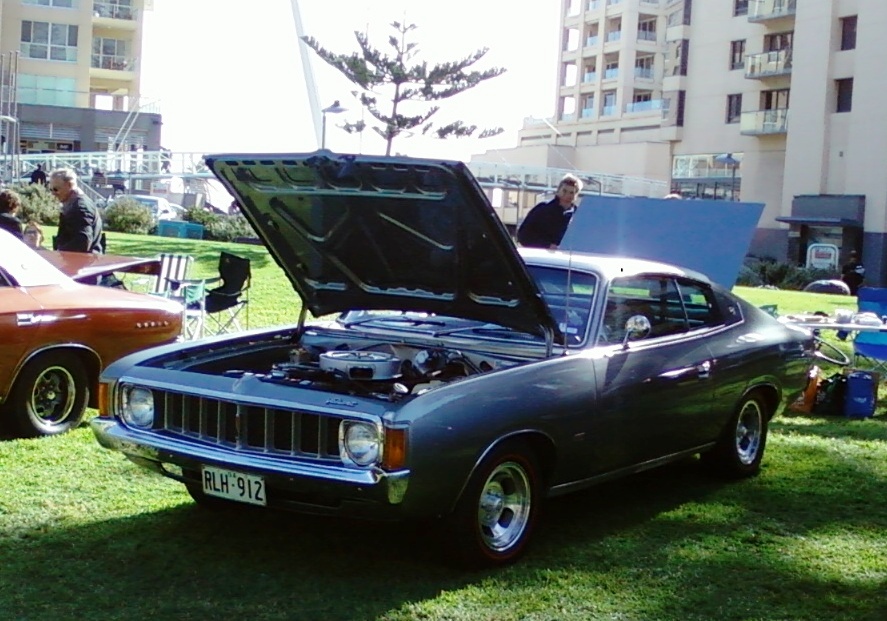
- 1971 VH 1971–1973 · Coupe · 104–225 kW (141–306 PS)

All generations by year: Chrysler Charger CL (1976–1978) · Chrysler Charger VK (1975–1976) · Valiant Charger VJ (1973–1975) · Valiant Charger VH (1971–1973)
Which one is mine?
Pick the year of first registration to see which generation it is.
- Chrysler Charger CL 1976–1978
- Chrysler Charger VK 1975–1976
- Valiant Charger VJ 1973–1975
- Valiant Charger VH 1971–1973
Which Valiant Charger to choose
Our verdict · Felix Hartmann
- For the strongest engine: an R/T E49, 225 kW (302 bhp) from a six with a four-speed.
- For the first R/T: a 1971 E38, the car of the launch year.
- For a V8: a 770 SE E55, one of 125, or a VJ with the 340.
- For an easier classic: a VJ or VK Charger 770 with the 318 V8 and an automatic.
- For a limited edition: a Sportsman (500 built) or a White Knight Special (200 built).
The American car with the same name is a different design. Its story is told in our guide to the Dodge Charger generations, and the company background in our history of the Chrysler Corporation. The Chrysler catalogue lists the Valiant Charger series, and the R/T is one of the Australian cars in our muscle car section. Figures from across the catalogue are compared in the car rankings.
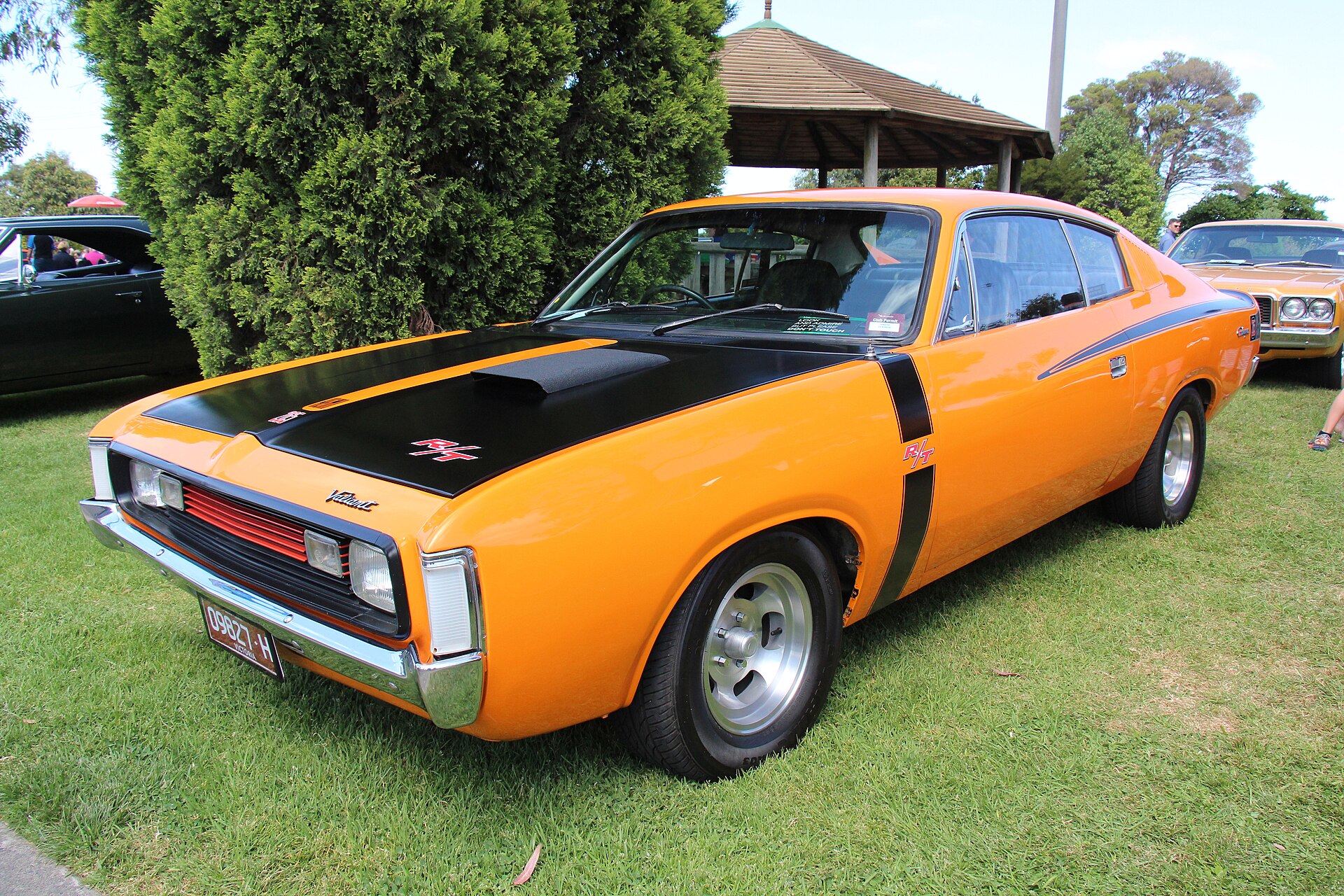
The Valiant Charger was a two-door hardtop built by Chrysler Australia from 1971 to 16 August 1978, on a shortened version of the Valiant sedan. Its R/T versions with a tuned 265 cu in six were Chrysler's answer to the Falcon GT-HO and the Torana XU-1. The 770 and later models offered V8s of up to 5.9 litres. The VH Charger was Wheels Car of the Year in 1971.
In short
- Four series: VH (1971 – March 1973), VJ (from March 1973), VK (October 1975) and CL (October 1976); badged Chrysler Charger from the VK.
- The R/T E38 had 209 kW (280 bhp) and the four-speed E49 225 kW (302 bhp) from a 4.3-litre six; the 770 SE E55 used a 340 V8 with 205 kW (275 bhp).
- Doug Chivas finished third at Bathurst in 1972 in an E49; in New Zealand Chargers were unbeaten in the Pukekohe endurance race from 1971 to 1979.
- At one point the Charger made up 80 % of all Australian Valiant production.
Specs by version
| Version | Engine | Power | Gearbox | Drive | Production years |
|---|---|---|---|---|---|
| Valiant Charger VH · R/T 4.3 I6 265 (VH) | 6 cyl · Petrol | 163 kW 222 PS219 hp | 3-sp Manual | Rear-wheel drive | 1971–1973 |
| Valiant Charger VH · 770 SE E55 5.6 V8 340 (VH) | 8 cyl · Petrol | 205 kW 279 PS275 hp | 3-sp Automatic | Rear-wheel drive | 1971–1972 |
| Valiant Charger VH · R/T E38 4.3 I6 265 Six Pack (VH) | 6 cyl · Petrol | 209 kW 284 PS280 hp | 3-sp Manual | Rear-wheel drive | 1971–1973 |
| Valiant Charger VH · R/T E49 4.3 I6 265 Six Pack (VH) | 6 cyl · Petrol | 225 kW 306 PS302 hp | 4-sp Manual | Rear-wheel drive | 1971–1973 |
Verified Manufacturer and type-approval data from our catalog · Sources and methodology
Valiant Charger at a glance
| Specification | Valiant Charger |
|---|---|
| Maker | Chrysler Australia |
| Production | 1971 – 16 August 1978 |
| Body | two-door hardtop coupé |
| Platform | Chrysler A-body, short-wheelbase Valiant |
| Layout | front engine, rear-wheel drive |
| Engines | 215 to 265 cu in sixes (3.5 to 4.3 l), 318 to 360 cu in V8s (5.2 to 5.9 l) |
| Strongest version | R/T E49, 225 kW (302 bhp) |
| Designers | Bob Hubbach and Bryan Smyth (VH), Dennis Nicolle (VJ) |
| Award | Wheels Car of the Year 1971 |
| Names | Valiant Charger (VH, VJ), Chrysler Charger (VK, CL) |
VH Charger: the 1971 launch
Chrysler Australia launched the Charger in 1971 as part of the VH Valiant range. It was a short-wheelbase version of the Valiant sedan on the American A-body platform, with its own two-door hardtop body. Chrysler widened the wings and fitted a wider rear axle, so the Charger's track was much wider than that of any US A-body car. The Australian cars also used a larger wheel bolt pattern than the American ones of the time.
The range covered almost every kind of buyer, from a basic six to a V8 luxury coupé:
| Model | Engine | Power | Gearbox |
|---|---|---|---|
| Charger | 215 six (3.5 l) | 104 kW (140 bhp) | three-speed manual |
| Charger XL | 245 six (4.0 l) | 119 kW (160 bhp) | three-speed manual |
| Charger R/T | 265 six (4.3 l) | 163 kW (218 bhp) | three-speed manual |
| R/T E38 | 265 six (4.3 l) | 209 kW (280 bhp) | three-speed manual |
| R/T E49 | 265 six (4.3 l) | 225 kW (302 bhp) | four-speed manual |
| Charger 770 | 265 six (4.3 l) | 151 kW (203 bhp) | three-speed automatic |
| 770 V8 | 318 V8 (5.2 l), two-barrel | 172 kW (230 bhp) | three-speed automatic |
| 770 SE (E55) | 340 V8 (5.6 l), four-barrel | 205 kW (275 bhp) | three-speed automatic |
Wikipedia lists the ratings in bhp with its own kW conversions. The kW values in this table use the factor 0.7457, as in the 1CARS catalogue, so they can differ by one or two kilowatts. Launch prices in Australia, per Wikipedia, were A$2,795 (1971) for the base Charger, A$3,975 (1971) for the E38 or E49 and A$4,850 (1971) for the 770 SE. By our calculation the E38 cost A$580 (1971) more than the standard R/T. Between the cheapest and the dearest Charger the power more than doubled, from 104 to 225 kW. The 770 SE with the E55 V8 was built only 125 times, with an imported TorqueFlite 727 automatic.
Wheels magazine named the VH Charger its Car of the Year for 1971. The two-door soon dominated Valiant output: at one point it made up 80 % of the Valiants built in Australia.
R/T E38 and E49: the Six Pack Chargers
The R/T was the racing Charger. Its 265 cu in six came in several tuned forms with option codes. The E37 "Six Pack" package with triple side-draught Weber carburettors formed the basis of the 1971 touring car and could be ordered on any model. The E38 had 209 kW (280 bhp) and a three-speed manual. The E49 raised the figure to 225 kW (302 bhp) and added a four-speed gearbox; Wikipedia notes its strong torque but does not give a figure.
| Code | Series | What it was |
|---|---|---|
| E37 | VH | Six Pack 265 with triple Webers, available on all models |
| E38 | VH | R/T with 209 kW (280 bhp), three-speed manual |
| E49 | VH | R/T with 225 kW (302 bhp), four-speed manual |
| E55 | VH, VJ | 340 V8 with 205 kW (275 bhp) |
| E48 | VJ | street-tuned Six Pack with three twin-choke Webers and a four-speed |
| E57 | VJ, VK | 360 V8 (5.9 l), two-barrel, 190 kW (255 bhp), from late 1974 |
Every R/T had a six-cylinder engine. Chrysler also planned V8 performance Chargers. They were among the cars named in the newspaper story that started the 1972 Supercar scare, and they were cancelled, like the Falcon GT-HO Phase IV and the V8 Torana XU-1.


VJ Charger: round headlights and the 340 V8 (1973–1975)
The VJ of March 1973 brought seven-inch round headlights and ended the R/T. Performance moved to the V8s, and the E55 340 was rated at 205 kW (275 bhp) in the VJ. The cars also gained electronic ignition and, in many cases, a Carter ThermoQuad carburettor in place of the earlier AVS. Early VJ heads had 2.02-inch inlet valves, later ones 1.88-inch.
Special editions kept the range fresh. The Charger Sportsman of August 1974, 500 cars, combined the XL trim with the 265 six and a four-speed manual. Late in 1974 the E57 360 V8 with 190 kW (255 bhp) replaced the E55.

VK and CL: the Chrysler Charger (1975–1978)
From the VK of October 1975 the car was badged Chrysler Charger. The VK dropped the E48 Six Pack, leaving a basic 4.3-litre six, and the 770 offered 4.0, 4.3, 5.2 and 5.9-litre engines. In June 1976 the ADR 27A emission rules removed the 3.5-litre six and the 5.9-litre V8 from the range. After July 1976 Chrysler built 200 White Knight Specials on the XL, and the Drifter offered the 4.3 or 5.2-litre engine with a four-speed manual only.
The CL of late October 1976 was the last series. Production of the Australian Charger ended on 16 August 1978.
Racing: Bathurst and New Zealand
The Charger won on its first race outing, the Toby Lee 100 at Oran Park in 1971, with Doug Chivas at the wheel. At the 1972 Hardie-Ferodo 500 Chivas drove an R/T E49 to third place, behind a Falcon XY GT-HO and a Torana GTR XU-1. According to Wikipedia, brake pad problems cost him about six seconds a lap. Chrysler withdrew from Australian touring car racing at the end of 1972.
The car's best record came in New Zealand, where Chargers were assembled from imported kits. They were unbeaten in the B&H 500 mile race, later a 1000 km event, at Pukekohe Park Raceway from 1971 to 1979. Leo Leonard and Jim Little were the most successful Charger drivers there.

Photo gallery


Chrysler Valiant Charger evolution in numbers
Did you know?
- The Chrysler Valiant Charger ran for 7 years, from 1971 to 1978, over 4 generations in our catalog.
- The most powerful Chrysler Valiant Charger is not the newest: the Valiant Charger VH (1971–1973) offered up to 225 kW (306 PS), the Chrysler Charger VK up to 190 kW (258 PS).
Most powerful version, kW
Figures from the 1cars catalog: power is the strongest version of each generation; generations without the figure are left out.
Chrysler Valiant Charger in our rankings
- No. 35 of 88 · Most powerful cars of the 1970s (225 kW · top 40%)
- No. 97 of 345 · Cars with the most generations (4 generations · top 41%)
- No. 415 of 859 · Most powerful cars (225 kW · top 50%)
- No. 491 of 912 · Longest-running car nameplates (7 years · top 60%)
- No. 222 of 313 · Most powerful coupes (225 kW · top 71%)
- No. 131 of 154 · Most powerful V8 cars (205 kW · top 86%)
More powerful than 60% of ranked cars of the 1970s in the 1CARS catalog (No. 35 of 88).
FAQ
What engine did the Valiant Charger R/T have?
A 265 cu in (4.3-litre) six. The standard R/T had 163 kW (218 bhp), the E38 209 kW (280 bhp) and the E49 225 kW (302 bhp).
What is the difference between the E38 and the E49?
The E38 had 209 kW (280 bhp) and a three-speed manual; the E49 had 225 kW (302 bhp) and a four-speed manual.
Was there a V8 Valiant Charger?
Yes. The 770 offered a 318 V8, the 770 SE E55 a 340 V8 with 205 kW (275 bhp), and from late 1974 the E57 360 V8 with 190 kW (255 bhp).
When was the Valiant Charger made?
From 1971 to 16 August 1978, in the VH, VJ, VK and CL series.
Is the Valiant Charger related to the Dodge Charger?
Only by name and by its Chrysler origin. The Australian car was a short-wheelbase Valiant on the A-body platform, not a version of the American Dodge.
Data sources
Data checked by an editor against the sources below.