
 Chrysler 300C Hardtop
Specs, engines and history
Updated Published Sources (2) Report an error
By Sarah Whitmore, Senior Automotive Writer Reviewed by Oleksandr Hnatiuk
- Built
- 1957
- Top power
- 291 kW (396 PS)
Our verdict
Our verdict · Sarah Whitmore
The 1957 Chrysler 300C combined two things that rarely met in the 1950s: a racing-derived Hemi engine and full luxury equipment. It is the best-known of the early letter cars, and its 1957 Forward Look styling makes it the most dramatic. For a collector, a well-documented hardtop is the sensible choice; a convertible or one of the 18 cars with the 291 kW engine is the top of the market.
The Chrysler 300C is the 1957 model of Chrysler's "letter series" of high-performance luxury cars, built in Detroit as a two-door hardtop and, for the first time, a convertible. It used a 392 cubic inch (6.4-litre) Hemi V8 with 280 kW (375 hp), or 291 kW (390 hp) in 18 special cars. Chrysler built 1,918 hardtops and 484 convertibles, priced from 4,929 dollars.
In short
- Model year 1957 only; the third letter car after the C-300 of 1955 and the 300B of 1956.
- 6.4-litre Hemi V8 with two four-barrel carburettors: 280 kW (375 hp) at 5,200 rpm as standard.
- New Forward Look body by Virgil Exner's studio, with tall fins and a large trapezoid grille.
- 2,402 cars in total; hardtop 4,929 dollars, convertible 5,359 dollars in 1957.

Specs by version
Engines
| Version | Engine | Power | Production years |
|---|---|---|---|
| 6.4 Hemi V8 (390 hp option) | 6.4 l · 8 cyl · Petrol 6,400 cc | 291 kW 396 PS390 hp | 1957 |
Performance
Show all 1 versions
| Version | Top speed |
|---|---|
| 6.4 Hemi V8 (390 hp option) | 241 km/h150 mph |
Verified Manufacturer and type-approval data from our catalog · Sources and methodology
Chrysler 300C at a glance

| Specification | Chrysler 300C (1957) |
|---|---|
| Body | 2-door hardtop sport coupé; 2-door convertible |
| Built | Detroit, Michigan, model year 1957 |
| Engine | 392 cu in (6,424 cc) Hemi V8, cast-iron block, 4.00 x 3.90 in bore and stroke |
| Power | 280 kW (375 hp) at 5,200 rpm; optional 291 kW (390 hp) at 5,400 rpm |
| Torque | 569 Nm (420 lb-ft) at 4,000 rpm |
| Compression | 9.25:1 (standard); about 10:1 (291 kW engine) |
| Fuel system | two four-barrel carburettors, solid valve lifters |
| Gearbox | TorqueFlite three-speed automatic; manual with the 291 kW engine |
| Front suspension | Torsion-Aire torsion bars |
| Wheelbase / length | 3,200 mm (126 in) / 5,568 mm (219.2 in) |
| Weight | 1,921 kg hardtop, 1,991 kg convertible |
| Tyres | 9.00 x 14 in |
| Production | 1,918 hardtops, 484 convertibles |
What the letter series was
Chrysler created the series in 1955 with the C-300, a two-door hardtop with a 331 cubic inch Hemi of 224 kW (300 hp). It was sold to private customers so that it could be homologated for NASCAR stock-car racing, and the chief engineer behind it was Robert MacGregor Rodger. From then on each model year carried the next letter of the alphabet: 300B for 1956, 300C for 1957 and so on until the 300L of 1965.

The 300C is not the same car as the modern Chrysler 300C, the rear-drive saloon of 2004–2023. The modern car borrowed the name and the Hemi idea, but it was a four-door family saloon rather than a limited-production hardtop.
| Letter car | Year | Engine | Power | Built |
|---|---|---|---|---|
| C-300 | 1955 | 331 cu in Hemi | 224 kW (300 hp) | 1,725 |
| 300B | 1956 | 354 cu in Hemi | 254 or 265 kW (340 or 355 hp) | 1,102 |
| 300C | 1957 | 392 cu in Hemi | 280 kW (375 hp); 291 kW option | 2,402 |
| 300D | 1958 | 392 cu in Hemi | 283 kW (380 hp); 291 kW with fuel injection | 809 |
| 300E | 1959 | 413 cu in wedge V8 | 283 kW (380 hp) | 647 |
| 300F | 1960 | 413 cu in Cross-Ram | 280 kW (375 hp); 298 kW option | 1,217 |
| 300G | 1961 | 413 cu in Cross-Ram | unchanged from 1960 | 1,617 |
| 300H | 1962 | 413 cu in | slightly more | 570 |
| 300J | 1963 | 413 cu in ram induction | about 7 kW (10 hp) more | 400 |
| 300K | 1964 | 413 cu in | 268 kW (360 hp) | 3,647 |
| 300L | 1965 | 413 cu in | 268 kW (360 hp) | 2,845 |
There was no 300I: Chrysler skipped the letter to avoid confusion with the number one. By our calculation, about 16,980 letter cars were built in eleven years, and the 300C accounts for roughly 14 % of them. Only the 300K and 300L, cheaper cars sold when the line had lost its exclusivity, were made in larger numbers.
The 392 Hemi engine
The 300C's engine grew to 392 cubic inches (6.4 litres) from the 354 of 1956. It kept the hemispherical combustion chambers that gave the Hemi its name and its free breathing, and it used two four-barrel carburettors and solid valve lifters, details normally found on racing engines. With 280 kW (375 hp) at 5,200 rpm and 569 Nm, the Chrysler 300 Club describes the 300C as the fastest and most powerful production car in America in 1957.

The 291 kW (390 hp) version had higher compression, larger exhaust headers and a low back-pressure exhaust, and came only with a manual gearbox and without power options; just 18 were built. By our calculation the standard engine gave about 44 kW per litre, and a hardtop carried about 6.9 kg per kW; the club's own figure is 11.3 lb per horsepower. Our power-to-weight calculator sets that against modern cars, and the power converter turns American gross horsepower into kW.
Exner's Forward Look body
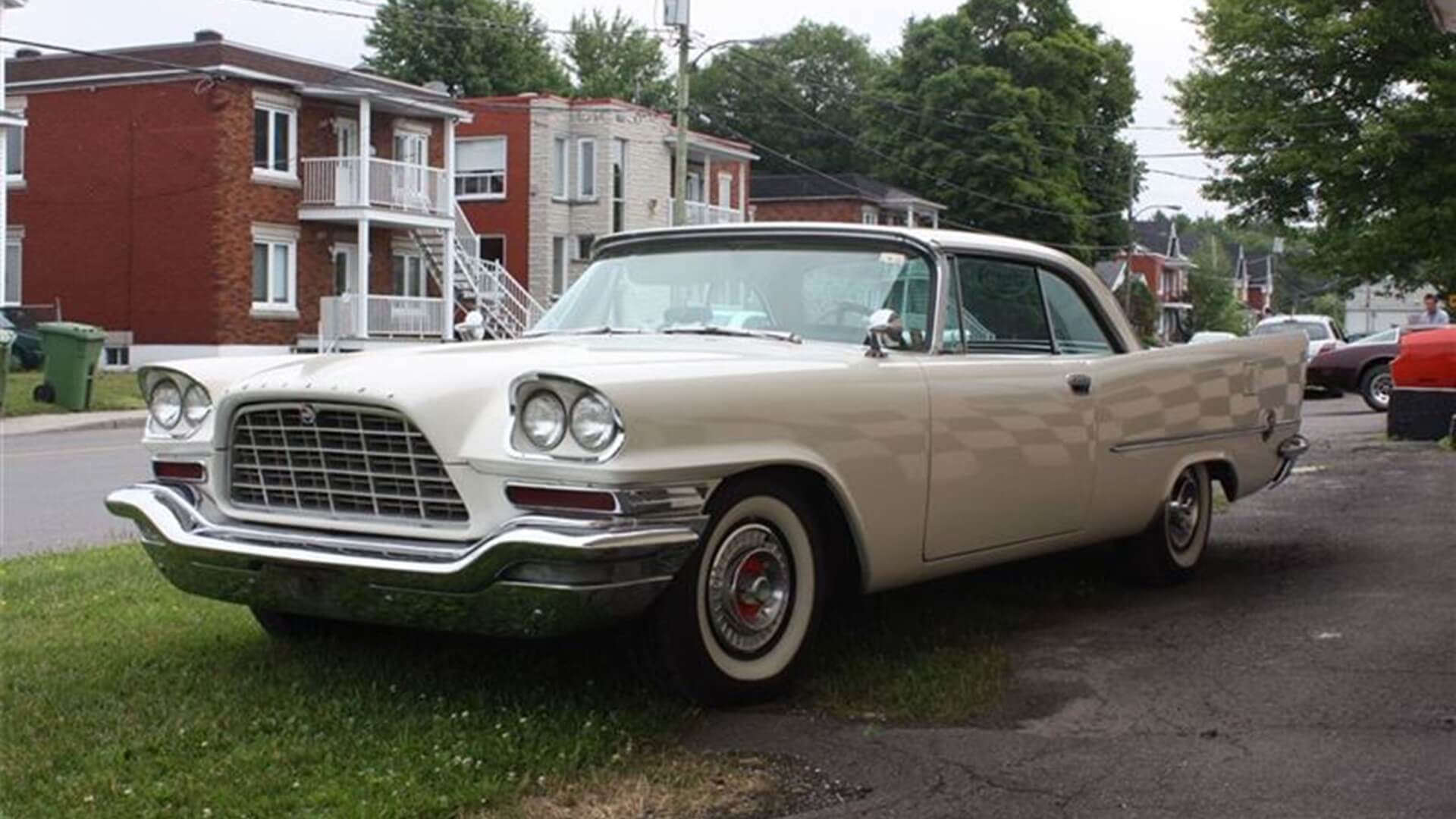
For 1957 every Chrysler Corporation car wore the "Forward Look" styling developed under Virgil Exner, marketed as the "100-Million-Dollar Look". The 300C gained tall rear fins and a new trapezoid grille unlike any earlier Chrysler. Much of the body still came from Chrysler's parts bin, but the letter car was set apart by details:
- a full leather interior;
- very little chrome, with a single spear-like moulding on each rear wing;
- round "300" medallions in red, white and blue on the wings, bonnet, boot lid and glove box;
- rectangular openings below the headlights that ducted cooling air to the front brakes, needed because the 14-inch wheels left little room for large drums;
- single-colour paint only, and no vertical guards on the front bumper.

The convertible, new for 1957, weighed 70 kg more than the hardtop and cost 430 dollars more.
Chassis: torsion bars and TorqueFlite
The 300C used Chrysler's new Torsion-Aire front suspension, in which longitudinal torsion bars replaced the coil springs of the 300B. The rear axle was a hypoid unit with a 3.36:1 ratio as standard. The TorqueFlite three-speed automatic was standard on the 300C, while the 291 kW cars used a manual gearbox.

The old version of this page gave a top speed of 241 km/h and 8 seconds to 100 km/h. We found no reliable source for these figures and have removed them; period tests of the 300C were run in American units and under different methods.
Production and 1957 prices
| Body | 1957 price | Built | Weight |
|---|---|---|---|
| 2-door hardtop sport coupé | 4,929 dollars | 1,918 | 1,921 kg (4,235 lb) |
| 2-door convertible | 5,359 dollars | 484 | 1,991 kg (4,390 lb) |
| 291 kW manual option | - | 18 (of the above) | - |
All 300 letter cars were built in Detroit. The total of 2,402 made the 300C the most successful letter car of the 1950s.

The 300C in Chrysler's history
The letter cars were Chrysler's image models of the late 1950s and early 1960s. The 300B of 1956 won NASCAR races for the team of Carl Kiekhaefer, and the 300C carried the image into the Forward Look era. The broader story of the company is told in our history of Chrysler.

300C compared with its 1957 rivals
| Car (1957) | Engine | Power (gross) | Character |
|---|---|---|---|
| Chrysler 300C | 6.4 l Hemi V8 | 280 kW (375 hp) | big luxury hardtop with racing engine |
| Chevrolet Bel Air (Fuel Injection) | 4.6 l V8 | 210 kW (283 hp) | lighter, cheaper sporty car |
| Ford Thunderbird | 5.1 l V8 | up to about 220 kW (300 hp, supercharged) | two-seat personal car |
The 300C was larger, heavier and much more expensive than the Chevrolet and Ford alternatives, but it had the strongest standard engine. That combination of luxury and power is why many historians see the letter cars as early ancestors of the muscle car, and our comparison tool lets you set a 300C against later cars; our muscle car section follows the type from there.

Buying and collecting a 300C
A 1957 300C is a rare car: only 2,402 were made, and the convertible is far rarer than the hardtop. Points to check:
- Matching numbers: the 392 Hemi, the TorqueFlite and the axle should match the car's records; a marque club such as the Chrysler 300 Club can help to verify a car's history.
- Correct details: leather interior, the red, white and blue medallions, single-colour paint and the brake-cooling ducts.
- The torsion-bar front suspension, and rust in the lower body panels and floors.
- Very rare options: a genuine 291 kW manual car should be documented beyond doubt.

More classic cars of this decade are in our classic cars section, and the brand's later models are in our Chrysler catalogue.

Chrysler 300C Hardtop in our rankings
- No. 86 of 708 · Biggest engines: cars (6,400 cc · top 13%)
- No. 61 of 222 · Biggest engines: coupes (6,400 cc · top 29%)
- No. 122 of 414 · Fastest cars (241 km/h · top 30%)
- No. 339 of 1080 · Most powerful cars (291 kW · top 32%)
- No. 15 of 44 · Fastest American cars (241 km/h · top 35%)
- No. 73 of 197 · Most powerful American cars (291 kW · top 40%)
Bigger engine than 87% of ranked cars in the 1CARS catalog (No. 86 of 708).
Chrysler 300C Hardtop photos 13


FAQ
What engine does the 1957 Chrysler 300C have?
A 392 cubic inch (6.4-litre) Hemi V8 with two four-barrel carburettors, giving 280 kW (375 hp) at 5,200 rpm and 569 Nm. A 291 kW (390 hp) version was fitted to 18 cars.
How many 1957 Chrysler 300Cs were made?
Chrysler built 2,402 cars in 1957: 1,918 two-door hardtops and 484 convertibles. The convertible was offered for the first time in the letter series, and only 18 cars were built with the 291 kW (390 hp) engine.
What does the C in Chrysler 300C mean?
It is the model-year letter. The series began as the C-300 in 1955, became the 300B in 1956 and the 300C in 1957, and continued to the 300L of 1965, skipping the letter I.
How much did a Chrysler 300C cost in 1957?
The hardtop cost 4,929 dollars and the convertible 5,359 dollars in 1957. The convertible therefore cost 430 dollars more, and it was also about 70 kg heavier than the hardtop.
Is the 1957 300C related to the modern Chrysler 300C?
Only by name and by the Hemi tradition. The modern 300C (2004–2023) was a four-door, rear-wheel-drive saloon, while the 1957 car was a limited-production two-door hardtop and convertible.
Data sources
Data checked by an editor against the sources below.
- The text of this article (1cars archive)
- Wikipedia - Chrysler 300 Letter Series


