 Chrysler PT Cruiser
Specs, engines and history
Published Sources (1) Report an error
By Sarah Whitmore, Senior Automotive Writer
Verdict
Our verdict · Sarah Whitmore
The PT Cruiser has gone down in history as one of Chrysler's most flamboyant models, and its unusual design brought the company solid commercial success. Apart from the styling, it is an ordinary compact car: practical and roomy inside with a big boot, but with a dated cabin, low ground clearance and mediocre handling. Even more than 20 years on, it still turns heads.
The Chrysler PT Cruiser is a retro-styled compact car built by the American company Chrysler. It was made as a five-door hatchback from 2000 and as a two-door convertible from the 2005 model year, and production ended in July 2010. The PT Cruiser was first shown at the Detroit motor show in 1999.
In short
- Built 2000–2010 in Toluca, Mexico, and Graz, Austria; about 1.35 million were made.
- Petrol engines from 1.6 to 2.4 litres, including 2.4 turbos with up to 169 kW (230 hp), and Mercedes-Benz diesels with 89 and 110 kW (121 and 150 PS).
- Five-speed manual or four-speed automatic, front-wheel drive only.
- A versatile cabin with a 538-litre boot and up to 1,800 litres with the rear seats removed.
Chrysler PT Cruiser at a glance
Chrysler was known for large cars with a hint of luxury, but at the end of the 1990s it decided to experiment with a small retro-styled car aimed at young, active people. Nobody knew how it would turn out - and it became a commercial success. More Chrysler models are listed in our Chrysler catalogue, and the company's history is told in our history of the Chrysler Corporation.
| Item | Detail |
|---|---|
| Debut | Detroit motor show, 1999 |
| Production | 2000–2010 |
| Plants | Toluca (Mexico); Graz (Austria) |
| Bodies | Five-door hatchback; two-door convertible (2005–2007 model years) |
| Facelift | 2006 model year |
| Total built | About 1.35 million |
The PT Cruiser was originally planned as a Plymouth, but by the time the production car appeared, the Plymouth brand was in decline and was soon discontinued, so the car was launched as a Chrysler. The letters PT stand for "Personal Transport" or "Personal Transportation".
Exterior
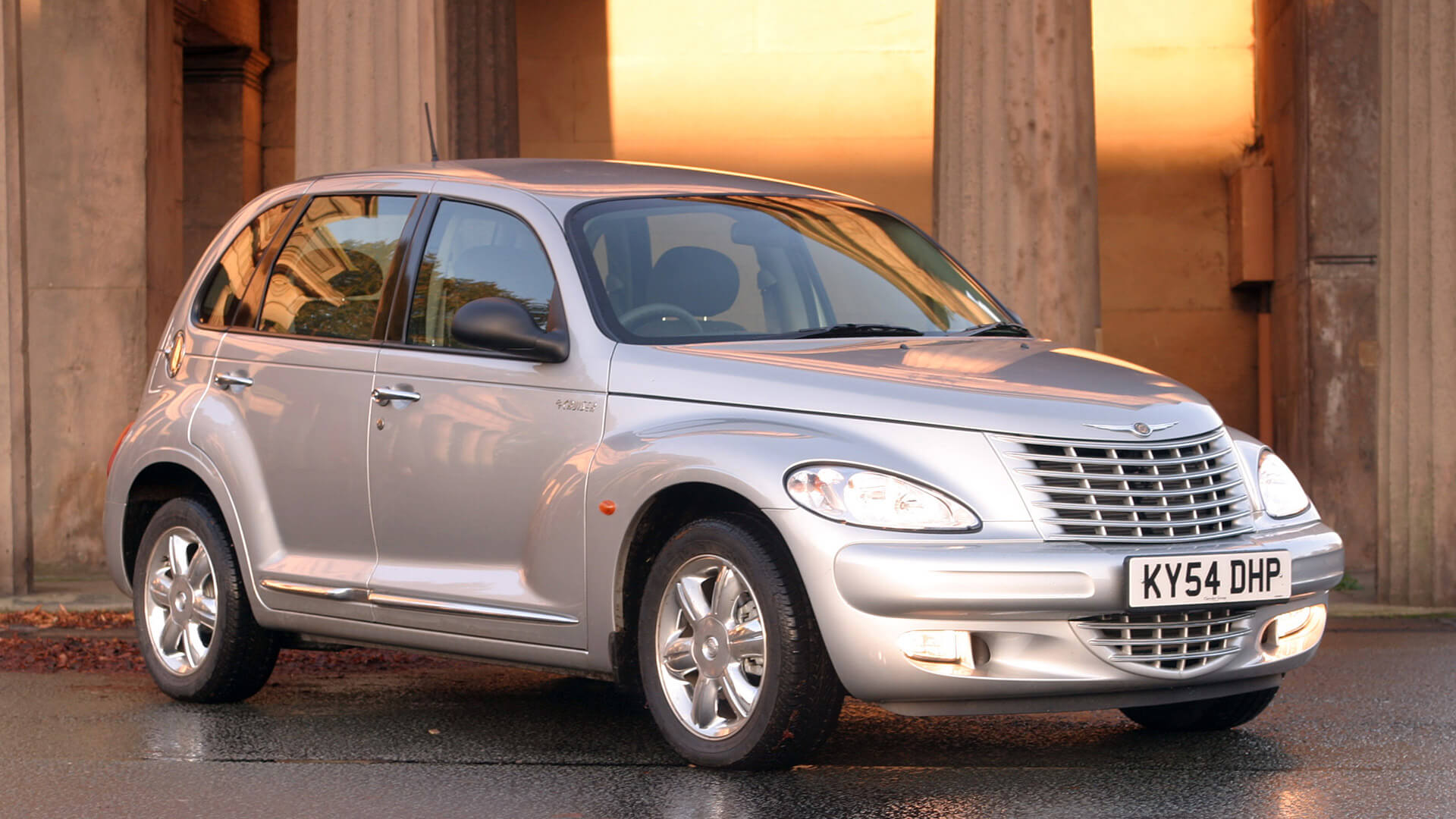
Ask anyone what sets this model apart, and they will mention its unconventional, vintage-inspired design. The PT Cruiser has rounded body lines and a bulging bonnet, and its massive grille - not chrome-trimmed on the early car - sits between front wings that rise above the bonnet line; the headlights are set into them. The front bumper has a large moulding, below which sit an air intake and deeply recessed fog lamps. After the facelift the bumper looked more conventional, the moulding no longer seemed like a separate element, and the Chrysler grille gained horizontal slots and the winged badge, with scalloped headlights and available round fog lamps.
The profile is interesting, with pronounced wings and wheel arches; at times the car almost looks like a crossover, although it is officially a five-door hatchback. There is an attractive crease on the doors and a chrome moulding. Standard wheels are 16 inches, with 17-inch alloys optional. After the facelift, chrome trim on the wheels, mouldings and fuel flap freshened the look.
The rear is fairly simple: a small spoiler, an almost flat tailgate and compact tail lights mounted on the body rather than the tailgate. The rear bumper does not protrude much and carries additional lights, and the Chrysler badge sits in the centre of the tailgate. The facelift brought redesigned tail lights and a new spoiler that improved aerodynamics.
Interior
It would be strange if the retro theme stopped at the exterior, and it does not: the dashboard architecture in particular has retro touches. The driver faces a thin-rimmed four-spoke steering wheel - a drawback, as it can slip through the hands when turned quickly. Behind it, the instruments sit in deep, separate cowls, almost like three separate panels: the speedometer in the centre, the rev counter on the right and the fuel and temperature gauges on the left. Dark numerals on a white background give excellent contrast and readability.
The centre console has toggles for the climate controls, flanked by two round air vents. Everything is simple and clear, although the knobs look old-fashioned, and the audio buttons have very small lettering. A small round clock sits at the top of the console, and storage spaces at the bottom. The plastics are typically hard and cheap. Higher trims have full electric equipment, cruise control and a hi-fi audio system; the facelift added a line-in jack and optional satellite radio and Bluetooth.
The driver's seat is soft and shapeless; it suits people of any build, but on long trips the driver's back can go numb after an hour. There is no large central armrest, but each front seat has its own narrow one. Between the seats are the parking-brake lever and a tall, slim gear lever, and closer to the console a pair of cupholders and a lighter socket. Visibility is poor; the high seating position is meant to compensate but is not very comfortable either. There are three 12 V sockets, and with the rear seats removed the flat floor reveals additional boxes and compartments.
The rear seat is cramped: even passengers 175 cm tall lack knee room, and width is limited, so only two people sit comfortably. The boot, on the other hand, is a pleasant surprise: 538 litres, a lot for this class, and up to 1,800 litres with the rear seats removed.
Engines and transmissions
| Engine | Fuel | Power | Torque |
|---|---|---|---|
| 1.6 four-cylinder | Petrol | 85 kW (116 PS) | 157 Nm |
| 2.0 four-cylinder, DOHC | Petrol | 103 kW (140 hp) | 188 Nm |
| 2.4 four-cylinder, DOHC | Petrol | 105 kW (143 PS) | 229 Nm |
| 2.4 turbo | Petrol | 134 kW (180 hp) | 285 Nm |
| 2.4 turbo (GT) | Petrol | 158–169 kW (215–230 hp) | 332 Nm |
| 2.1 CRD (Mercedes-Benz), 8 valves | Diesel | 89 kW (121 PS) | 300 Nm |
| 2.1 CRD (Mercedes-Benz), 16 valves | Diesel | 110 kW (150 PS) | 300 Nm |
All engines are four-cylinders and drive the front wheels. The petrol versions reach 100 km/h in 7.0–13.5 seconds and have top speeds of about 176–193 km/h. The diesels, sold in Europe, Asia and South Africa, use about 7 l/100 km on the combined cycle, reach 100 km/h in 10–12 seconds and top out at 183 km/h.
Every engine could be paired with a five-speed manual gearbox, while the four-speed automatic was offered only with the 2.0 and 2.4. The automatic will not thrill keen drivers, but there are no real complaints about it.
Chassis
The suspension is tuned in a classic American way: soft, which makes the car roll. The brakes bite hard. The PT Cruiser handles acceptably, but body roll and strong understeer are noticeable. When the front end starts to slide, it happens abruptly, but it is easily corrected by lifting off the throttle.
Safety
In 2002 Euro NCAP gave the PT Cruiser three out of five stars. It performed poorly in the frontal test, scoring 6 of 16 points, mainly because of high loads on the legs and knees, but achieved the maximum 16 points in the side test thanks to the high seating position and side airbags. In the United States the Insurance Institute for Highway Safety rated it "Good" for frontal crash protection but "Poor" in the side test, and the PT Cruiser was the only car in its class without electronic stability control. It cannot be called a very safe car, although it has remote central locking, an alarm with immobiliser, four airbags and traction control.
What owners say
Owners praise the versatile cabin, decent plastics and leather, galvanised body and good paintwork. The car is easy to repair, roomy and warm inside and has original looks. On the downside, some parts can be hard to find, the suspension is weak and visibility is poor, and the interior now looks very basic and dated.
Rivals
The PT Cruiser has few real rivals, and not many drivers truly appreciate its original design. Alternatives include the Chevrolet HHR, Suzuki Liana, Kia Cee'd and Hyundai i30. Its big boot and flexible rear seats make it a very practical choice.
Chrysler PT Cruiser in our rankings
In production longer than 57% of ranked nameplates in the 1CARS catalog (No. 362 of 912).
FAQ
When was the Chrysler PT Cruiser made?
From 2000 to July 2010; the convertible was built for the 2005–2007 model years.
What does PT stand for in PT Cruiser?
Personal Transport, or Personal Transportation.
Where was the Chrysler PT Cruiser built?
Mainly in Toluca, Mexico, and also in Graz, Austria, for markets outside North America.
How big is the Chrysler PT Cruiser boot?
538 litres, and up to 1,800 litres with the rear seats removed.
Data sources
Data checked by an editor against the sources below.