Jensen — West Bromwich's V8 grand tourers, from the 541 to the FF
Jensen Motors was a British maker of fast grand tourers from West Bromwich, England, run for its first decades by the brothers Alan and Richard Jensen. It is best known for the Interceptor of 1966, an Italian-styled coupé with a big Chrysler V8, and for the FF, the first production road car with four-wheel drive and anti-lock brakes. Jensen also built bodies and complete cars for other makers, from Austin-Healey to Volvo. The company went into receivership in 1975, and later revivals built only small numbers.
Key takeaways
- The firm began as W J Smith & Sons; the Jensen brothers took control in 1934 and renamed it Jensen Motors.
- The fibreglass-bodied 541 of 1954 was followed by the C-V8 of 1962 with a 6-litre Chrysler V8.
- Jensen built 6,408 Interceptors from 1966 to 1976 and about 320 FFs from 1966 to 1971.
- The Jensen-Healey sports car of 1972–1976 used a Lotus 907 engine; 10,503 were built.
Jensen at a glance
| Fact | Value |
|---|---|
| Origin | W J Smith & Sons (1922); Jensen Motors from 1934 |
| Founders | Alan Jensen (1906–1994) and Richard Jensen (1909–1977) |
| Base | West Bromwich, England (Carters Green works) |
| Best-known cars | 541, C-V8, Interceptor, FF, Jensen-Healey |
| Contract work | Austin A40 Sports, Austin-Healey bodies, Volvo P1800, Sunbeam Tiger |
| Owners | Norcros (1959), William Brandt's (1968), Kjell Qvale (1970) |
| Receivership | September 1975; premises auctioned August 1976 |
| Revivals | Interceptor Series 4 (1980s), S-V8 (2001), Jensen International Automotive (2010) |
The Jensen brothers and W J Smith
The company that became Jensen Motors was founded in 1922 as W J Smith & Sons Limited. In 1926 the young brothers Alan and Richard Jensen built a boat-tailed body on an Austin Chummy, and between 1929 and 1933 Alan designed the Standard Avon open two-seaters for the New Avon Body Company. In May 1931 Smith's announced the Jensen Wolseley Hornets.
W J Smith died in 1934. The brothers gained a controlling stake and renamed the firm Jensen Motors Limited. That year the film star Clark Gable commissioned a Jensen-bodied car on a Ford V8 chassis. The design that began as the "White Lady" became the S-type, in production from 1935, and in the late 1930s commercial vehicles were sold under the JNSN name.
During the Second World War the factory made military parts, including tank turrets, ambulances and fire engines. The PW saloon appeared in 1946, and the designer Eric Neale joined the company that year.
Interceptor I, the 541 and contract work
The first car called Interceptor was a coupé built from 1950 to 1957 at the Carters Green factory. Jensen also built for others. From 1951 to 1953 it made more than 4,000 Austin A40 Sports. In 1952 BMC picked another company's design for its new sports car, but Jensen won the contract to build the bodies of the Austin-Healey 100. By the end of 1960 about 350 of Jensen's 850 workers were building Austin-Healey cars.
The Jensen 541 was first shown at the London Motor Show in October 1953 and was built from 1954 to 1959. Its fibreglass body sat on a steel chassis, and a 4.0-litre Austin six-cylinder gave a claimed 101 kW (135 bhp). The Motor magazine measured 186.4 km/h in 1955 with an overdrive car. From 1956 the 541 Deluxe had Dunlop disc brakes front and rear. Only 226 were made.
In June 1959 Norcros Limited bought Jensen. The company finished bodies for the Volvo P1800 from 1960 to early 1963. In October 1962 the C-V8, with a 6-litre Chrysler V8, replaced the 541S. Jensen also assembled the Sunbeam Tiger until its contract ended at the end of 1967.

The Interceptor and the FF, 1966–1976
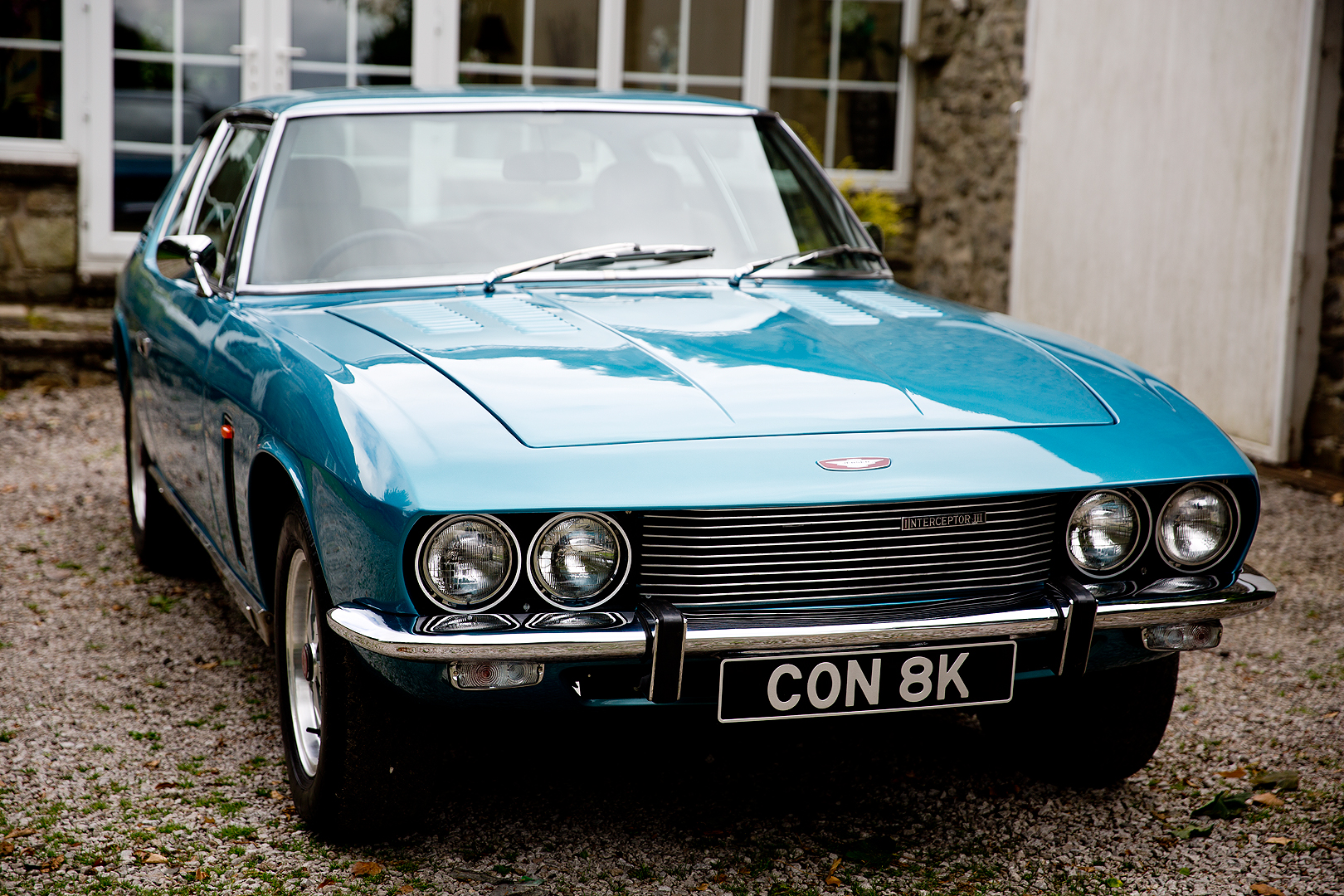
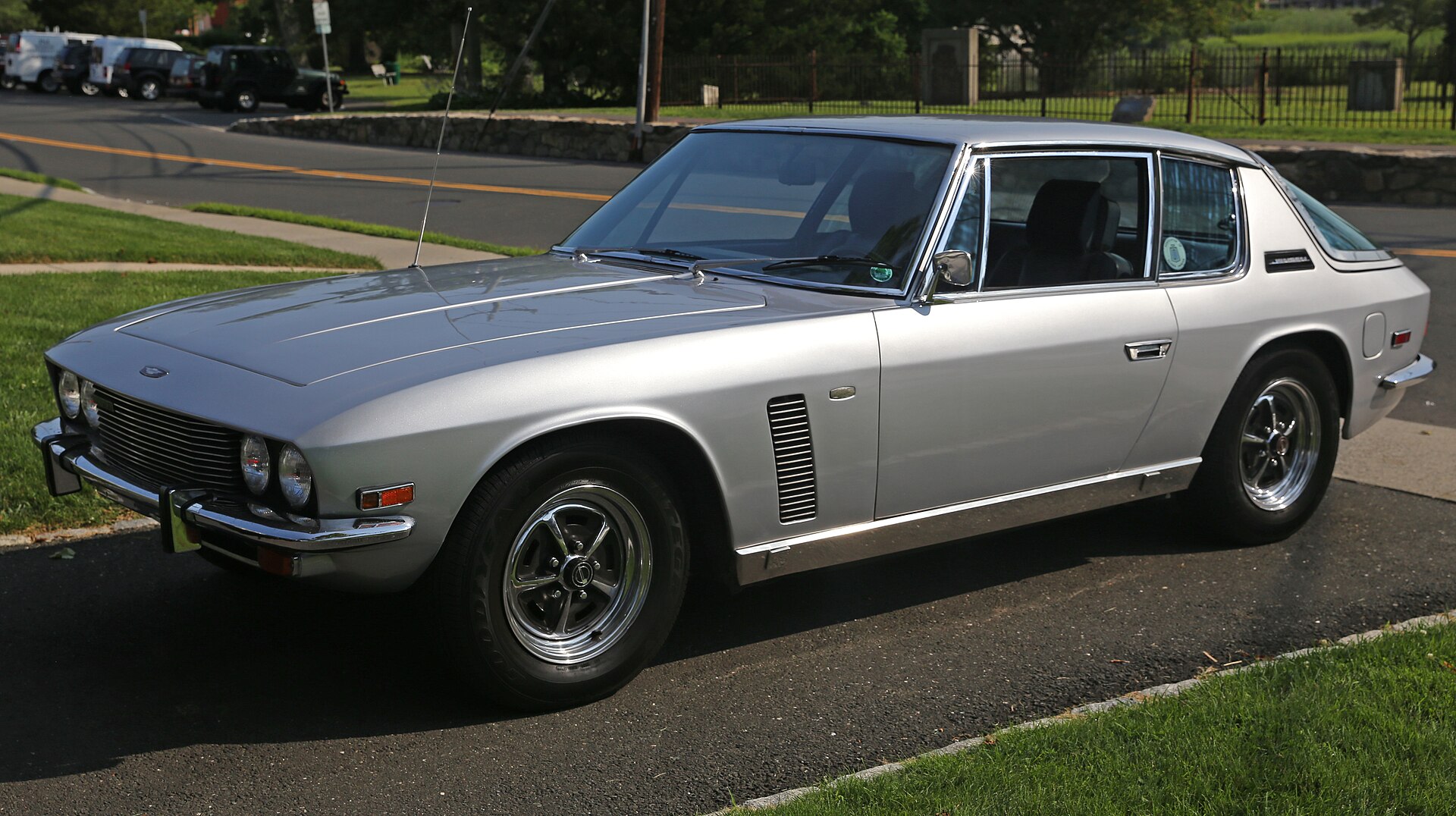
The car that defined Jensen arrived in 1966. The new Interceptor had a steel body designed by Carrozzeria Touring of Italy, credited to Federico Formenti, and the first bodies were built by Vignale before production moved to West Bromwich. Under the bonnet was a Chrysler V8: first the 383 cu in (6.3-litre) and from 1971 the 440 cu in (7.2-litre). In 1970 the 6.3-litre was rated at 250 kW (335 hp) SAE gross.
The FF was the more radical sister. It used the same 6,277 cc V8 but added the Ferguson Formula four-wheel-drive system and Dunlop Maxaret anti-lock brakes. It was the first production car outside the off-road class with both features, and it was 127 mm longer than the Interceptor. Jensen showed an early FF at Earls Court in October 1964 and built about 320 between 1966 and 1971.
| Interceptor family | Years | Built |
|---|---|---|
| FF (four-wheel drive) | 1966–1971 | About 320 |
| Interceptor SP (six-carburettor 440) | From 1971 | 232 |
| Interceptor convertible | From 1974 | 267 |
| Interceptor coupé | 1975 | 60 |
| All Interceptors | 1966–1976 | 6,408 |
The Mk II was announced in October 1969 and the Mk III in 1971. Owners changed too. The founders resigned from the board in 1966 after disagreements, William Brandt's Sons and Co bought the company in 1968, and the end of the Austin-Healey and Sunbeam contracts in 1967 made Jensen a full-time car maker.

Jensen-Healey and receivership
In 1970 the San Francisco dealer Kjell Qvale, the largest Austin-Healey dealer in the United States, became majority shareholder, and Donald Healey became chairman. Their joint project, the Jensen-Healey, was announced in March 1972. It had a 1,973 cc twin-cam, 16-valve Lotus 907 four-cylinder with about 107 kW (144 bhp). A fastback version, the Jensen GT, followed in September 1975.
| Model | Years | Built |
|---|---|---|
| Jensen-Healey Mk I | July 1972 – August 1973 | 3,357 |
| Jensen-Healey Mk II / JH5 | August 1973 – August 1975 | 7,146 |
| Jensen GT | September 1975 – May 1976 | 509 |
The timing was bad. The 1973 oil crisis hit sales of the big V8 Interceptor, engine supply was difficult, and strikes, parts shortages and inflation added to the losses. Output reached 86 cars a week in 1974, but in July 1975 the company announced redundancies affecting 700 workers. In September 1975 Bank of America appointed a receiver, production ended in May 1976, and the empty premises were auctioned in August 1976.

Revivals after 1976
Parts and service work continued as Jensen Parts & Service. In 1982 Ian Orford bought the rights to the name and revived the Interceptor. The Series 4 of the late 1980s used a 5.9-litre Chrysler V8 of about 186 kW (250 bhp), and roughly 36 were built before that company was liquidated in 1993.
A new two-seater, the S-V8, was launched at the British International Motor Show in 1998. Only 110 orders had come in by October 1999, against a plan of 300. Production started at Speke, Liverpool, in August 2001, but only 20 cars left the factory before the company went into administration in July 2002. In 2010 Jensen International Automotive was set up to rebuild and update Interceptors; deliveries of the Interceptor R began in early 2011.
The Jensen models on 1cars are in the Jensen catalogue, and the most famous car has its own page on the Jensen Interceptor, FF and SP. Cars that Jensen built for others include the Austin-Healey 3000 and the Sunbeam Tiger. Another European GT with a Chrysler V8 is the Facel Vega HK500.

Jensen timeline
| Year | Event |
|---|---|
| 1922 | W J Smith & Sons founded |
| 1934 | Brothers take control; Jensen Motors Limited |
| 1935 | S-type in production |
| 1950 | First Interceptor |
| 1952 | Austin-Healey 100 body contract |
| 1954 | Fibreglass 541 in production |
| 1959 | Norcros buys Jensen |
| 1962 | C-V8 with a Chrysler V8 |
| 1966 | Interceptor and FF in production |
| 1970 | Kjell Qvale majority shareholder |
| 1972 | Jensen-Healey announced |
| 1975 | Receiver appointed (September) |
| 1976 | Production ends (May); premises auctioned (August) |
| 2001 | S-V8 production at Speke |
| 2010 | Jensen International Automotive founded |
Landmark Jensen models
| Model | Years | Why it matters |
|---|---|---|
| 541 | 1954–1959 | Fibreglass GT; disc brakes from 1956 |
| C-V8 | 1962–1966 | First Jensen with a Chrysler V8 |
| Interceptor | 1966–1976 | Touring-styled V8 coupé; 6,408 built |
| FF | 1966–1971 | First production road car with 4WD and ABS |
| Jensen-Healey | 1972–1976 | Lotus-engined sports car; 10,503 built |
Photo gallery

FAQ
Who founded Jensen?
The brothers Alan and Richard Jensen. They took control of W J Smith & Sons in 1934 and renamed it Jensen Motors.
What engine did the Jensen Interceptor use?
Chrysler V8s: the 6.3-litre 383 from 1966 and the 7.2-litre 440 from 1971.
Why is the Jensen FF important?
It was the first production road car outside the off-road class with four-wheel drive (Ferguson Formula) and anti-lock brakes (Dunlop Maxaret).
How many Jensen Interceptors were made?
6,408 between 1966 and 1976, plus about 320 FFs.
Why did Jensen Motors close?
The 1973 oil crisis hurt sales of the V8 cars, and engine supply problems, strikes and inflation caused heavy losses. A receiver was appointed in September 1975, and production ended in May 1976.
Sources
- Wikipedia — Jensen Motors (accessed 24 Oct 2026)
- Wikipedia — Jensen Interceptor (accessed 24 Oct 2026)
- Wikipedia — Jensen FF (accessed 24 Oct 2026)
- Wikipedia — Jensen-Healey (accessed 24 Oct 2026)
- Wikipedia — Jensen 541 (accessed 24 Oct 2026)
Found a mistake? Report an error