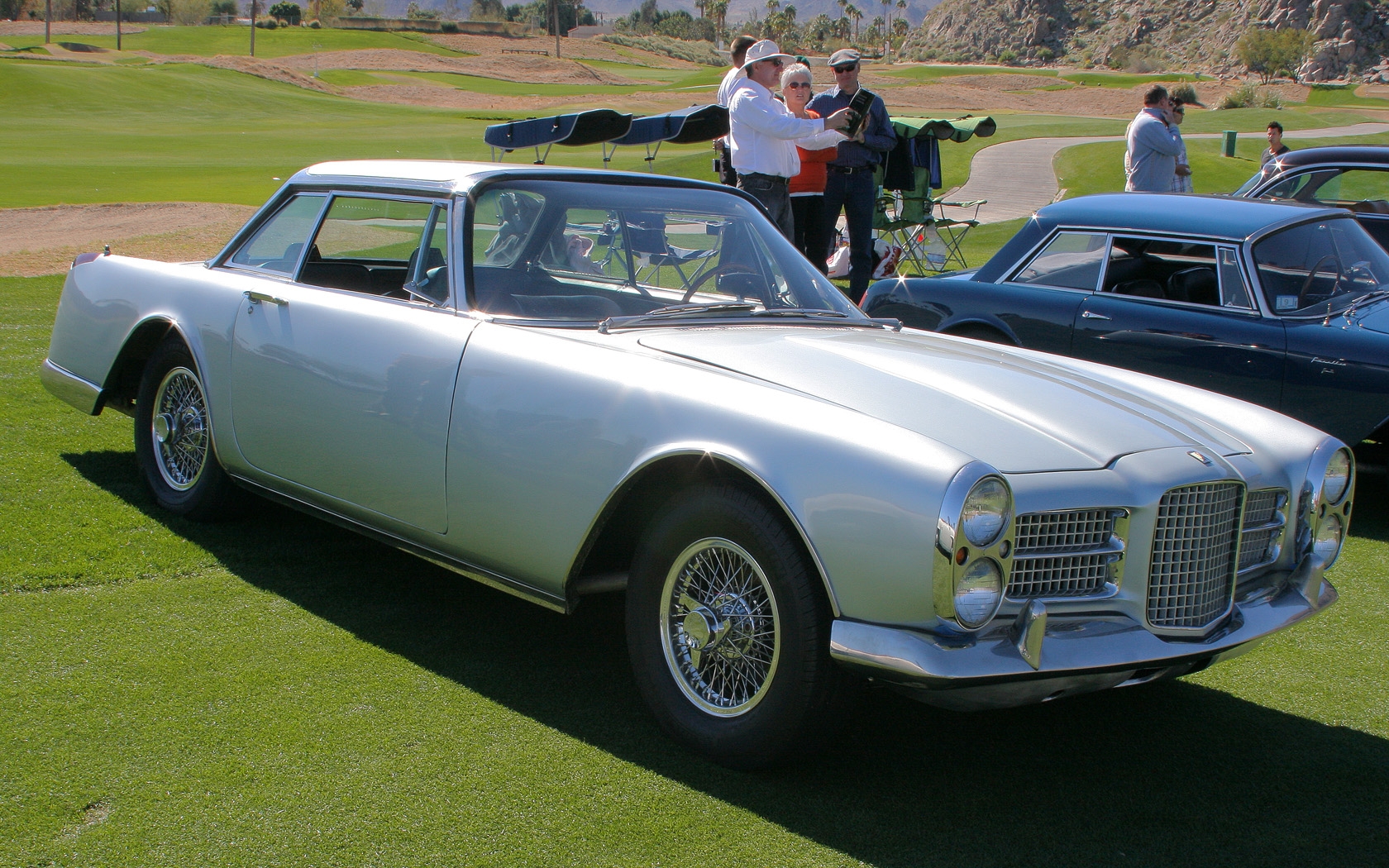
 Facel Vega HK500
Specs, engines and history
Published Sources (1) Report an error
By Oleksandr Hnatiuk, Automotive Editor & Used Car Specialist
- Built
- 1959–1962
- Top power
- 265 kW (360 PS)
Which Facel Vega HK500 to choose
Our verdict · Oleksandr Hnatiuk
- For performance: a later car with the 6.3-litre V8 and 265 kW (360 hp).
- For safer braking: a car built from April 1960, when front disc brakes became standard.
- For driving involvement: a car with the Pont-à-Mousson four-speed manual gearbox.
- For an alternative: the Facel II, the final V8 coupé, of which only 183 were built.
Facel, short for Forges et Ateliers de Construction d'Eure-et-Loir, was set up on 20 December 1939 by Bronzavia, a French military aircraft subcontractor, to make special components. Jean Daninos, who had worked at Citroën, ran it from 1945. After the war Facel built short-run bodies for Panhard, Simca, Ford France and Delahaye, among them the Ford Comète of 1951. On 22 July 1954 Daninos created his own marque, Facel Vega, named after the star Vega, and in October 1954 the first cars were shown at the Paris Motor Show. Facel built about 2,900 cars of all kinds before production stopped in 1963–1964, and English Wikipedia quotes the verdict that it "lost money on every car they built".
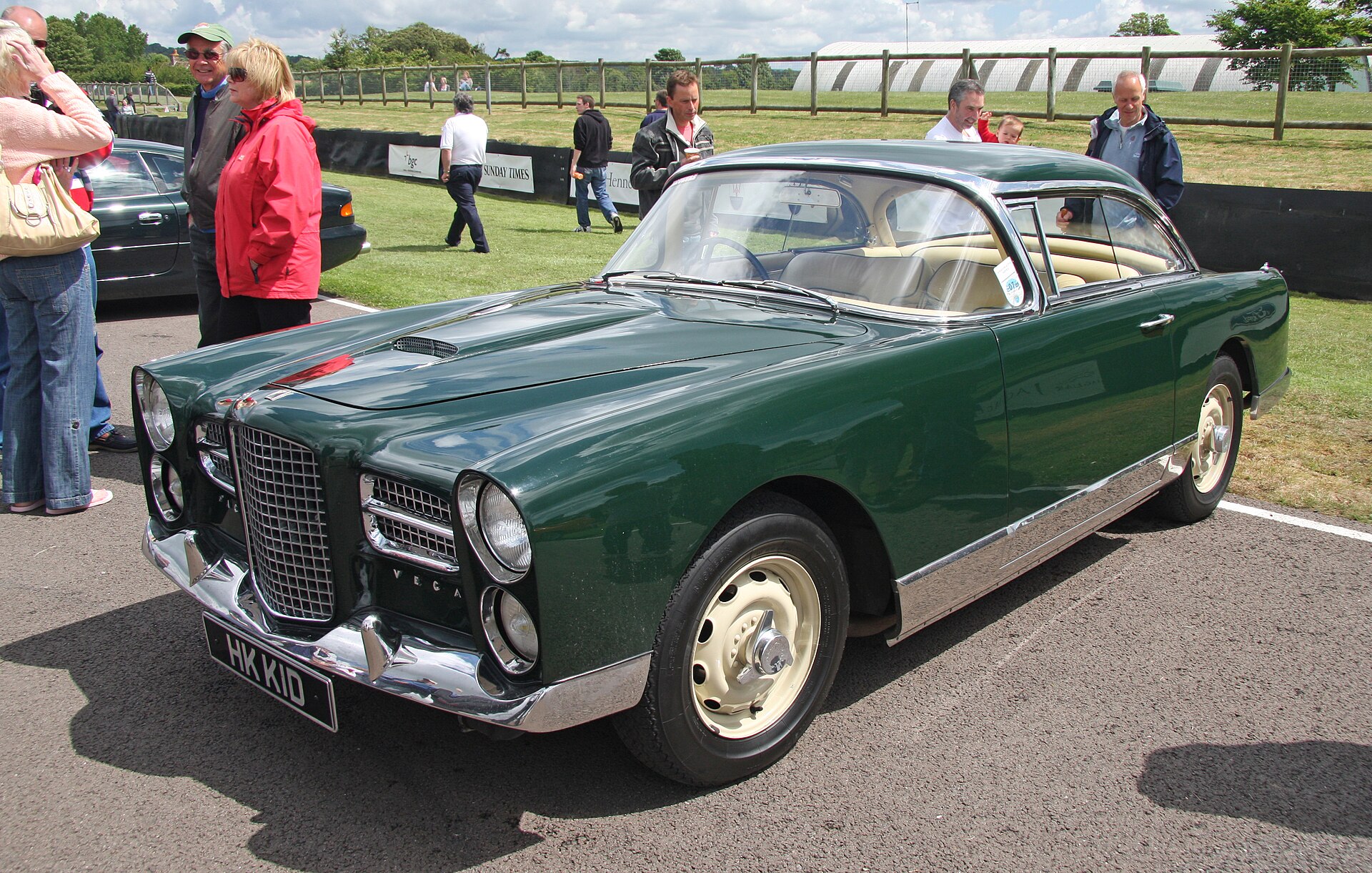
The HK500 is the best known Facel Vega: a fast French grand tourer with a big Chrysler V8. Introduced for 1959 as a renamed and improved version of the FV coupé, it was built until 1962, when the Facel Vega II replaced it. With 489 cars it was Facel's most successful V8 model, and its customers included film stars, racing drivers and royalty.
Specs by version
Verified Manufacturer and type-approval data from our catalog · Sources and methodology
In short
- Built 1959–1962 in France; 489 cars, the most of any Facel V8 model.
- Chrysler V8 of 5.8 litres with 246 kW (335 hp), later 6.3 litres with 265 kW (360 hp).
- Top speed 147 mph (237 km/h) and 0–60 mph in 8.5 seconds, according to English Wikipedia.
- Front disc brakes optional at first, standard from April 1960; tubular frame and leaf-sprung live rear axle.
Facel Vega HK500 at a glance
| Parameter | Value |
|---|---|
| Maker | Facel S.A., France |
| Production | 1959–1962 |
| Built | 489 |
| Predecessor / successor | Facel Vega FV and FVS / Facel Vega II |
| Body | two-door coupé |
| Chassis | welded tubular frame; double wishbones and coil springs at the front, leaf-sprung live rear axle |
| Engines | Chrysler V8: 5.8 litres, 246 kW (335 hp); 6.3 litres, 265 kW (360 hp) |
| Gearbox | four-speed manual by Pont-à-Mousson (extra cost) or Chrysler automatic |
| Brakes | front discs, optional at first, standard from April 1960 |
| Wheelbase | 2,660 mm (German Wikipedia) |
| Top speed | 237 km/h (147 mph), English Wikipedia; 210–230 km/h, German Wikipedia |
| 0–60 mph | 8.5 s |
| Fuel consumption | 16.5 l/100 km (German Wikipedia) |
Jean Daninos and Facel before the Vega
German Wikipedia adds detail on the founder and the early business. Jean Daninos had worked at Citroën, where he helped develop the Traction Avant, and later as a designer at an aircraft plant. Facel made stamped metal parts, furniture, kitchens and aircraft parts. From 1945 it was linked with Métallon, a tie that lasted until January 1953, and its body division dates from 1948. Facel also built a Bentley Cresta body on a Bentley Mark VI chassis. The company's address was 19 Avenue George V in Paris, and the Facel Vega name was suggested by Pierre Daninos, after the star Vega.
From the FV to the HK500
The FV of 1954 already had the formula: a tubular frame designed by Lance Macklin, styling by Jean Daninos and an American V8 at the front. Its body was an enlarged version of the Facel-built Simca and Ford Comète. Over five years the engine grew steadily:
| Model | Year | Engine | Power |
|---|---|---|---|
| FV | 1954 | DeSoto Hemi V8, 4.5 l | 132 kW (180 hp) |
| FV1 | 1955 | 4.8 l | 147 kW (200 hp) |
| FV2 / FVS | 1955 | 4.8 l | 184 kW (250 hp) |
| FV2B | 1956 | 5.4 l | 210 kW (285 hp) |
| FV3 | 1957 | Plymouth "277" V8, 4.5 l | 147 kW (200 hp) |
| FV3B | 1957 | "301" V8 | 186 kW (253 hp) |
| FV4 | 1958 | 5.8 l | 239 kW (325 hp) |
| HK500 | 1959 | 5.8 l, later 6.3 l | 246 kW (335 hp), later 265 kW (360 hp) |
English Wikipedia counts 357 FVs and FVSs, so with the HK500 the series reached 842 or 846 cars, depending on the source. In the United States the FV2 was sold as the FVS.

Engine and performance
The HK500 started with a 5.8-litre Chrysler V8 of 246 kW (335 hp), later replaced by a 6.3-litre unit of 265 kW (360 hp). German Wikipedia describes the HK1 of spring 1959 with the Chrysler 383 engine and up to 291 kW (390 hp SAE). It notes that the papers often show 5.9 litres because of French tax rules. The buyer could choose a Chrysler automatic or, at extra cost, a four-speed manual gearbox from Pont-à-Mousson.
English Wikipedia gives a top speed of 147 mph (237 km/h) and 0–60 mph in 8.5 seconds; German Wikipedia gives 210–230 km/h. German Wikipedia also compares fuel use. It gives 16.5 litres per 100 km for the HK500, against 15.0 for the Ferrari 250 GT, 15.7 for the Mercedes-Benz 300 SL and 15.5 for the Aston Martin DB4. The fuel cost calculator shows what 16.5 litres per 100 km means at today's prices. The engines themselves came from the company described in the history of the Chrysler Corporation.

Chassis, brakes and equipment
The frame is welded from tubes. German Wikipedia describes the layout of the FV series. It has double wishbones with coil springs and an anti-roll bar at the front, a Salisbury live axle on leaf springs at the rear, and hydraulic dampers all round. The earlier FV and FV1 had 280 mm aluminium drum brakes, and servo assistance arrived with the FV2B. Front disc brakes became available in 1958; on the HK500 they were an option at first and standard from April 1960. For the HK1, German Wikipedia lists discs of 308 mm at the front and 295 mm at the rear. Power steering was optional, and the electrics changed from 6 to 12 volts.

The Facel family: Excellence, Facellia and Facel II
The HK500 was one of several Facel models, and the others explain both the company's reputation and its fall.
| Model | Years | Engine | Built (German Wikipedia) |
|---|---|---|---|
| Excellence | 1958–1964 | Chrysler V8, 4.8 to 6.4 l | 152 |
| HK500 | 1959–1962 | Chrysler V8, 5.8 and 6.3 l | 489 |
| Facellia | from 1960 | own 1,647 cc twin-cam four, 85 kW (115 PS) | 1,258 |
| Facel II | from December 1961 | Chrysler V8, 6.3 l | 1 prototype + 183 |
| Facel III | from April 1963 | Volvo B18, 1,780 cc, 79 kW (108 PS) | about 400 |
| Facel 6 | from August 1964 | 2,852 cc six from the Austin-Healey 3000 engine, 110 kW (150 PS) | 43 |
The four-door Excellence was a pillarless hardtop saloon with rear-hinged rear doors. The small Facellia was announced in 1959 and sold from March 1960. Its engine had only two camshaft bearings and suffered failures, high oil consumption and burned pistons. Those problems hurt the brand. German Wikipedia counts 1,174 V8 cars in total, including 11 cabriolets; English Wikipedia says 77 % of V8 production was exported.

Owners and the Camus accident
Facel Vegas were bought by a remarkable list of people. English Wikipedia names Pablo Picasso, Ava Gardner, Christian Dior, Stirling Moss, Frank Sinatra, Dean Martin, Fred Astaire and Debbie Reynolds. German Wikipedia adds the Shah, King Hassan II and Ringo Starr. In Germany, the importer Auto Becker of Düsseldorf sold 67 Facel Vegas from 1958.
The marque is also linked to a death. On 4 January 1960 the publisher Michel Gallimard lost control of his Facel Vega FV2 near Villeblevin. He and his passenger, the Nobel Prize-winning writer Albert Camus, were killed. Some sources suggest that Gallimard's unfamiliarity with the car's handling played a part.
The end of Facel
Jean Daninos resigned in August 1961, and André Belin, a former oil executive, took over. The company passed under the control of SFERMA, a subsidiary of Sud Aviation. Production stopped in 1963, and the factory closed at the end of October 1964. The HK500's successor, the Facel II, was longer and faster, and Paul Frère measured 247 km/h in a manual car, but it could not save the company.
| Date | Event |
|---|---|
| 20 December 1939 | Facel founded by Bronzavia |
| 1945 | Jean Daninos takes over |
| 22 July 1954 | Facel Vega marque created |
| October 1954 | first Facel Vega shown at the Paris Motor Show |
| 1959 | HK500 introduced |
| 4 January 1960 | Albert Camus killed in a Facel Vega FV2 |
| April 1960 | front disc brakes standard on the HK500 |
| August 1961 | Daninos resigns |
| 1962 | Facel Vega II replaces the HK500 |
| end of October 1964 | factory closes |
More cars of the period are in the 1950s classics and 1960s classics sections.
Photo gallery

Facel Vega HK500 in our rankings
- No. 10 of 56 · Most powerful French cars (265 kW)
- No. 77 of 557 · Biggest engines: cars (6,279 cc · top 14%)
- No. 52 of 173 · Biggest engines: coupes (6,279 cc · top 31%)
- No. 338 of 859 · Most powerful cars (265 kW · top 40%)
- No. 180 of 313 · Most powerful coupes (265 kW · top 59%)
- No. 99 of 154 · Most powerful V8 cars (265 kW · top 65%)
Bigger engine than 86% of ranked cars in the 1CARS catalog (No. 77 of 557).
FAQ
How many Facel Vega HK500 were built?
489 between 1959 and 1962, the most of any Facel V8 model.
What engine does the Facel Vega HK500 have?
A Chrysler V8: first of 5.8 litres with 246 kW (335 hp), later of 6.3 litres with 265 kW (360 hp).
How fast is the Facel Vega HK500?
English Wikipedia gives 147 mph (237 km/h) and 0–60 mph in 8.5 seconds; German Wikipedia gives a top speed of 210–230 km/h.
What car was Albert Camus killed in?
A Facel Vega FV2, the predecessor of the HK500, driven by Michel Gallimard, on 4 January 1960.
What replaced the Facel Vega HK500?
The Facel Vega II, introduced in December 1961 and sold from 1962.
Data sources
Data checked by an editor against the sources below.