
 Honda CR-Z
Specs, engines and history
Updated Published Sources (6) Report an error
By Felix Hartmann, Automotive Technology & EV Contributor Reviewed by Oleksandr Hnatiuk

- Built
- 2010–2016
- Top power
- 97 kW (132 PS)
Which Honda CR-Z to buy
Our verdict · Felix Hartmann
A 2013 or later car with the lithium-ion battery, the 97 kW system and the S+ button is the best buy. Choose the six-speed manual; it suits the car's character and keeps the driving engaging. The CR-Z is best suited to a single driver or a couple who want a distinctive, economical coupé for town and country roads. Families should look elsewhere, because the rear seats are tiny or absent. When buying, ask for proof of IMA battery health, check the clutch on manual cars and look for software updates. If you want more speed from Honda, the Honda Civic Si is a quicker alternative.
The Honda CR-Z is a compact three-door hybrid coupé built from 2010 to 2016. It pairs a 1.5-litre i-VTEC petrol engine with Honda's IMA electric motor, for 90 kW (123 PS) at launch and 97 kW (132 PS) from the 2013 update. It was one of very few hybrids sold with a six-speed manual gearbox. Honda presented it as a spiritual successor to the CR-X.
In short
- Concept shown at the Tokyo Motor Show in October 2007; production car revealed in Detroit in January 2010.
- Hybrid system: 1.5 i-VTEC engine plus a thin electric motor between engine and gearbox that assists the engine.
- Japanese test-cycle consumption of 4.0–4.4 l/100 km; Japan Car of the Year 2010–2011.
- Two seats in North America, a small 2+2 in Europe and Japan; production ended in 2016.

Running cost
Fuel · CR-Z 1.5 L 4 cyl Automatic (AV-S7) · 2011 (EPA)
about 1,700 EUR fuel a year at 15,000 km
6.5 l/100 km · petrol at 1.75 EUR/l · change mileage, fuel price or version
Specs by version
Engines
| Version | Engine | Gearbox | Drive | Production years |
|---|---|---|---|---|
| 1.5 L 4 cyl Automatic (AV-S7) · 2016 (EPA) | 1.5 l · 4 cyl · Hybrid 1,500 cc | CVT | Front-wheel drive | 2016 |
| 1.5 L 4 cyl Manual 6-spd · 2016 (EPA) | 1.5 l · 4 cyl · Hybrid 1,500 cc | 6-sp Manual | Front-wheel drive | 2016 |
| 1.5 L 4 cyl Automatic (AV-S7) · 2015 (EPA) | 1.5 l · 4 cyl · Hybrid 1,500 cc | CVT | Front-wheel drive | 2015 |
| 1.5 L 4 cyl Manual 6-spd · 2015 (EPA) | 1.5 l · 4 cyl · Hybrid 1,500 cc | 6-sp Manual | Front-wheel drive | 2015 |
| 1.5 L 4 cyl Automatic (AV-S7) · 2014 (EPA) | 1.5 l · 4 cyl · Hybrid 1,500 cc | CVT | Front-wheel drive | 2014 |
| 1.5 L 4 cyl Manual 6-spd · 2014 (EPA) | 1.5 l · 4 cyl · Hybrid 1,500 cc | 6-sp Manual | Front-wheel drive | 2014 |
| 1.5 L 4 cyl Automatic (AV-S7) · 2013 (EPA) | 1.5 l · 4 cyl · Hybrid 1,500 cc | CVT | Front-wheel drive | 2013 |
| 1.5 L 4 cyl Manual 6-spd · 2013 (EPA) | 1.5 l · 4 cyl · Hybrid 1,500 cc | 6-sp Manual | Front-wheel drive | 2013 |
| 1.5 L 4 cyl Automatic (AV-S7) · 2012 (EPA) | 1.5 l · 4 cyl · Hybrid 1,500 cc | CVT | Front-wheel drive | 2012 |
| 1.5 L 4 cyl Manual 6-spd · 2012 (EPA) | 1.5 l · 4 cyl · Hybrid 1,500 cc | 6-sp Manual | Front-wheel drive | 2012 |
| 1.5 L 4 cyl Automatic (AV-S7) · 2011 (EPA) | 1.5 l · 4 cyl · Hybrid 1,500 cc | CVT | Front-wheel drive | 2011 |
| 1.5 L 4 cyl Manual 6-spd · 2011 (EPA) | 1.5 l · 4 cyl · Hybrid 1,500 cc | 6-sp Manual | Front-wheel drive | 2011 |
Performance
Show all 12 versions
| Version | Fuel consumption |
|---|---|
| 1.5 L 4 cyl Automatic (AV-S7) · 2016 (EPA) | 6.5 l/100 km36.2 mpg US · 43.5 mpg UK |
| 1.5 L 4 cyl Manual 6-spd · 2016 (EPA) | 7.1 l/100 km33.1 mpg US · 39.8 mpg UK |
| 1.5 L 4 cyl Automatic (AV-S7) · 2015 (EPA) | 6.5 l/100 km36.2 mpg US · 43.5 mpg UK |
| 1.5 L 4 cyl Manual 6-spd · 2015 (EPA) | 7.1 l/100 km33.1 mpg US · 39.8 mpg UK |
| 1.5 L 4 cyl Automatic (AV-S7) · 2014 (EPA) | 6.5 l/100 km36.2 mpg US · 43.5 mpg UK |
| 1.5 L 4 cyl Manual 6-spd · 2014 (EPA) | 7.1 l/100 km33.1 mpg US · 39.8 mpg UK |
| 1.5 L 4 cyl Automatic (AV-S7) · 2013 (EPA) | 6.5 l/100 km36.2 mpg US · 43.5 mpg UK |
| 1.5 L 4 cyl Manual 6-spd · 2013 (EPA) | 7.1 l/100 km33.1 mpg US · 39.8 mpg UK |
| 1.5 L 4 cyl Automatic (AV-S7) · 2012 (EPA) | 6.5 l/100 km36.2 mpg US · 43.5 mpg UK |
| 1.5 L 4 cyl Manual 6-spd · 2012 (EPA) | 6.9 l/100 km34.1 mpg US · 40.9 mpg UK |
| 1.5 L 4 cyl Automatic (AV-S7) · 2011 (EPA) | 6.5 l/100 km36.2 mpg US · 43.5 mpg UK |
| 1.5 L 4 cyl Manual 6-spd · 2011 (EPA) | 6.9 l/100 km34.1 mpg US · 40.9 mpg UK |
Verified Manufacturer and type-approval data from our catalog · Sources and methodology
Honda CR-Z key specifications

| Parameter | Metric | Imperial |
|---|---|---|
| Engine | 1,497 cc I4 SOHC i-VTEC, petrol | 91.4 cu in |
| Electric motor | 10 kW (15 kW from 2013), IMA | - |
| System power | 90 kW (123 PS); 97 kW (132 PS) from 2013 | 121 / 130 hp |
| System torque (manual) | 174 Nm; 190 Nm from 2013 | 128 / 140 lb-ft |
| Gearbox | 6-speed manual or CVT, front-wheel drive | - |
| Battery | 144 V, 0.6 kWh lithium-ion (2013 update) | - |
| 0–100 km/h | about 10 s (10.5 s in a Japanese test) | 0–60 mph 8.3–8.8 s |
| Length / width / height | 4,080 / 1,740 / 1,395 mm | 160.6 / 68.5 / 54.9 in |
| Wheelbase | 2,435 mm | 95.9 in |
| Kerb weight | 1,211–1,236 kg | 2,670–2,725 lb |
| Boot | 225 l; 401 l with rear seat backs folded | 7.9 / 14.2 cu ft |
From the CR-X tribute to the Detroit launch
After the first Insight of 1999, Honda wanted a hybrid that was fun to drive rather than only frugal. According to the old 1cars text, two concepts prepared the way: the Remix of 2006 and the Small Hybrid Sports of 2007. The CR-Z concept itself appeared at the Tokyo Motor Show on 23 October 2007.

Honda said the name stands for "Compact Renaissance Zero". It described the car as a spiritual successor to the second-generation CR-X, the light sporty hatchback of the late 1980s. The production model was revealed at the Detroit auto show in January 2010. It used the sixth generation of Honda's Integrated Motor Assist (IMA) system, first seen in the Insight.
Demand in Japan was strong at first. Honda took more than 10,000 orders in less than a month, and about 19,000 cars had been delivered by the end of August 2010. The CR-Z was then sold in Europe and North America, and it was voted Japan Car of the Year 2010–2011. For the bigger picture, read the history of Honda.
IMA hybrid system and the six-speed manual
The CR-Z is a mild hybrid, not a full hybrid like the Toyota Prius. Its thin electric motor sits between the engine and the gearbox and assists the 1.5-litre i-VTEC engine when accelerating. It also recovers energy when braking. The system is designed to support the petrol engine, which does most of the work, rather than to drive the car on its own.

At launch the system delivered 90 kW (123 PS) and 174 Nm with the manual gearbox. The CVT version had slightly less engine power. For the 2013 model year, Honda fitted a 15 kW motor and a 144-volt lithium-ion battery of 0.6 kWh. System output rose to 97 kW (132 PS) and 190 Nm with the manual.
The 2013 car also gained an "S+" button on the steering wheel. When the battery is more than 30 % charged and the car moves faster than about 29 km/h, it gives up to five seconds of extra electric boost. Three driving modes, Sport, Normal and Econ, change throttle response, steering weight and air-conditioning use.
Most buyers chose the six-speed manual. It made the CR-Z the third Honda hybrid offered with a manual, after the Insight and the Civic Hybrid. The CVT was optional.
Platform, suspension and handling
According to the old 1cars text, the CR-Z uses the platform of the second-generation Insight with a much shorter wheelbase and wider tracks. At 2,435 mm, its wheelbase is very short for a 4.08-metre car. The front wheels hang on MacPherson struts, while a simple torsion beam carries the rear.

Steering has electric power assistance, and there are disc brakes on all four wheels, ventilated at the front. The car sits low, with 150 mm of ground clearance and 16-inch wheels with 195/55 tyres; 17-inch wheels came with later versions. Testers praised the quick steering, but many found the ride firm and the extra weight of the hybrid system noticeable.
Cabin, seats and boot space
The dashboard is the most futuristic part of the car. A 3D-style speedometer sits in the middle, flanked by displays that show hybrid assist and charge. In Sport mode the instrument lighting turns red; in Econ mode it glows green when driving efficiently.

North American cars have two seats. European and Japanese cars have two small rear seats, which the old 1cars text fairly called suitable only for children. The boot holds 225 litres, rising to 401 litres with the rear seat backs folded, and there is a 19-litre compartment under the floor. The tall tail with its split rear window limits rear visibility.
Fuel consumption and running costs
The CR-Z was never as frugal as a full hybrid, but it used little fuel for a sporty coupé.

| Test cycle | 6-speed manual | CVT |
|---|---|---|
| Japan 10·15 mode | 4.4 l/100 km | 4.0 l/100 km |
| Japan JC08 mode | 4.9 l/100 km | 4.4 l/100 km |
| US EPA city / highway (2011) | 31 / 37 mpg | 35 / 39 mpg |
By our calculation, the US EPA figures equal about 6.4–7.6 l/100 km for the manual and 6.0–6.7 l/100 km for the CVT. Real-world averages reported by owners were close to 39 mpg, or about 6 l/100 km. Compare the CR-Z with other cars on fuel cost in the 1cars fuel cost comparison tool.
Safety equipment and crash tests
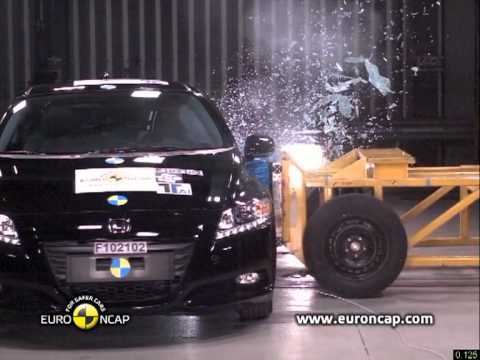
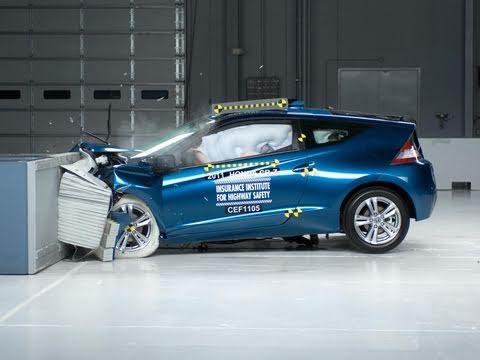
Six airbags, vehicle stability assist, ABS and brake force distribution were standard. The body uses Honda's ACE (Advanced Compatibility Engineering) front structure, which spreads crash forces across the front of the car. In the 2011 ANCAP test, the CR-Z scored 14.56 of 16 points in the frontal offset test and the maximum 16 in the side impact. In the United States, NHTSA gave models from 2012 four stars for frontal impact and five stars for rollover.

The 2013 update and later changes
Honda showed the updated CR-Z at the 2012 Paris Motor Show. Besides the stronger hybrid system and the S+ button, it received a new front bumper and grille, new wheels and a revised interior.

A further refresh for 2016 brought new bumpers, LED lights and an updated touchscreen, and the US range added an EX-L trim. The base CR-Z LX then started at 20,295 US dollars (about €18,300 at the time). The old 1cars text also lists an Active Sound Control system that plays engine sound through the speakers.
The Japanese tuner Mugen built 300 CR-Z Mugen RZ cars with a supercharger and 116 kW (156 hp). Honda sold about 35,000 CR-Zs in the United States from 2010 to 2018, with 11,330 in the best year, 2011. European sales ended in 2014, and North American production stopped at the end of 2016.
CR-Z against its rivals
| Model | Powertrain | Seats | Character |
|---|---|---|---|
| Honda CR-Z | 1.5 petrol mild hybrid | 2 or 2+2 | Sporty hybrid coupé |
| Toyota Prius | 1.8 petrol full hybrid | 5 | Maximum economy |
| Volkswagen Scirocco | 1.4–2.0 turbo petrol, diesel | 4 | Faster, more practical |
| Mini Cooper | 1.6 petrol | 4 | Small premium hatch |
| Hyundai Veloster | 1.6 petrol | 4 (3 doors + 1) | Unusual three-door coupé |
The Toyota Prius used less fuel but felt slower and less engaging. A Mini Cooper or a Volkswagen Scirocco was quicker in most versions and more practical. The CR-Z sat between the two worlds and never fully satisfied either camp. You can put any two of these cars side by side with the 1cars comparison tool.

Rivals
Compare with…
Compare Honda CR-Z with
- Subaru BRZ quick spec comparison
-
In production
- Years
- 2012–present
- Body
- Coupe
- Fuel
- Petrol
- Power
- 147–173 kW (200–235 PS)
2 generations
- ZC6
- ZD8

Honda CR-Z in our rankings
- No. 3 of 53 · Most economical coupes (6.5 l/100 km)
- No. 124 of 297 · Most economical cars (6.5 l/100 km · top 44%)
- No. 689 of 1082 · Longest-running car nameplates (6 years · top 69%)
- No. 287 of 354 · Most powerful cars of the 2010s (97 kW · top 82%)
- No. 852 of 1011 · Most powerful cars (97 kW · top 85%)
- No. 542 of 627 · Biggest engines: cars (1,500 cc · top 89%)
More economical than 94% of ranked coupes in the 1CARS catalog (No. 3 of 53).
Honda CR-Z photos 24


Honda CR-Z videos 4
Honda CR-Z video 1

Honda CR-Z video 2
Honda CR-Z video 3

Video review
FAQ
Is the Honda CR-Z a real hybrid?
Yes, but a mild one. The IMA electric motor assists the 1.5-litre petrol engine and recovers energy when braking, while the engine does most of the work. That makes it different from full hybrids such as the Toyota Prius, which can drive further on electricity alone.
How much power does the Honda CR-Z have?
Early cars combine engine and motor for 90 kW (123 PS); manual versions offer 174 Nm of torque. From the 2013 model year the system delivers 97 kW (132 PS), and a steering-wheel S+ button adds short bursts of electric boost.
What is the fuel consumption of the Honda CR-Z?
On the Japanese 10·15 cycle, the CVT version used 4.0 l/100 km and the manual 4.4 l/100 km. The US EPA rated the manual at 31 mpg city and 37 mpg highway.
Why was the Honda CR-Z discontinued?
Sales fell after a strong start, from 11,330 US sales in 2011 to about 3,000 a year by 2015. Honda ended European sales in 2014 and North American production at the end of 2016 to make room for other hybrids.
How fast is the Honda CR-Z?
A Japanese road test timed 0–100 km/h in 10.5 seconds, and US magazines measured 0–60 mph in 8.3 to 8.8 seconds. The old 1cars text gives a top speed of about 200 km/h.
Data sources
Data checked by an editor against the sources below.
- The text of this article (1cars archive)
- Wikipedia - Honda CR Z
- Euro NCAP - Euro Ncap S Best Performing Cars Of 2010
- US EPA fueleconomy.gov - 37094.shtml
- US EPA fueleconomy.gov - 37093.shtml
- US EPA fueleconomy.gov - 35657.shtml


