
 Honda S2000
Specs, engines and history
Updated Published Sources (6) Report an error
By Sarah Whitmore, Senior Automotive Writer Reviewed by Oleksandr Hnatiuk

- Built
- 1999–2009
- Top power
- 184 kW (250 PS)
Which Honda S2000 to buy
Our verdict · Sarah Whitmore
For the pure experience, a European or Japanese 2.0-litre car from 2004 onwards combines the 9,000 rpm engine with the calmer chassis. North American 2.2-litre cars suit owners who drive more in traffic. The Type S and Club Racer are collector cars and are priced accordingly.
Many S2000s have been modified or driven hard on track days. A buyer should check for accident damage on the X-bone frame, wear on the gearbox synchronisers, the condition of the soft top and its rear window, oil consumption and any signs of over-revving. A documented service history and original suspension are worth paying for. Honda's other drivers' cars on 1cars include the Honda NSX and the Civic Si.
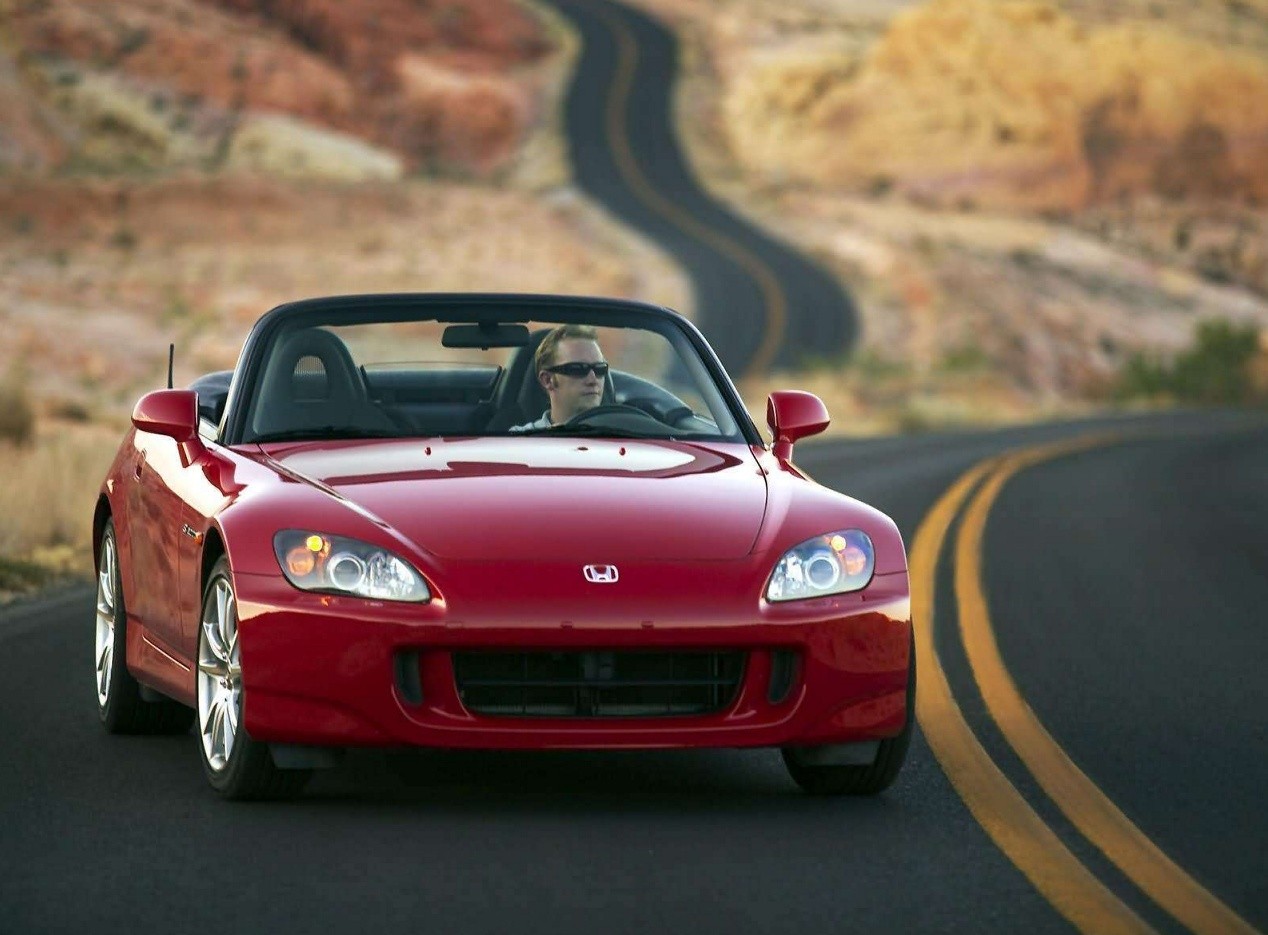
The Honda S2000 is a two-seat, front-engined, rear-wheel-drive roadster that Honda built from April 1999 to 2009 to mark its 50th anniversary. Its 2.0-litre F20C four-cylinder made 177–184 kW (241–250 PS) and revved to 9,000 rpm. From 2004 North American cars got a 2.2-litre engine. Around 114,000 were built.
In short
- AP1 (1999–2003, and 2.0-litre cars to 2009 in Europe and Australia): 2.0-litre F20C with 177 kW (241 PS) in Europe and 184 kW (250 PS) in Japan.
- AP2 (2004–2009, North America; Japan from 2006): 2.2-litre F22C1 with more torque and an 8,000 rpm red line.
- Every S2000 has a six-speed manual gearbox, a Torsen limited-slip differential and a 50:50 weight distribution.
- A good S2000 is one of the most rewarding used sports cars, but clean, unmodified examples are getting scarce.
Specs by version
Engines
| Version | Engine | Gearbox | Drive | Production years |
|---|---|---|---|---|
| 2 L 4 cyl Manual 6-spd · 2003 (EPA) | 2.0 l · 4 cyl 2,000 cc | 6-sp Manual | Rear-wheel drive | 2003 |
| 2 L 4 cyl Manual 6-spd · 2002 (EPA) | 2.0 l · 4 cyl 2,000 cc | 6-sp Manual | Rear-wheel drive | 2002 |
| 2.2 L 4 cyl Manual 6-spd · 2009 (EPA) | 2.2 l · 4 cyl 2,200 cc | 6-sp Manual | Rear-wheel drive | 2009 |
| 2.2 L 4 cyl Manual 6-spd · 2008 (EPA) | 2.2 l · 4 cyl 2,200 cc | 6-sp Manual | Rear-wheel drive | 2008 |
| 2.2 L 4 cyl Manual 6-spd · 2007 (EPA) | 2.2 l · 4 cyl 2,200 cc | 6-sp Manual | Rear-wheel drive | 2007 |
| 2.2 L 4 cyl Manual 6-spd · 2006 (EPA) | 2.2 l · 4 cyl 2,200 cc | 6-sp Manual | Rear-wheel drive | 2006 |
| 2.2 L 4 cyl Manual 6-spd · 2005 (EPA) | 2.2 l · 4 cyl 2,200 cc | 6-sp Manual | Rear-wheel drive | 2005 |
| 2.2 L 4 cyl Manual 6-spd · 2004 (EPA) | 2.2 l · 4 cyl 2,200 cc | 6-sp Manual | Rear-wheel drive | 2004 |
Performance
Show all 8 versions
| Version | Fuel consumption |
|---|---|
| 2 L 4 cyl Manual 6-spd · 2003 (EPA) | 11.8 l/100 km19.9 mpg US · 23.9 mpg UK |
| 2 L 4 cyl Manual 6-spd · 2002 (EPA) | 11.8 l/100 km19.9 mpg US · 23.9 mpg UK |
| 2.2 L 4 cyl Manual 6-spd · 2009 (EPA) | 11.2 l/100 km21.0 mpg US · 25.2 mpg UK |
| 2.2 L 4 cyl Manual 6-spd · 2008 (EPA) | 11.2 l/100 km21.0 mpg US · 25.2 mpg UK |
| 2.2 L 4 cyl Manual 6-spd · 2007 (EPA) | 11.8 l/100 km19.9 mpg US · 23.9 mpg UK |
| 2.2 L 4 cyl Manual 6-spd · 2006 (EPA) | 11.8 l/100 km19.9 mpg US · 23.9 mpg UK |
| 2.2 L 4 cyl Manual 6-spd · 2005 (EPA) | 11.8 l/100 km19.9 mpg US · 23.9 mpg UK |
| 2.2 L 4 cyl Manual 6-spd · 2004 (EPA) | 11.8 l/100 km19.9 mpg US · 23.9 mpg UK |
Verified Manufacturer and type-approval data from our catalog · Sources and methodology
Honda S2000 at a glance
| Fact | Honda S2000 |
|---|---|
| Body | two-seat roadster with electric soft top; optional aluminium hardtop |
| Production | 15 April 1999 – 2009 |
| Plants | Takanezawa, Tochigi (to 2003); Suzuka (from 2004) |
| Chief engineer | Shigeru Uehara |
| Engines | 2.0 l F20C, 2.2 l F22C1 |
| Power | 177–184 kW (237–250 hp) |
| Gearbox | 6-speed manual only |
| Built | 113,889 in total (final official figure) |
The S2000 continued Honda's early S-series roadsters, the S500, S600 and S800 of the 1960s. It previewed at the 1995 Tokyo Motor Show as the SSM concept, and the production car went on sale in 1999. The history of Honda puts it in the company's wider sports-car line.

The F20C and F22C1 engines
The heart of the S2000 is its engine. The F20C is a 2.0-litre twin-cam four with VTEC variable valve timing, and it reaches maximum power at 8,300 rpm. With about 124 hp per litre it held the record for the highest specific output of any naturally aspirated production car until the Ferrari 458 Italia arrived in 2010.
| Engine | Market | Power | Torque | Red line |
|---|---|---|---|---|
| F20C 2.0 l | Europe and US (1999–2003) | 177 kW (241 PS, 237 hp) at 8,300 rpm | 208 Nm at 7,500 rpm | 9,000 rpm |
| F20C 2.0 l | Japan | 184 kW (250 PS) at 8,300 rpm | 218 Nm at 7,500 rpm | 9,000 rpm |
| F22C1 2.2 l (2,157 cc) | North America from 2004 | 177 kW (237 hp) at 7,800 rpm | about 220 Nm | 8,000 rpm |
| F22C1 2.2 l | Japan from 2006 | 178 kW (242 PS) | 221 Nm | 8,000 rpm |
The 2.2-litre engine has a longer stroke. It gives the same peak power at lower revs and more torque in the middle of the range, so the car feels less dependent on high revs in daily driving. Purists still prefer the 9,000 rpm 2.0-litre, and in Europe the 2.0-litre F20C stayed in the car until the end. According to German tests, the engine made the same power on 92, 95 and 98 RON petrol.
Chassis, gearbox and handling
The S2000 uses a high X-bone frame: a stiff backbone that joins the front and rear of the body and adds rigidity without a roof. The engine sits behind the front axle, which gives a 50:50 weight distribution. Suspension is by double wishbones all round, and the electric power steering is quick.

Power reaches the rear wheels through a six-speed manual gearbox and a Torsen limited-slip differential. Honda never offered an automatic. The Japanese Type V of July 2000 added variable-ratio steering that cut lock-to-lock turns from 2.4 to 1.4.
| Dimension | Metric | Imperial |
|---|---|---|
| Length | 4,112 mm (AP1); 4,135 mm (Club Racer) | 161.9 in |
| Width | 1,750 mm | 68.9 in |
| Height | 1,270 mm | 50.0 in |
| Wheelbase | 2,400 mm | 94.5 in |
| Ground clearance | 130 mm | 5.1 in |
| Kerb weight (German 2.0) | about 1,320 kg | about 2,910 lb |
| Boot | about 152 l | 5.4 cu ft |
| Wheels | 16 in (AP1), 17 in (from 2004) | – |
The early AP1 earned a reputation for snappy behaviour at the limit. Honda softened that with each update: a revised suspension and a glass rear window with a heater in 2002, then retuned springs and dampers, 17-inch wheels and Bridgestone RE050 tyres in 2004. From 2006 the car gained a drive-by-wire throttle and electronic stability control, called VSA. With about 1,320 kg and 177 kW, a German S2000 carries about 7.5 kg per kW; the power-to-weight calculator compares it with other sports cars.
AP1 vs AP2: what changed in 2004
The 2004 update is usually called the change from AP1 to AP2, although strictly AP2 is the chassis code of the 2.2-litre North American car. Cars for Europe and Australia kept the 2.0-litre engine and the AP1 code, while Japan switched to the 2.2-litre in 2006.

- Engine: 2.2-litre F22C1 in North America, with an 8,000 rpm red line instead of 9,000.
- Gearbox: shorter ratios for the first five gears and carbon-fibre synchronisers.
- Chassis: new springs, dampers and anti-roll settings for more predictable handling.
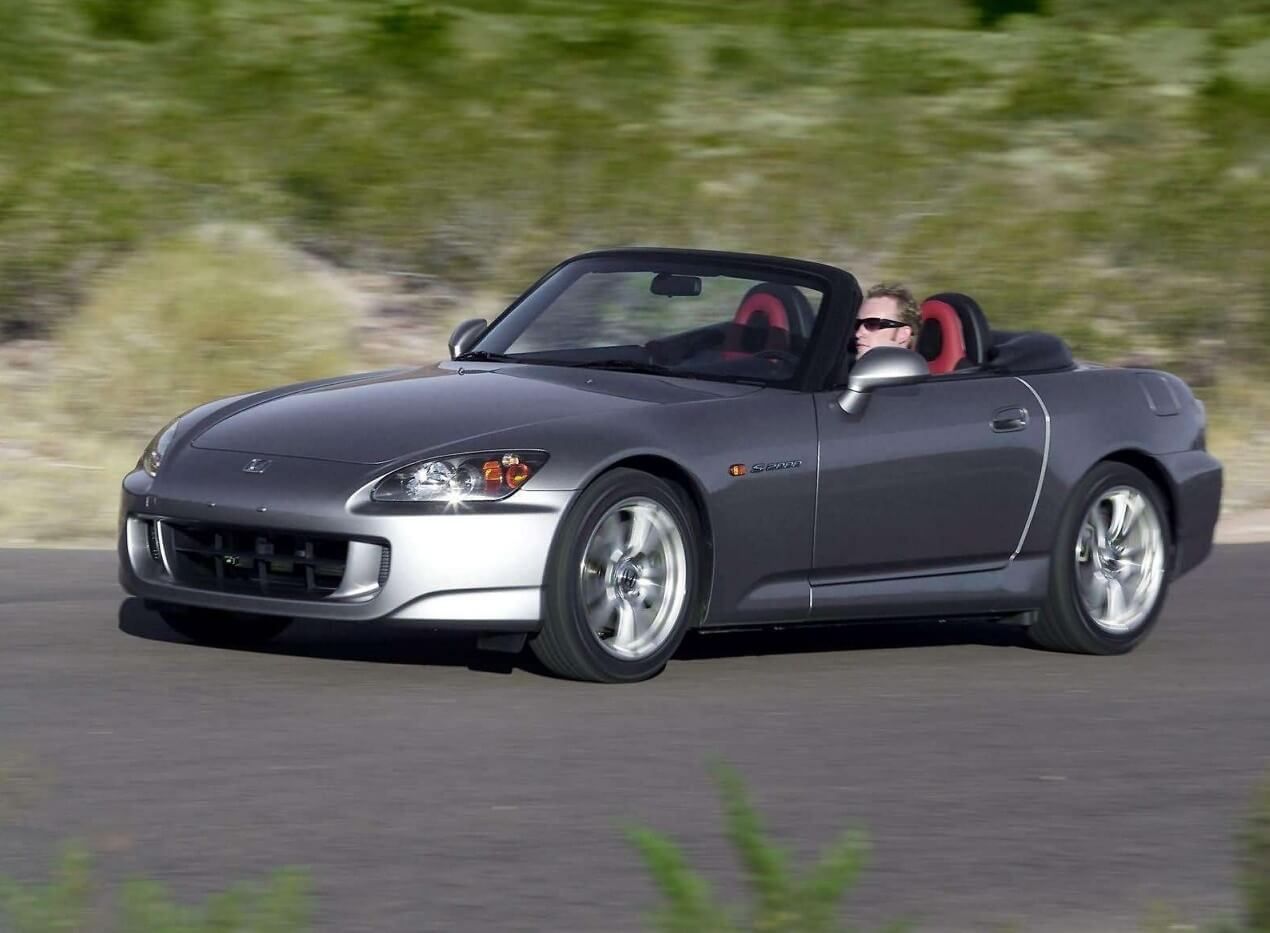
- Styling: new front and rear bumpers, LED tail lights, oval exhaust tips and 17-inch wheels.
- Cabin: the old 1cars review noted two-tone seats, speakers in the headrests and an updated audio unit.
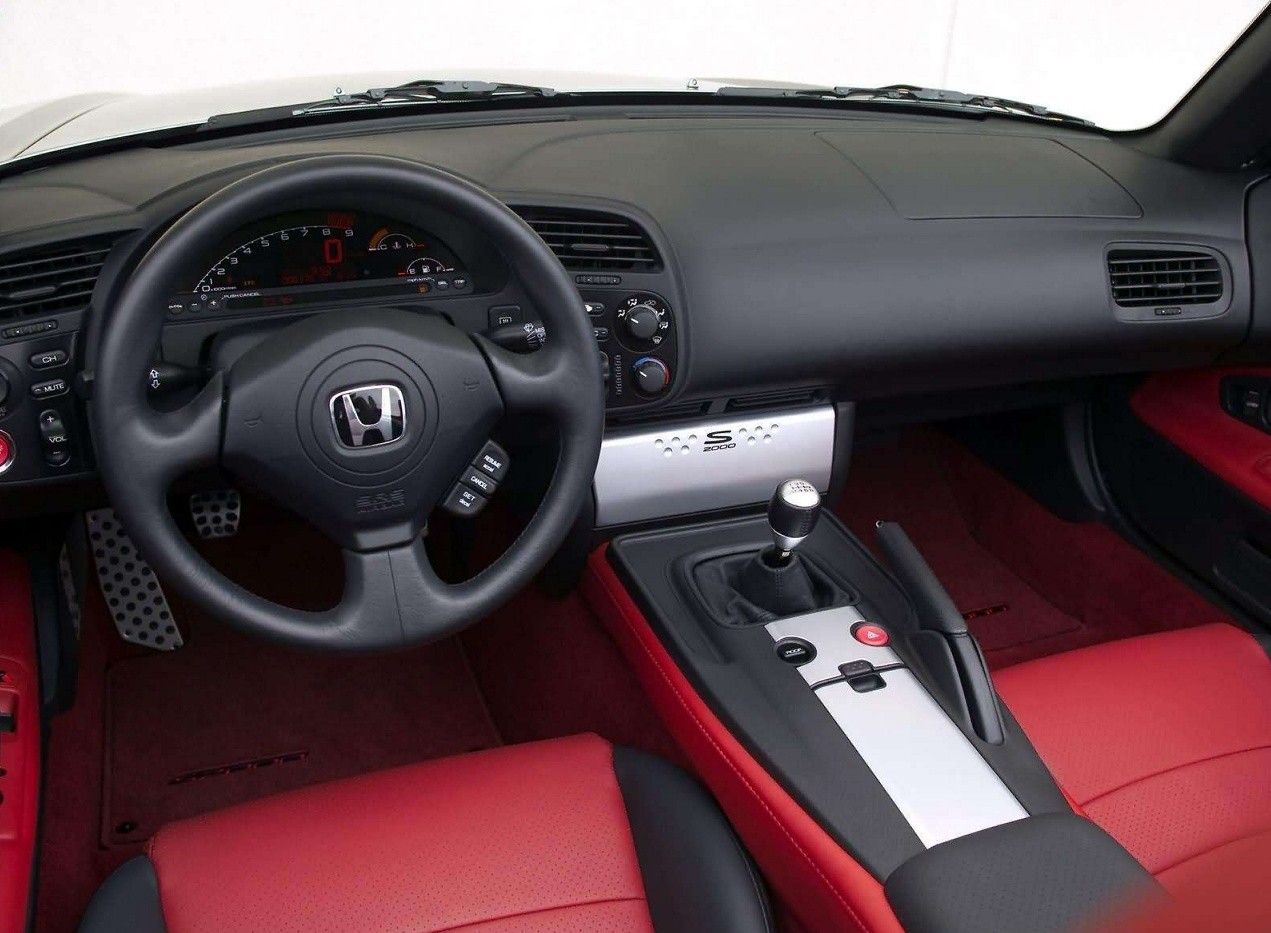
The digital instrument panel, with a curved rev bar that lights up to 9,000 rpm, a red engine start button and the electric roof that folds in about six seconds stayed throughout.
Special editions: Type S, Club Racer and Ultimate Edition
Honda built several limited versions at the end of production. The Club Racer (US, 2008–2009) had a fixed hardtop, no spare wheel, stiffer suspension and weighed 41 kg less than the standard car; 699 were made. The Japanese Type S (2007–2009) had its own body kit, Alcantara trim and revised suspension, and 1,755 were sold. Europe received the Ultimate Edition in 2009, and the UK a run of 100 GT Edition 100 cars.

In Germany 4,550 S2000s were registered between 1999 and 2010, with the best year in 2000. About 65,000 of the roughly 110,000 cars sold by the end of 2008 went to the United States.
Safety
Euro NCAP gave the S2000 four stars in 2002. Australia's ANCAP later rated it one star overall in 2009, with 11.63 of 16 points in the offset frontal test and 15.25 of 16 in the side impact test.

Rivals: how the S2000 compares
| Model | Engine | Layout | Character |
|---|---|---|---|
| Honda S2000 | 2.0–2.2 l naturally aspirated four | front-mid engine, RWD | high-revving, precise, manual only |
| Mazda MX-5 (NB/NC) | 1.6–2.0 l four | front engine, RWD | lighter, softer, cheaper to run |
| BMW Z4 (E85) | 2.0–3.2 l straight-six | front engine, RWD | more torque, more comfort |
| Porsche Boxster (986/987) | 2.5–3.4 l flat-six | mid engine, RWD | better balance and brand, higher costs |
| Nissan 350Z Roadster | 3.5 l V6 | front engine, RWD | heavier, more torque, less precise |
The S2000 is the only car in this group that needs revs to give its best. Drivers who enjoy working the gearbox love it; those who want relaxed torque are better served by a six-cylinder BMW or Nissan. Other open two-seaters are listed in the 1cars convertibles section, and the S2000 can be set against any of them in the comparison tool.

Rivals
Compare with…
Compare Honda S2000 with
- Mazda RX-8 quick spec comparison

Honda S2000 in our rankings
- No. 7 of 15 · Most economical convertibles and roadsters (11.2 l/100 km)
- No. 426 of 1082 · Longest-running car nameplates (10 years · top 43%)
- No. 64 of 130 · Most powerful Japanese cars (184 kW · top 50%)
- No. 47 of 81 · Most powerful convertibles and roadsters (184 kW · top 59%)
- No. 592 of 1011 · Most powerful cars (184 kW · top 59%)
- No. 375 of 627 · Biggest engines: cars (2,200 cc · top 61%)
In production longer than 57% of ranked nameplates in the 1CARS catalog (No. 426 of 1082).
Honda S2000 photos 16




Honda S2000 videos 3

Crash test

Test drive

Video overview
FAQ
What is the difference between the Honda S2000 AP1 and AP2?
AP1 is the original car with the 2.0-litre, 9,000 rpm F20C. AP2 is the North American car from 2004 with the 2.2-litre F22C1, more mid-range torque, an 8,000 rpm red line, shorter gearing and retuned suspension.
How much horsepower does the Honda S2000 have?
European and American 2.0-litre cars produce 177 kW (241 PS, 237 hp), Japanese 2.0-litre cars 184 kW (250 PS). The 2.2-litre F22C1 also gives 177 kW but reaches it at 7,800 rpm.
How many Honda S2000s were made?
The final official production figure is 113,889 cars from 1999 to 2009. Honda's earlier figure of 110,673 counted worldwide sales to the end of 2008, of which about 65,000 went to the United States.
Did the Honda S2000 come with an automatic gearbox?
No. Every S2000 has a six-speed manual gearbox driving the rear wheels through a Torsen limited-slip differential. Honda never offered an automatic, all-wheel drive or a hybrid version.
Why was the Honda S2000 discontinued?
Honda ended production in 2009 as sales fell and the global economic crisis cut demand for sports cars. Plans for a successor were dropped at the same time, and no direct replacement has followed.
Data sources
Data checked by an editor against the sources below.
- The text of this article (1cars archive)
- Wikipedia - Honda S2000
- US EPA fueleconomy.gov - 25788.shtml
- US EPA fueleconomy.gov - 24758.shtml
- US EPA fueleconomy.gov - 23479.shtml
- US EPA fueleconomy.gov - 21633.shtml


