Facel Vega — Jean Daninos and the Last French Luxury GT, 1939 to 1964
Facel Vega was the last great French maker of luxury grand tourers. The company behind it, Facel, was set up in December 1939 to make metal parts for the aircraft industry. After the war it built bodies for other car makers, and in October 1954 it showed its own car, the Vega, in Paris. Under Jean Daninos it combined hand-built French bodies with large Chrysler V8 engines, and its customers included Pablo Picasso, Ava Gardner, Stirling Moss and Ringo Starr. Problems with the small Facellia ruined the company, and the factory closed in October 1964.
Key takeaways
- Facel was founded on 20 December 1939 as a subsidiary of the aero-equipment firm Bronzavia; the Facel Vega marque followed on 22 July 1954.
- Every large Facel used an American Chrysler-group V8, from a 4.5-litre DeSoto Hemi in 1954 to a 6.7-litre Chrysler wedge in the last Facel IIs.
- The company built about 2,900 cars in ten years; Jean Daninos's own figure is about 3,000.
- Warranty claims on the Facellia's in-house engine forced Daninos out in August 1961 and closed the factory in October 1964.
Facel Vega at a glance
| Fact | Value |
|---|---|
| Company | Facel S.A. (Forges et Ateliers de Constructions d'Eure-et-Loir) |
| Founded | 20 December 1939, by Bronzavia |
| Key person | Jean Daninos (1906–2001) |
| Head office | Avenue George V, Paris |
| Assembly plant | Colombes, near Paris |
| Car marque created | 22 July 1954 |
| Engines | Chrysler-group V8s; in-house 1.6-litre four (Facellia); Volvo and BMC engines at the end |
| Best-known models | FV/HK500, Excellence, Facel II, Facellia |
| Total output | about 2,900 cars (Facel Vega article) |
| End | Factory closed in October 1964 |
Origins: a supplier to the aircraft industry
Facel began as a war-time supplier. Bronzavia, a French subcontractor for military aviation, created the company on 20 December 1939 to make special components. The name is an acronym of Forges et Ateliers de Constructions d'Eure-et-Loir, after the department west of Paris. From 1939 to 1945 it was run by Marcel Koehler, who had earlier worked for the motorcycle maker Koehler-Escoffier.
The man who turned Facel into a car maker was Jean Daninos. Born in Paris on 2 December 1906, of Greek-French origin, he started at Citroën, where he worked on the coupé and cabriolet versions of the Traction Avant. He then moved to the aircraft maker Morane-Saulnier and in 1937 became technical director of Bronzavia. During the war he worked in the United States with General Aircraft, a company that used Bronzavia patents. In 1945 Henri Feuillée, the former head of Bronzavia and a major Facel shareholder, called him back, and Daninos took over Facel from Koehler. He was the brother of the humorist Pierre Daninos, author of Les Carnets du Major Thompson.
Coachbuilder to the French industry
After the war Facel merged with Métallon in 1945, a partnership that lasted until January 1953. The combined business pressed steel on a large scale. It made body panels for Delahaye's light military vehicles, for Simca, Delahaye and Somua lorries, for Vespa, Piaggio and Motobécane scooters and for Massey Ferguson tractors. With Hispano-Suiza it also made combustion chambers for Rolls-Royce jet engines.
Complete bodies became a second business. Together with L'Aluminium Français, Facel designed the all-aluminium body of the Panhard Dyna X, of which about 45,000 were built for Panhard. A body assembly division set up in 1948 produced coupés and cabriolets for the Simca 8, Simca 9 and Simca Aronde, including the Plein Ciel and Océane. Daninos worked closely with Simca's chief executive, Henri Théodore Pigozzi. With Pininfarina, Facel built the Bentley Cresta on a Mark VI chassis, followed in 1951 by the Cresta II. In September 1951 it launched the Ford Comète coupé for Ford's French company, built until 1955, when Simca took over Ford France. The lines of the Cresta and the Comète led directly to the first Vega.
The Vega: French bodies and Chrysler V8s
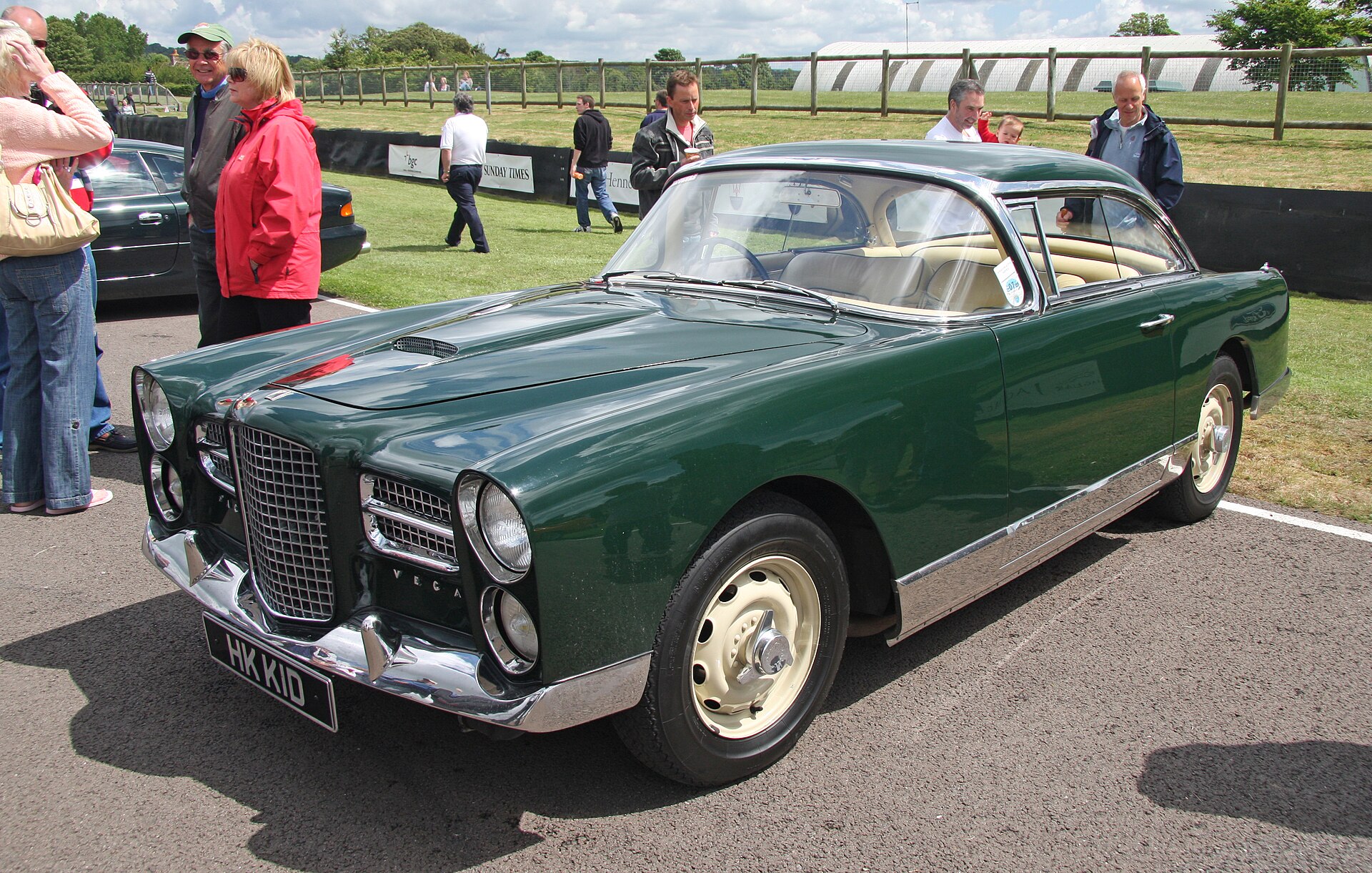
The first prototype was finished in October 1953, and the Facel Vega marque was registered on 22 July 1954. The production car, called simply Vega at first and later FV, appeared at the Paris show that October. No French maker offered a suitable large engine, so Daninos used American ones. The first FV had a 4.5-litre DeSoto Firedome Hemi V8 of 132 kW (180 hp), with Chrysler's two-speed PowerFlite automatic or, at extra cost, a four-speed manual from Pont-à-Mousson. Top speed was 172 to 193 km/h depending on the axle ratio.
The engineering was simple: a tubular chassis designed by Lance Macklin, double wishbones and coil springs at the front and a leaf-sprung live rear axle. Daninos styled the body himself.
The aircraft-style dashboard was one of the first with a centre console over the gearbox. On the FV2 of October 1955, Marcel Bigot, head of the paint shop, hand-painted the metal dash to look like burr wood.
Engines grew quickly. The FV1 of 1955 had 4.8 litres and 147 kW (200 hp), the FV2 184 kW (250 hp), and the 5.4-litre FV2B of 1956 210 kW (285 hp). The FV4 of 1958 had a 5.8-litre V8 of 239 kW (325 hp). Power steering and power brakes became standard in 1957 and front disc brakes were available from 1958. In total 357 FV and FVS cars were built; FVS (Facel Vega Sport) was the name used for American buyers. Only a handful were convertibles, because Daninos disliked their lack of rigidity.

HK500, Excellence and Facel II
The HK500 of 1959 was an upgraded FVS. It began with a 5.8-litre V8 of 246 kW (335 hp) and soon received a 6.3-litre Chrysler engine of 265 kW (360 hp); top speed was 237 km/h. Disc brakes became standard in April 1960, and 489 HK500s were built up to 1962. Total FV and HK500 production is given as 842 or 846, depending on the source. About 77% of all Facel output went abroad, because France's fiscal horsepower tax made big engines very costly at home. The model is covered in detail in the Facel Vega HK500 history and specifications.
The four-door Excellence was shown at the Paris show in October 1956 and built from 1958 to 1964 in Colombes. It used a lengthened FV chassis, pillarless sides and rear-hinged rear doors. Early cars had a 6.4-litre Hemi of 268 kW (360 hp); later ones used 5.9- and 6.3-litre wedge-head V8s. At the October 1961 Paris show an automatic Excellence cost 72,500 new francs in France, more than twelve Renault Dauphines. Only 156 were built. In 1959 Daninos discussed selling it as a Packard through Studebaker-Packard dealers in North America. The plan was dropped after Daimler-Benz, which had a sales agreement with Studebaker-Packard, objected.
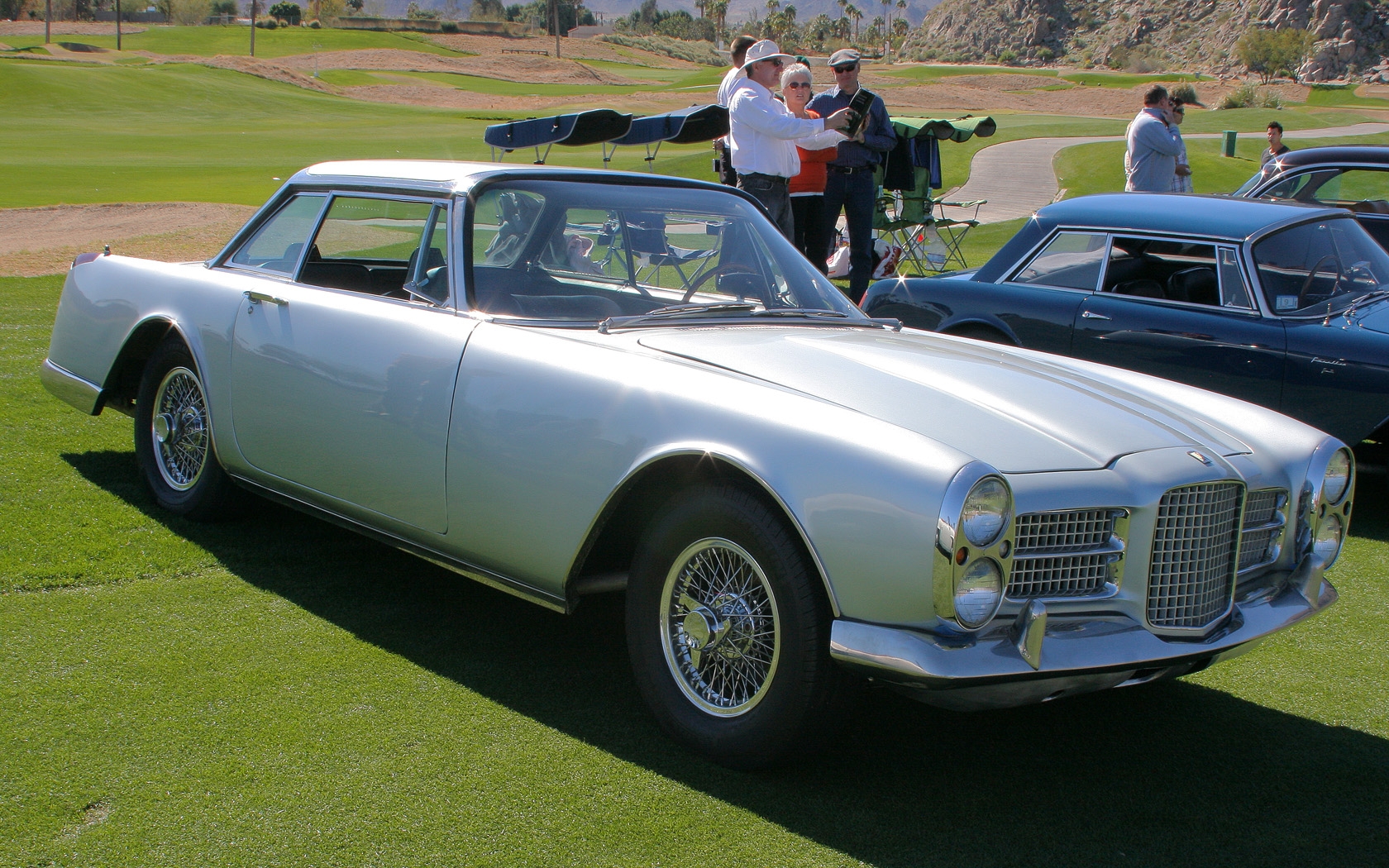
The last V8 car, the Facel II, was unveiled in Paris in 1961 and built from 1962 to 1964. Its 6.3-litre Chrysler Typhoon V8 was rated at 265 kW (355 hp) with the automatic and 290 kW (390 hp) with the manual; later cars used a 6.7-litre engine. Sports Car Graphic recorded a two-way average of 240 km/h, and the company advertised it as the fastest four-seat coupé in the world. Daninos's book gives 180 built; other sources give 182 to 184.

A small sports car and the collapse
The small Facellia, first shown in 1959 and built from 1960, was meant to bring Facel to a larger market. It was a cabriolet and coupé about the size of a Mercedes-Benz 190 SL. Its 1.6-litre twin-cam four came from a former Talbot-Lago chief engineer, with advice from Harry Weslake, and Pont-à-Mousson built it. The camshafts ran in only two bearings, and the engine suffered from flex, timing problems and frequent failures. Charles Deutsch and Jean Bertin were called in, but the engine was judged a failure.
Daninos resigned in August 1961 and was replaced by André Belin, a former oil company executive, who offered owners free replacement engines. Before the end the firm was placed under the control of SFERMA, a subsidiary of Sud Aviation. The Facel III used a Volvo B18 engine, and about 1,100 were built until 1963. The Facel 6, with a 2.8-litre Austin-Healey engine, came too late. Fewer than 30 were built before the backers withdrew, and the factory closed at the end of October 1964. Daninos died in Cannes on 13 October 2001.

Owners, the Camus accident and reputation
Besides Picasso and Ava Gardner, owners included Christian Dior, Frank Sinatra, Tony Curtis, François Truffaut and the racing driver Maurice Trintignant. Stirling Moss drove his HK500 between races rather than flying. Ringo Starr's Facel II had the 6.7-litre engine.
On 4 January 1960 the publisher Michel Gallimard lost control of his FV2 near Villeblevin; he and his passenger, the Nobel Prize-winning writer Albert Camus, were killed. In 2008 readers of The Daily Telegraph in Britain voted the Facel II one of the most beautiful cars of all time. Other cars from the same years are collected in the 1950s classic cars section, and more defunct makers appear in lost car brands. The surviving Facel Vega model is listed in the Facel Vega catalogue, and the engine supplier's own story is told in the history of the Chrysler Corporation.
Collecting the cars today
The cars grew much stronger in ten years. The first FV of 1954 had 132 kW for about 1,800 kg, roughly 73 kW per tonne. Compared with that, a manual Facel II had 290 kW for a dry weight of 1,880 kg, about 154 kW per tonne on these figures. The power-to-weight calculator does the same sum for any other car.
Performance, small numbers and famous owners explain today's prices. In Paris in February 2014 Bonhams sold a rusty Facel II that needed a full rebuild for €155,250. In October 2011 Artcurial sold a modified 1963 car for €204,445. The V8 cars are the simpler choice for a buyer, because their Chrysler engines are well known. A Facellia is best suited to owners prepared to check which engine it carries.
Facel Vega timeline
| Year | Event |
|---|---|
| 1939 | Facel founded by Bronzavia (20 December) |
| 1945 | Jean Daninos takes over; merger with Métallon |
| 1951 | Ford Comète and Bentley Cresta II |
| 1954 | Facel Vega marque created (22 July); Vega shown in Paris (October) |
| 1956 | FV2B with 5.4-litre V8; Excellence shown |
| 1959 | HK500 and Facellia introduced |
| 1961 | Daninos resigns (August); Facel II shown |
| 1963 | Facel III production ends |
| 1964 | Factory closes (end of October) |
Landmark Facel Vega models
| Model | Years | Why it matters |
|---|---|---|
| FV / FVS | 1954–1959 | First Facel Vega; 357 built |
| HK500 | 1959–1962 | 6.3-litre V8, 237 km/h; 489 built |
| Excellence | 1958–1964 | Pillarless four-door saloon; 156 built |
| Facel II | 1962–1964 | Last V8 model, up to 290 kW (390 hp) |
| Facellia | 1960–1963 | Small sports car whose engine ruined the company |
Photo gallery


FAQ
Who founded Facel Vega?
Facel was founded in 1939 by the aero-equipment company Bronzavia. Jean Daninos ran it from 1945 and created the car marque in 1954.
What engines did Facel Vega use?
The large cars used Chrysler-group V8s from DeSoto, Plymouth and Chrysler, from 4.5 to 6.7 litres. The Facellia had its own 1.6-litre four, and the last small cars used Volvo and Austin-Healey engines.
How many Facel Vegas were made?
About 2,900 cars of all models, according to the Facel Vega article; Jean Daninos's article gives about 3,000.
Why did Facel Vega close?
The Facellia's twin-cam engine failed often, and the warranty costs caused losses the company could not recover. The factory closed in October 1964.
Which Facel Vega was Albert Camus killed in?
An FV2 driven by the publisher Michel Gallimard, which crashed near Villeblevin on 4 January 1960.
Sources
- Wikipedia — Facel Vega (accessed 24 Oct 2026)
- Wikipedia — Jean Daninos (accessed 24 Oct 2026)
- Wikipedia — Facel Vega FV/FVS/HK500 (accessed 24 Oct 2026)
- Wikipedia — Facel Vega Excellence (accessed 24 Oct 2026)
- Wikipedia — Facel Vega Facel II (accessed 24 Oct 2026)
Found a mistake? Report an error