 Sunbeam Tiger
Specs, engines and history
Published Sources (1) Report an error
By Felix Hartmann, Automotive Technology & EV Contributor
- Built
- 1964–1967
- Top power
- 122 kW (166 PS)
Sunbeam began as John Marston's bicycle business in Wolverhampton, which registered the name in 1888. Experimental cars ran around the town from 1899, the first production Sunbeam was sold in 1901, and the Sunbeam Motor Car Company was formed in January 1905. Under chief designer Louis Coatalen, who joined in 1909, Sunbeam won the French Grand Prix in 1923 with Henry Segrave and held the land speed record several times; the 1000HP car reached 203.792 mph on 29 March 1927. Sunbeam became part of S.T.D. Motors in 1920, was bought by the Rootes group in 1935, and the name was used on cars until 1976.
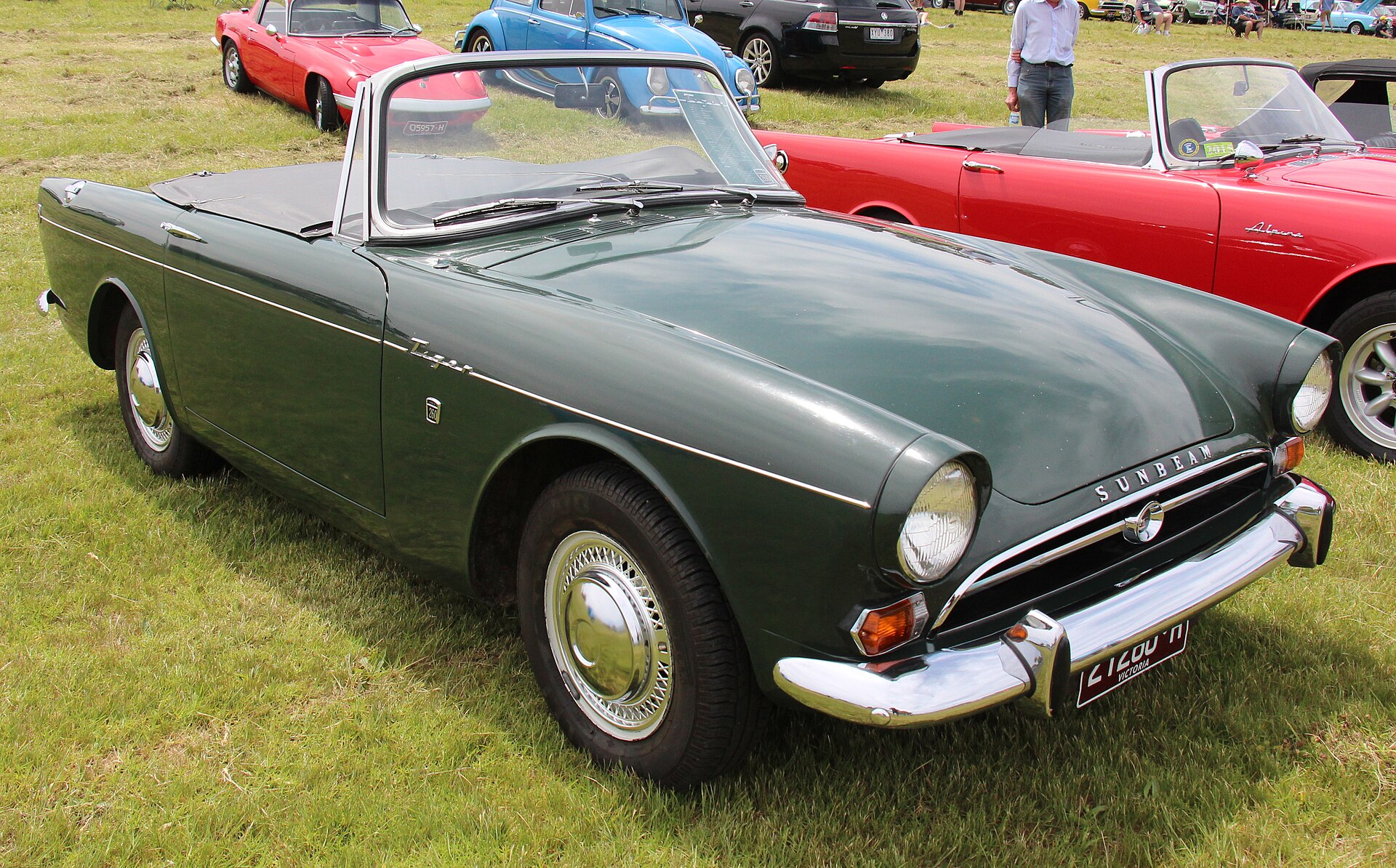
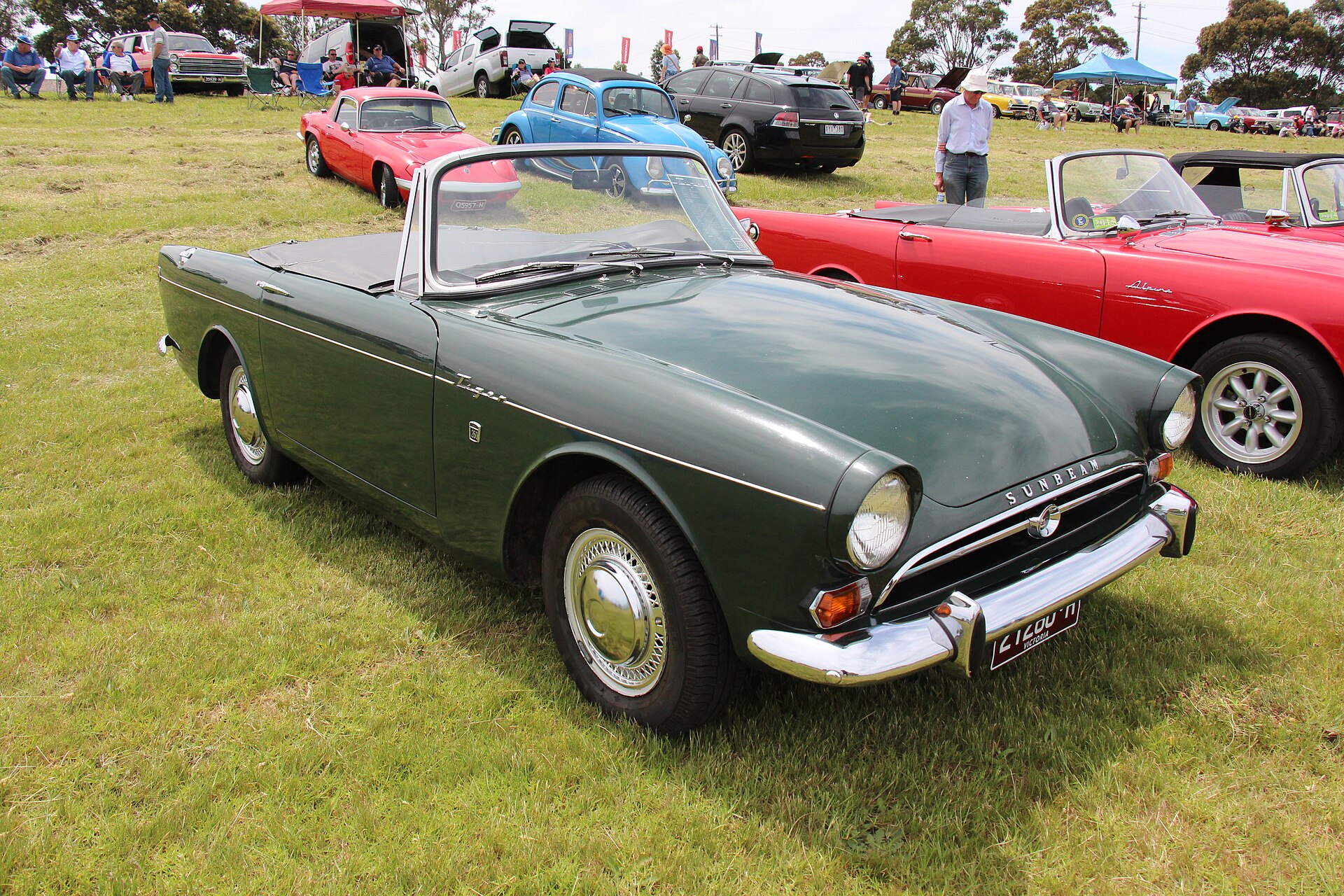
The Tiger is the V8 version of the Sunbeam Alpine roadster that Rootes sold from 1964 to 1967. Its Ford V8 came from America, its prototype from Carroll Shelby's workshop, and its assembly from Jensen in West Bromwich. About 7,083 were built before Chrysler's takeover of Rootes ended the car, because Chrysler would not sell a car with a rival's engine.
Specs by version
Verified Manufacturer and type-approval data from our catalog · Sources and methodology
In short
- Built by Jensen in West Bromwich from June 1964 to 27 June 1967; 7,083 by the infobox count (7,128 in the article text).
- Mark I: 4.3-litre (260 cu in) Ford V8 of 122 kW (164 bhp); Mark II: 4.7-litre (289 cu in) Ford V8.
- 0–60 mph in 8.6 seconds (Mark I) and 7.5 seconds (Mark II), top speed 120–122 mph.
- Mostly exported: of 1,649 cars built in 1964, all but 56 went to North America.
Sunbeam Tiger at a glance
| Parameter | Metric | Imperial |
|---|---|---|
| Maker | Rootes Group; assembled by Jensen Motors, West Bromwich | — |
| Production | June 1964 – June 1967 | — |
| Built | 7,083 (infobox); 6,450 Mark I/IA and 633 Mark II | — |
| Body | two-seat roadster, based on the Sunbeam Alpine | — |
| Engines | Ford V8, 4,261 cc (Mk I) and 4.7 l (Mk II) | 260 and 289 cu in |
| Power (Mk I) | 122 kW (164 bhp) at 4,400 rpm | — |
| Gearbox | Ford four-speed manual | — |
| Wheelbase | 2,184 mm | 86 in |
| Length × width × height | 3,962 × 1,537 × 1,308 mm | 156 × 60.5 × 51.5 in |
| Kerb weight | 1,203 kg | 2,653 lb |
| Weight distribution | 51.7 % front / 48.3 % rear | — |
Sunbeam: Wolverhampton cars and speed records
Sunbeam's first production car, the Mabley of 1901, was a "sociable" with a single-cylinder De Dion engine; several hundred were sold in 1901 and 1902 at £130 each. The company's motorcycles came later, from 1912. Coatalen's first design, the 14/20, was upgraded in 1911 and renamed 16/20.
Racing made the name. Kenelm Lee Guinness set Sunbeam's first land speed record at Brooklands in 1922, at 133.75 mph in the 350HP car. Malcolm Campbell bought that car, renamed it Blue Bird and raised the record to 146.16 mph at Pendine Sands in September 1924 and to 150.76 mph in 1925. In 1926 Segrave took the record in the 4-litre Sunbeam Tiger, the car whose name the V8 roadster borrowed almost four decades later.
| Year | Event |
|---|---|
| 1888 | Sunbeam name registered for bicycles |
| 1901 | first production Sunbeam car |
| 1905 | Sunbeam Motor Car Company Limited |
| 1920 | Sunbeam, Talbot and Darracq form S.T.D. Motors |
| 1923 | Segrave wins the French Grand Prix |
| 1926 | land speed record with the 4-litre Tiger |
| 1927 | 1000HP car reaches 203.792 mph |
| 1935 | Rootes buys Sunbeam |
| 1959 | Sunbeam Alpine roadster |
| April 1964 | Tiger shown at the New York Motor Show |
| June 1967 | last Tiger assembled |
From Alpine to Tiger: the Shelby prototype
The idea came from racing driver Jack Brabham, who suggested a Ford V8 in the Alpine to Ian Garrad, Rootes' West Coast sales manager. Garrad asked Carroll Shelby for a prototype, estimated at eight weeks and US$10,000 in 1963 money (£3,571). In the meantime Ken Miles built a running V8 conversion in about a week for US$800 (1963), using a Series II Alpine, a Ford V8 and a two-speed automatic.
Shelby's prototype, the "white car", was started in April 1963 and was ready for trials at the end of that month. Lord Rootes approved production after driving it in July 1963, and the first order was for 3,000 engines. The car was called Thunderbolt until shortly before its debut at the New York Motor Show in April 1964, when it was renamed Tiger. Shelby received a royalty on every car built; his own story is told in the article on Shelby as a car brand.
Rootes' Ryton factory had no spare capacity, so Jensen in West Bromwich assembled the car from June 1964, at up to 300 a month.


Engineering changes for the V8
The Alpine needed more than an engine swap. Rack-and-pinion steering replaced the Burman recirculating-ball unit, the front springs were stiffened, a Panhard rod was added, and the spare wheel and battery were moved. Kerb weight rose from the Alpine's 1,010 kg (2,220 lb) to 1,203 kg (2,653 lb), with 51.7 % of it on the front wheels.
With 122 kW and 1,203 kg, a Mark I has about 101 kW per tonne; the power-to-weight calculator compares that with modern sports cars.

Mark I, Mark IA and Mark II
| Version | Years | Engine | Compression | 0–60 mph | Top speed | Built |
|---|---|---|---|---|---|---|
| Mark I / IA | 1964–1967 | 260 cu in (4.3 l) Ford V8, 122 kW (164 bhp) | 8.8:1 | 8.6 s | 120 mph (193 km/h) | 6,450 |
| Mark II | 1967 | 289 cu in (4.7 l) Ford V8 | 9.3:1 | 7.5 s | 122 mph (196 km/h) | 633 |
Mark IA is the name for later Mark I cars with the Series V Alpine body panels. Dealers offered tuned engines of up to 183 kW (245 hp) at extra cost. The Mark II was built only in 1967.

Prices in America and Britain
| Market and year | Price |
|---|---|
| North America, 1964, Mark I | US$3,499 (1964) |
| United Kingdom, March 1965, Mark I | £1,446 (1965) |
| North America, 1967, Mark II | US$3,842 (1967; a Ford Mustang cost US$2,898) |
In South Africa the same car was sold under another name, the Sunbeam Alpine 260.
Le Mans, rallies and drag strips
Rootes built three racing Tigers for the 1964 24 Hours of Le Mans, a prototype and two entries, at a cost of US$45,000 each in 1964. They had Lister-built fastback bodies and BorgWarner T10 gearboxes and weighed 1,186 kg (2,615 lb). Neither entry finished: one had a piston failure after three hours, the other a broken crankshaft. All three cars survive.
Rally results were better. Rootes took the first three places in the 1964 Geneva Rally, and in the 1965 Monte Carlo Rally a Tiger finished fourth overall, the best place for a front-engined, rear-wheel-drive car. The 1966 Acropolis Rally showed that low sports cars did not suit rough stages, and the Tiger was withdrawn from rallying. A Tiger won its class and finished 12th overall in the 1965 Daytona Continental, and for two years it held the AHRA class record for the quarter mile at 108 mph in 12.95 seconds.
Chrysler and the end of the Tiger
Chrysler bought a large non-controlling stake in Rootes in June 1964 for £12.3 million (1964) and took control in 1967 for a further £20 million (1967). It did not want to sell a car powered by a competitor's engine, and its own V8s did not fit the engine bay. Production stopped when Rootes' stock of Ford engines ran out, and Jensen assembled the last Tiger on 27 June 1967. The name came back in 1972 on the Avenger Tiger saloon.
On television, Maxwell Smart drove a Tiger in the opening credits of the first two seasons of Get Smart; rebadged Alpines were used for scenes the Tiger could not handle.
Buying a Tiger today
- Originality: few Tigers survive in standard form, because they were easy and cheap to modify.
- Mark: the 633 Mark II cars with the 289 engine are the rarest.
- Alpine conversions: check that the car was built as a Tiger, since Alpines were rebadged even for Get Smart.
More open British cars of the period are in the 1960s classics section.
Photo gallery


Sunbeam Tiger in our rankings
- No. 177 of 557 · Biggest engines: cars (4,261 cc · top 32%)
- No. 19 of 49 · Biggest engines: convertibles and roadsters (4,261 cc · top 39%)
- No. 68 of 94 · Most powerful cars of the 1960s (122 kW · top 73%)
- No. 58 of 79 · Most powerful convertibles and roadsters (122 kW · top 74%)
- No. 640 of 859 · Most powerful cars (122 kW · top 75%)
- No. 95 of 109 · Most powerful British cars (122 kW · top 88%)
Bigger engine than 68% of ranked cars in the 1CARS catalog (No. 177 of 557).
FAQ
How many Sunbeam Tigers were made?
7,083 according to the English Wikipedia infobox (6,450 Mark I and IA plus 633 Mark II); the article text gives 7,128.
What engine is in a Sunbeam Tiger?
A Ford V8: the 260 cu in (4.3-litre) unit in the Mark I and the 289 cu in (4.7-litre) unit in the Mark II.
Who built the Sunbeam Tiger?
Jensen Motors assembled it in West Bromwich for the Rootes Group; Carroll Shelby built the prototype.
Why was the Sunbeam Tiger discontinued?
Chrysler took control of Rootes in 1967 and would not sell a car with a Ford engine, and its own V8s did not fit.
How fast is a Sunbeam Tiger?
The Mark I reached 120 mph and 60 mph in 8.6 seconds; the Mark II reached 122 mph and 60 mph in 7.5 seconds.
Data sources
Data checked by an editor against the sources below.