Sunbeam — From Land Speed Records to Rootes Sports Cars
Sunbeam was a British car maker from Wolverhampton whose name began on bicycles in 1888 and ended on Rootes and Chrysler cars in 1976. In its own era it was a racing and engineering company: under Louis Coatalen it won Grands Prix, built aero engines and in 1927 produced the first car to exceed 200 mph. After a receivership the Rootes brothers bought it in 1935, and Sunbeam became their sporting brand, with the Sunbeam-Talbot saloons, the Rapier, the Alpine and the Ford V8-powered Tiger.
Key takeaways
- John Marston registered the Sunbeam name for his cycles in 1888; car manufacture began in 1901, and the Sunbeam Motor Car Company was formed in January 1905.
- Louis Coatalen, chief designer from 1909, led a racing programme that brought Grand Prix wins in 1923–1924 and several land speed records.
- The Sunbeam 1000HP, driven by Henry Segrave, reached 327.97 km/h at Daytona on 29 March 1927, the first car over 200 mph.
- Rootes bought Sunbeam in July 1935; the name was used on new cars until 1976.
Sunbeam at a glance
| Fact | Value |
|---|---|
| Name registered | 1888 (cycles), 1900 (motor cars) |
| Founder | John Marston |
| Car company | Sunbeam Motor Car Company Ltd, January 1905 |
| Home | Wolverhampton |
| Key engineer | Louis Coatalen (from 1909) |
| Records | Land speed records 1922–1927, first car over 200 mph |
| Owners | STD Motors (1920), Rootes (1935), Chrysler (stake 1964, control 1967) |
| Best-known models | 3-litre Super Sports, Sunbeam-Talbot 90, Rapier, Alpine, Tiger |
| Last use as a make | 1976 |
Origins: John Marston and Sunbeamland
John Marston was 23 in 1859 when he bought two tinplate businesses in Bilston and set up on his own. In 1888 he registered the Sunbeam name for his bicycle business, the trademark followed in 1893, and John Marston Limited was incorporated in 1895. In 1897 he opened the Sunbeamland cycle factory in Paul Street, Wolverhampton.
The first cars
Experimental cars were built from 1899, though none were sold. In 1900 the Sunbeam trademark was registered for motor cars, and land was bought in Upper Villiers Street, Blakenhall, for a works. Production began in 1901 with the Mabley, a single-cylinder "sociable" with a De Dion engine, priced at £130 in the United Kingdom in 1901; several hundred were sold in 1901 and 1902.
Thomas Pullinger joined in 1902, and that November Sunbeam showed a 12-horsepower four-cylinder car priced at 500 guineas (£525). A six-cylinder 16-horsepower car followed in February 1904. In January 1905 the Sunbeam Motor Car Company was formed to take over the car business from John Marston Ltd.
Coatalen, racing and STD Motors
Louis Coatalen came from Hillman-Coatalen in 1909 as chief designer. His first design, the 14/20, was the first Sunbeam with shaft drive to the rear axle. Output rose from 100 cars in 1909 to 853 in 1911 and 2,350 in 1912, when the company was listed on the London Stock Exchange and began building aero engines. In the First World War Sunbeam built the V8 Arab and the more successful V12 Cossack aero engines, as well as trucks, ambulances and 647 aircraft. John Marston died in March 1918, aged 82, a day after his son Roland.
In June 1920 Darracq bought Sunbeam, and on 13 August 1920 Darracq was renamed STD Motors, after Sunbeam, Talbot and Darracq. Racing continued. Jean Chassagne won the 1922 Tourist Trophy, and Henry Segrave won the French and Spanish Grands Prix in 1923 and 1924. The 3-litre Super Sports, described as the first production twin-cam car in the world, finished second at Le Mans in 1924.

Land speed records
Sunbeam cars set a series of land speed records in the 1920s. In 1922 Kenelm Lee Guinness took the 350HP to 133.75 mph (215.25 km/h) at Brooklands. Malcolm Campbell, who renamed the car Blue Bird, reached 146.16 mph (235.22 km/h) at Pendine Sands in September 1924 and 150.76 mph (242.62 km/h) in 1925. In 1926 Segrave took the record in the 4-litre V12 Tiger.
The best-known record car was the 1000HP, designed by Captain Jack Irving. It used two Matabele aero engines of about 22.4 litres each, which together gave about 670 kW (900 hp), less than its name suggests. On 29 March 1927 Segrave drove it at Daytona Beach at 203.79 mph (327.97 km/h), and it became the first car to exceed 200 mph. The car is kept at the National Motor Museum in Beaulieu. A later attempt with the Silver Bullet in 1930 failed.

Rootes, the Talbot link and the Alpine
In October 1934 Sunbeam went into receivership. In July 1935 Rootes Securities announced that it had bought the Sunbeam Motor Car Company. In 1938 Rootes created the Sunbeam-Talbot make, combining Talbot coachwork with Hillman and Humber chassis, beginning with the Sunbeam-Talbot 10 and 3-litre. The Sunbeam-Talbot 80 and 90 followed in 1948.
In 1954 the Talbot name was dropped, the 90 became the Sunbeam Mark III, and Sunbeam became the sporting make of the group. The first Alpine of 1953–1955, hand-built by Thrupp & Maberly, had a 2,267 cc engine. Sheila van Damm won the Coupe des Dames with one in the July 1953 Coupe des Alpes.
The Rapier of 1955–1967 was closely related to the Hillman Minx. The second Alpine of 1959–1968 was a two-seat roadster credited to Kenneth Howes and Jeff Crompton (the infobox names Roy Axe). It was built in five series with engines from 1,494 cc to 1,725 cc, the last with 69 kW (93 bhp), and 69,251 were made. A Sunbeam Harrington won the Index of Thermal Efficiency at Le Mans in 1961.


The Tiger, Chrysler and the end
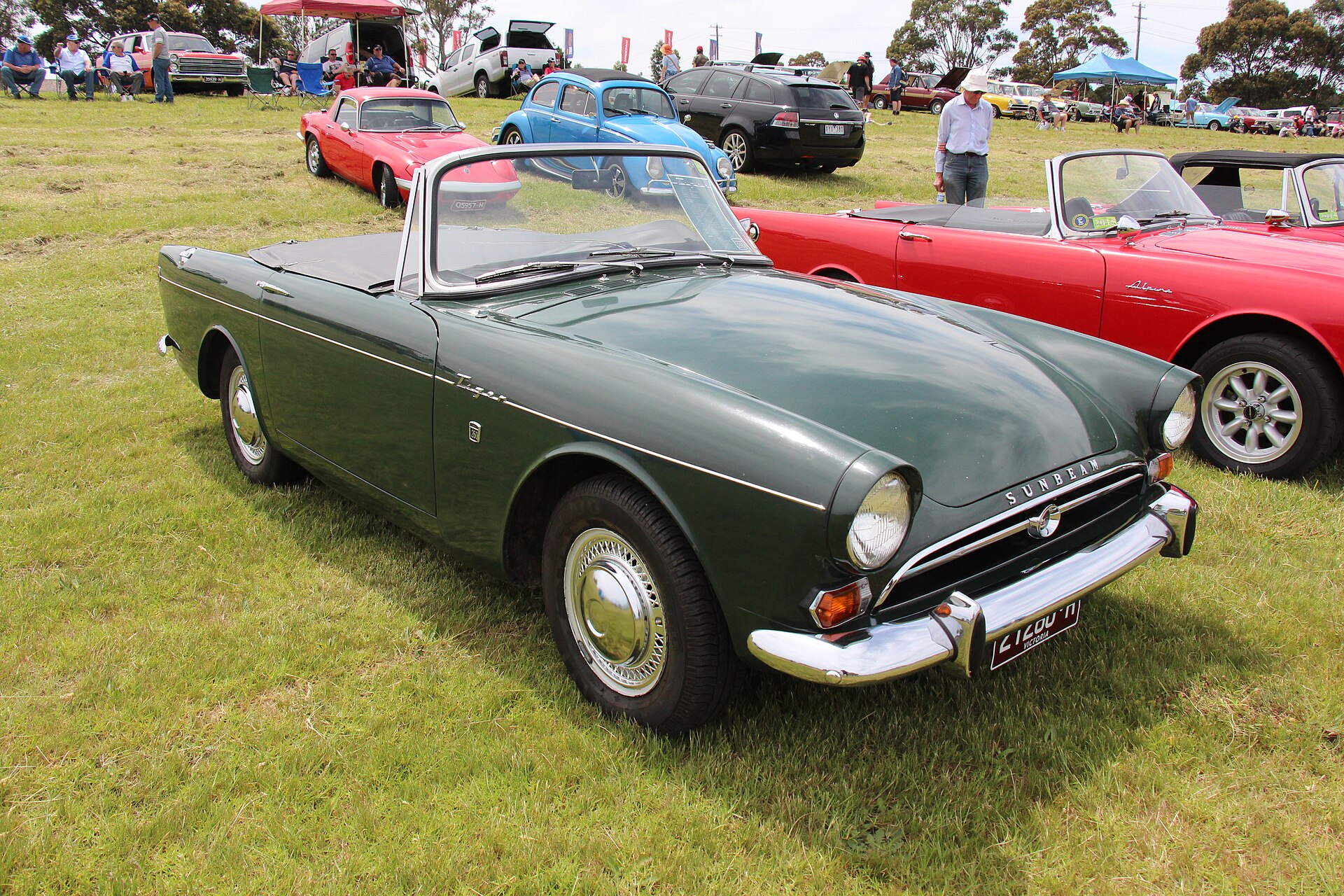
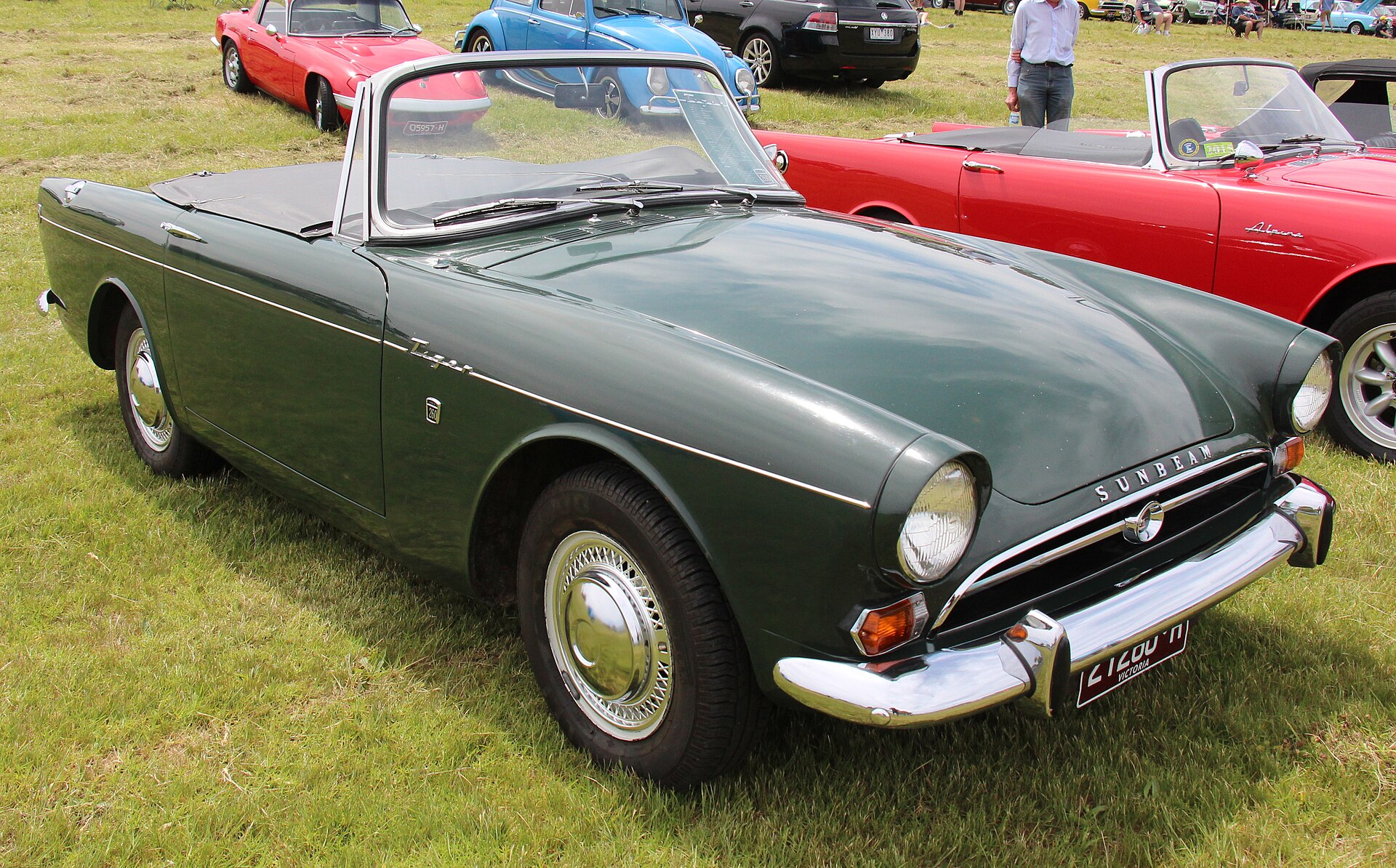
The Sunbeam Tiger of 1964–1967 put a Ford V8 into the Alpine. Carroll Shelby helped design it and ran the prototype work in the United States, and Rootes paid him a royalty on every car. Jensen assembled the Tiger at West Bromwich because the Rootes plant at Ryton had no spare capacity. The Mark I had a 4.3-litre V8 of 122 kW (164 hp) and reached 190 km/h; the Mark II, with a 4.7-litre engine, was built only for export to the United States. About 7,100 Tigers were made, and one appeared in the opening credits of the first two seasons of the TV series Get Smart.
Chrysler bought a stake in Rootes in 1964 and took control in 1967. It ended Tiger production when the stock of Ford engines ran out, and the last Tiger was assembled on 27 June 1967. The Imp-based Stiletto ran from 1967 to 1972, and the fastback Rapier and Alpine of 1967–1976 were the last cars sold as Sunbeams. Chrysler then dropped the make. The name lived on as a model: the Chrysler Sunbeam hatchback of 1977–1979 and the Talbot Sunbeam of 1979–1981, after PSA bought Chrysler Europe. Sunbeam models are listed in the Sunbeam catalogue, the later Rootes and PSA badge in the Talbot catalogue, and other pre-war cars in the classic cars section.
Sunbeam timeline
| Year | Event |
|---|---|
| 1888 | Sunbeam name registered for Marston's cycles |
| 1901 | Car production begins with the Mabley |
| 1905 | Sunbeam Motor Car Company formed (January) |
| 1909 | Louis Coatalen becomes chief designer |
| 1912 | Stock market listing; aero engines |
| 1920 | Darracq buys Sunbeam; STD Motors |
| 1923 | Segrave wins the French Grand Prix |
| 1924 | Campbell's Blue Bird record at Pendine |
| 1927 | 1000HP passes 200 mph at Daytona (29 March) |
| 1934 | Receivership (October) |
| 1935 | Rootes buys Sunbeam (July) |
| 1938 | Sunbeam-Talbot make |
| 1959 | Second Alpine roadster |
| 1964 | Sunbeam Tiger |
| 1976 | Last cars sold as Sunbeams |
Landmark Sunbeam models
| Model | Years | Why it matters |
|---|---|---|
| Mabley | 1901 | First Sunbeam car on sale |
| 3-litre Super Sports | 1924 onwards | Twin-cam production car, second at Le Mans 1924 |
| 1000HP | 1927 | First car to exceed 200 mph |
| Sunbeam-Talbot 90 | 1948–1954 | Rootes saloon that became the Mark III |
| Alpine | 1959–1968 | Two-seat roadster, 69,251 built |
| Tiger | 1964–1967 | Ford V8 Alpine developed with Carroll Shelby |
| Rapier fastback | 1967–1976 | One of the last Sunbeam-badged cars |
Photo gallery

FAQ
Who founded Sunbeam?
John Marston, a Wolverhampton industrialist, who registered the Sunbeam name for his bicycles in 1888. Cars followed in 1901.
Which Sunbeam was the first car to reach 200 mph?
The 1000HP. Henry Segrave drove it at 203.79 mph (327.97 km/h) at Daytona Beach on 29 March 1927.
What was the Sunbeam Tiger?
A Sunbeam Alpine fitted with a Ford V8, built from 1964 to 1967 with help from Carroll Shelby and assembled by Jensen.
Who owned Sunbeam?
STD Motors from 1920, the Rootes group from 1935 and Chrysler, which took control of Rootes in 1967.
When did the Sunbeam brand end?
Sunbeam was last used as a make on new cars in 1976. The name then appeared as a model, the Chrysler and later Talbot Sunbeam, until 1981.
Sources
- Wikipedia — Sunbeam Motor Car Company (accessed 24 Oct 2026)
- Wikipedia — Sunbeam (car) (accessed 24 Oct 2026)
- Wikipedia — Sunbeam 1000hp (accessed 24 Oct 2026)
- Wikipedia — Sunbeam Alpine (accessed 24 Oct 2026)
- Wikipedia — Sunbeam Tiger (accessed 24 Oct 2026)
Found a mistake? Report an error