 Bugatti Type 13
Specs, engines and history
Published Sources (1) Report an error
By Felix Hartmann, Automotive Technology & EV Contributor
- Built
- 1910–1926
- Top power
- 22 kW (30 PS)
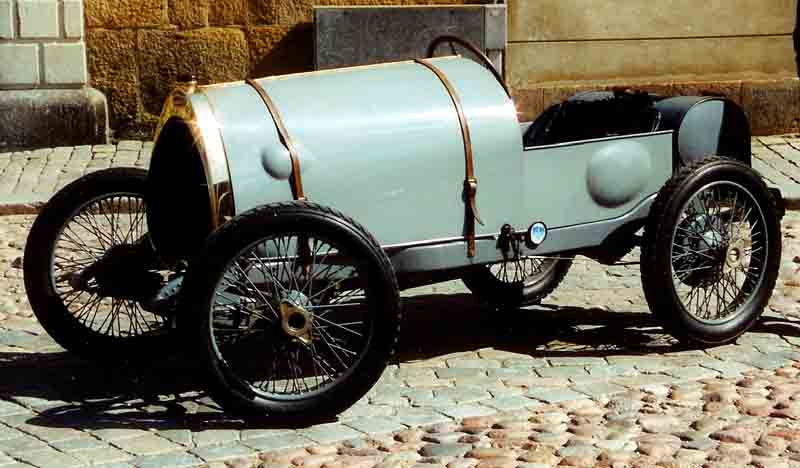
The Bugatti Type 13 is the first car sold under the Bugatti name: a light four-cylinder voiturette that Ettore Bugatti began building at Molsheim in 1910 and developed, with its longer-wheelbase sisters Types 15, 17, 22 and 23, into the 16-valve "Brescia" of the early 1920s. About 435 eight-valve cars were made up to 1920 and about 2,000 multivalve cars from 1920 to 1926. The name Brescia comes from the 1921 race in Italy in which Bugatti cars took the first four places.
In short
- Built at Molsheim, then in German Alsace, from 1910; production interrupted by the First World War and continued to 1926.
- 1,327 cc and 1,368 cc overhead-camshaft four-cylinders with eight valves; 16-valve versions of 1,368, 1,453 and 1,496 cc.
- About 300 kg, a wheelbase of about 2 m and a top speed of 125 km/h for the 16-valve 1.4-litre car.
- Second place in the 1911 French Grand Prix and first to fourth at the 1921 Brescia Grand Prix.
Specs by version
Engines
| Version | Engine | Power | Gearbox | Drive | Production years |
|---|---|---|---|---|---|
| Brescia 1.5 16V (1496 cc) | 1.5 l · 4 cyl · Petrol 1,496 cc | - | 4-sp Manual | Rear-wheel drive | 1923–1926 |
| 1.3 8V (1327 cc) | 1.3 l · 4 cyl · Petrol 1,327 cc | 11 kW 15 PS15 hp | 4-sp Manual | Rear-wheel drive | 1910–1912 |
| 1.4 16V (1368 cc) | 1.4 l · 4 cyl · Petrol 1,368 cc | 22 kW 30 PS30 hp | 4-sp Manual | Rear-wheel drive | 1919–1920 |
Dimensions and weight
Show all 3 versions
| Version | Wheelbase |
|---|---|
| Brescia 1.5 16V (1496 cc) | 2,000 mm78.7 in |
| 1.3 8V (1327 cc) | 2,000 mm78.7 in |
| 1.4 16V (1368 cc) | 2,000 mm78.7 in |
Verified Manufacturer and type-approval data from our catalog · Sources and methodology
Bugatti Type 13 at a glance
| Parameter | Value |
|---|---|
| Maker | Automobiles E. Bugatti, Molsheim (Alsace) |
| Production | 1910–1926, interrupted by the First World War |
| Built | about 435 eight-valve cars (Types 13, 15, 17, 22, 23, to 1920); about 2,000 16-valve cars (1920–1926) |
| Body | light voiturette; longer chassis for the Types 15, 17, 22 and 23 |
| Engine | SOHC inline-four, 1,327–1,496 cc, 8 or 16 valves |
| Power | 11 kW (15 PS) early 8-valve to about 22 kW (30 hp) 16-valve |
| Gearbox | four-speed, unsynchronised, separate from the engine |
| Wheelbase | 2,000 mm (Type 13); 2,400 mm (Type 15); 2,550 mm (Type 17) |
| Predecessor | Type 10 prototype (1908–1909) |
Development and production history
Ettore Bugatti, born in Milan in 1881, had designed cars for other companies before he built his own. He was head of technology at De Dietrich in Niederbronn from 1902, worked with Émile Mathis on cars sold as "Mathis-Hermes (Licence Bugatti)" from 1904 to 1906. In 1907 he became production director at Deutz in Cologne. While employed at Deutz he built a small car of his own in the basement of his house: the Type 10, with a 1,131 cc overhead-camshaft four and two valves per cylinder.
In 1909 Bugatti founded Automobiles E. Bugatti in Molsheim, then a German town in Alsace, and the Type 10 was developed into the Type 13. German Wikipedia records about five cars completed in late 1910 and 75 in 1911. The first known competition entry of a Bugatti was at the Gaillon hill climb on 21 October 1910, driven by M. Darritchon.
Alongside the short Type 13, Bugatti built the Type 15 on a 2,400 mm wheelbase and the Type 17 on 2,550 mm. The Types 22 and 23 of 1913 were updates with larger bodies and an oval radiator. In the same year Ettore Bugatti also designed a small car for another maker, the Type 19 Bébé, which Peugeot built under licence from 1913 to 1916; 3,095 were made.
The First World War stopped production in Alsace. Ettore Bugatti took two complete cars to Milan and buried parts for three more near the factory; after the war five racing cars were built from the remaining parts. Molsheim returned to French control in 1919, and the 16-valve engine became the basis of the post-war cars.
| Year | Event |
|---|---|
| 1908–1909 | Type 10 prototype built at Deutz |
| 1909 | Automobiles E. Bugatti founded at Molsheim |
| 1910 | Type 13 production starts; about 5 cars by the end of the year |
| 21 October 1910 | First known Bugatti competition entry, Gaillon hill climb |
| 1911 | 75 cars; second place in the Grand Prix de France at Le Mans |
| 1912 | Bore increased by 1 mm: 1,327 cc to 1,368 cc |
| 1913 | Types 22 and 23 with larger bodies and oval radiator |
| 1914–1918 | War; production interrupted |
| 1920 | Ernest Friderich wins the voiturette race at Le Mans |
| 1921 | First four places at the Brescia Grand Prix |
| 1926 | Front-wheel brakes; end of production |

Design and engineering
The Type 13 was a small, light car for its period. English Wikipedia gives a weight of about 300 kg and a wheelbase of about 2 m; German Wikipedia lists 2,000 mm and a track of 1,150 mm, with an overall length of 2.80–3.00 m. The four-speed gearbox with reverse had straight-cut gears without synchromesh and was mounted separately from the engine; third gear was direct.
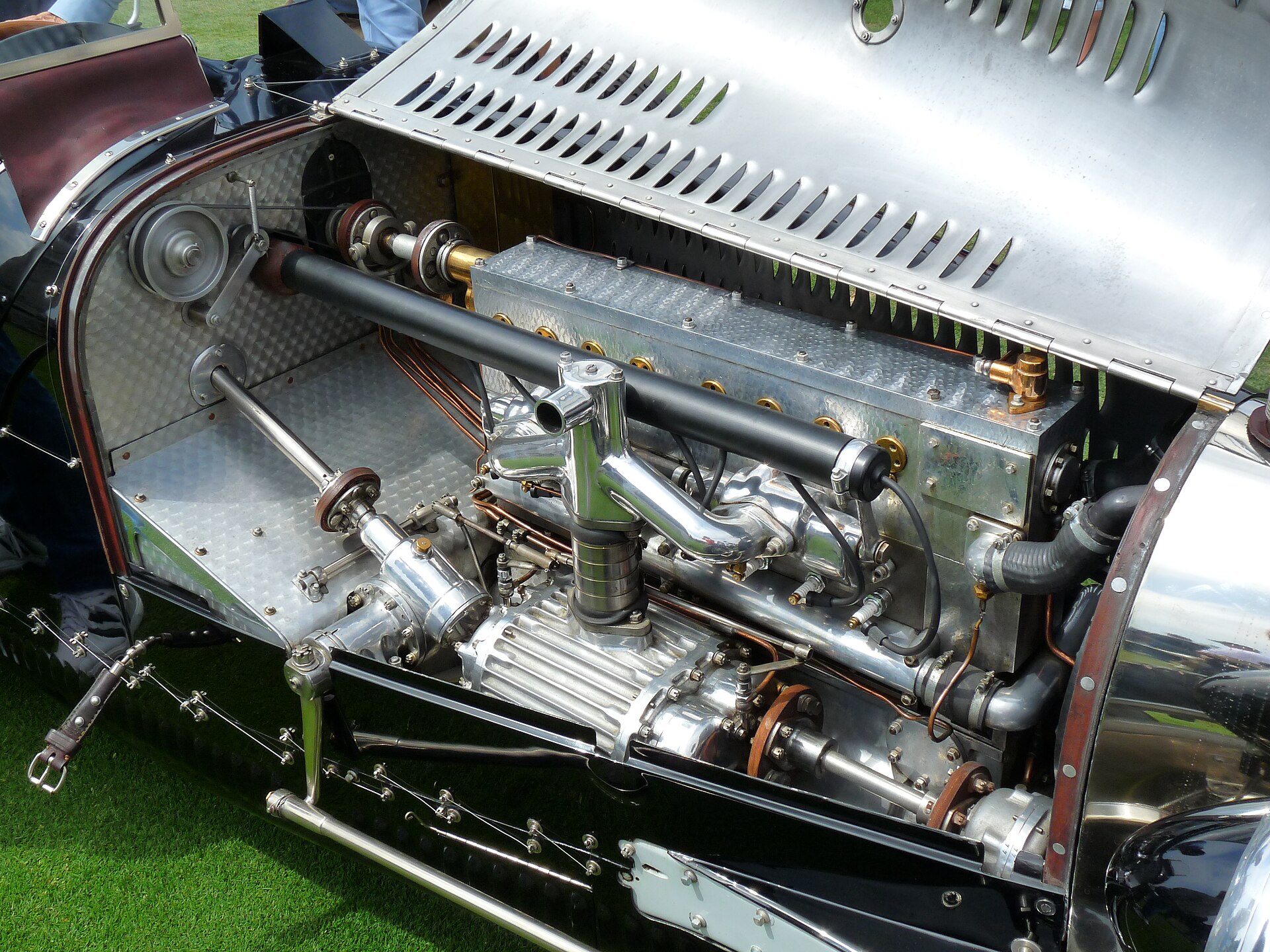
The engine was a water-cooled inline-four with a single overhead camshaft. Early crankshafts ran in three bronze plain bearings; the last and most powerful versions were offered with ball bearings. Front-wheel brakes were added only in 1926.

Engines and drivetrain
| Engine | Years | Displacement | Bore × stroke | Valves | Power |
|---|---|---|---|---|---|
| 1.3 l 8V | 1910–1912 | 1,327 cc | 65 × 100 mm | 8 | 11 kW (15 PS) |
| 1.4 l 8V | 1912–1914, 1919–1920 | 1,368 cc | 66 × 100 mm | 8 | 13 kW (18 PS) |
| 1.4 l 16V | 1919–1920 | 1,368 cc | 66 × 100 mm | 16 | about 22 kW (30 PS) |
| 1.45 l 16V (Brescia) | 1921–1922 | 1,453 cc | 68 × 100 mm | 16 | about 22 kW (30 PS); 29–37 kW (40–50 PS) racing |
| 1.5 l 16V (Brescia) | 1923–1926 | 1,496 cc | 69 × 100 mm | 16 | - |
With twin Zenith carburettors the 16-valve 1.4-litre engine gave 22 kW (30 hp) at 4,500 rpm, and English Wikipedia gives a top speed of 125 km/h. It also describes the Brescia as the first full-production car with a multivalve engine. Our power converter translates the PS figures into kW, and the power-to-weight calculator compares the Type 13's ratio with any modern car.
Bugatti Type 13 specifications
| Parameter | Metric | Imperial |
|---|---|---|
| Wheelbase | 2,000 mm | 78.7 in |
| Track | 1,150 mm | 45.3 in |
| Length | 2,800–3,000 mm | 110–118 in |
| Weight | about 300 kg | about 660 lb |
| Engine | 1,327–1,496 cc SOHC I4 | 81–91 cu in |
| Power | 11–22 kW (15–30 PS) | - |
| Top speed (1.4 16V) | 125 km/h | 78 mph |
| Gearbox | 4-speed, unsynchronised | - |
Types 15, 17, 22 and 23
| Variant | Years | Wheelbase | Notes |
|---|---|---|---|
| Type 13 | 1910–1926 | 2,000 mm | short two-seater, racing base |
| Type 15 | - | 2,400 mm | longer chassis |
| Type 17 | - | 2,550 mm | longest chassis; bore increased in 1912 |
| Type 22 | 1913 | 2,400 mm | update of the Type 15, larger body, oval radiator |
| Type 23 | from 1913 | - | oval radiator |
| Brescia | 1920–1926 | - | name for all later 16-valve cars |
Racing: Le Mans 1911 and Brescia 1921
At the 1911 Grand Prix de France at Le Mans, Ernest Friderich drove a small Bugatti to second place after seven hours, behind the far larger FIAT of Victor Hémery. In 1920 Bugatti entered three cars in the voiturette race at Le Mans. Friderich won, while the leading car of Pierre de Vizcaya was disqualified because Ettore Bugatti had touched the radiator cap during the race. In 1921 Bugatti cars took the first four places at the voiturette Grand Prix at Brescia in Italy, and from then on all four-valve-per-cylinder models were called "Brescia". Forty racing versions of the Type 13 were built.


The Type 13 in numbers
Simple arithmetic on the figures above shows the car's character. With about 22 kW and about 300 kg, the 16-valve car had about 14 kg per kilowatt, from an engine of only 1.4 litres. The step from eight to sixteen valves roughly doubled power, from 13 kW to about 22 kW, with the same 1,368 cc displacement. The roughly 2,000 Brescias built in six years outnumbered all the pre-war eight-valve cars more than four to one.
Which Type 13 to look for
- For history: one of the early eight-valve Type 13s of 1910–1914.
- For performance: a 16-valve Brescia with the 1,453 or 1,496 cc engine.
- For touring: a long-wheelbase Type 17 or Type 23.
- For racing heritage: one of the 40 racing cars, or a car with a documented race history.
The company's story is told in our history of Bugatti and the extraordinary history of Bugatti; today's models are in the Bugatti catalogue, and more early cars in classic cars.
Photo gallery

Bugatti Type 13 in our rankings
- No. 226 of 912 · Longest-running car nameplates (16 years · top 27%)
- No. 508 of 557 · Biggest engines: cars (1,496 cc · top 92%)
- No. 46 of 49 · Biggest engines: convertibles and roadsters (1,496 cc · top 94%)
- No. 76 of 79 · Most powerful convertibles and roadsters (22 kW · top 97%)
- No. 56 of 56 · Most powerful French cars (22 kW)
- No. 852 of 859 · Most powerful cars (22 kW)
In production longer than 73% of ranked nameplates in the 1CARS catalog (No. 226 of 912).
FAQ
When was the Bugatti Type 13 produced?
From 1910 to 1926 at Molsheim, with an interruption during the First World War.
How many Bugatti Type 13 were built?
About 435 eight-valve cars of the Types 13, 15, 17, 22 and 23 up to 1920, and about 2,000 16-valve Brescia cars from 1920 to 1926; another source gives 476 and 2,006.
What engine does the Bugatti Type 13 have?
An overhead-camshaft four-cylinder of 1,327 to 1,496 cc, with eight or sixteen valves and 11–22 kW (15–30 PS).
Why is it called the Brescia?
After Bugatti cars took the first four places in the 1921 voiturette Grand Prix at Brescia, the name was used for all later 16-valve models.
What did the Type 13 achieve in racing?
Second place in the 1911 French Grand Prix, victory in the 1920 voiturette race at Le Mans and the first four places at Brescia in 1921.
Data sources
Data checked by an editor against the sources below.