 Bugatti Type 41 Royale
Specs, engines and history
Published Sources (1) Report an error
By Felix Hartmann, Automotive Technology & EV Contributor
- Built
- 1927–1933
- Top power
- 224 kW (305 PS)
The Bugatti Type 41 Royale is the giant luxury car that Ettore Bugatti built at Molsheim in Alsace between 1927 and 1933. He planned 25 cars for the royal houses of Europe, but the Great Depression left him with a handful of chassis and only three outside buyers. English Wikipedia counts seven cars produced, German Wikipedia six chassis, and six survive. The 12.8-litre straight-eight later found a second career in French railcars.
In short
- 12,763 cc single-overhead-camshaft straight-eight with 205–224 kW (275–300 hp) at 1,800 rpm and 1,186 Nm, according to English Wikipedia.
- About 6.4 m long, 4.3 m between the axles and about 3,175 kg, one of the largest cars ever built.
- No king ever took delivery; the first car went to a private customer in 1931–1932.
- 79 SNCF railcars used the surplus engines, which turned the project into a commercial success for Bugatti.
Bugatti Royale at a glance
| Parameter | Metric | Imperial |
|---|---|---|
| Maker | Automobiles Ettore Bugatti, Molsheim, Alsace | — |
| Production | 1927–1933 (English Wikipedia infobox) | — |
| Built | seven cars (English Wikipedia) or six chassis (German Wikipedia) | — |
| Layout | front engine, rear-wheel drive, gearbox at the rear axle | — |
| Engine | straight-eight, SOHC, three valves per cylinder, 12,763 cc | 778.8 cu in |
| Bore × stroke | 125 × 130 mm (prototype 125 × 150 mm, 14.7 litres) | — |
| Power | 205–224 kW (275–300 hp) at 1,800 rpm | — |
| Torque | 1,186 Nm | 875 lb-ft |
| Gearbox | three-speed manual, aluminium casing | — |
| Wheelbase | about 4,300 mm | 169.3 in |
| Length × width | about 6,400 × 2,100 mm | 252.0 × 82.7 in |
| Kerb weight | about 3,175 kg | 7,000 lb |
| Top speed | 200 km/h (German Wikipedia) | — |
Why Ettore Bugatti built the Royale
Ettore Bugatti wanted a car that would outclass Rolls-Royce, Mercedes-Benz, Maybach and Cadillac, with the strongest and smoothest engine of its day. English Wikipedia retells the story that he took up the idea after an English woman compared his cars unfavourably with Rolls-Royce. German Wikipedia dates the start of planning to 1919. The target customers were Europe's royal families, which gave the car its name.
The size makes the ambition clear. English Wikipedia compares the Royale with the Rolls-Royce Phantom VII of 2003–2017: the Bugatti is about 20% longer and more than 25% heavier. Each cylinder displaced more than the whole engine of Bugatti's contemporary Type 40 touring car. France's fiscal rating was 73 CV, while a Rolls-Royce Phantom I or II was rated at 40 CV.
The first chassis, 41100, ran in 1926 with an open tourer body taken from a Packard. That year W. F. Bradley tested it for Autocar at Ettore's request and found that it handled with the balance of the smaller Bugatti sports cars. In June 1928 a Royale was shown in public at the German Grand Prix at the Nürburgring. Ettore announced that King Alfonso of Spain would receive one in 1928, but the king was deposed in April 1931 without taking delivery. He also refused to sell a car to King Zog of Albania, saying that "the man's table manners are beyond belief!" The wider story of the factory is in our history of pre-war Bugatti.

Engine: a 12.8-litre straight-eight
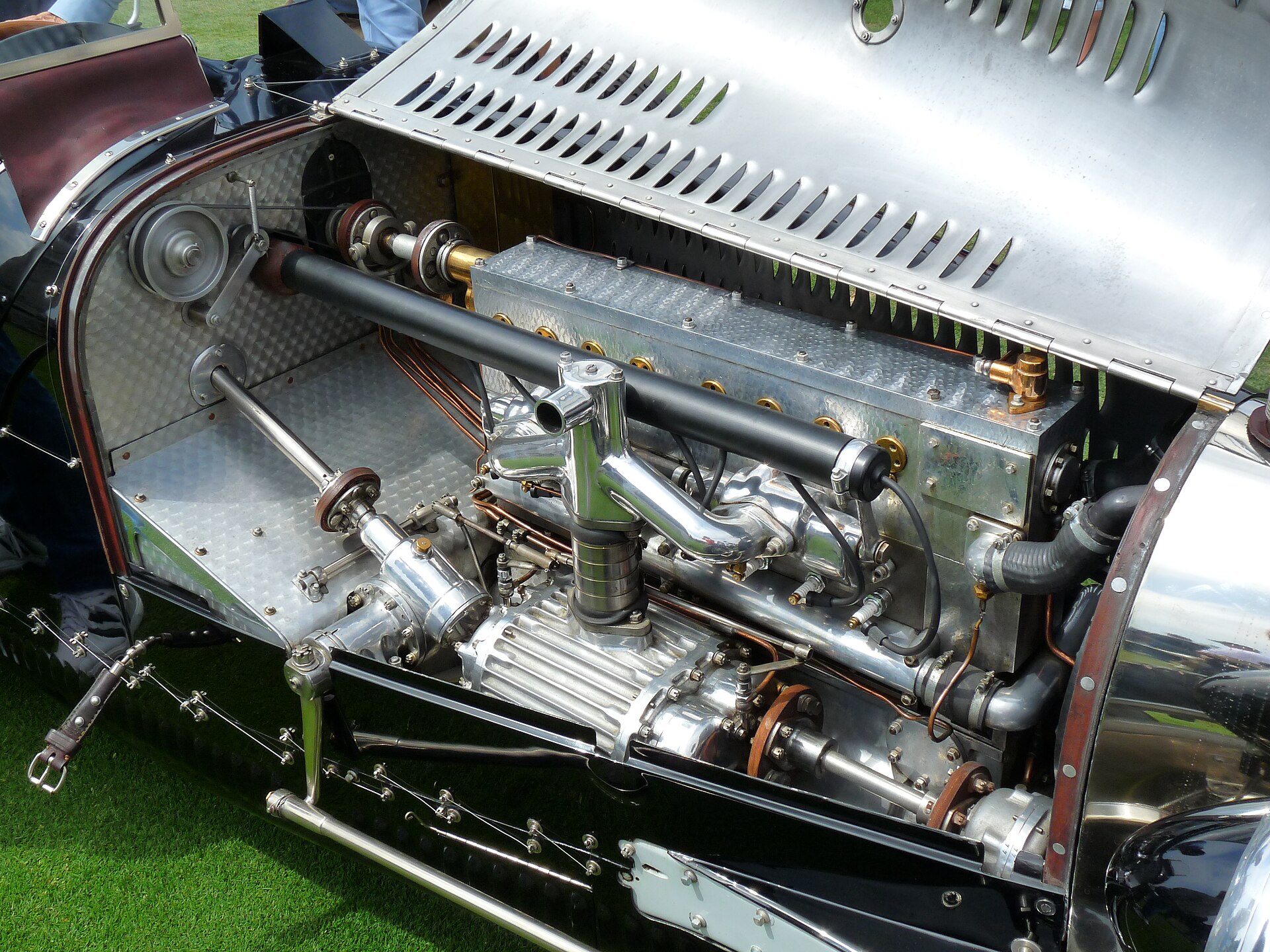
The engine came from an aero-engine design for France's Air Ministry that never went into production; German Wikipedia names it as the Type 34 of 1923. It is a straight-eight with a monobloc iron block and an integral cylinder head, so there is no head gasket. About 1.4 m long and 1.1 m high, it is among the largest engines ever fitted to a passenger car.
| Item | Royale series engine |
|---|---|
| Displacement | 12,763 cc; the prototype had 14.7 litres with a 150 mm stroke |
| Bore × stroke | 125 × 130 mm |
| Valve gear | one central overhead camshaft, three valves per cylinder |
| Carburettor | one, made for the car |
| Power | 205–224 kW (275–300 hp) at 1,800 rpm (English Wikipedia) |
| Torque | 1,186 Nm |
| Oil / water | 14 litres / 48 litres (German Wikipedia) |
| Fuel tank | 190 litres |
The sources disagree on details. English Wikipedia describes two inlet valves and one exhaust valve per cylinder and only three main bearings; German Wikipedia gives one inlet and two exhaust valves and a crankshaft in nine main bearings. German Wikipedia quotes power figures from 147 kW (200 PS) to 220 kW (300 PS) and thinks about 202 kW (275 PS) is the most likely real output. The engine pulled so hard at low speed that the driver could select second gear at about 10 km/h and accelerate beyond 100 km/h without changing up.
Maintenance was demanding. Grinding the valves was a routine job, and with a one-piece block and head it meant taking the whole engine apart. With about 3,175 kg to move, even 224 kW gives only about 71 kW per tonne, a figure our power-to-weight calculator puts in context.
Chassis, wheels and the elephant
The chassis followed Bugatti practice. Semi-elliptic leaf springs carried the front axle, and the rear used Bugatti's forward- and rear-facing quarter-elliptic springs. To balance the long engine, the aluminium three-speed gearbox sat at the rear as a transaxle, and the clutch housing was mounted on the chassis rather than the engine to reduce noise.
The cast alloy "Roue Royale" wheels measured 610 mm (24 in) and were cast in one piece with the brake drums. The brakes were large cable-operated drums that worked well but needed a strong leg. Inside, English Wikipedia mentions whalebone dashboard controls and a walnut-covered steering wheel. On the radiator cap sat a standing elephant, a sculpture by Ettore's brother Rembrandt Bugatti. Every Royale was bodied individually, so no two cars look alike.

The six surviving Royales
| Chassis | Body | Story |
|---|---|---|
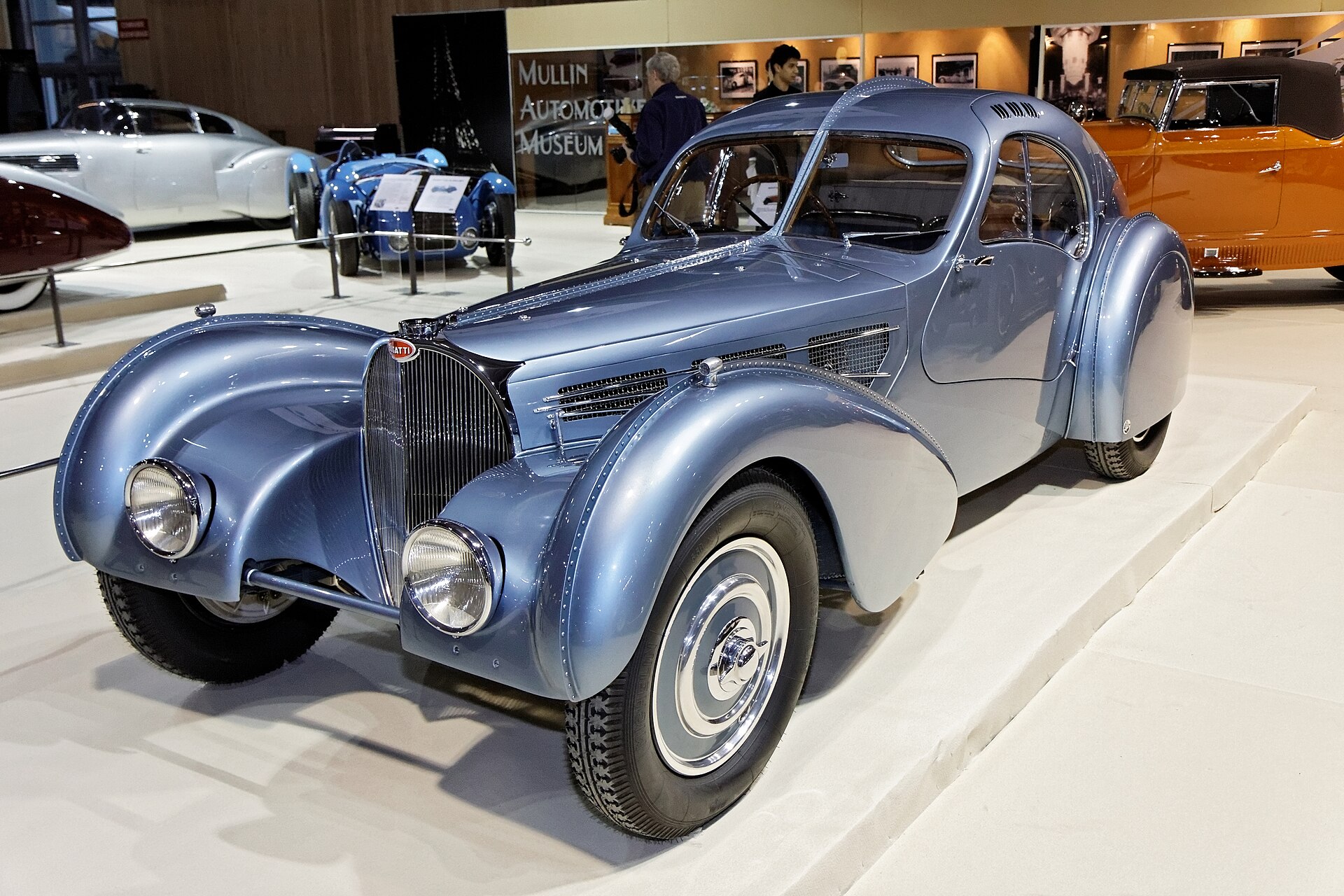
| 41100 "Coupé Napoléon" | Packard open tourer, Weymann coupé, then Coupé Napoléon | prototype; wrecked when Ettore fell asleep at the wheel in 1930 or 1931, rebuilt; Bugatti family car until 1963; now in Mulhouse |
| 41111 Esders / Binder | open two-seater by Jean Bugatti, later coupé de ville by Henri Binder | first car sold, to Armand Esders in 1932; hidden in the Paris sewers in the war; bought by Volkswagen AG in 1999 |
| 41121 Weinberger | cabriolet by Ludwig Weinberger, Munich | delivered in May 1932 to Dr Joseph Fuchs; found in a New York scrapyard by Charles Chayne in 1946; Henry Ford Museum, Dearborn, since 1957 |
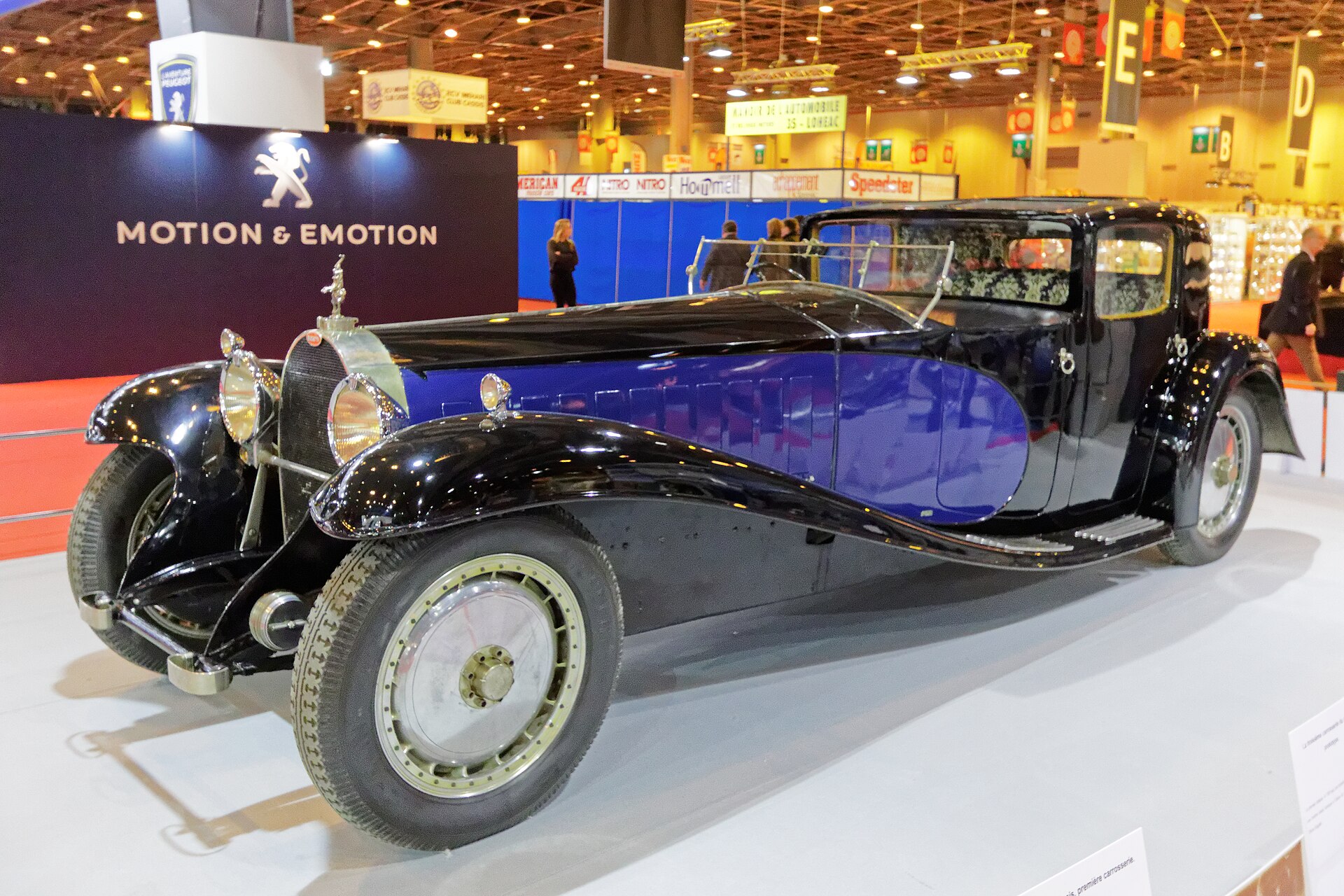
| 41131 Park Ward | limousine by Park Ward | sold in 1933 to Captain Cuthbert W. Foster; bought by Fritz Schlumpf in 1963; now in Mulhouse |
| 41141 Kellner | two-door coach by Kellner | unsold, kept by Bugatti; sold to Briggs Cunningham in 1950; later Hans Thulin and the Meitec Corporation |
| 41150 Berline de Voyage | touring saloon | unsold, kept by Bugatti; Cunningham, then Cameron Peck, Tom Monaghan and the Blackhawk Collection |
During the Second World War, 41100, 41141 and 41150 were bricked up at the Bugatti family home in Ermenonville to hide them. In the summer of 1950 L'Ebe Bugatti sold 41141 and 41150 to the American racer Briggs Cunningham, and the two cars reached the USA in January 1951. The two Mulhouse cars now stand in the Cité de l'Automobile, the former Musée National de l'Automobile.
All six surviving Royales were shown together for the first time at the Pebble Beach Concours d'Elegance in 1985. In 2007 five of them came to the Goodwood Festival of Speed for the model's 80th anniversary. Auction figures for the Royale appear in the sources only in non-euro currencies, so they are not given here.

Railcars: how the engines paid off
When the last Royale was finished, 23 engines were left over. Bugatti used them in railcars for France's state railway SNCF, with two or four engines per vehicle. German Wikipedia dates the start of the railcar work to 1935. English Wikipedia counts 79 railcars and 186 engines. Derated to about 149 kW (200 hp; our power converter gives the PS and hp equivalents), the engines still performed well, and one railcar set a world average-speed record of 196 km/h (122 mph) over 70.7 km. The last of them stayed in regular service until 1956 or 1958, depending on the source. Thanks to the railcars, the Royale turned from a financial failure into a commercial success.

Replicas and the Royale's legacy
The Royale's rarity has produced a whole family of copies. Tom Wheatcroft had Ashton Keynes Vintage Restorations build an exact replica of the Coupé Napoléon; it was good enough that the same firm was later asked to make a replacement piston for the Kellner car. Prince Joachim of Denmark used that replica on his wedding day on 24 May 2008. The Dutch firm Hevec Classics showed a reconstruction of the 1926 Packard-bodied prototype in 2011 and an Esders roadster replica in 2016. The Sinsheim technology museum (Auto & Technik Museum) has a replica built for the 1968 film Rebus.
Two later cars borrowed the look. The Panther De Ville, built from 1974 to 1985 on Jaguar mechanicals, was styled after the Type 41, and in 1976 Franco Sbarro built a one-off copy of the Park Ward limousine with a 16-cylinder engine made from two Rover V8s. For a modern luxury car with a similar mission, see our article on the Rolls-Royce Phantom.
Seeing a Royale today: museums and collecting
- In a museum: two cars (41100 and 41131) are in the Cité de l'Automobile in Mulhouse, France, and the Weinberger cabriolet is in the Henry Ford Museum in Dearborn, Michigan.
- At an event: Volkswagen's Esders/Binder car appears at museums and events; it was at the Goodwood Revival in 2004.
- For the engine: a Bugatti railcar is preserved in Mulhouse as well, at the Cité du Train.
- Beware of copies: several replicas and reconstructions exist, so check the chassis number before you believe a photo.
Current and past models of the marque are listed in the Bugatti catalogue, and more veteran and pre-war cars are in our classic cars section.
Photo gallery


Bugatti Type 41 Royale in our rankings
- No. 12 of 56 · Most powerful French cars (224 kW · top 22%)
- No. 426 of 859 · Most powerful cars (224 kW · top 51%)
- No. 545 of 912 · Longest-running car nameplates (6 years · top 69%)
More powerful than 78% of ranked French cars in the 1CARS catalog (No. 12 of 56).
FAQ
How many Bugatti Royales were made?
English Wikipedia counts seven cars produced and six survivors; German Wikipedia describes six chassis. Only three were sold to outside customers when new.
What engine does the Bugatti Royale have?
A 12,763 cc straight-eight with a single overhead camshaft, three valves per cylinder and 205–224 kW (275–300 hp) at 1,800 rpm. The prototype had 14.7 litres.
Why is it called the Royale?
Ettore Bugatti designed it for Europe's royal families. None of them bought one: King Alfonso of Spain was deposed before delivery, and Ettore refused to sell to King Zog of Albania.
Where are the Bugatti Royales now?
Two are in the Cité de l'Automobile in Mulhouse, one in the Henry Ford Museum in Dearborn, one belongs to Volkswagen, and two are in private hands.
What happened to the unused Royale engines?
The 23 surplus engines went into SNCF railcars. English Wikipedia counts 79 railcars with 186 engines in total, and one set an average-speed record of 196 km/h.
Data sources
Data checked by an editor against the sources below.