 Bugatti Type 57
Specs, engines and history
Published Sources (1) Report an error
By Felix Hartmann, Automotive Technology & EV Contributor
- Built
- 1934–1940
- Top power
- 147 kW (200 PS)
Which Type 57 to choose
Our verdict · Felix Hartmann
- For touring: a Ventoux or Galibier on the standard chassis, the most common and most usable bodies.
- For performance: a 57C or a supercharged 57S, with 119–147 kW instead of 100 kW.
- For the design: the Atalante, closest in spirit to the Atlantic, of which only three survive.
- For history: the 1937 Le Mans Tank in Philadelphia and the Atalantes in Mulhouse can be seen in public.
Production figures and body counts differ widely between sources, so the chassis record matters more than the badge. Other models of the marque are in the Bugatti catalogue, and the company's later revival is told in our history of Bugatti.
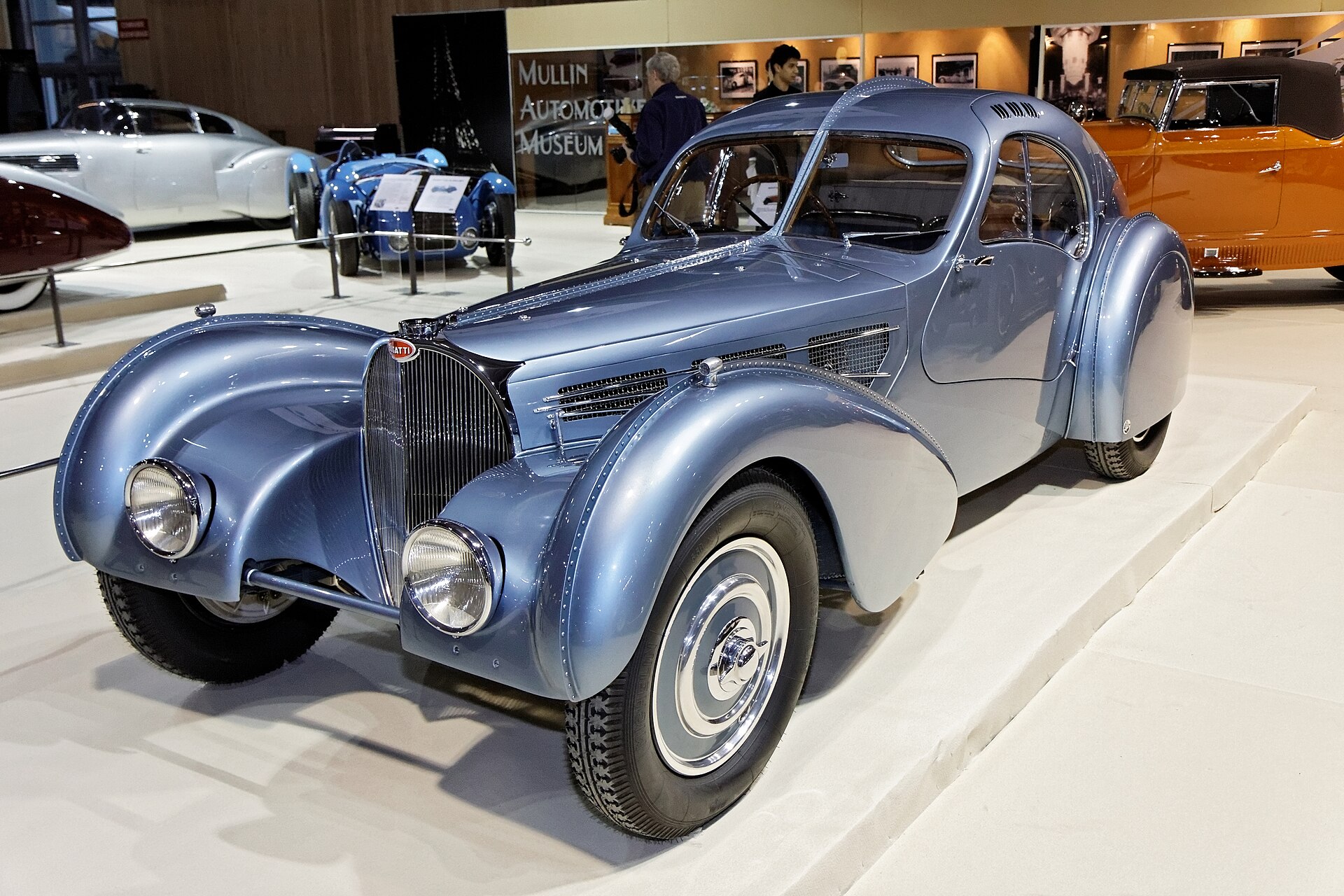
The Bugatti Type 57 is the grand tourer that Jean Bugatti, son of the company's founder, designed for production at Molsheim from 1934 to 1940. English Wikipedia counts 710 cars, which makes it the most-produced and longest-built Bugatti and the last new model before the Second World War. Its lowered 57S chassis carried the 57SC Atlantic, a riveted coupé of which only four were made and which is now one of the most valuable cars in the world. The Type 101 of 1951 revived the design.
In short
- 3,257 cc twin-cam straight-eight: 100 kW (135 hp) in the Type 57, up to 147 kW (200 hp) in the supercharged 57SC.
- Factory bodies Galibier (saloon), Ventoux (coupé), Stelvio (cabriolet), Atalante and Atlantic (coupés) and, from 1938, Aravis.
- Four Atlantic coupés were built in 1936–1938; three survive and one, "La Voiture Noire", has been missing since 1941.
- The 57G "Tank" won the 24 Hours of Le Mans in 1937, and a 57C-based Tank won again in 1939.
Bugatti Type 57 at a glance
| Parameter | Metric | Imperial |
|---|---|---|
| Maker | Automobiles Ettore Bugatti, Molsheim, Alsace | — |
| Production | 1934–1940 | — |
| Built | 710 (English Wikipedia); German Wikipedia quotes 630 to 830 | — |
| Designer | Jean Bugatti; bodies drawn by Joseph Walter (German Wikipedia) | — |
| Engine | straight-eight, DOHC, 3,257 cc, bore × stroke 72 × 100 mm | 198 cu in |
| Power | 100 kW (135 hp, Type 57) to 147 kW (200 hp, 57SC) | — |
| Gearbox | four-speed manual, Cotal pre-selector as an option | — |
| Wheelbase | 3,302 mm (Type 57), 2,979 mm (57S) | 130 / 117 in |
| Track | 1,349 mm | 53 in |
| Weight | about 950 kg (chassis figure given by English Wikipedia) | 2,090 lb |
| Top speed | 153 km/h (Type 57) to 217 km/h (supercharged 57S) | 95–135 mph |
| Predecessor / successor | Type 49 / Type 101 (1951) | — |
Jean Bugatti and the Type 57
German Wikipedia explains the background. Bugatti's sales had fallen from 622 cars in 1930 to 156 in 1932, and the company needed a single, more modern touring car. Jean Bugatti was officially in charge of the Type 57 and took over day-to-day management in 1936, while Joseph Walter drew the factory bodies. Production ran in three series: the second from late 1936 with a stronger chassis, a rubber-mounted engine and Allinquant telescopic dampers, and the third from 1938 with hydraulic brakes.
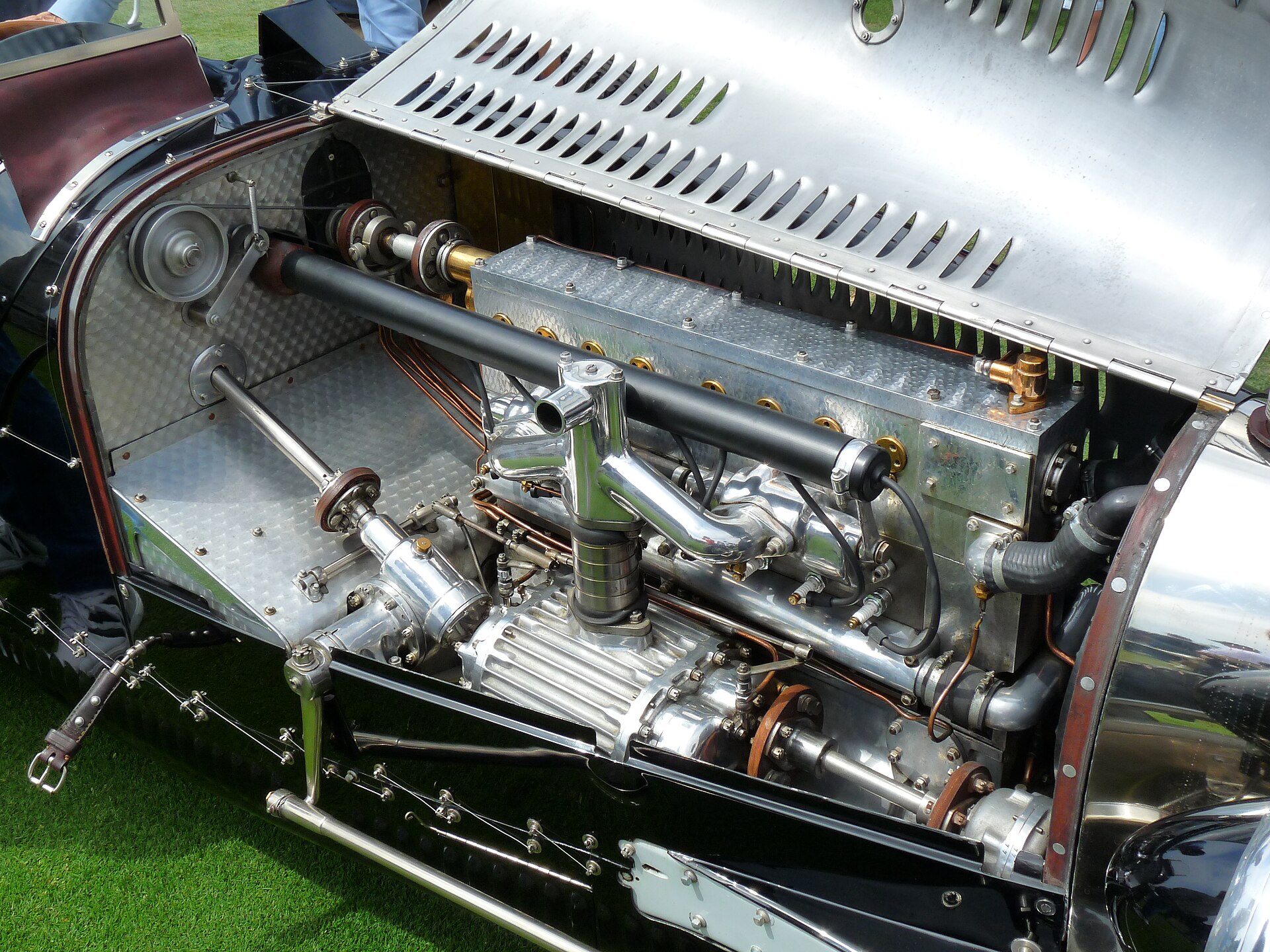
The engine was based on the Type 49's, with a 72 mm bore and 100 mm stroke. Unlike the bevel-driven Type 50 and Type 51 engines, it used spur gears at the rear to drive two overhead camshafts, with fibre gear wheels for quieter running. German Wikipedia adds a six-bearing crankshaft and a non-removable cylinder head. The grille was a smaller version of the Royale's horseshoe, and thermostat-controlled shutters on the engine sides regulated the temperature.
Ettore Bugatti kept his own ideas about the chassis. He insisted on a rigid front axle on semi-elliptic springs rather than independent suspension, and he strongly opposed the hydraulic brakes that replaced the cable system in 1938. For the company's earlier history, see our pre-war Bugatti history.

Type 57, 57C, 57S and 57SC compared
| Version | Years | Engine | Power | Notes |
|---|---|---|---|---|
| Type 57 | 1934–1940 | 3,257 cc | 100 kW (135 hp) | 630 built (English Wikipedia); 153 km/h |
| Type 57T | — | tuned 3,257 cc | — | 185 km/h |
| Type 57C | 1937–1940 | Roots supercharger | 119 kW (160 hp) | about 96 built; German Wikipedia: 95 |
| Type 57S | 1936–1938 | dry sump, lowered chassis | 125 kW (170 hp) | 201 km/h; 43 "Surbaissé" cars in all (English Wikipedia) |
| Type 57SC | 1936–1938 | supercharged 57S | 147 kW (200 hp) | two built as SC; most 57S were later supercharged at Molsheim |
| Type 57G Tank | 1936 | racing version | about 150 kW (200 PS, German Wikipedia) | three built |
| Type 57S45 | 1936–1938 | 4,743 cc | — | one or two prototypes |
"S" stands for surbaissé (lowered) and "C" for compresseur (supercharger). To lower the 57S, the rear axle had to pass through the frame, and the engine needed dry-sump lubrication. The wheelbase shrank to 2,979 mm; German Wikipedia gives 2,890 mm. The 57S also had a V-shaped dip at the bottom of the radiator and mesh grilles on the engine sides. Supercharging raised the top speed from 201 km/h (125 mph) to 217 km/h (135 mph).
The power gain from the base car to the 57SC is 47 kW, almost 50% more from the same displacement. Our power converter gives these figures in PS and hp.

The 57SC Atlantic: four coupés
The Atlantic grew out of the Aérolithe, a 1935 prototype on a shortened Type 57 chassis that became the 57S chassis. Its body was made of Elektron, a light magnesium alloy that is highly flammable when hot and cannot be welded. The panels were therefore riveted on the outside, a technique taken from aircraft, and that created the dorsal seam running from nose to tail. The Aérolithe was shown at the Paris Motor Show and at Olympia in London, then reportedly taken apart at Molsheim.
The production cars kept the seam but used plain aluminium. At first they were called "Coupé Aero"; the name changed to Atlantic in memory of Jean Mermoz, a French aviator and friend of Jean Bugatti, who disappeared over the Atlantic in December 1936.
| Chassis | Delivered | First owner | What happened |
|---|---|---|---|
| 57374 | 2 September 1936 | Victor Rothschild | supercharged in 1939; later Peter Williamson, Pebble Beach Best of Show 2003; sold in 2010 to a collector associated with the Mullin Automotive Museum |
| 57453 "La Voiture Noire" | October 1936 | factory car | the only Atlantic with the supercharger from new; driven by Jean Bugatti and William Grover-Williams; last recorded in February 1941, whereabouts unknown |
| 57473 | 13 December 1936 | Jacques Holtzschuch | facelifted in 1939–1941; destroyed when hit by a train near Gien in 1955; rebuilt by 1977 and restored again after 2006 |
| 57591 | 2 May 1938 | Richard B. Pope | supercharged in 1939; owned by Ralph Lauren since 1988; Best of Show at Pebble Beach 1990 and Villa d'Este 2013 |
Pierre-Yves Laugier's 2004 book Bugatti: les 57 Sport showed that 57453 and 57473 were separate cars, correcting the earlier belief that they were one. Bugatti's 2019 one-off La Voiture Noire, a modern hypercar, was named after the missing coupé. The 2015 design study is described in our article on the Bugatti Atlantic concept.
Atalante, Stelvio and the other bodies
| Factory body | Type | Notes from German Wikipedia |
|---|---|---|
| Galibier | four-door saloon | no B-pillar, rear-hinged rear doors; a 57C Galibier reached 182.6 km/h at Montlhéry in 1939 |
| Ventoux | two-door coupé | two or four side windows; the most popular body |
| Stelvio | cabriolet | mostly built by Gangloff |
| Atalante | two-seat coupé | introduced in April 1935, about 40 on the S chassis (English Wikipedia: 17) |
| Atlantic | coupé | four built, design no. 1076bis |
| Aravis | sports cabriolet | from 1938; seven built by Letourneur & Marchand |
The Atalante, named after Atalanta of Greek mythology, had a one-piece windscreen and no dorsal seam. Four Atalantes are in the Cité de l'Automobile in Mulhouse. One of them, chassis 57502, built in 1937 for the 5th Earl Howe, was found in a garage in Newcastle upon Tyne in 2008 after 48 years untouched, and sold for €3.4 million at Rétromobile in Paris on 7 February 2009. Gangloff alone built about 180 Type 57 bodies, and independent coachbuilders such as Vanvooren added one-offs.

Le Mans winner and the death of Jean Bugatti
The 57G "Tank", a streamlined racing car based on the Type 57, was built three times in 1936. It won the 1936 French Grand Prix at Montlhéry and the Grand Prix de la Marne. In 1937 Jean-Pierre Wimille and Robert Benoist won the 24 Hours of Le Mans; Jean Bugatti then gave the Atlantic "La Voiture Noire" to Benoist. The 1937 winner, chassis 57335, is the only surviving Tank and is displayed at the Simeone Foundation Automotive Museum in Philadelphia. In 1939 Wimille and Pierre Veyron won Le Mans again in a 57C with a Tank-style body.
On 11 August 1939 Jean Bugatti, aged 30, was killed testing that car on the closed road between Molsheim and Strasbourg, when he swerved to avoid a drunken cyclist. He considered the Atlantic, especially 57453, his most innovative design.

Photo gallery

Bugatti Type 57 in our rankings
- No. 20 of 56 · Most powerful French cars (147 kW · top 36%)
- No. 547 of 912 · Longest-running car nameplates (6 years · top 69%)
- No. 584 of 859 · Most powerful cars (147 kW · top 69%)
More powerful than 64% of ranked French cars in the 1CARS catalog (No. 20 of 56).
FAQ
How many Bugatti Type 57SC Atlantics were made?
Four production Atlantics were built between 1936 and 1938, plus the Aérolithe prototype. Three survive; the fourth, "La Voiture Noire", has been missing since 1941.
What engine does the Bugatti Type 57 have?
A 3,257 cc twin-cam straight-eight with 100 kW (135 hp) in standard form, 119 kW (160 hp) with a supercharger in the 57C and 147 kW (200 hp) in the 57SC.
How many Type 57s were built?
English Wikipedia gives 710 cars from 1934 to 1940; German Wikipedia quotes sources from 630 to 830.
Who designed the Bugatti Atlantic?
Jean Bugatti, Ettore's son. The riveted seam comes from the Elektron-bodied Aérolithe prototype, whose magnesium panels could not be welded.
Did the Type 57 win Le Mans?
Yes. The 57G Tank won in 1937 with Wimille and Benoist, and a 57C-based Tank won in 1939 with Wimille and Veyron.
Data sources
Data checked by an editor against the sources below.